


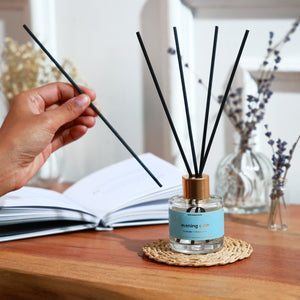
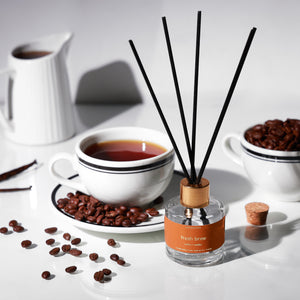

Small space + high intensity is a personal problem: a bedside, a desk, a study, one closed room, for chosen hours. Answered by a reed at ₹749–₹849 with all six fibre reeds, or by Safar at ₹3,999 — waterless, undiluted, 3 speeds, 1/2/3-hour auto-off, named and sold as a car and travel diffuser, no published room coverage.
Large space + high coverage is a transport problem: an open-plan living-dining, a floor, a villa, a clinic. Answered by Vaayu at ₹11,999, rated to 1000 m³ or roughly 2,000–3,000 sq ft.
One room, properly covered is the middle, and it is Sukoon at ₹1,899 — 270–320 sq ft, water-diluted, adds humidity, needs filling.
The honest gap: nothing at SOSA is waterless and rated for one room. And Megh ₹3,499 is the clearest illustration of the whole confusion — six-litre tank, around 100 hours runtime, about 215 sq ft, less than the ₹1,899 Sukoon.
2. Intensity is bought with payload and with a smaller volume. More oil into less air. Undiluted oil rather than oil diluted in water — this is the real difference between a cold-air nebuliser and an ultrasonic machine, and it is a mechanism difference rather than a formulation one. And a closed door, which is the cheapest intensity tool in existence, because it stops the air you have just scented from leaving.
3. Coverage is bought with moved air, and with nothing else. This is the sentence that resolves most of the confusion in this category. Fragrance molecules go where the air goes. A passive format adds no air, so its concentration falls away with distance and adding oil only raises the peak, never the reach. An active machine spends energy pushing droplets into the room, and a coverage rating becomes meaningful only because of that.
4. Buying for the wrong one is expensive in both directions. Buying coverage when you needed intensity gives you a large machine run at its lowest setting in a small room — capacity you paid for and will never use. Buying intensity when you needed coverage gives you a lovely fragrant corner and a room that still does nothing, which is the single most common complaint we receive and the reason this cluster exists.
5. Both can also be a dose problem rather than a machine problem, and that is worth ruling out first. Reed count is a volume dial: six fibre reeds is full projection, three is a soft bedside level with roughly double the life. A 50ml bottle is specified for up to about 150 sq ft and a 130ml above that. And you adapt to your own home within minutes, so the only honest instrument is somebody who has just walked in from outside.
Alcohol-free, phthalate-free, paraben-free, IFRA-compliant, 0 ppm formaldehyde. Free shipping above ₹499, and a portion of every order supports girl-child education through Nanhi Kali.
The two specifications, defined properly
The vocabulary problem is real. Every product in this category is advertised as strong, powerful or long-lasting, and none of those words distinguishes between the two things a buyer might mean. Once you can name which of the two you are short of, the right product is usually obvious and frequently cheaper than you feared. Here are the two, plus the third variable that decides how either one feels in practice.
 Safar₹3,999Intensity rises when more fragrance arrives in less air. There are four honest levers and only one of them costs real money. Payload: undiluted oil rather than oil dispersed in water. An ultrasonic machine throws a wet mist that is mostly water carrying oil; a cold-air nebuliser shatters undiluted oil into a dry mist, so each droplet is fragrance rather than fragrance mixed with water — same oil, different payload per droplet. Volume: a small room concentrates far faster than a large one. Containment: a closed door, which costs nothing. Dose: reed count or machine intensity. Note that only the first requires a purchase, and the last two are free.
 Sukoon₹1,899Coverage is a transport specification, and it is the one you cannot buy with fragrance. Molecules travel where the air travels, so a device that adds no air can only rely on the room’s own currents — which are slow, uneven and different in every home. This is why a coverage figure is meaningful for a machine and close to meaningless for a reed. Sukoon states 270–320 sq ft because its mist plume moves air across that area; Vaayu states up to 1000 m³, roughly 2,000–3,000 sq ft, because pressurised atomisation puts a dry nano-mist into airflow that carries it. And the part people underestimate: coverage delivers evenness, and evenness is most of what a hotel space actually feels like. A steep gradient reads as a boundary you cross; a flat one reads as an atmosphere you are inside.
 Garden Bloom₹799Neither specification explains the commonest complaint of all, which is it seems to have stopped working. Olfactory receptors adapt to a constant, unchanging stimulus within minutes — the signal still arrives, the brain stops reporting it because nothing has changed. That is why you can only smell your own home after being away from it, and why a hotel is noticeable partly because you arrive un-adapted to it. It also means that no amount of intensity or coverage will make you perceive your own home continuously; what both of them reliably change is what a visitor experiences and what you notice walking in from outside. If guests remark on the fragrance and you cannot detect it, nothing is broken and buying more of either specification will overshoot the room for everybody else.
Why the two specifications trade against each other
They are not simply independent; in a fixed budget and a fixed room they actively pull in opposite directions, and understanding why makes the shopping much easier. Intensity is cheapest in a small closed volume, and coverage is only worth paying for in a large connected one. A 120 sq ft bedroom with the door shut will reach a perceptible, fairly even concentration with almost anything, because there is nowhere for the air to go — which means intensity is nearly free there and coverage is nearly worthless. An open-plan living-dining flowing into a passage has the opposite profile: intensity at the machine is easy and irrelevant, because what you notice is the fall-off between the sofa and the far end of the room.
This is why the same rupee buys different things in different rooms, and why the honest recommendation changes with the floor plan rather than with the budget. In a small room, money spent on coverage is money spent on capacity behind a closed door. In a large connected space, money spent on intensity produces a hot spot near the device and a room that still falls away — which is exactly what people describe when they say a machine is "strong but only in one place". The most expensive version of this mistake is buying the biggest machine in the range for the smallest room in the house, and it happens constantly, because the biggest machine is the only one with a confident number attached to it.
There is a second trade worth naming, because it decides whether you are happy a month later. High intensity held constantly is not the same purchase as high coverage held constantly. A device you perceive continuously in your own home is set too strong for its volume; home fragrance is designed to be noticed on arrival and at transitions rather than at every moment. Coverage, by contrast, is meant to be constant — the whole point of an evenly scented space is that you stop being able to locate the source, which is also why you can never find the diffuser in a hotel room. The scent is usually introduced into the building’s moving air rather than released from an object on a table, so there is no gradient to walk up and nothing to find. That absence of a findable source is a large part of why it reads as designed.
| Intensity at a point | Coverage and evenness | What it costs you | Price | |
|---|---|---|---|---|
| Reed diffuser | High at the bottle; six reeds full, three soft | Effectively none — a zone, not a room | Nothing. No power, no filling, no charging, silent | ₹749–₹1,349 |
| Boond | Moderate — oil diluted in water | Up to ~150 sq ft, 300ml, ~6 hours, USB | A plug, a tank, added humidity | ₹899 |
| Sukoon | Moderate — diluted payload, adjustable | 270–320 sq ft, 500ml, 16–18 hours on low | Dilution, added humidity, refilling, possible white mineral dust in hard water | ₹1,899 |
| Megh | Moderate — diluted | Only ~215 sq ft, despite a 6L tank and ~100 hours runtime | Less coverage than the ₹1,899 Sukoon. A runtime and humidity machine, never a coverage upgrade | ₹3,499 |
| Safar | High — undiluted oil, dry mist, 3 speeds | None published. Personal and small-space scenting | Named and sold as a car and travel diffuser. 1/2/3-hour auto-off, needs recharging | ₹3,999 |
| Vaayu | High — undiluted, adjustable intensity | Up to 1000 m³ — roughly 2,000–3,000 sq ft | ₹11,999, mains power, and a machine sized for a floor. Wrong for one bedroom | ₹11,999 |
| The gap this table makes obvious: read down the two waterless rows and there is nothing between "no published coverage" and "2,000–3,000 sq ft". SOSA has no mid-sized waterless nebuliser rated for one bedroom. A reader who wants undiluted intensity and a stated room figure has to choose which of the two matters more — Safar for the payload, Sukoon for the figure. | ||||
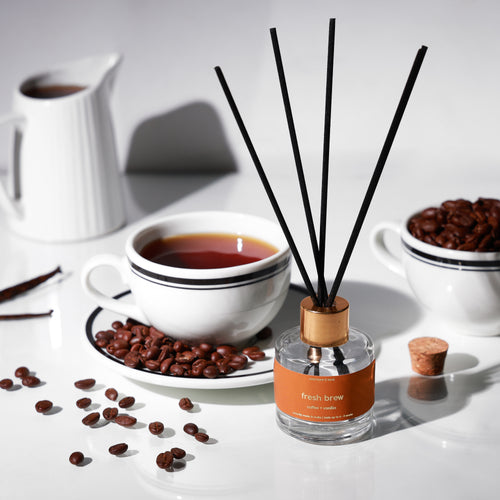 Intensity · Fresh Brew 9.5₹849Shop →
  Coverage · Sukoon₹1,899Shop →
  Ultrasonic-only · Hotel Collection₹999Shop →
Diagnosing your own room in five minutes, before you spend anything
This costs nothing and it tells you which of the two specifications you are short of. Smell at the source, then at one metre, then at the far corner, then at the doorway. If it is strong at the source and gone by the corner, your intensity is fine and you have no coverage — that is a mechanism purchase and no fragrance will fix it. If it is faint at the source too, you have a dose problem, and dose is the cheap one: check that all six fibre reeds are in, check the bottle against the room’s measured size — 50ml is specified for up to about 150 sq ft and 130ml above that — and flip the reeds, which restores projection without opening a new bottle.
Then check the two things that quietly cancel both specifications. Air exchange: air that leaves takes the fragrance with it, so a room ventilated all day is not a fragrance environment during those hours and becomes one the moment the windows close. Wind speed rises with height, so a high-floor balcony door turns the air over far more aggressively than a low-floor window. And placement: a doorway is the most turbulent point in a home — the door opens, the air exchanges, and anything sitting there is repeatedly stripped and then met at close range. Slightly inside, out of the draught, gives a better first impression and a longer bottle. Under a running split AC is the other place to avoid, because it strips the light top notes within days and leaves you with the base.
Finally, run the adaptation test, because it is the one that saves the most money. Leave the room for fifteen minutes and return, or simply ask a visitor. If they notice it and you do not, both your intensity and your coverage are adequate and the problem is your own nose, which is behaving exactly as everybody’s does. Sensitivity to individual materials also varies enormously between people, so it is entirely normal for a household to disagree about whether a room smells of anything. In that situation buying a bigger machine makes the room too much for everyone else while you continue to notice nothing, and that is the most common way this gets worse instead of better.
What to buy for each specification — and the missing rung
The range sorted by which of the two specifications it actually delivers, rather than by price. The last row is the honest gap, which is precisely a gap in one of the two columns.
| Buy | What it is | Which specification it buys | Price |
|---|---|---|---|
| 1. Diagnose first — free ★ | Source, one metre, far corner, doorway. Then reed count, bottle size against the measured room, placement out of the draught, and a visitor’s verdict | Tells you which of the two you lack, and frequently fixes it at no cost | ₹0 |
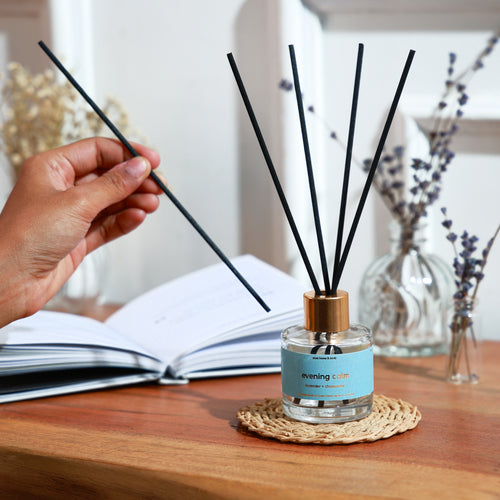
| 2. A reed diffuser | Passive capillary — six fibre reeds, refillable glass, 50ml up to ~150 sq ft for 6–8 weeks, about ₹13–₹15 a day. Strength scale from Evening Calm 8.9 to Fresh Brew 9.5 | Intensity in a zone. No coverage — and silence, no power and no maintenance, which no machine matches | ₹749–₹1,349 |
| 3. Sukoon ★ | Ultrasonic water mist, 500ml, 16–18 hours on low, three 15ml Hotel Collection scents included | Coverage of one room, 270–320 sq ft, at moderate intensity. You accept dilution, humidity and refilling | ₹1,899 |
| 4. Safar | Waterless cold-diffusion of undiluted oil — 20ml, 2000 mAh Type-C, 3 speeds, 1/2/3-hour auto-off, 6.9 cm. Named and sold as a car and travel diffuser | Maximum intensity per droplet at small scale. No published coverage figure, and it needs recharging | ₹3,999 |
| 5. Vaayu | Up to 1000 m³ or roughly 2,000–3,000 sq ft, 400ml tank up to about 90+ days, app plus onboard buttons, 1h/4h/8h/24h windows, key-lock, under 38 dB, 5W, wall or HVAC mount | Coverage and evenness across a connected home. Wrong for one bedroom, where the coverage is simply unused | ₹11,999 |
| The clearest illustration of the confusion: Megh | 6L tank, around 100 hours of runtime, about 215 sq ft of coverage | Buys runtime and humidity, not coverage — less area than the ₹1,899 Sukoon. Tank size and reach are unrelated specifications | ₹3,499 |
| The honest gap | Nothing at SOSA is both waterless and rated for one room — Safar has the payload and no published figure, Vaayu has the figure and far too much of it | Said plainly, because a reader who wants high intensity and stated coverage in one bedroom has to choose which half to give up | — |
Versailles
If I could give a home-fragrance buyer one piece of vocabulary, it would be this pair of words. Intensity and coverage are two different specifications and the entire category advertises both of them as "strong". A reader searching for the strongest diffuser has no way of knowing whether they will receive a product that is very concentrated within a metre or one that is moderate everywhere — and those are opposite experiences.
The reason it matters commercially is that the mistake is expensive in both directions. Buying coverage for a small closed bedroom means owning a machine you run at its lowest setting for years. Buying intensity for an open-plan floor means a hot spot by the device and the same disappointing fall-off at the far end that sent you shopping in the first place. And there is a third version that is subtler and more common than either: buying a stronger fragrance to solve a coverage problem. It cannot work, because coverage is made of moving air and no bottle contains any.
I will also say the awkward thing about our own range one more time, since this page makes it unusually visible. If you want high intensity — undiluted, waterless, dry — and a stated coverage figure for one bedroom, we do not sell that. Safar has the payload and no published room figure; Vaayu has the figure and roughly fifteen times more of it than a bedroom can use. You have to decide which half matters more, and for most people the honest answer is Sukoon at ₹1,899, accepting the water — or the reed already on the shelf, with three reeds instead of six and the door closed for an hour. Everything is composed in Pune, and part of every order funds a girl’s classroom through Nanhi Kali.
Frequently asked questions
- Hotel room scenting vs hotel lobby scenting — two engineering problems, separated.
- Lobby smell in my bedroom — a commercial machine? — no, and why.
- Lobby intensity without scenting the whole house — containment and control.
- A 120 sq ft bedroom and a lobby — the arithmetic page.
- Safar or Vaayu for a small room? — the head-to-head.
- Do I need Vaayu for one bedroom? — no, in the first sentence.
- When Safar makes more sense — small volume, occupied hours, no wall mount.
- When a home is large enough for Vaayu — real thresholds, not adjectives.
- Safar vs Vaayu, chosen by space — the family pillar.
- Brand: the SOSA founder story.
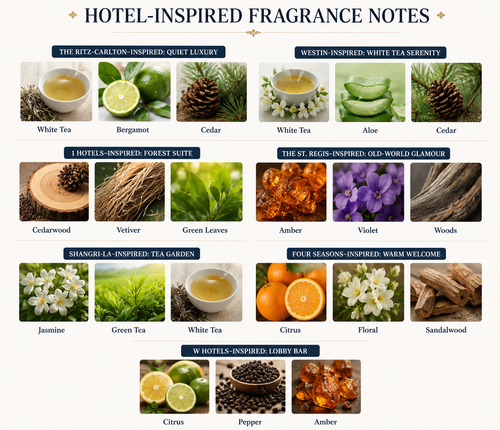
Facts verified August 2026: Three diffusion mechanisms are described — passive capillary (reed diffusers), ultrasonic water mist (Boond ₹899, 300ml, up to ~150 sq ft, ~6 hours, USB, night light; Sukoon ₹1,899, 500ml, 270–320 sq ft, 16–18 hours on low, three 15ml Hotel Collection scents included; Megh ₹3,499, 6L tank, ~100 hours runtime, ~215 sq ft, which is less coverage than Sukoon) and waterless cold-air nebulising (Safar ₹3,999, 20ml bottle, 2000 mAh Type-C battery, up to 10 hours continuous or around 30 hours intermittent, 3 speeds, 1/2/3-hour auto-off timer, 6.9 cm, named and sold as a car and travel diffuser with car, handbag, desk, bedside and hotel room among its stated uses, no published room-coverage figure; Vaayu ₹11,999, coverage up to 1000 m³ or roughly 2,000–3,000 sq ft, 400ml refillable tank lasting up to about 90+ days, Bluetooth app and onboard buttons, 1h/4h/8h/24h run windows, choice of days, adjustable mist intensity, key-lock, under 38 dB which SOSA states is quiet enough for a bedroom, clinic or office, freestanding or wall/HVAC mount, 5W, CE, RoHS, SGS). Cold-air machines are intended for alcohol-free, water-free oils formulated for cold-air diffusion, such as the SOSA Hotel Collection; thick undiluted essential oils can clog the nozzle over time. Aangan ₹25,999 and Meenar ₹38,500 are commercial HVAC systems for 8,000–10,000 and 12,000–18,000 sq ft and are never a home recommendation. SOSA reed diffusers: five scents, 50ml ₹749–₹849 lasting 6–8 weeks and suiting rooms up to ~150 sq ft, 130ml ₹1,249–₹1,349 lasting 14–18 weeks and suiting above 150 sq ft, six fibre reeds included and flipped every 3–5 days, about ₹13–₹15 a day, heat-stable CCT carrier rather than DPG, alcohol-free, phthalate-free, paraben-free, IFRA-compliant, 0 ppm formaldehyde, refillable glass bottle, climate-tested at 45°C and 85% RH, composed in Pune. The SOSA strength scale measures perceived intensity in a room: Evening Calm 8.9, Garden Bloom 8.9, Morning Freshness 9.0, Mountain Breeze 9.4, Fresh Brew 9.5. Duos are two 50ml bottles at ₹1,498–₹1,598; refills 300ml ₹2,399 and 500ml ₹3,499, oil only and never a first purchase. Hotel Collection fragrance oils are water-based and ultrasonic-only at 15ml ₹299 (a refill), 100ml ₹999, 300ml ₹1,799 and a pack of seven at ₹1,799; they cannot be used in reed diffusers and reed oil cannot be used in ultrasonic machines, so no hotel-inspired reed diffuser exists. No health, air-quality, allergy or antimicrobial claims are made, and fragrance does not remove a smell — source, then ventilation, then fragrance. Free shipping above ₹499. A portion of every order supports girl-child education through Nanhi Kali. SOSA is an independent Indian fragrance house; the Hotel Collection scents referenced here are SOSA’s own interpretations inspired by the world’s finest hotels, and SOSA is not affiliated with, endorsed by or a supplier to any hotel brand. Prices subject to change — see the live product pages.