



The best free fix of all: a ceiling fan on low, in a closed room. A reed diffuser has no fan of its own, and a fan is the transport it structurally lacks. It will shorten the bottle’s life — that is the trade, and it is yours to make.
Before you buy “better projection”: understand that a passive diffuser has no projection mechanism to upgrade. Paying more buys you more emission — a higher peak at the bottle — and leaves the distance to your chair exactly where it was.
The honest gap: moving it fixes one seat beautifully and cannot fix two seats at once, and it cannot make a room even. If your requirement is the bed and the desk, or evenness rather than one good spot, that is a mechanism question, and the honest first answer there is Sukoon at ₹1,899, not something dearer.
2. Put it at the right height and out of the wrong air. At or slightly below nose height when you are seated or lying down, on a surface rather than on the floor and rather than on a high shelf. Keep it off a windowsill, out of a balcony draught and out of the direct blast of a split AC, which strips the reeds and throws everything at one wall. But do not hide it in a dead corner either — it needs the room’s air to move past it.
3. Use the reed count as the volume dial it is. All six fibre reeds is full output. Three is a soft bedside level and roughly doubles how long the bottle lasts. If you are moving the bottle to within half a metre of your pillow, three reeds is usually the better setting, not six — closer and softer beats further and louder.
4. Turn the ceiling fan on low and close the door. This is the best free advice on this page. A reed has no fan; a fan is precisely the transport it lacks, and on low in a closed room it will carry the zone outward in a way no amount of oil can. It will also shorten the bottle’s life, because faster-moving air evaporates faster. I would rather you knew that and chose than found out in week four.
5. Only then consider spending — and consider mechanism, not price. If, having done all of the above, you still need fragrance in two places at once or evenly across the whole room, no reed diffuser at any price will deliver it, because the limit is structural. That is the point at which Sukoon at ₹1,899 becomes a sensible purchase rather than an upsell.
Alcohol-free, phthalate-free, IFRA-compliant, made in Pune. A portion of every order supports girl-child education through Nanhi Kali.
The three free moves, in order of how much they actually change
I want to be careful here, because the temptation on a page like this is to gesture at the free fixes and hurry on to the machines. That would be dishonest, and it would also be bad advice: a large share of the people who write to us with this exact question are fixed for nothing, and I would rather have a customer who solved it with a shelf than one who solved it with a purchase they did not need. So here are the three, ranked by effect, and each of them is genuinely free.
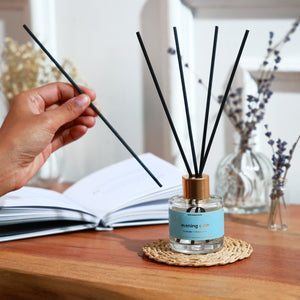
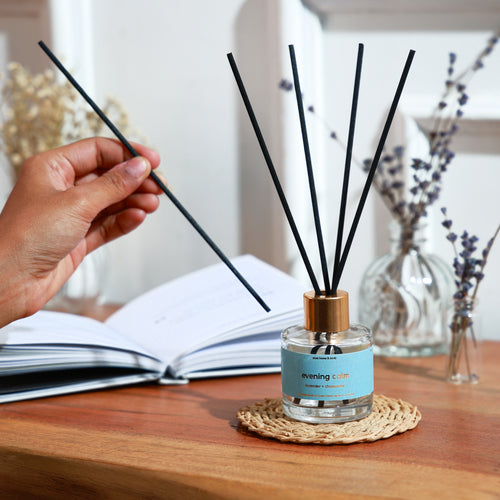
 Evening Calm₹799The concentration around a reed diffuser falls away steadily from the bottle outward. That is not a fault, it is the definition of a point source, and it means the single most powerful thing you can do is stand somewhere different on that curve. Moving the bottle from a chest of drawers across the room to the bedside table changes the experience entirely without a single rupee changing hands, because you have not asked the product to do anything new — you have simply stopped standing outside its range. The mistake almost everybody makes is moving it a token amount. If the change is not big enough to feel silly, it is not big enough to test.
 Mountain Breeze₹849Height is the fix people skip and then benefit from most. A diffuser on the floor is below the level at which you meet the air, and one on a tall shelf is above it; at or slightly under nose height, for the position you are usually in, is where it belongs. Then think about which air it is sitting in. A windowsill, an open balcony door and the direct blast of a split AC all take fragrance away from you rather than towards you — air that leaves the room takes the fragrance with it, and the AC blast strips the reeds and throws everything at one wall. Equally, a dead corner behind a wardrobe gives the vapour nowhere to go. You want the quiet part of a room that still breathes.
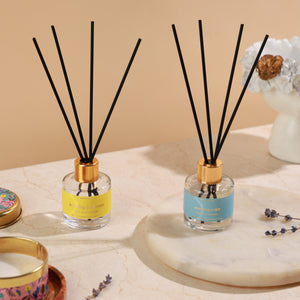
 Morning Freshness₹749Everything else on this list changes where you stand or how much leaves the bottle. A ceiling fan on low changes the thing a reed diffuser cannot change about itself: it moves the air. That is why it is the best free advice in this whole family of questions, and why I say it before I mention any machine we sell. Run it low, in a closed room, and not with the bottle directly under the blades at full speed, which simply flings the vapour outward and empties the bottle. The trade is real and I will not bury it: a fan shortens the bottle’s life, because moving air evaporates oil faster. You are converting weeks into reach. Sometimes that is exactly the exchange you want, and it is yours to make knowingly.
Why “better projection” is not something you can buy on a passive product
This is the part I would want a friend to tell me before I spent again. There are two entirely separate quantities at work in your bedroom, and almost every disappointing purchase in home fragrance comes from confusing them. Emission is how much fragrance leaves the bottle — decided by reed count, by bottle size, by temperature and by the oil itself. Transport is how far it gets — decided almost entirely by moving air, which a reed diffuser does not supply and has never claimed to. When you tell me the fragrance is wonderful at the dresser and absent at the bed, you are describing a transport problem in a product that has no transport system. Raising emission does not touch it. It raises the peak where the peak already was.
Which is why the upgrades that look like projection upgrades are usually not. A bigger bottle is the clearest example: bottle volume is a duration specification, not a coverage specification. A 130ml lasts 14–18 weeks where a 50ml lasts 6–8; it does not reach further, it reaches for longer. The most instructive case is in our own range rather than anyone else’s. Our Megh ultrasonic machine has a six-litre tank and roughly a hundred hours of runtime, and it covers about 215 sq ft — less than the ₹1,899 Sukoon’s 270–320. Six litres buys you runtime and humidity. It does not buy you a bigger room. If the biggest thing on our own shelf is not the strongest, you can see why a bigger reed bottle is not either.
There is a second question hiding behind this one, and people are slightly embarrassed to ask it: am I paying for the fragrance or for the machine? When you move from a reed to an active diffuser, mostly the machine. That is the honest answer to the whole projection question. A ₹749 reed and a machine costing many times that can run related scents and produce completely different rooms, and the difference in price is buying transport, control and evenness — not a better smell. The oil in your reed bottle is not the limiting factor. If it were, the room nearest the bottle would be disappointing too, and it is not; you have told me it is lovely.
Every free fix, ranked by what it actually does
The complete list of changes that cost nothing, what each one alters — emission or transport — and what it costs you elsewhere. I have included the last row because a page that lists only the fixes that work is as misleading as one that lists only the products that fit your search.
| Change | What it alters | Effect on your chair | What it costs you |
|---|---|---|---|
| 1. Halve the distance ★ | Neither — it moves you, not the physics | The largest single change available at any price | Nothing. The bottle lasts exactly as long |
| 2. Ceiling fan on low, door closed | Transport — the thing a reed lacks | Large, and the only free change that improves evenness | Shortens the bottle’s life; faster air evaporates faster |
| 3. Nose height, on a surface | Neither — geometry | Moderate, and instant | Nothing |
| 4. Out of the draught, not in a dead corner | Transport, by not throwing it away | Moderate; largest if it was on a windowsill | Nothing |
| 5. All six reeds instead of three | Emission only | Higher peak near the bottle; the far side of the room is unchanged | Roughly halves how long the bottle lasts |
| 6. Flip the reeds every 3–5 days | Emission, briefly | A lift for a few hours; it adds no range at all | Nothing, but do not expect it to solve this |
| What none of them can do: make one room even | Evenness is a property of moved air | A point source always has a gradient. Free fixes reposition the gradient; they do not remove it | Said plainly rather than dressed up |
Softest · Evening Calm₹799Shop → 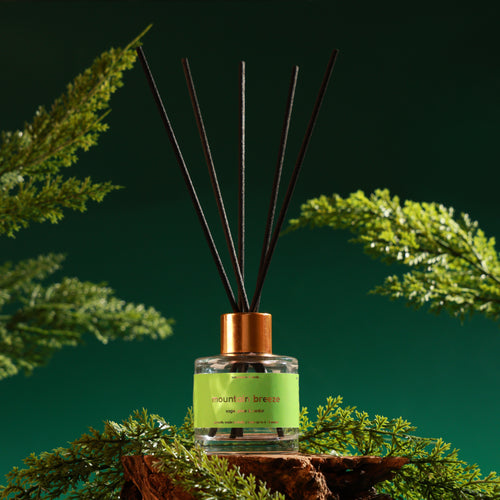 Deepest woody · Mountain Breeze₹849Shop →
 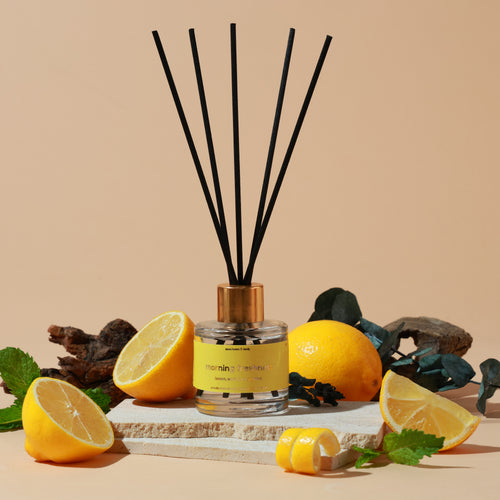 Brightest · Morning Freshness₹749Shop →
When moving it stops being enough — the two honest cases
I have spent this page arguing for the free fix, so let me be equally straight about its limits. Moving a reed diffuser closer solves one problem completely and two problems not at all. It gives you an excellent seat. It cannot give you two seats, and it cannot give you a room. The first case is two places at once: the bed and the reading chair, the bed and the desk, the pillow and the doorway you walk through. A point source has one peak. Put it by the bed and the desk is now the far end; put it between them and neither is good, because the middle of two positions is the furthest ordinary place from both. No amount of moving resolves a requirement for two locations, and the second bottle people usually buy at this stage does not resolve it either — it produces a second peak with a valley in between, which is a different arrangement rather than a better one.
The second case is evenness. If what you want is not a good spot but a room that reads the same at the bed, the wardrobe and the door, you are describing a property of moving air, and a reed does not move air. This is the moment where spending is rational rather than hopeful, and it is worth knowing where the ladder actually starts. Sukoon at ₹1,899 is an ultrasonic machine rated for 270–320 sq ft with a 500ml tank and 16–18 hours on low, and it is very often the correct answer for one bedroom — it must never be skipped on the way to something dearer. Above it, Safar at ₹3,999 is a waterless cold-diffusion device that shatters undiluted oil into a dry mist; it is named and sold as a car and travel diffuser, SOSA has published no room coverage figure for it, and its timer runs one, two or three hours before it needs recharging, so it is a device you switch on rather than one you forget about. And then there is a real gap in our range: between Safar and the ₹11,999 Vaayu there is no mid-sized waterless bedroom machine. Vaayu is rated to 1000 m³, roughly 2,000–3,000 sq ft, and in a 120 sq ft bedroom nine-tenths of it is wasted. I would rather name that gap than sell around it.
And before any of that, one diagnostic worth running, because it costs nothing and it changes what a fair number of people decide. If the room felt strongly fragranced in week one and quiet now, ask whether it has stopped working or whether you have stopped noticing. Receptors adapt to a constant stimulus within minutes — the molecules keep arriving and the brain stops reporting them. Leave the house for a quarter of an hour and walk back in, and ask somebody who does not live there. A visitor is a better instrument than you are, in your own home, always.
If you do buy, buy in this order
Assuming you have moved it, raised it, tried the fan and closed the door, here is the order I would actually spend in, with the reasoning for each step and the thing at the end that I would talk you out of. Note the row about switching mechanism, because it is the most common disappointment in this whole subject and it has nothing to do with reach.
| Step | What it is | When it is the right answer | Price |
|---|---|---|---|
| 1. Move it, six reeds, fan on low ★ | Distance, height, airflow and reed count | Always first. A large share of people stop here | Free |
| 2. A reed where you sit | 50ml from ₹749, six fibre reeds, roughly ₹13–₹15 a day, silent, no power, works in a power cut | When one excellent seat is genuinely what you want | ₹749–₹849 |
| 3. Sukoon ultrasonic | 500ml, 270–320 sq ft, 16–18 hours on low, three 15ml Hotel Collection scents included. Moves air. Adds humidity, needs filling, and in hard-water cities can leave white mineral dust | When the requirement is evenness or two places at once in one bedroom | ₹1,899 |
| 4. Safar waterless | Undiluted oil, cold diffusion, 20ml, cordless, three speeds, 1/2/3-hour timer. Named and sold as a car and travel diffuser; no published room coverage; needs recharging | When you want the waterless mechanism at personal scale and will switch it on deliberately | ₹3,999 |
| 5. Switching mechanism may mean switching scent | Reed oil cannot go into an ultrasonic machine, the water-based Hotel Collection cannot go into reeds, and Safar takes pure fragrance oil | Read this before you buy a machine expecting your favourite reed scent to move across. It does not | 15ml refill ₹299 |
| The honest gap: no mid-sized waterless bedroom machine | Between Safar ₹3,999 and Vaayu ₹11,999 there is nothing. Vaayu is 1000 m³, roughly 2,000–3,000 sq ft, and is the wrong purchase for one bedroom | Named rather than sold around. For one room, Sukoon is usually the answer | ₹1,899 / ₹3,999 |

Versailles
The letters that begin should I move it or should I buy something better are, almost without exception, from people who like what they bought. That is the first thing I notice and it changes how I want to answer. You are not telling me the fragrance is wrong. You are telling me it is lovely in one place and you would like it where you actually are, which is a completely reasonable thing to want and a completely different problem from the one you might think you have.
So my answer is nearly always the unprofitable one. Move it. Halve the distance, put it at the height of your face when you are sitting down, close the door, and put the ceiling fan on low. If that works, you have solved it for nothing, and I would far rather have that outcome than a sale, because a customer who was sold a device for a problem a shelf would have fixed does not come back.
What I also owe you is the limit. A reed diffuser is a beautiful object that runs silently for six to eight weeks on about thirteen or fifteen rupees a day, needs no socket, nothing to fill, nothing to charge, nothing to remember, and keeps working during a power cut. What it does not have is a fan. If your requirement is two places at once, or a room that reads the same everywhere, that is a mechanism you need rather than a stronger bottle — and I would send you to Sukoon at ₹1,899 long before anything with a bigger number on it. Everything is composed in Pune, and a part of every order funds a girl’s classroom through Nanhi Kali.
Frequently asked questions
- My diffuser is across the bedroom and I can’t smell it from my bed — the four changes, in order.
- How to make the fragrance reach the bed — why distance is the dominant lever.
- Should it go on the bedside table? — yes, and it is not a compromise.
- Only 100 sq ft and still nothing from the bed — small does not mean even.
- A 10 × 12 bedroom with the diffuser near the door — the worst spot in the room.
- Fragrance wherever I am — are reeds enough? — for evenness, honestly no.
- Strong walking in, gone once in bed — two mechanisms stacking.
- Two diffusers on opposite sides? — two hills, not a plateau.
- Reaching the bed without the bottle beside it — where active diffusion legitimately begins.
- Brand: the SOSA founder story.
SOSA facts verified August 2026: Reed diffusers in 50ml and 130ml only — Morning Freshness ₹749 / ₹1,249, Evening Calm ₹799 / ₹1,299, Garden Bloom ₹799 / ₹1,299, Mountain Breeze ₹849 / ₹1,349, Fresh Brew ₹849 / ₹1,349. 50ml suits rooms up to about 150 sq ft and runs 6–8 weeks; 130ml suits above 150 sq ft and runs 14–18 weeks; roughly ₹13–₹15 a day. Six fibre reeds, not rattan, in a refillable glass bottle, on a heat-stable CCT carrier rather than DPG, alcohol-free, phthalate-free, paraben-free, IFRA-compliant, 0 ppm formaldehyde, tested at 45°C and 85% RH, composed in Pune. Six reeds is full output; three is a soft bedside level and roughly doubles the life; flip every 3–5 days. Machines: Boond ₹899 (300ml, up to about 150 sq ft), Sukoon ₹1,899 (500ml, 270–320 sq ft, 16–18h on low), Megh ₹3,499 (6 litres, about 100 hours runtime, only about 215 sq ft), Safar ₹3,999 (waterless cold diffusion of undiluted oil, 20ml, 2000 mAh, three speeds, 1/2/3-hour timer — named and sold as a car and travel diffuser, with no published room coverage figure), Vaayu ₹11,999 (up to 1000 m³, roughly 2,000–3,000 sq ft, 400ml tank). Between Safar and Vaayu SOSA has no mid-sized waterless bedroom machine, and this guide says so rather than stretching a product to cover it. Reed oil and the water-based Hotel Collection are separate products and are not interchangeable in either direction; there is no hotel-inspired reed diffuser. No health, air-quality or sleep claims are made for any SOSA product, and fragrance does not remove an unwanted smell — deal with the source, then ventilate, then fragrance. Free shipping above ₹499. A portion of every order supports girl-child education through Nanhi Kali. SOSA is an independent Indian fragrance house; the Hotel Collection is SOSA’s own interpretation inspired by the world’s finest hotels, and SOSA is not affiliated with or endorsed by any hotel brand. Prices subject to change — see the live product pages.