



The practical version: shut the balcony doors twenty minutes to half an hour before guests arrive or before you sit down for the evening. Leave the room while it happens. Come back in and judge the first three seconds.
Do this first: a closed room concentrates everything in it, not only what you like. Deal with any source — the kitchen, the bin, the drying rack — and air the room properly with the doors wide, then close them and let the diffuser work. Fragrance sits alongside an odour, it does not remove one.
The honest gap: if you have no intention of closing the balcony door in the hours you use the room, the living room is not the room to buy a diffuser for. Put the money in the bedroom and the bathroom, which close by themselves, and I would rather say that than sell you a second bottle for a room that is open to the sky.
2. Twenty minutes to half an hour is the practical figure for a living room. Not because there is a magic number — there is not, and it varies with the size of the room — but because that is roughly the span in which most people notice an unmistakable change. Shut the doors when you start getting ready rather than when the doorbell goes.
3. Air the room properly before you close it, not after. A closed room concentrates whatever is in it, and that includes the things you would rather not concentrate: cooking from an hour ago, a bin that needs emptying, damp fabric on a rack. Fragrance does not remove an odour; the two sit alongside each other and the mixture is frequently worse than either. The order is always source, then ventilation, then fragrance. A balcony on a high floor is superb ventilation, so use it hard for ten minutes with everything open, and then shut it and let the diffuser fill a room that is already clean.
4. Leave the room while it works. This is the part people skip and it changes the whole experience. Olfactory receptors adapt to an unchanging smell within minutes, so if you sit in the room for the entire twenty you will conclude nothing has happened. Go and do something else, then come back and judge the first three seconds. That is also exactly what your guests will experience, because they arrive un-adapted.
5. And it is not cheating in the slightest. A reed diffuser is a continuous, uncontrolled product with no off switch and no boost. The room is the only variable you hold, and using it deliberately is the difference between owning a diffuser and operating one. If you would rather not close the doors, that is a perfectly reasonable choice — it simply means the living room is not the room to buy for.
Alcohol-free, phthalate-free, paraben-free, IFRA-compliant, 0 ppm formaldehyde, six fibre reeds in a refillable glass bottle, composed in Pune. Free shipping above ₹499, and a portion of every order supports girl-child education through Nanhi Kali.

Why the door is the control, and the bottle is not
It helps to be precise about what a reed diffuser is and is not. It is a slow, steady release with no fan, no power and no timer, and it runs whether the house is full or empty. That continuity is its great virtue — it asks nothing of you and it is always already going — and it is also the reason it has no volume knob you can reach for at seven in the evening. The knob exists; it is just not on the bottle. Everything below is what happens when you turn it.
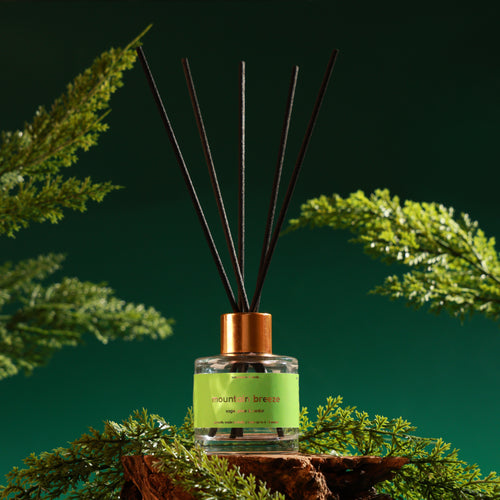
 Mountain Breeze₹849How strongly a room reads is the difference between two rates: how fast fragrance is added and how fast the air carrying it is replaced. The reeds decide the first and the openings decide the second, and in a high flat with a balcony door the second is by a distance the larger number. Nothing you buy changes it — you cannot out-release an open wall. Close the door and the addition continues unaltered while the removal drops to whatever ordinary leakage a shut room has, so the level in the room climbs instead of holding flat. That is the entire mechanism, and it explains a thing people find strange: the diffuser that seemed to do nothing all afternoon is unmistakable an hour after the doors are shut, without anybody touching it.
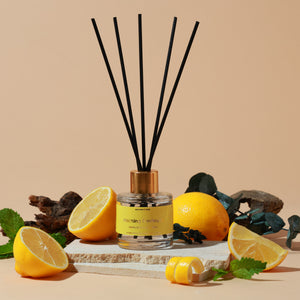
 Morning Freshness₹749The same physics that lets fragrance build also lets everything else build, which is why the order of operations matters more than the choice of scent. If the room still holds cooking from an hour ago, or a bin, or clothes on a rack, closing the door concentrates those alongside the diffuser and you end up with a mixture rather than a fragrance. Adding a pleasant smell to an unpleasant one does not cancel anything; it gives the nose two things to track, and the result is usually less pleasant than either alone. So run it in this order: deal with the source, then open everything wide for ten honest minutes — a high-floor balcony is a magnificent ventilation device and this is the one moment when all that airflow is entirely on your side — then close, then let the diffuser do the only job it can actually do, which is to scent a room that is already clean and aired.
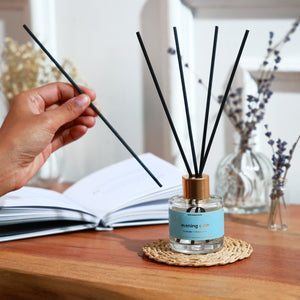
 Evening Calm₹799Receptors adapt to a constant, unchanging stimulus within minutes; the signal keeps arriving and the brain stops reporting it because nothing about it is new. This is why nobody smells their own home and everybody smells somebody else's from the doorway. It has a very practical consequence for the twenty-minute routine: the person who stays in the room while it fills is the one person guaranteed not to appreciate the difference. Shut the doors, then go and change, or lay the table, or take a shower. Walk back in and give yourself three seconds of honest attention before your nose settles again. That first impression is what everyone arriving at your door will get, and it is the only reading of your own home that is worth anything. If a guest remarks on a fragrance you cannot detect, the diffuser is working perfectly for everyone but you.
The routine, written out
Nothing here costs money, and I would rather a reader spent an evening trying it than an evening choosing a second scent. Ninety minutes before people arrive: deal with anything that is generating a smell — the kitchen extraction, the bin, the shoe rack near the door, laundry that is still damp. This is the part that actually decides how a room smells and the part nobody enjoys. Forty minutes before: open the balcony doors and any window on another side, and let the flat scour itself for ten minutes. On a high floor this is remarkably quick, which is the great compensating advantage of all that airflow. Twenty-five minutes before: close the balcony doors. Check that the diffuser is on the far wall rather than the sill, is at roughly nose height, is out of any direct sun, and has all six reeds in if you want full projection. Flip the reeds if it has been three to five days since you last did — flipping releases a fresh burst, and this is exactly the moment for it to land. Then leave the room. Come back in five minutes before the doorbell and judge those first seconds.
Two variations worth knowing. If your living room and balcony are the only ventilation for a kitchen that has just been used, do the ten-minute airing with the kitchen extraction still running, and give the soft furnishings a fair chance — cooking aerosols condense onto curtains and upholstery and re-release for hours, so a room can smell of dinner again after the air itself is clear. That is not a failure of the airing; it is the deposited fraction returning, and the honest answer is that fragrance is the last step in that sequence rather than a substitute for the first two. And if twenty minutes is more notice than your life allows, that is a real argument for a machine: Sukoon at ₹1,899 fills a room of 270–320 sq ft in minutes and can be switched off again, which is precisely the job a reed cannot do.
A word on flame, because closing a room and lighting something often happen in the same half hour. Fragrance oil is flammable, so a diffuser should never share a surface with a diya, an agarbatti or a lit candle, and a balcony draught that catches a curtain near an open flame is a hazard in its own right. If you are lighting anything at all, do it away from the diffuser and away from anything that moves in the air.
| What you could do | Cost | How much it changes | Verdict |
|---|---|---|---|
| Close the balcony doors for twenty to thirty minutes | ₹0 | The largest single change available | Do this first, every time. It is the product's operating condition, not a trick |
| Air the room hard for ten minutes before closing it | ₹0 | Decides whether what accumulates is pleasant | Non-negotiable if anything has been cooked, dried or left in the room |
| Move the bottle off the sill to the far wall, and flip the reeds | ₹0 | Substantial, and permanent rather than for one evening | The second free change. Flipping releases a fresh burst; do it on a 3–5 day cadence |
| Add reeds, or move from three to six | ₹0 | Real in a closed room, largely wasted in an open one | Useful once the doors are shut. In moving air it mostly empties the bottle faster |
| Buy a 130ml instead of a 50ml | About ₹500 more | Right if the room is above ~150 sq ft, otherwise over-specified | A size decision, not a strength decision. 14–18 weeks against 6–8 |
| Buy a stronger scent because the room feels weak | ₹749–₹1,349 | Least of anything on this list, if the doors stay open | The honest gap. Changing the bottle cannot fix an open wall — change the room first |
Why this is a way of using the product, not a workaround
There is a slight embarrassment in the question as people ask it, as though closing the door were an admission that the diffuser is not good enough on its own. I would like to take that away, because the framing is upside down. Every ambient fragrance in the world works by accumulation in an enclosed volume. Hotels do not scent lobbies against an open street; they scent a controlled interior and keep the doors managed. A room with an open wall is not a difficult fragrance environment so much as an outdoor one, and no product is expected to perfume the outdoors. Closing the door is not compensating for a shortcoming. It is supplying the condition the whole category assumes.
It is also, quietly, the most efficient thing you can do with the oil. A reed diffuser holds nothing in reserve — every millilitre eventually leaves the glass through the reeds — so the only real waste in this product is fragrance entering a room that nobody is in, or one whose air is on its way outside. Closing the door for the hours you are actually in the room converts an open-ended loss into something you get to experience. That is why the answer to "should I close the door" and the answer to "how do I stop wasting oil" turn out to be the same answer, which is unusual and satisfying.
Where I would be honest is about how far it goes. Twenty minutes will change how a room reads on arrival, and change it considerably; it will not make a diffuser noticeable to somebody sitting in the room for three hours, because that person will adapt. It will not overcome a smell that has not been dealt with, and it will not turn a 50ml into the right bottle for a 300 sq ft open-plan space. And if the truth about your household is that the balcony doors are open every hour you are at home — which is a perfectly good way to live, and the reason many people bought a flat with a balcony in the first place — then the correct conclusion is not a bigger purchase. It is to fragrance the bedroom and the bathroom, which close by themselves, and to let the living room be what you clearly want it to be.
What to buy for a room you close in the evening — and the honest gap
If the twenty-minute routine is something you will genuinely do, a living room becomes worth buying for. In the order I would buy it, with a last row that is not a product.
| Buy | What it is | When it is the right answer | Price |
|---|---|---|---|
| 1. Mountain Breeze 130ml ★ | Pine, sage and cedar at 9.4 — dry and resinous, the most presence in a large room | A living room above 150 sq ft with a real closed evening block. Six reeds once the doors shut | ₹1,349 |
| 2. Garden Bloom 50ml or 130ml | British rose and night-blooming jasmine at 8.9, indole held below the animalic threshold | A room people are invited into, where a floral has somewhere to gather | ₹799 / ₹1,299 |
| 3. Sukoon | 500ml tank, 270–320 sq ft, 16–18 hours on low, three 15ml Hotel Collection scents included | If twenty minutes of notice is more than your evenings allow — it fills a room in minutes and switches off | ₹1,899 |
| 4. Morning Freshness 50ml | Malabar lemon, peppermint and eucalyptus at 9.0, on two or three reeds | The bathroom — small, enclosed, closes by itself, and can run close to three months | ₹749 |
| 5. Evening Calm 50ml | Kashmir lavender and chamomile at 8.9, the softest in the range, on three reeds | The bedroom, which has a closed block whether or not you ever shut the balcony | ₹799 |
| The honest gap: twenty minutes, and airing the room | The two most effective actions on this page cost nothing and cannot be bought. If the balcony doors stay open through every hour you are home, no bottle and no machine changes that — a machine run into an open room wastes water and oil exactly as a reed wastes oil. And the Megh at ₹3,499 is not the way round it: about 215 sq ft, less than the Sukoon at ₹1,899, because it is a runtime and humidity machine | Before anything else, and instead of a second bottle | ₹0 |

Versailles
People ask this question apologetically, as though closing a door were a confession. I would like to reverse that entirely. Every ambient fragrance ever made works by accumulating in an enclosed volume, which is why hotels scent controlled interiors rather than open forecourts. A living room with a balcony wall standing open is, in fragrance terms, an outdoor space, and nobody expects a bottle to perfume the outdoors.
What I like about this particular answer is that it is free, and that it is the same answer to a completely different question. Readers write to ask how to stop wasting oil, and readers write to ask how to make the room smell more, and the reply to both is: close the room for the hours you are in it. A reed diffuser gives you the whole bottle either way — nothing is held back — so the only meaningful waste is fragrance leaving a room you are not in or a room that is on its way outside. Shutting the doors for the evening converts that loss into something you actually get to smell.
The part I would not let anybody skip is the airing before the closing. A closed room concentrates whatever is in it, and I have had more disappointed letters from people who shut a room over yesterday's cooking than from any other cause. Deal with the source, open everything for ten minutes, then close it, then leave the room and come back in. If that routine is not something your household will do, buy for the bedroom and the bathroom instead and enjoy the balcony. Everything is composed in Pune, and a part of every order funds a girl's classroom through Nanhi Kali.
Frequently asked questions
- The 20th floor and a cross-breeze — the mechanism page for the whole family.
- Floor-to-ceiling balcony doors — the placement page, and why the sill is the worst shelf in the flat.
- 800 sq ft, reeds or Sukoon? — the honest comparison, including what a machine wastes.
- A balcony attached to the bedroom — three reeds, the far wall, and the hours that work.
- Does a higher floor shorten bottle life? — yes, through airflow rather than altitude.
- A breezy Mumbai high-rise and a Bengaluru one with an open balcony — two cities, two different answers.
- Fresh air by day, fragrance at night — the split setup, in full.
- Sukoon only in the evening — exactly the case a machine exists for.
- Brand: the SOSA founder story.
SOSA facts verified August 2026: Five reed scents, all alcohol-free on a heat-stable CCT (caprylic/capric triglyceride) carrier rather than DPG, phthalate-free, paraben-free, IFRA-compliant, 0 ppm formaldehyde, six fibre reeds in a refillable glass bottle, composed in Pune, India, and tested at a 45°C heat soak and 85% relative humidity. Morning Freshness 50ml ₹749 · 130ml ₹1,249 · 9.0, with a eucalyptus globulus base that slows lemon evaporation three to four times. Evening Calm 50ml ₹799 · 130ml ₹1,299 · 8.9, the softest in the range. Garden Bloom 50ml ₹799 · 130ml ₹1,299 · 8.9, with indole held below the threshold at which jasmine reads animalic above 30°C. Mountain Breeze 50ml ₹849 · 130ml ₹1,349 · 9.4. Fresh Brew 50ml ₹849 · 130ml ₹1,349 · 9.5, the deepest. 50ml suits rooms up to about 150 sq ft and lasts 6–8 weeks; 130ml suits rooms above that and lasts 14–18 weeks; six reeds give full projection and three a soft level that roughly doubles the life; flip cadence is every three to five days. Cost per day approximately ₹13–₹15 on a 50ml. Duos: Day & Night ₹1,498, Fresh & Grounded ₹1,548, Warmth & Bloom ₹1,598, each two 50ml bottles. Refills 300ml ₹2,399 · 500ml ₹3,499, oil only and not a first purchase. Machines: Boond ₹899 (300ml, up to about 150 sq ft, around 6 hours), Sukoon ₹1,899 (500ml, 270–320 sq ft, 16–18 hours on low, three 15ml Hotel Collection scents included), Megh ₹3,499 (six-litre tank, around 100 hours of runtime, about 215 sq ft — a runtime and humidity machine, never a coverage upgrade). Hotel Collection oils are water-based and ultrasonic-only; reed oil and Hotel Collection oil are not interchangeable in either direction and there is no hotel-inspired reed diffuser. SOSA sells no room spray, air purifier, dehumidifier, odour eliminator, plug-in, timer or subscription; every SOSA spray is a car perfume. Free shipping above ₹499. A portion of every order supports girl-child education through Nanhi Kali. SOSA is an independent Indian fragrance house and is not affiliated with or endorsed by any hotel brand. Prices subject to change — see the live product pages.