



What that means: removal is somewhere between six and forty times faster with the window genuinely open. The emission never changed; only the exit did.
The catch: one window with the bedroom door shut is a hole, not a flow. You need two openings, and the door is usually the second one.
2. Because the emission never stops. A body in a bed emits steadily for eight hours: skin lipids transferring onto sheets and pillowcases and oxidising against warm fabric, water vapour, warmth. That is the same on an open night and a closed one. What differs is whether the room can carry any of it away while it is being produced.
3. Because a closed room settles at a higher level, every time. Concentration in any room settles where emission and removal balance. Lower the removal by a factor of ten and you raise the level the room settles at by a similar order. This is why the effect is so reliable — it is not an event that sometimes happens, it is a property of the arrangement, and it will repeat on every closed night.
4. Because one window is often not enough on its own. An open window is a hole; ventilation is a flow, and a flow needs somewhere for air to go. If the bedroom door is shut and the window is on one wall, very little moves. Open the window and the bedroom door together — in a bedroom, the door is usually your second opening — or leave a real gap under it and let the rest of the flat do the exhausting.
5. And this tells you what fragrance can and cannot do. Scent is additive: it adds molecules and removes nothing, so it cannot substitute for an air change. Ventilate on a schedule and then a reed diffuser or a Sukoon gives the room a character worth having.
Made in India, composed by an ISIPCA Versailles-trained perfumer — and a portion of every order supports girl-child education through Nanhi Kali.
What an open window is actually doing, and what it is not
It is worth being precise, because the wrong mental model leads people to buy the wrong things. An open window does not add anything to your bedroom. It does not deliver freshness, and outdoor air in most Indian cities is not notably clean. What it does is give the room an exit. Everything the bed and the body release is going in at the same rate on both nights; on the open night it is also going out, continuously, and the concentration in the room never gets anywhere. On the closed night the same material has nowhere to go for eight hours and simply piles up. You are not smelling a different room in the morning. You are smelling the same room after a very different amount of removal.
The second thing worth understanding is that the comparison is unusually clean, and you should use it. Almost every question about household smell is hard because there are five candidate causes and no way to isolate them. Here you have a natural controlled experiment: one variable, everything else held constant, repeated over many nights. If the open nights are consistently fine, you have proved that your problem is the air-change rate and not a hidden source, which saves you from pulling the wardrobe apart looking for something that was never there. And the negative result is equally informative: if you sleep with everything open and the morning is still wrong, accumulation is not your explanation and there is something in the room that needs finding.
Getting an actual flow rather than an open hole
 Step fourFrom ₹749Air moves when there is a pressure difference and somewhere for it to go. A single window in a bedroom with the door shut gives you very little of either, which is why people report opening a window and noticing almost no change. Open the window and the bedroom door at the same time, and ideally have something open on the far side of the flat as well, so the air crossing your bedroom has a route out of the building. If you cannot leave the bedroom door open at night, leave a genuine gap under it — a door with a 10mm clearance and a window on the latch behaves very differently from a door sealed against a rug.
Symptom to cause: reading the open-versus-closed test
The whole value of this question is that it comes with a result already. These rows are arranged by what that result was, because each outcome points somewhere different.
| What you notice | Most likely cause | How to confirm it | What actually fixes it |
|---|---|---|---|
| Open nights fine, closed nights consistently strange ★ | Air-change rate, plain and simple — accumulation with no exit | Repeat once more to be sure, changing nothing else | Sleep with an opening where you can; hard purges either side of the night if not |
| Window open, door shut, and barely any improvement | A hole rather than a flow — nowhere for the air to go | Open the window and the bedroom door together and re-test the same night | Two openings every time; a gap under the door; a fan in the window blowing outwards |
| Everything open all night and the morning is still wrong | Not accumulation — there is a source in the room | Hunt it: pillow, mattress, wardrobe, under the bed, the en-suite door | Find and remove the source; ventilation was never going to fix this one |
| Better with the window open, but the outside air is worse | Traffic, a neighbour's kitchen or construction dust arriving with the flow | Compare early morning with evening — the outdoor load changes by the hour | Purge in short events at the cleanest hours; mesh the window; fan blowing outwards |
| Closed-window nights bring a sewer or drain note | A dry P-trap in the en-suite — plumbing, not fragrance | Pour a mug of water down each drain and see if the note disappears for a week | Refill traps weekly; if it returns, get the seal checked by a plumber. |
| Musty earth note that the window only partly clears | Damp or mould somewhere in the room — a health issue first | Look behind the headboard, under the window sill and along external walls | Locate the moisture, remove the growth. Fragrance has no role. |
| If none of these fit: run the test properly once: one night sealed, one night with window and door open, same sheets on both. One controlled comparison is worth a fortnight of guessing. | |||
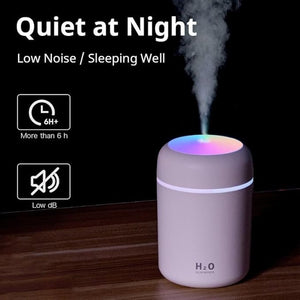
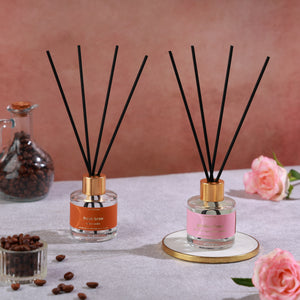
Reeds · always-on roomsFrom ₹749Shop →  Sukoon · when you want a switch₹1,899Shop →
  Hotel Collection · the scentFrom ₹299Shop →
What to do when you genuinely cannot leave it open
Switch from continuous ventilation to scheduled purges. If mosquitoes, noise, dust, rain, security or an air conditioner rule out an open window overnight, the answer is not to give up on ventilation — it is to concentrate it. Ten to fifteen minutes with the window and the bedroom door wide open just before bed means the night starts at the bottom of the curve rather than wherever the room drifted to during the day. Ten to fifteen minutes again on waking, with the duvet thrown fully back rather than the bed made, clears the overnight build-up before it has all day to sit in the fabric. Where the window faces a shaft or the air outside is poor, put a fan in the opening blowing outwards; it exhausts the room rather than importing the street.
Then reduce what the sealed night has to deal with. A closed room is unforgiving, so give it less to hold: sheets and pillowcases weekly, a washable protector on the pillow washed monthly, worn clothes in a basket rather than over a chair, damp towels out on the balcony, and the en-suite door shut so the bedroom is not sharing air with a permanently damp room for eight hours. Run the ceiling fan over an open bed for an hour in the morning, because moving air is what dries fabric. If the room is air-conditioned, wash the filter monthly and remember the unit is recirculating — it has cooled the same air all night and exchanged none of it, which makes the morning purge more important, not less.
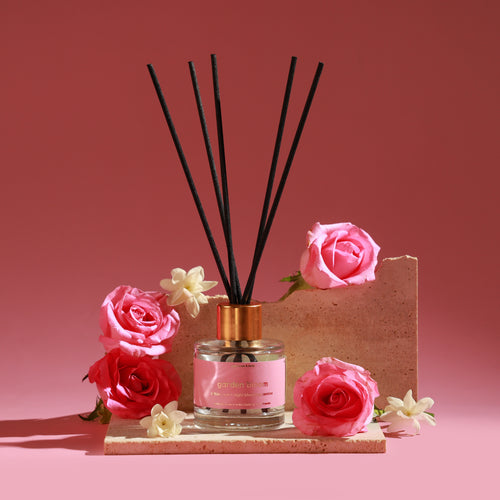
Then, and only then, the fragrance layer. On a sealed night a room holds on to whatever is in it, and that includes what you added on purpose. This is the single strongest argument for under-dosing a bedroom: a reed diffuser from ₹749 on three or four reeds rather than six, placed on the far side of the room from the bed and away from an AC vent. Reed count is the volume control, and a closed bedroom needs the smallest setting of any room in the flat. If you would rather scent were something you turn on and off, the Sukoon at ₹1,899 takes 3–6 drops of the water-based Hotel Collection from ₹299 and covers roughly 270–320 sq ft — run it while you read and switch it off at lights out. The two liquids are not interchangeable.
What to do, in order
The first three steps are free and they are the ones that actually decide how the room smells at six in the morning. The fourth is the purchase, and in a sealed bedroom it should be the smallest dose you use anywhere.
| Step | What to do | When | Cost |
|---|---|---|---|
| 1. Remove the source | Damp towels out, worn clothes in a basket, en-suite door shut at night, water down rarely-used drains weekly | Before anything else | ₹0 |
| 2. Move the air | Window and bedroom door open together — overnight if you can, otherwise ten to fifteen minutes either side of it | Daily, five to ten minutes | ₹0 |
| 3. Deal with what holds it | Weekly sheets and pillowcases, pillow protector washed monthly, ceiling fan over an open bed in the morning | Weekly to monthly | ₹0 |
| 4. Then the always-on layer ★ | A SOSA reed diffuser — a quiet continuous background on three or four reeds, across the room from the bed | 50ml 6-8 weeks · 130ml 14-18 | from ₹749 |
| 5. Or the on-demand layer | Sukoon with a Hotel Collection scent — scent while you read and silence once the light is off; covers roughly 270–320 sq ft | Run it when you want it | ₹1,899 |
Versailles
This is my favourite question in the whole cluster, because the person asking it has already done the hard part and does not realise. They ran a controlled experiment across many nights and got a consistent result. All that is left is to believe it. The window is the cause, which means nothing is wrong with the bed, the room or the person, and the fix is a habit rather than a purchase.
The mistake I see next is expecting one open window to do the job of a cross-draught. A window on its own is a hole in a wall; air only moves through it if there is somewhere for the air to go. In a bedroom, the bedroom door is the second opening, and I have watched people conclude ventilation "does not work in this flat" purely because they had never opened both at once.
When you cannot open anything at night — and half of urban India cannot, for perfectly good reasons — do two hard purges instead and go lighter on fragrance, not heavier. A sealed room holds everything, including what I sell you. Three reeds is plenty. A portion of every order funds a girl's classroom through Nanhi Kali.
Frequently asked questions
- Why a closed bedroom turns stuffy overnight — the four components of stuffy.
- Fine at night, weird by morning — the eight-hour accumulation curve.
- Away for a weekend and it still smells stale — nothing emitting, nothing exchanging.
- Is a reed enough for 120 sq ft? — the coverage arithmetic, with numbers.
- Brand: the SOSA founder story.
SOSA products & prices (verified August 2026): Hotel Collection water-based ultrasonic diffuser fragrance 15ml ₹299 · 100ml ₹999 · 300ml ₹1,799 · Pack of 7 (15ml, all fragrances) ₹1,799; refills 100ml from ₹999. Seven scents: The Ritz-Carlton-inspired (white tea · bergamot · cedar), Westin-inspired (white tea · aloe · cedar), 1 Hotels-inspired (cedarwood · vetiver · green leaves), The St. Regis-inspired (amber · violet · woods), Shangri-La-inspired (jasmine · green tea · white tea), Four Seasons-inspired (citrus · floral · sandalwood), W Hotels-inspired (citrus · pepper · amber). Diffusers: Boond 300ml ₹899 · Sukoon 500ml ₹1,899 · Megh 6L ₹3,499. Water-based, phthalate-free, composed to IFRA standards for home diffusion; 3–6 drops per tank. Made in India, Pune. The Hotel Collection scents are SOSA's own interpretations inspired by the world's finest hotels; all hotel names are trademarks of their respective owners and are used only to describe the scent style — SOSA is an independent Indian fragrance house, not affiliated with or endorsed by any hotel brand. Prices and availability subject to change — see the live product pages.