

Guests on a schedule: the Sukoon ₹1,899 is the better tool — 500ml tank, 270–320 sq ft, 16–18 hours on low, three 15ml scents included. It fills a room in minutes, which is the one thing a reed cannot do.
Where either one goes: not at the door. An entrance is the most turbulent point in a home; place fragrance about a metre inside, out of the door's swing, and put a machine in the living room rather than the foyer.
Two honest gaps: the Megh at ₹3,499 is not a coverage upgrade over the Sukoon — it covers about 215 sq ft against the Sukoon's 270–320 and is a runtime machine. And there is no hotel-inspired reed diffuser: the Hotel Collection is water-based and ultrasonic-only.
2. If guests are scheduled, the machine is genuinely better. The Sukoon at ₹1,899 fills a room in minutes, covers 270–320 sq ft and runs 16–18 hours on low from a 500ml tank, with three 15ml Hotel Collection scents included. Run it for the half hour before people arrive and nothing evaporates into an empty flat all afternoon.
3. Do not put either one at the door. An entrance is the most turbulent point in a home: the door opens, air exchanges in a single movement, and anything sitting there is repeatedly stripped and then met at very close range. A reed belongs about a metre inside, off the swing arc and off the line between the door and your balcony. A machine belongs in the living room, because 270–320 sq ft is a living-room specification and a foyer is a fraction of that.
4. Count the running cost honestly, both ways. A 50ml reed works out at roughly ₹13 to ₹15 a day across 6–8 weeks, with no power, water or refilling. A machine has oil, water, electricity and the small daily act of filling and switching it on. Neither is universally cheaper. For a space in use most of the day the reed wins on effort and cost; for a room used three hours an evening the machine wins on waste.
5. If you want both, split them by room rather than by strength. Reed at the entrance for continuity, machine in the living room for the evenings you have people over. That is the setup I use myself, and it is two purchases rather than one, so I would not start there.
Alcohol-free, phthalate-free, paraben-free, IFRA-compliant, 0 ppm formaldehyde, six fibre reeds in a refillable glass bottle, composed in Pune. Free shipping above ₹499, and a portion of every order supports girl-child education through Nanhi Kali.
The two-second window, and whose nose it belongs to
Everything about this question follows from one fact that is easy to state and easy to forget. The impression you are trying to create is not available to you. Olfactory receptors adapt to a constant stimulus within minutes, so by the time you have crossed your own hall you have stopped reporting your own home entirely. Your guest walks in with a nose that has been calibrating itself against a lift, a corridor and the street, and for about two seconds it is comparing rather than ignoring. After that they adapt too, and the fragrance quietly becomes part of the furniture for them as it already is for you.
Two consequences follow, and both of them point away from the obvious purchase. First, the fragrance has to be already in the air when the door opens — not starting up, not building, not warming through. Anything that requires you to have anticipated the moment is a system that will be off at exactly the times you did not anticipate: the neighbour returning a dish, the courier, the friend who says they are five minutes away and is at the door. Second, strength is almost irrelevant within that window. An un-adapted nose does not need volume; it needs presence. This is why hotels, which have thought about this problem harder than anybody, run one consistent scent at a low level rather than a strong one at intervals.
And it is why the door itself is the wrong place for the hardware. An entrance is where the largest single air exchange in the home happens, in one movement, several times a day. A bottle on the threshold gives up what it has built to the corridor every time somebody comes home, and is then experienced from thirty centimetres by that same person as they take their shoes off. Repeatedly emptied and occasionally overwhelming. A metre inside, out of the swing, off the draught line — the fragrance has somewhere to sit between openings and the visitor meets it a step after the door rather than at the same instant.
The honest division between the two systems
These are not two grades of the same thing. They are two different physical systems with different failure modes, and the reason this comparison is worth a whole page is that the specification sheet actively misleads you here.
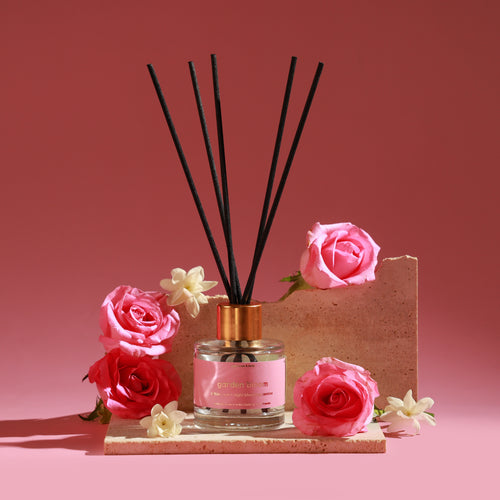
 Garden Bloom₹799A reed diffuser has no switch and that is both its limitation and, for this specific question, its entire case. It runs on Tuesday afternoon when nobody is home and it is running when the bell goes at nine on a Sunday. It needs no power, no water, no tank and no maintenance beyond flipping the reeds every three to five days. It costs roughly ₹13 to ₹15 a day over the life of a 50ml, once, with no recurring purchase beyond the next bottle. What it cannot do is be turned up for guests, turned off while you are away, or fill a room in ten minutes. If you cannot predict the moment, you should stop trying to and buy the thing that never stops.
 Sukoon₹1,899The Sukoon at ₹1,899 is the only fast option we make: a 500ml tank, 270–320 sq ft of coverage, 16–18 hours on low, and three 15ml Hotel Collection scents in the box. It fills a room in minutes rather than hours, and because it can be turned off, it does not spend the working day scenting an empty flat. That is a real and underrated advantage — fragrance running into an empty room is the largest single waste there is. Its weakness for this particular question is equally real: it has to be switched on by somebody who knew the door was about to open. A machine at rest has no specification.
Reed, Sukoon, Boond and Megh, scored for a front door
The same four products would rank differently on a page about a bedroom used only at night. This table is scored for one thing: a guest walking in.
| System | Specification | Ready when the bell goes? | Running cost and effort | Price |
|---|---|---|---|---|
| Reed diffuser 50ml ★ | Up to ~150 sq ft, 6–8 weeks, six fibre reeds | Always. It has no off switch, which here is the point | ~₹13–₹15 a day, no power, water or filling | ₹749–₹849 |
| Reed diffuser 130ml | Above ~150 sq ft, 14–18 weeks | Always | Same, over a longer bottle | ₹1,249–₹1,349 |
| Sukoon | 500ml tank, 270–320 sq ft, 16–18h on low, three 15ml scents included | Only if you switched it on. Fills a room in minutes when you did | Oil, water, power, and filling it. Nothing wasted on an empty flat | ₹1,899 |
| Boond | 300ml, up to ~150 sq ft, ~6 hours, USB, night light | Only if switched on, and sized for a bedroom rather than a hall | Lowest machine entry, shortest run | ₹899 |
| Megh | 6-litre tank, ~100 hours runtime, ~215 sq ft — less coverage than the Sukoon | Only if switched on, and it is not the coverage answer | A runtime and humidity machine. Wrong purchase for this question | ₹3,499 |
Which scent guests actually ask about
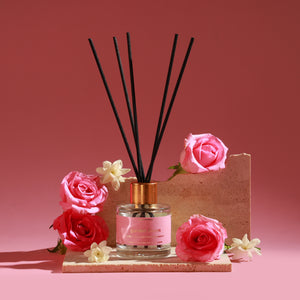
Assuming the reed is the answer, the choice of composition matters less than people expect and in a specific direction. An un-adapted nose in a two-second window registers character rather than detail, so what you want is something with a clear identity at a modest dose. Garden Bloom at ₹799 is the one that gets asked about at entryways more than anything else we make: British rose over night-blooming jasmine, with the indole held below the level where jasmine turns animalic in heat, so it stays floral rather than going heavy in an Indian summer. It is a floral and it is not a blind buy — anti-floral is a common and firmly held position — so if anybody in the house has ever complained about flowers, take the next row instead.
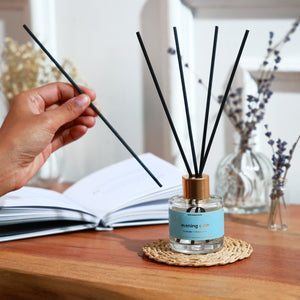
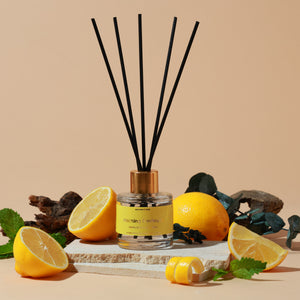
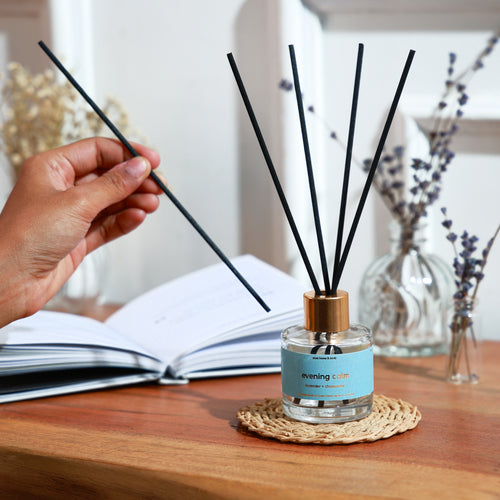
That next row is Evening Calm at ₹799, Kashmir lavender and chamomile at 8.9, the softest thing we make and the one that offends nobody. It is the safest choice for a household you cannot poll and for guests you do not know well. If you would rather the entrance read as clean and awake than as composed, Morning Freshness at ₹749 is the bright answer, and it is also the correct one if there is a shoe rack anywhere near the door — citrus contrasts with a stale note where a floral tends to sweeten it.
Two things not to do. Do not buy a second bottle for the corridor outside your flat; that air belongs to the building, exchanges constantly, and you will be scenting a stairwell at your own expense. And do not run a candle by the door for guests. Fragrance oil and wax are flammable, an entrance has a door that swings and objects put down in a hurry, and a lit flame in a space nobody is sitting in is not advice I will give. Our jar candles from ₹379 belong on a table in a room you are in.
What to buy — and the two gaps worth knowing about
In the order I would spend, for the commonest version of this question. The last row is the honest gap, and on this page there are two of them, because both are places where our own range is easy to misread.
| Buy | What it is | When it is the right answer | Price |
|---|---|---|---|
| 1. Garden Bloom 50ml ★ | Rose and night-blooming jasmine, 8.9 — the entryway scent guests ask about | An unpredictably opened door, and nobody in the house who dislikes florals | ₹799 |
| 2. Evening Calm 50ml | Kashmir lavender and chamomile, the softest at 8.9 | A household you cannot poll, or guests whose taste you do not know | ₹799 |
| 3. Morning Freshness 50ml | Malabar lemon, peppermint, eucalyptus, 9.0 | If there is a shoe rack near the door, or you want clean rather than composed | ₹749 |
| 4. Sukoon | 500ml, 270–320 sq ft, 16–18h on low, three 15ml scents included | Guests on a schedule, or a living room used in defined evening hours. Run it for the half hour before | ₹1,899 |
| 5. Reed at the door plus Sukoon inside | Continuity in the entrance, speed in the living room | Only once you know you need both. Two purchases, and most people do not | ₹2,648+ |
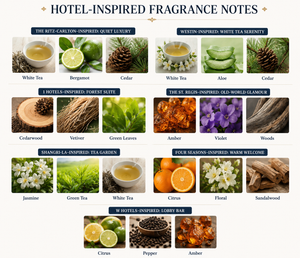
| The honest gaps: Megh, and the hotel oils | Megh ₹3,499 covers about 215 sq ft against the Sukoon's 270–320 — it is a runtime machine, never a coverage upgrade. And the Hotel Collection is water-based and ultrasonic-only: those oils cannot go in reeds, reed oil cannot go in a machine, and there is no hotel-inspired reed diffuser | Said plainly, because both are bought by mistake | ₹3,499 / ₹299+ |

Versailles
People expect me to argue for the more expensive object, and on a great many pages in this series I do. Not on this one. The front door is the strongest case in our whole range for the cheapest thing we sell.
The reason is unglamorous. A first impression is created by somebody else's nose, at a moment you did not choose, in a window of about two seconds. Every property that makes a machine attractive — the control, the speed, the ability to run it only when it matters — depends on knowing the moment in advance. If your household is the kind where people appear at the door, all of that value collapses to zero and the ₹749 bottle that has been running quietly since Tuesday wins outright.
Where the Sukoon earns its ₹1,899 is the invited evening: extract the cooking, open everything for ten minutes, close up, and run the machine for the last twenty. That is a different question from this one and it has its own page. If you can only buy one thing this month and you want your door to be worth opening, buy the reed, put it a metre inside, use three or four reeds, and stop thinking about it. Everything is composed in Pune, and a portion of every order funds a girl's classroom through Nanhi Kali.
Frequently asked questions
- Shoe rack beside the main door — the honest sequence, and why the rack comes first.
- Small 2BHK, shoes near the entrance — the three lines that decide the spot.
- The entrance feels stale but the house is fine — the dead-air pocket, explained.
- Door opens straight into the living room — one air volume, not two.
- Only ₹500 to spend — what that budget honestly buys.
- Too strong every time you walk past — the dose page.
- The console table beside the door — yes, with conditions.
- Small foyer, large living room — scent the space people occupy.
- The hotel lobby question — one scent, low dose, always on.
- Brand: the SOSA founder story.
SOSA products — facts verified August 2026: Reed diffusers, five scents, all alcohol-free, on a heat-stable CCT (caprylic/capric triglyceride) base, phthalate-free, paraben-free, IFRA-compliant, 0 ppm formaldehyde, six fibre reeds in a refillable glass bottle, composed and made in Pune, India. Morning Freshness 50ml ₹749 · 130ml ₹1,249 · 9.0. Evening Calm 50ml ₹799 · 130ml ₹1,299 · 8.9, the softest in the range. Garden Bloom 50ml ₹799 · 130ml ₹1,299 · 8.9. Mountain Breeze 50ml ₹849 · 130ml ₹1,349 · 9.4. Fresh Brew 50ml ₹849 · 130ml ₹1,349 · 9.5. 50ml suits rooms up to about 150 sq ft and lasts 6–8 weeks; 130ml suits above that and lasts 14–18 weeks; cost per day roughly ₹13–₹15 on a 50ml. Machines: Boond ₹899 (300ml, up to ~150 sq ft, around 6 hours, USB, night light), Sukoon ₹1,899 (500ml, 270–320 sq ft, 16–18 hours on low, three 15ml Hotel Collection scents included), Megh ₹3,499 (6-litre tank, around 100 hours runtime, only about 215 sq ft of coverage — a runtime and humidity machine, never a coverage upgrade over the Sukoon). Hotel Collection oils are water-based and ultrasonic-only: 15ml ₹299, 100ml ₹999, 300ml ₹1,799. Reed diffuser oil and Hotel Collection oil are not interchangeable in either direction, and there is no hotel-inspired reed diffuser. SOSA makes no room spray, plug-in, air purifier, dehumidifier, odour eliminator, timer or subscription; every SOSA spray is a car perfume. Free shipping above ₹499. SOSA is an independent Indian fragrance house and is not affiliated with or endorsed by any hotel brand. Prices subject to change — see the live product pages.