
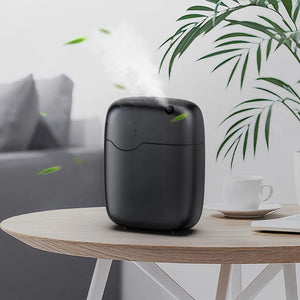




Fragrance frames the meal — it never competes with the food. And it certainly never covers cooking smell. In a dining room you clear the odour at its source first; only then do you scent, low and off the table, to set the mood.
Can fragrance mask cooking smell? No. Scent laid over lingering food odour gives you two smells fighting, not a clean room. Ventilate and extract first.
What order do I work in? Extraction and airflow at the source, then wipe the surfaces oil settles on, then add a low, fresh scent to frame the room.
Which scent won't clash with the next meal? A clean citrus-mint such as Morning Freshness — kept on a sideboard, never on the table.
1. Extract at the source. Run the chimney or exhaust the whole time you cook, and leave it going ten to fifteen minutes after the flame is off. Most lingering smell is the vapour you let escape into the room in the last few minutes.
2. Cross-ventilate. Open a window on the opposite side of the flat so air moves through rather than sitting. Even ten minutes of a through-draught after a fried or fish meal changes the room completely.
3. Wipe where oil lands. Fried-food odour clings to the film of grease on the table, chair backs and the wall behind the hob. A quick wipe-down removes the reservoir that keeps re-releasing the smell.
4. Only now, scent. With the air genuinely clear, a low fresh note reads as cleanliness. Lay it over dirty air and it just reads as "someone is hiding something."
I get asked constantly for "a fragrance strong enough to cover the cooking." There isn't one, and you wouldn't want it. Indian cooking is gloriously aromatic — the tadka, the roasting masala, the char on a roti — and those smells are meant to peak and then leave. The mistake is trying to bury them under something sweeter and heavier. You end up with a dining room that smells like fried onions and vanilla, which is worse than either alone.
Think of it the way a good restaurant does. The kitchen is vented hard, the dining room is aired, and whatever scent you notice is quiet and clean — never a candle fighting the kitchen. That sequence, clear then frame, is the whole discipline.
 Morning Freshness reed from ₹749
No fragrance can out-compete an under-vented kitchen. If your chimney is undersized, clogged with a year of oil, or switched off to save the whir, that is your real problem. Clean or upgrade it before you spend a rupee on scent. In a humid coastal flat this matters double — moist air holds odour longer, so a dining room in Mumbai or Kochi goes stale faster than the same room in Pune.
Once the air is clean, you want a note that says "aired and cared for," not "dessert." Clean citrus and mint do this best — they read as freshness to an Indian nose without ever smelling like food. That is why I steer dining rooms toward Morning Freshness (Malabar lemon & mint) rather than a gourmand coffee-vanilla, which belongs in a cosy winter corner, not next to a working meal. Keep whatever you choose on the sideboard or a shelf across the room, never on the dining table.
| Your situation | Use this | Why |
|---|---|---|
| Small, separate dining room | Morning Freshness reed · ₹749 | Passive, no power, no humidity; clean citrus-mint baseline on the sideboard |
| Dining corner you scent before guests | Sukoon · ₹1,799 + Hotel Collection · ₹299 | Run an hour before, switch off as you serve; sets the mood then recedes |
| Open-plan kitchen-dining floor | SOSA Vaayu · ₹11,999 | Waterless, app-scheduled, no added humidity; one clean note across the whole space |
In a humid coastal city running scent for hours, prefer the waterless Vaayu over an ultrasonic — you do not want to add moisture to already-damp air.

- Dining Room Fragrance: The Hosting Guide — the full pillar
- The Best Fragrance for a Dining Room — food-friendly casts
- Scenting an Open Kitchen & Dining Room — the two-zone problem
- Reed vs Ultrasonic vs SOSA Vaayu for the Dining Room
- Shop all home & hotel scenting