




How to Make Your Kitchen Smell Good (and Keep It That Way)
The kitchen is won at the extractor, not the diffuser. Clear the cooking first, control the sources, and only then lay a clean, fresh scent that knows its place — never over the hob, never pretending to be the food.
Do this first: extract and ventilate while you cook, lids on, wipe grease, empty the bin. Scent comes after the air is clean.
Then scent it: a clean, non-food note — a Morning Freshness lemon-mint reed on a far counter.
The honest truth: no fragrance masks last night's fish or oil. Only cleaning and airflow do that.
Most advice about a good-smelling kitchen starts at the wrong end. It reaches for the scented spray before it reaches for the exhaust switch — and so the kitchen ends up smelling of fried onion and synthetic apple, which is worse than either alone. A kitchen is the hardest room in the house to keep fresh precisely because you are actively making strong odours in it every single day. Tadka, mustard seeds cracking in hot oil, fish, garlic, boiling dal — these are not smells you scent over. They are smells you remove at source, and only then do you get to think about fragrance.
So the order matters more than the product. Get the sequence right and even a modest ₹749 reed does beautiful work. Get it wrong and the most expensive machine in my range will only add a second layer to the mess.
1. Extract while you cook. Switch the chimney or exhaust on before the pan gets hot, not after the smoke arrives. Open a window if you can — cross-ventilation clears in minutes what fragrance cannot touch in hours.
2. Contain at the pan. Lids on when you are boiling or simmering. A covered pot releases a fraction of the odour of an open one. Most lingering "cooking smell" is steam that was allowed to fill the room.
3. Wipe grease the same day. Airborne oil settles on tiles, the hob and the chimney filter, then re-releases odour for days. A warm cloth on surfaces after cooking is the single most underrated freshener there is.
4. Deal with the bin and sink. A wet bin and a food-clogged drain are two quiet sources that undo everything else. Empty daily, rinse the bin, keep the sink clear.
5. Now — and only now — scent. With clean, moving air, a clean fragrance finally has something to sit on. Place it away from the hob and keep it light.
That fifth step is where SOSA comes in, and it is the smallest step, not the biggest. My rule for casting a kitchen scent is simple: it must not smell of food. Sweet, vanilla, bakery and gourmand notes may be lovely in a bedroom, but next to actual cooking they read as confused — is that dessert, or is that the fragrance? Clean citrus, mint and light herbal notes sidestep the problem entirely. They say "fresh and wiped-down", which is exactly the message a kitchen wants to send.
| Situation | What I'd use | Why it fits |
|---|---|---|
| Everyday baseline, hands-off | Morning Freshness reed · from ₹749 | Passive, no power, no heat near the hob; clean lemon-mint that never turns sweet |
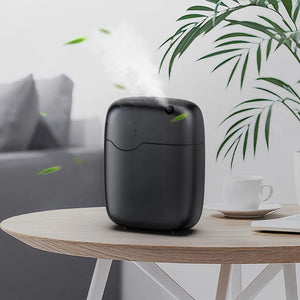
| A quick reset between meals | Boond · ₹799 + Hotel Collection ₹299 | Short bursts of mist on a far counter after cooking and cleaning |
| Open kitchen into the living room | Sukoon · ₹1,799 + Hotel Collection | Larger tank to hold a light note over a bigger, joined space |
| Open-plan floor / humid coastal home | SOSA Vaayu · ₹11,999 | Waterless, adds no damp, app-scheduled to run between cooking sessions |
Ultrasonic systems (Boond, Sukoon) run the water-based Hotel Collection and add mild humidity; Vaayu nebulises waterless oil and adds none. Keep every diffuser away from heat and open flame.

One placement note, because it decides everything. Keep the scent on a far counter, as distant from the hob as your kitchen allows. This is not only about clashing with cooking — it is practical safety. A reed is the safest choice near a kitchen because it holds no power, produces no heat and cannot be affected by a hot surface. If you use an electric diffuser, keep it well clear of heat, open flame and water. And do the honest thing: switch scent to the background while you cook, and let it do its quiet work in the hours after.