
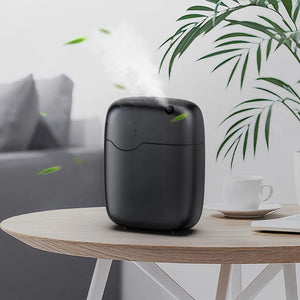



Five things to have in place: clinical zones already fragrance-free, so most of the building is covered · a dose set low and key-locked so it cannot drift · a named fragrance-free place to wait, away from the machine and the door it serves · one written sentence at reception · and the willingness to switch the unit off for a named patient.
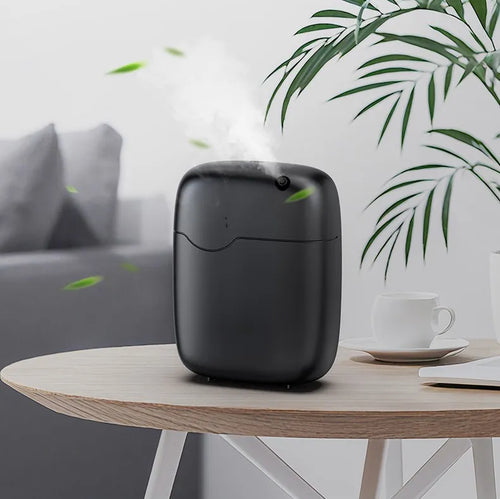
The machine: the Vaayu at ₹11,999 stops from the app in ten seconds without anybody crossing the hall. Be honest that switching off does not clear a room instantly, so move the patient as well.
2. Most of the work is already done by the zoning, if you have done the zoning. Consultation and examination rooms, treatment and procedure rooms, sample collection, the laboratory, dispensing, imaging and paediatric clinical areas are fragrance-free by default, which means the part of the visit where the patient is least able to move away from a smell is already clear.
3. Run it lower than you want to, and lock it there. The level should be set for the person most likely to object rather than the person most likely to enjoy it. Set it once in week one by walking in cold, key-lock it, and accept that within a fortnight your own staff will have stopped noticing it and will be the worst possible judges of whether it should go up.
4. Have a fragrance-free place to wait, and know where it is. Not a vague gesture at the far end of the hall — a named row of seats, a side bay or a quiet corner that the machine does not reach, which somebody has actually stood in and checked. Being able to point at it is the difference between handling this well and improvising.
5. Write one sentence for the desk, and switch the machine off when it is asked for. The sentence tells a patient what is running, that it makes no medical claim of any kind, and that it can be turned off. The Vaayu stops from a phone in the back office in ten seconds. Be honest that the room does not clear instantly, so move the patient as well as switching it off.
6. And never describe a fragrance as hypoallergenic, low-allergen or safe for sensitive patients. No such product exists, a lighter composition run low simply puts less material into the air, and a clinic repeating that sentence to a patient would be repeating something untrue.
A portion of every order supports girl-child education through Nanhi Kali.
Who you will actually meet, and what is honestly true
A waiting hall in a multi-speciality clinic sees a different population from a hotel lobby, and the difference is the whole of this page. People come to you because something is wrong — they are nauseated, they are in the early hours of a migraine, they are pregnant, they have asthma, they are between chemotherapy cycles, they have a head cold and a headache, or they have simply learned over years that strongly scented places do not suit them. Every one of those groups is over-represented in your building rather than under-represented. So the question is not whether you will meet somebody who reacts to fragrance. It is whether you will have decided what to do before you do.
The five things, and what each one costs
The complete practical answer in five rows, with what each one is, who owns it, what it costs and how long it takes to put in place. The first row is the one that does most of the work and it is the one you should already have. The last row is what not to do, printed rather than implied.
| Do this | What it actually is | Who owns it | How long | Cost |
|---|---|---|---|---|
| 1. Keep every clinical zone fragrance-free ★ | The twelve exclusions, enforced with door discipline — so the part of the visit where a patient cannot move away is already clear | Facilities and housekeeping | One floor walk | ₹0 |
| 2. Set a low dose and lock it | The level chosen for the person most likely to object, set by walking in cold in week one, then key-locked so habituation cannot raise it | Facilities, once | An hour | A setting |
| 3. Name a fragrance-free place to wait | A specific bay, row or corner somebody has stood in with the machine running. Written into the SOP by name, not gestured at | Front office and facilities | Twenty minutes | ₹0 |
| 4. Write one sentence for the desk | What is running, that it makes no medical claim, that it can be switched off, and where the fragrance-free seating is. The wording in full | Front office | Ten minutes | ₹0 |
| 5. Be able to switch it off in seconds | App control from the back office so nobody crosses a full hall, plus the honest step of moving the patient, because a room does not clear instantly | Whoever holds the app | Immediate | Included |
| Then log it for three months | One line in the day book each time it comes up, so the frequency drives the decision rather than anybody's instinct | Front office | Ongoing | ₹0 |
| Not this: calling it hypoallergenic | There is no hypoallergenic fragrance and no composition that is safe for everybody. Saying so to a patient means repeating something untrue | Nobody | — | — |
The dose, the off switch and the sentence at the desk
Start with the dose, because it decides how often any of the rest is needed. The level in a clinic waiting hall should be set for the person most likely to object to it, and that is a genuinely different number from the level that makes the hall smell pleasant to somebody who walks in once. Set it in the first week by arriving cold each morning before the building fills, come down a step at a time until you reach the point where you register that the air is clean rather than that the room is scented, and then stop there. The one-line test I use everywhere in this cluster applies with particular force on this page: a patient should not be able to tell you what the fragrance is, only that the place did not smell of anything unpleasant. If somebody at your desk can name it, it is too high. Then key-lock it, because the person most likely to raise the setting in month three is a member of your own staff who has stopped being able to smell the building — habituation is guaranteed rather than possible, and it acts only on the people who are there all day, never on the patient arriving for the first time. Choose the composition by exclusion too. Nothing heavily floral, nothing sweet, nothing gourmand, nothing anybody could name as a perfume. The Westin-inspired White Tea Serenity — white tea, aloe and cedar — is the lightest of the seven and the default in a medical facility; the 1 Hotels-inspired Forest Suite is the dry one where a café corner reaches the same seating. And run the hours honestly: on about thirty minutes before the first appointment so the level has arrived before the patients do, off with the last one, and never raised at midday because the hall filled, since a busy waiting hall is an air-change problem and raising fragrance makes it worse for exactly the people this page is about.
Then the off switch, and the honesty that has to come with it. The Vaayu stops from the Bluetooth app in the back office in about ten seconds, which matters more than it sounds: it means nobody walks the length of a full waiting hall to crouch at a machine while a patient watches, which is an embarrassing thirty seconds for somebody who has just had to explain a health issue at a counter. What I will not pretend is that switching it off empties the room. A nebulised fragrance does not vanish when the unit stops; the level falls gradually as the air in the space turns over, and how fast depends entirely on your ventilation rather than on the machine. So the correct protocol is both halves at once: switch it off, and move the patient to the fragrance-free seating you named earlier, quietly, without an announcement and without making them the centre of the room. Then decide in advance who is allowed to do this, because a request that has to be escalated to a manager who is in a meeting is a request that fails. My answer is that whoever is on the front desk should be able to have it switched off within a minute, without asking permission and without a conversation about whether it was necessary. The cost of switching it off unnecessarily is nothing at all. The cost of not switching it off is a patient who feels unwell in a building they came to for help, and who tells people. On the staff side, ask your own team privately rather than in a group, particularly whoever sits nearest the unit, and take a quiet yes as a yes and a quiet no as a no.
Then the written sentence, the log and the limits, which are the parts that make this durable. Put one paragraph in the SOP: what is running and where, the sentence the desk says, the name of the fragrance-free waiting place, who can switch it off, and a clear instruction not to debate a patient's account of themselves. The sentence itself should say three things and nothing more — that a light fragrance runs in the entrance and waiting area as part of housekeeping, that it makes no medical or health claim of any kind, and that it can be switched off. Nothing about the fragrance being gentle, natural, hypoallergenic or suitable for sensitive patients, because those words are either untrue or unverifiable and a clinic should not be the one saying them. Using fragrance in a clinic without making medical claims is the same discipline applied to the whole building, and describing it internally and to patients is the language version. Then log each request for three months and let the number decide what happens next: if a particular department's waiting area produces this conversation weekly, stop scenting that area rather than continuing to manage it, and treat that as a good outcome rather than a defeat. On the products and their limits, for completeness: an alcohol-free reed diffuser from ₹749 is still a fragrance product and is not an answer for a sensitive patient — alcohol-free refers to what is not in the formulation, not to what evaporates out of it. The ultrasonic Sukoon at ₹1,899 and Boond at ₹899 hold standing water and belong in one administrative cabin with a named owner. Candles are not appropriate in a healthcare facility because an open flame is a fire-safety matter. SOSA does not make a room spray, and a spray would be the worst possible product here in any case, because it is a sudden high dose delivered by whoever happens to be holding it. And if a smell in your building has a source — a bin, a dry trap, a linen route, an air-conditioning drain pan — fix it rather than covering it, because a patient who is sensitive to fragrance is usually the first person to notice both the smell and the thing you put over it.
The SOSA edit
What a multi-speciality clinic should actually put in place, in the order it matters. Four of the six rows cost nothing, one is a setting, and only the last is a purchase. The row about what not to say is printed rather than implied, because it is the mistake I see most often.
| Do this | What it is | When it earns its place | Cost |
|---|---|---|---|
| 1. Enforce the fragrance-free clinical zones ★ | The twelve exclusions, with door discipline behind them, so the least escapable part of a visit is already clear | First, and it does more for sensitive patients than everything else combined | ₹0 |
| 2. Name a fragrance-free place to wait | A specific bay, row or corner that somebody has stood in with the machine running, written into the SOP by name | Second. Pointing beats improvising, every time | ₹0 |
| 3. Write the sentence for the front desk | What is running, that it makes no medical claim of any kind, that it can be switched off, and where the fragrance-free seating is | Third. Ten minutes of work that prevents most of the awkwardness | ₹0 |
| 4. Ask your own staff, privately | The receptionist sitting four feet from the unit for nine hours is more exposed than any patient. Ask her alone rather than in a meeting | Fourth, and again when anybody new joins that desk | ₹0 |
| 5. Vaayu set low, key-locked, app-stoppable | Waterless, up to 1000 m³, adjustable intensity, app plus 1h/4h/8h/24h timers, under 38 dB, auto-stop, key-lock so the level cannot drift | Last. Set it for the person most likely to object, then lock it and leave it | ₹11,999 |
| Not this: any claim of being hypoallergenic | There is no hypoallergenic fragrance and none of ours is described that way. IFRA-standard and phthalate-free are manufacturing standards, not promises to an individual | Never. A clinic repeating that to a patient is repeating something untrue | — |

Versailles
A clinic owner in Chandigarh told me about two of her regular patients who react to strong smells, and she asked me which of the seven scents would be safe for them. The honest answer was none of them, and I said so — there is no hypoallergenic fragrance, and any supplier telling her otherwise would be inventing a category to close a sale. What we did instead took an afternoon and cost nothing: the machine came down a setting and went behind its key-lock, the two seats by the window at the far end of the hall became the named fragrance-free place to wait, and her front office got two sentences on a card. Both patients still come. Neither has had to explain themselves twice.
I would rather write that page than the one where I tell you our formulation is gentle. Fragrance is housekeeping and presentation, it makes no medical claim of any kind, and a product that some people react to is exactly the sort of thing a clinic is entitled to hear about plainly from the person selling it. If the log tells you after three months that a particular waiting area produces this conversation every week, stop scenting that area. That is not a failure of the product or of your judgement. It is the building telling you where the line is, and this whole group of pages exists to say that finding the line is the point.
Everything is made and supported from Pune, and a part of every order funds girl-child education through Nanhi Kali. You get a space that smells like somewhere looked after; a girl gets a classroom. That equation has always felt right to me.
Frequently asked questions
- Asthma, allergies and fragrance sensitivity: how should a medical centre decide where to scent? — the zoning decision behind this one.
- What should a clinic say to a patient who asks about the fragrance in reception? — the wording for the desk.
- Patients who react badly to strong smells, and a lobby you still want to be pleasant — both, by zoning.
- Which areas of a medical centre should always be left fragrance-free? — the list that does most of this work.
- Brand: the SOSA founder story.
Facts verified August 2026: Product facts used in this guide. SOSA Vaayu ₹11,999: waterless cold-air nebulising diffuser, atomises undiluted fragrance oil to a dry residue-free nano-mist with no water reservoir, coverage up to 1000m³ (approximately 2,000–3,000 sq ft), 400ml refillable tank lasting up to about 75 days per fill, Bluetooth app plus onboard control, 1h/4h/8h/24h timer scheduling, adjustable intensity, under 38 dB, DC 12V/1A at 5W, 165 × 80.5 × 215 mm and 0.9 kg, freestanding or wall or HVAC mounted, auto-stop and key-lock, CE, RoHS and SGS certified, supplied with four hotel-inspired fragrances. SOSA Aangan ₹25,999: HVAC-connected or standalone commercial nebulising diffuser, coverage up to 3,000m³ (roughly 8,000–10,000 sq ft), 800ml reservoir, metal body, programmable schedules, under 42 dB. Ultrasonic machines are water-based, hold standing water and consume 30–50 ml of water an hour: Sukoon ₹1,899 (500ml, 270–320 sq ft, 16–18 hours on low, 3–6 drops per tank, steady/2H/4H timers, three 15ml Hotel Collection scents included), Boond ₹899 (300ml), Megh ₹3,499 (6 litres). Hotel Collection water-based fragrance 15ml ₹299, 100ml ₹999, 300ml ₹1,799, Pack of 7 at 15ml ₹1,799 against ₹2,093 bought singly; the Vaayu and Aangan take their own undiluted oil rather than these water-based bottles. Alcohol-free reed diffusers from ₹749, requiring 24–72 hours to reach their working level. Free shipping above ₹499. Coverage arithmetic: cubic metres equal floor area in square feet divided by 10.76 and multiplied by ceiling height in metres, counting only the volumes that are actually scented. This guide makes no medical, therapeutic or clinical claim of any kind for fragrance: a diffuser does not purify, disinfect or clean air, and does not treat, calm or affect any patient or condition. Fragrance is housekeeping and presentation. Clinical areas should be left fragrance-free, and a persistent odour should be traced to its source and corrected rather than covered. SOSA is not affiliated with or endorsed by any hotel brand. Prices subject to change — see the live product pages.