

The test: a room earns a bottle if somebody sleeps in it, or sits in it for an hour at a stretch, most days. A study nobody studies in and a second bedroom kept for parents who visit twice a year both fail it.
The ceiling: six bottles, full stop — living-dining, both bedrooms, both bathrooms, closed kitchen. Past that a flat stops smelling of a fragrance and starts smelling of fragrance.
2. Apply the occupancy test to each one. A room earns a bottle if somebody sleeps in it, or sits in it for an hour at a stretch, most days. The living-dining zone always passes — it has no door and it is where people gather. The master bedroom always passes. The bathroom always passes. The second bedroom, the second bathroom and the closed kitchen pass only if they exist and are used the way their name suggests.
3. Count the bathrooms honestly. A second bathroom is not a bonus room — it is a full extra candidate, on its own bottle, never sharing with the first. Skipping it to save ₹749 is the least sensible saving in a 2BHK, because a bathroom is the cheapest, smallest, most-visited room you own.
4. In most 2BHKs, exactly one candidate fails. Usually it is the second bedroom, kept for storage or as a study, or occupied so rarely it does not clear the bar. That is how six becomes four: living-dining, master, bathroom, and — if it passes — the second bedroom. ₹3,696 when it does, ₹2,847 when it does not.
5. The ceiling is six, and it is a real ceiling. Living-dining, both bedrooms, both bathrooms, closed kitchen — ₹5,694 — and no household should ever be buying a seventh. Past six, a flat stops smelling of a fragrance and starts smelling of fragrance.
Alcohol-free, IFRA-compliant, composed by an ISIPCA Versailles-trained perfumer and handmade in small batches in Pune — and every purchase funds a girl's education through Nanhi Kali.
Why six candidates, not four
A builder's floor plan for a 2BHK gives you between three and five doors that shut — a master bedroom, a second bedroom, one or two bathrooms, and sometimes a closed kitchen — plus one open living-dining zone that has no door at all. Add those together and the maximum any 2BHK offers you is six places worth naming: the open zone, and up to five shuttable doors. That is the full list, before a single fact about the people living there has entered the conversation. It is also, not coincidentally, the ceiling this whole cluster works to — six bottles, because six is the most a 2BHK's architecture can ever ask for.
A 1BHK does not need this exercise because there is nothing to subtract — one bedroom, one bathroom, done. A 2BHK is the first size of home where the list of shuttable doors and the list of rooms actually worth scenting stop being the same list. The gap between them is exactly the gap between a builder's floor plan and a household's real behaviour, and it is wide enough that two flats with identical layouts can land on entirely different bottle counts. The flat downstairs might run four bottles because a toddler sleeps in the second room. Yours might run three because that same room holds a desk and an ironing board. Same six candidates, different subtraction.
This is also why the honest number for a given household is never higher than what its actual occupancy supports, no matter how many doors the builder handed over. Buying for the floor plan rather than the household is the single most common overspend I see at this size of home — a bottle placed in a spare room because the room exists and looks unfinished without one, not because anyone's evening is spent in it. The floor plan gives you the candidates. Only the household gets to say which of them survive.
The three decisions in the count
 Garden Bloom 130ml₹1,299Walk the flat and write the list down before deciding anything: living-dining, master bedroom, second bedroom, bathroom, second bathroom if you have one, closed kitchen if you have one. Most builder layouts give three to five shuttable doors — a single bathroom and an open kitchen counter are the norm rather than the exception, which means the six-candidate maximum is rarer in practice than the floor plan brochure suggests. Counting first and judging second stops you skipping the bathroom, which people do more often than they skip a bedroom, simply because a bathroom feels like an afterthought on the walk-through.
The household matrix
The six-candidate list is the same for every 2BHK. What changes is which candidates survive the occupancy test, and that depends entirely on who lives there — not on carpet area, not on the builder's brochure. The table below runs the count for the household shapes that come up most often, with the totals checked by hand against the catalogue prices.
| Household | Candidates that pass | Bottles | Total |
|---|---|---|---|
| Two working adults, second room unoccupied ★ | Living-dining, master, bathroom | 3 | ₹2,847 |
| Couple with a child | Living-dining, master, child's room, bathroom | 4 | ₹3,696 |
| Shared flat, two flatmates ★ | Living-dining (joint pick), each flatmate's own bedroom, bathroom | 4 | ₹3,696 |
| Family of four or five, both bedrooms occupied, two bathrooms | Living-dining, master, second bedroom, both bathrooms | 5 | ₹4,445 |
| Same family, plus a closed kitchen | All five above, plus the closed kitchen | 6 | ₹5,694 |
| Second bedroom kept for occasional guests | Living-dining, master, bathroom — the guest room runs a bottle only during the stay | 3, occasionally 4 | ₹2,847+ |
| Note on the ceiling: six is the most any 2BHK should run, and it is an architectural ceiling as much as a household one — living-dining, both bedrooms, both bathrooms, closed kitchen exhausts every candidate the floor plan can offer. A household wanting a seventh bottle is almost always trying to scent a passage or a balcony, neither of which holds fragrance long enough to be worth it. | |||
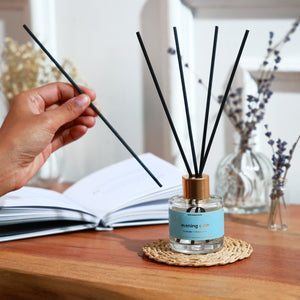
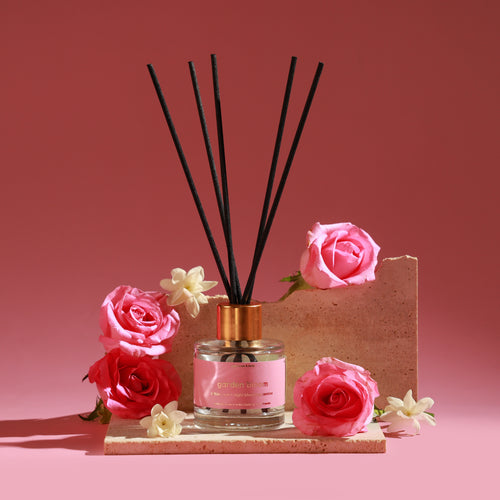
Garden Bloom · the living-dining130ml ₹1,299Shop → 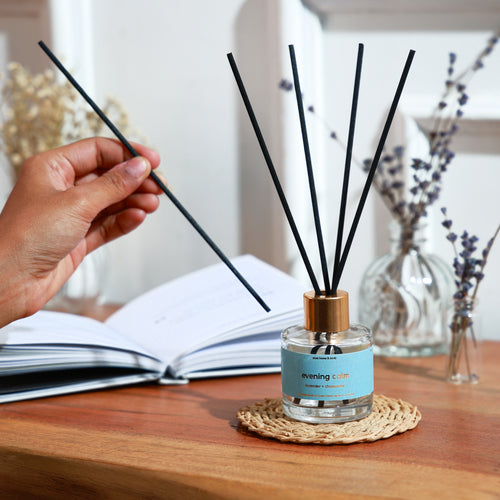 Evening Calm · the master50ml ₹799Shop →
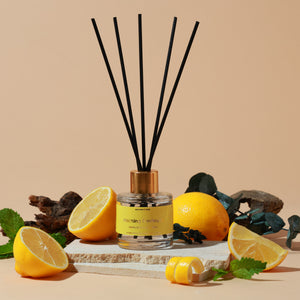
 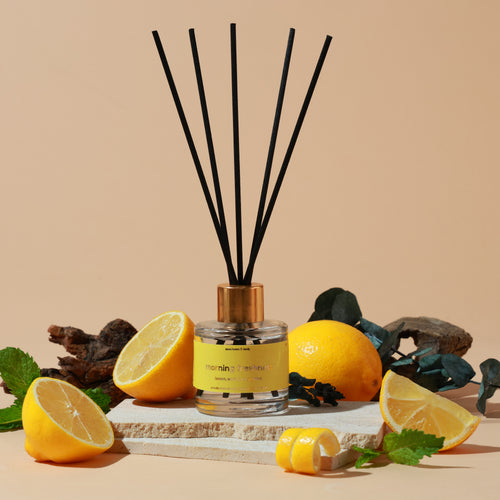 Morning Freshness · the bathroom50ml ₹749Shop →
Reeds, flipping and placement across a bigger flat
Reed counts follow the room, not the household size. Six in the living-dining zone, where the air turns over constantly and the most people pass through. Three in every bedroom that passed the occupancy test — the master and, where it applies, the second bedroom or the flatmate's room — because a sealed room with a sleeper in it does not want the full six reeds regardless of how many candidates the flat has. Two to three in every bathroom that passed, and if there are two, both get their own reed count rather than one bathroom running heavier to compensate for the other. Give each bottle seventy-two hours before judging it; the first evening under-represents a bottle that is still saturating its reeds.
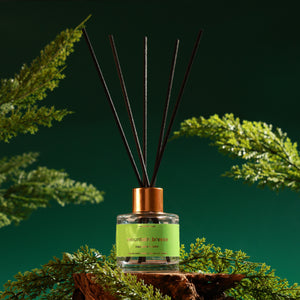
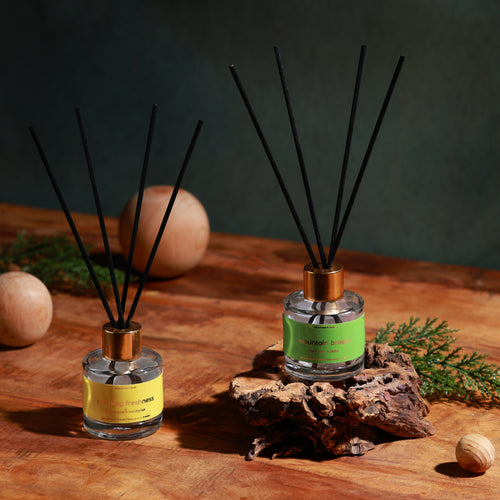
In a shared flat, the joint zone is the one place the counting method gets a social dimension. Each flatmate's bedroom is their own call entirely — nobody else's occupancy test applies to a room they don't live in. The living-dining zone is different, because everyone passes through it: choose together, or default to whichever scent is least assertive, which in the catalogue is Mountain Breeze or Morning Freshness rather than the more decisive floral of Garden Bloom. Flip every bottle saturated-end up every three to five days; in a household with more than one flatmate or more than one child, put the flip on a fixed day of the week so it does not become the one bottle everyone assumes somebody else is handling.
Placement scales the same way it did in a 1BHK, doubled or trebled with the room count. A metre off the floor, clear air around the bottle, out of a ceiling fan's or split AC's direct draught, off the windowsill, away from the hob if the kitchen is open. In a second bedroom used seasonally by parents, it is entirely reasonable to let the bottle run dry between visits rather than paying to scent an empty room eleven months of the year — start fresh reeds when they arrive. And in any home with a child or a pet with the run of the flat, every open bottle belongs above their reach, full stop.
What a 2BHK reed count actually costs
The arithmetic in full, checked by hand against every price in the catalogue. A reed diffuser carries no electricity cost and no consumable beyond the oil, so the running cost is purely the refill, and because the glass is designed to be refilled rather than replaced, year two is a fraction of year one regardless of how many bottles you run.
| Setup | What you get | Covers | Total |
|---|---|---|---|
| Three candidates pass | Garden Bloom 130ml ₹1,299 + Evening Calm 50ml ₹799 + Morning Freshness 50ml ₹749 | Living-dining + master + bathroom | ₹2,847 |
| Four candidates pass ★ | The three above + Mountain Breeze 50ml ₹849, second bedroom occupied | The standard 2BHK | ₹3,696 |
| Five candidates pass | The four above + a second Morning Freshness 50ml ₹749 | Two bathrooms in use | ₹4,445 |
| Six candidates pass — the ceiling | The five above + Morning Freshness 130ml ₹1,249, closed kitchen | Every candidate the flat has | ₹5,694 |
| Running cost | A 300ml refill ₹2,399, or 500ml ₹3,499 (₹7/ml) | 500ml is ten 50ml fills — roughly ₹350 a fill | from ₹2,399 |
Versailles
"How many do I need for a 2BHK" is a question I have learned to answer with a question of my own: how many rooms do you actually use. Nearly everyone who asks has already counted the doors — three, four, five, however many the builder gave them. Almost nobody has counted the doors they actually walk through and stop behind for an hour or more. That second number is always smaller, and it is the only one that should decide what you buy.
The households that overspend in a 2BHK are rarely reckless. They are thorough — they see six candidate rooms and feel that leaving one bare is somehow incomplete. It is not incomplete. A second bedroom kept for storage is doing its job perfectly well without a bottle in it, and the ₹849 saved is better spent on the bathroom you use twice a day than on a room you open twice a month.
Six is the most a 2BHK should ever run, and most households never reach it, nor should they try to. Count the doors, test the occupancy, count the bathrooms honestly, and stop when the list runs out. Every purchase funds a girl's education through Nanhi Kali — not a percentage, not a quarterly cheque. Every one.
Frequently asked questions
- Best reed diffuser setup for a 2BHK — the fixed three and the variable fourth, in full.
- Is one reed diffuser enough for an entire 2BHK? — why a single bottle never reaches the second door.
- How many reed diffusers do you need for a 1BHK? — the same rule where it barely has to work.
- The complete SOSA 1BHK buying guide — the counting method at its simplest.
- Brand: the SOSA founder story.
SOSA reed diffusers & prices (verified August 2026): Morning Freshness (Malabar lemon · peppermint · eucalyptus) 50ml ₹749 · 130ml ₹1,249 · Evening Calm (lavender · chamomile) 50ml ₹799 · 130ml ₹1,299 · Garden Bloom (British rose · night-blooming jasmine) 50ml ₹799 · 130ml ₹1,299 · Fresh Brew (Coorg coffee · Kerala vanilla) 50ml ₹849 · 130ml ₹1,349 · Mountain Breeze (Himalayan pine · sage · cedar) 50ml ₹849 · 130ml ₹1,349. Duo sets: Day & Night 2 × 50ml ₹1,498 · 2 × 130ml ₹2,498; Fresh & Grounded 2 × 50ml ₹1,548 · 2 × 130ml ₹2,548; Warmth & Bloom 2 × 50ml ₹1,598 · 2 × 130ml ₹2,598. Refills 300ml ₹2,399 · 500ml ₹3,499. Six fibre reeds included with every bottle; refillable glass. 50ml suits rooms up to 150 sq ft and lasts 6–8 weeks; 130ml suits rooms above 150 sq ft and lasts 14–18 weeks. Fractionated coconut oil (CCT) carrier, alcohol-free, phthalate-free, paraben-free, IFRA-compliant, low VOC; tested through 45°C heat and 85% monsoon humidity. Composed and handmade in small batches in Pune. Ultrasonic machines quoted for comparison: Boond ₹899 · Sukoon ₹1,899 · Megh ₹3,499, which run the separate water-based Hotel Collection fragrances (15ml ₹299 · 100ml ₹999 · 300ml ₹1,799) — the two lines are not interchangeable. Every purchase funds a girl's education through Nanhi Kali. Prices and availability subject to change — see the live product pages.