Founder Diaries · Clinics & Medical Centres · Noise, Siting and the Consultation Room
By Sonal Sahani · ISIPCA Versailles 12 min read Updated November 2026
The
Vaayu runs under 38 dB and the
Aangan under 42 dB, and in a working clinic that puts both of them below the background of the room you are worried about.
A consultation cabin has its own split or cassette unit running, and manufacturers typically quote those somewhere between the low thirties and the mid forties of decibels on low to medium at a metre. It very often has a ceiling fan as well. The door is closed. There is a corridor and ten to thirty metres of building between the cabin and wherever the diffuser is standing. A machine quieter than the air conditioning in the room you are standing in is not going to be heard through a closed door from the other end of a floor. What does make a quiet machine audible is not its rating but where you put it — bolted to a lightweight partition that a consulting room shares, or stood on a hollow reception counter that works as a soundboard. And the honest last point is that a clinic's real noise problem is almost never the diffuser. It is the queue display, the token announcer, the trolley wheels and the corridor.
Quick answers — read this first
The numbers: Vaayu under 38 dB,
Aangan under 42 dB. For comparison, manufacturers commonly quote a wall-mounted or cassette split indoor unit at roughly 30 to 45 dB on low to medium at a metre, a ceiling fan on medium lands in the same region, ordinary conversation at a metre is around 60 dB, and a token announcer or queue display in a waiting hall is louder again.
The free test, and it takes four minutes: stand inside the consultation room with the door closed, with the room's own air conditioning running as it normally does. Have somebody switch the machine on and off in the lobby at random intervals without telling you when. If you cannot identify the moments it started, it is not audible from that room, and no decibel figure is going to tell you more than that.
Three places not to site it: screwed to a lightweight partition — gypsum on studs, plywood, or glazing — that a consulting room shares, because the panel will radiate what the bracket feeds into it; on a hollow reception counter or a thin unsupported shelf, which turns an airborne pulse into structure-borne sound; and immediately beside a registration or billing desk where patients give names, ages and complaints aloud, because anything intermittent there gets noticed and then switched off by the person sitting at it.
Site it instead: on a masonry wall bracket at about two metres with the fixings into solid wall, or on a solid shelf with rubber feet, in the public volume, away from any shared lightweight partition. A diffuser is not an air purifier and makes no clinical claim of any kind.
The short answer
Short answer: the Vaayu runs under 38 dB and the Aangan under 42 dB, which places both below the background a consultation room already carries from its own split or cassette unit and its ceiling fan, and that is before a closed door and ten to thirty metres of building are counted. It will not normally be heard from a consultation room. What makes a quiet machine audible is siting rather than rating - fixed to a lightweight partition a consulting room shares, or stood on a hollow counter that acts as a soundboard - so mount it on masonry at about two metres, or on a solid shelf with rubber feet.
The free test: stand in the consultation room with the door shut and the room's own air conditioning running normally, and have somebody switch the machine on and off in the lobby at random without telling you when. If you cannot identify the starts, it is not audible from there. A phone sound-level app is not a calibrated instrument, but it will still show you whether the machine moves the reading at all against the room's existing background, which is the question that matters.
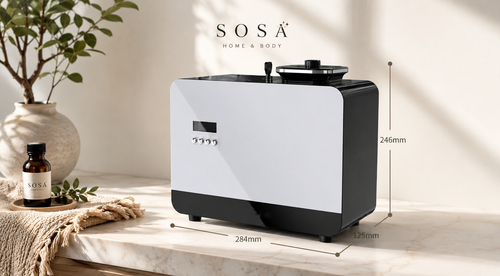
The machines, costed: Vaayu Rs 11,999 - waterless cold-air nebulisation, no standing water tank, up to 1000 m3, 400ml lasting about 75 days, app plus 1h/4h/8h/24h timers, under 38 dB, auto-stop and key-lock, 0.9 kg at 165 x 80.5 x 215 mm, freestanding or wall or HVAC mounted. Aangan Rs 25,999 - HVAC-connected or standalone, up to 3,000 m3, 800ml, metal body, programmable, under 42 dB. Free shipping above Rs 499.
Straight answer
How loud is a scent diffuser, and will it be heard from a consultation room?
1. The figures first. The Vaayu runs under 38 dB. The Aangan, which is a larger commercial machine in a metal body, runs under 42 dB. Those are the published running figures and they are the numbers to put in a specification. What they mean in a building needs the comparison, because a decibel figure on its own tells a facility manager almost nothing.
2. Now the room you are actually asking about. A consultation cabin is not a quiet room. It has its own air conditioning — a hi-wall split or a ceiling cassette — and manufacturers commonly quote indoor units somewhere between the low thirties and the mid forties of decibels on low to medium settings at a metre. In a great many Indian clinics there is a ceiling fan as well, and a fan on medium lands in the same region. There is a computer, a printer that wakes up, a door that opens and closes, and a conversation taking place at perhaps 60 dB at a metre, which is the whole point of the room.
A machine rated under 38 dB is quieter than the air conditioning in the room it would have to be heard across.3. Then add the building. The diffuser is not in the consultation room — it is in the public volume, which is where every page on this site says fragrance belongs and clinical rooms stay fragrance-free. So between the machine and the person asking the question there is a closed door, a corridor and somewhere between ten and thirty metres of floor. A closed solid-core door with reasonable edge seals is worth a substantial reduction on its own, distance takes care of more, and the corridor's own background takes care of the rest. In practice the answer to the question in the title is no, it will not be heard from a consultation room, and the reason is three separate margins stacked rather than one clever specification.
4. The one thing that genuinely matters is the character of the sound rather than its level. A nebulising diffuser does not hum continuously like a fan; it makes a short pulse each time it cycles, with quiet between pulses. An intermittent sound is noticed more readily than a steady one at the same level, which is why a machine can measure well and still annoy somebody if it is sited badly — and conversely why a steady air-conditioning background absorbs it so completely.
Everything useful about diffuser noise in a clinic is therefore a siting question, not a rating question.5. So: three places not to put it. First, do not screw it to a lightweight partition that a consulting room shares — gypsum on studs, plywood, or glazing. A bracket on a stud wall feeds the pulse into a panel, the panel radiates it into the room on the other side, and if the partition stops at the false ceiling rather than going to the slab, the ceiling void carries it over the top as well. Fix to masonry. Second, do not stand it on a hollow reception counter or a thin unsupported shelf, which acts as a soundboard and turns a small airborne pulse into structure-borne sound you can feel through the desk. A solid shelf, with rubber feet or a felt pad, and 0.9 kg is doing nothing to a solid surface. Third, do not put it immediately beside a registration or billing desk where patients are saying their names, ages and complaints aloud — not because it will interfere with anything, but because anything intermittent within a metre of a person who is concentrating gets noticed, and the person who notices it is the one with the power to unplug it.
6. And the point I would make last and mean most. A clinic's real noise problem is not the diffuser. It is the token announcer and the queue display, the television nobody chose, the trolley and wheelchair wheels on a hard floor, the corridor that carries every footfall, the lift chime, and three phones ringing at reception. Those run at levels the diffuser is not remotely in competition with, all day. If noise in your waiting hall is a genuine concern — and in many Indian clinics it should be — the useful work is in the queue system, the flooring, the seating and the ceiling, and
the shared waiting-area page goes into what else that hall needs. A diffuser under 38 dB is not on that list, in either direction: it will not fix the noise and it will not add to it.
A portion of every order supports girl-child education through Nanhi Kali.
TL;DR: Vaayu under 38 dB, Aangan under 42 dB — quieter than the split unit and ceiling fan already running in the consultation room, with a closed door and twenty metres of building in between. It will not be heard. What makes a quiet machine audible is siting: never on a lightweight shared partition, never on a hollow counter, never beside a desk where patients speak. And the real noise in a clinic is the queue display and the corridor.
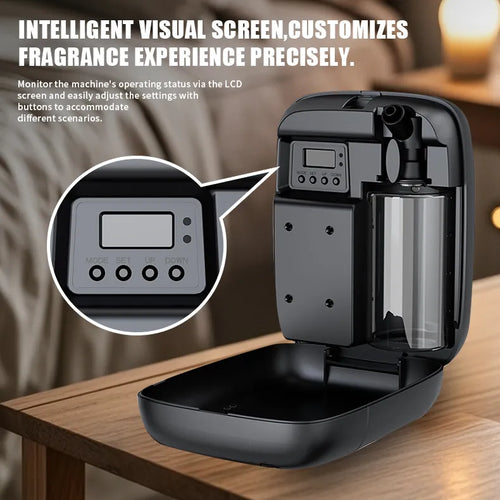
0.9 kg, two screws, and the wall it goes on matters
SOSA Vaayu ₹11,999
At 0.9 kg and 165 × 80.5 × 215 mm the
Vaayu is a two-screw bracket job at about two metres, and the only specification that matters acoustically is what the screws go into.
Masonry takes the fixing and does nothing with it. A gypsum-on-studs or plywood partition takes the fixing and radiates it into whatever is on the other side — which in a clinic is frequently a consulting room, and if the partition stops at the false ceiling the void carries it over the top as well. Fix to solid wall, or stand it on a solid shelf with rubber feet. Under 38 dB, auto-stop, key-lock, app plus 1h/4h/8h/24h timers.
The four-minute test, and the three places not to put it
There is a free test for this and it is better than any number I can give you. Stand inside the consultation room with the door closed and the room's own air conditioning running exactly as it normally does — not switched off for the test, which is the mistake everybody makes. Have a colleague switch the machine on and off in the lobby at random intervals and not tell you when. If you cannot identify the moments it started, it is not audible from that room, and that is the end of the enquiry. Do the same thing at the registration desk, which is the position closest to a machine standing in the reception zone, and at the nearest point of the corridor. A phone sound-level app is not a calibrated instrument and I would not put its readings in a specification, but it is perfectly good for the only comparison that matters here, which is whether the machine moves the reading at all against the room's existing background — stand in the waiting hall, note the reading with the machine off, note it with the machine on, and in most clinics the two numbers will be the same because the hall's own background is doing all the work. While you have the app open, read the waiting hall during a peak: the number you get will be the token announcer and the corridor, not anything you are thinking of buying.
1
THE COMPARISON
Under 38 dB against the room's own split unit and ceiling fan
A decibel figure is only useful against a background, so here is the background.
Manufacturers commonly quote a hi-wall split or ceiling-cassette indoor unit somewhere between the low thirties and the mid forties of decibels on low to medium settings at a metre, which is the unit running in the consultation room itself. A ceiling fan on medium sits in much the same region, and most Indian consultation cabins have both. A conversation at a metre is around 60 dB and is the purpose of the room. A printer waking up, a chair moving, a door closing and a phone on a desk are all above anything a diffuser does. Against that, the
Vaayu at under 38 dB and the
Aangan at under 42 dB are not quiet machines in a quiet room; they are quiet machines in a room that is already busier than they are, and they are not even in that room. Three margins apply at once: the machine is below the room's own background; a closed solid-core door with reasonable edge seals removes a great deal more; and there are ten to thirty metres of corridor and public volume in between, because fragrance belongs in the public areas and clinical rooms stay fragrance-free with their doors shut. That is also, incidentally, why the Aangan's extra four decibels never come up in practice — a machine sized for an atrium or a concourse, or sitting in a plant room dosing an air-handling unit, is a long way from anybody's consulting room.
What the Vaayu actually does in a clinic's public areas has the operating detail.
2
WHERE NOT TO PUT IT
The lightweight partition, the hollow counter, and the desk where patients speak
This is where the real content of the question sits, because a machine's rating is fixed and its position is not. First: never bracket it to a lightweight partition that a clinical room shares. A gypsum-on-studs wall, a plywood screen or a glazed partition is a panel, a bracket couples the machine's cycle pulse directly into that panel, and the panel radiates it into the room on the far side — which can be more audible there than in the room the machine is standing in. It gets worse where the partition stops at the false ceiling instead of running to the structural slab, because then the ceiling void is a flanking path over the top of the wall and carries sound as well as air. If you do not know whether your partitions go to the slab, knock on one at head height and then knock just below the ceiling line; and while you are asking that question, note that a shared ceiling void is also the path by which a café corner reaches a waiting hall, which is a smell problem before it is a noise one. Fix to masonry, and if the only available wall is lightweight, stand the machine instead. Second: never on a hollow reception counter top or a thin unsupported shelf. Those act as soundboards and convert a small airborne pulse into structure-borne sound somebody can feel through the desk they are leaning on. A solid shelf with rubber feet or a felt pad under the machine; 0.9 kg does nothing to a solid surface. Third: not within a metre of a registration or billing position where patients are giving names, ages and complaints aloud. This is a human point rather than an acoustic one. A diffuser is not a masking device and I am not going to pretend it helps with speech privacy — it does not. But an intermittent sound a metre from somebody concentrating on a queue gets noticed, and the person who notices it is the person who can reach the plug. Put it at the far end of the counter-back, on a column beside the seating, or on the wall by the entrance.
3
THE REAL PROBLEM
The queue display, the corridor, and what is actually making your hall loud
If somebody in your facility has raised noise as a concern, I would take it seriously and then look somewhere other than the diffuser.
In the Indian clinics I have walked through, the loudest things in a waiting hall are, in roughly this order: the token announcer and the queue display, which are often set loud enough to be heard over the hall they are making loud; a television nobody chose and nobody is watching; trolley, wheelchair and equipment wheels on a hard floor; footfall and conversation in an inter-departmental corridor with tiled floors, painted plaster walls and a hard ceiling, which is a room designed to reflect everything; the lift chime; and reception's telephones. Those run at conversational levels and above, continuously, through the whole day. A machine under 38 dB is not in that league and is not going to be identified by anybody in that hall. The useful work, if noise matters to you, is in the queue system's volume and whether it needs to announce at all, a softer floor finish or an acoustic ceiling tile in the corridor, upholstered-but-wipeable seating rather than hard plastic — wipeable seating being on
the free-and-cheap list for other reasons anyway — and the simple discipline of turning the television off. None of that is fragrance work and I do not sell any of it. What I will say about the diffuser, in both directions, is that it will not make your hall quieter and it will not make it louder, and that a machine on a timer running one steady low setting all day is the version of it that nobody notices at all.
The procurement checklist has the noise figure in the place a purchase committee expects to find it.
The specification line I would write: running noise under 38 dB, wall-mounted to masonry at 1.8 to 2.2 metres or stood on a solid shelf with rubber feet, not fixed to any lightweight partition shared with a clinical room, and not within a metre of a registration position. That is the whole acoustic brief for a clinic.
What a clinic actually sounds like
The diffuser against the things already running in the building. The two SOSA figures are published machine specifications; the others are the ranges manufacturers and facilities teams commonly work to, given for comparison rather than as measurements of your building.
Print this
The diffuser is not in the top ten sounds in your waiting hall
| Sound source |
Typical running level |
Where it is |
What it means |
| SOSA Vaayu ★ |
Under 38 dB, and intermittent rather than a continuous hum |
The public volume — reception, waiting hall, corridor. Never a clinical room |
Below the background of the room you are asking about, with a closed door in between |
| SOSA Aangan
|
Under 42 dB, metal body |
An atrium, a concourse, or a plant room dosing an AHU |
Sized for buildings where it is nowhere near a consulting room |
| The consultation room's own split or cassette unit |
Commonly quoted from the low thirties to the mid forties at a metre, on low to medium |
In the room, two metres from the patient |
The diffuser is quieter than this, and it is not in the room |
| A ceiling fan on medium |
Commonly in the same region as the air conditioning |
Directly above the consultation desk |
Present in most Indian cabins, and continuous |
| Conversation at a metre |
Around 60 dB |
The consultation itself |
The purpose of the room, and far above everything above it |
| Token announcer, queue display and television |
Set loud enough to carry over a full hall |
The waiting area, all day |
This is your noise problem. What the hall actually needs
|
| Trolley wheels, footfall and a hard-floored corridor |
Conversational and above, in bursts |
Between every department |
Flooring, ceiling tile and seating work — not fragrance work |
| Never |
A machine bracketed to a gypsum or plywood partition a consulting room shares, stood on a hollow counter, or placed a foot from a registration position |
The three positions that make a quiet machine audible |
Masonry fixing, solid shelf, rubber feet, two metres |
Shop this guide
The quiet machine, the mount, and the larger one
The SOSA principle
Under 38 dB is quieter than the air conditioning already running in the room you are worried about. Noise in a clinic is a siting question, not a rating question. Masonry bracket, solid shelf, rubber feet, two metres, and never on a partition a consulting room shares.
The loudest thing in your waiting hall is the token announcer, and the second loudest is the corridor. A diffuser is not in the top ten and will not change either of them.
Mounting, structure-borne sound, and the real noise problem
The mounting is the whole of the acoustic specification, and it costs under ₹500. The Vaayu is 0.9 kg at 165 × 80.5 × 215 mm, so this is a two-screw bracket at about 1.8 to 2.2 metres, and the only thing that matters is what the screws go into. Masonry — brick, block or concrete — takes the fixing and does nothing further with it. A gypsum-on-studs partition, a plywood screen or a glazed partition takes the fixing and becomes a radiating panel, which is how a machine measured at under 38 dB becomes audible in the room on the other side of the wall rather than the room it is standing in. In a clinic that other room is very often a consulting cabin, which makes this the only genuine acoustic risk on the whole subject. If you do not know what your partitions are, knock on one at head height; and knock again just below the ceiling line, because a partition that stops at the false ceiling leaves the ceiling void as a flanking path over the top of the wall, carrying sound and, separately, carrying smells — which is why keeping fragrance out of clinical zones ends up talking about partitions taken up to the structural slab. Where there is no masonry available, stand the machine instead: a solid shelf, rubber feet or a felt pad, and nothing hollow underneath it. A hollow counter top is a soundboard, and a soundboard converts a small airborne pulse into something a receptionist can feel through the desk she is leaning on.
Then the positions to avoid for reasons that are about people rather than physics. Do not put a machine within a metre of a registration, billing or triage position where patients are giving their names, ages and complaints aloud. A diffuser is not a masking device and I will not suggest otherwise — it does nothing for speech privacy and nothing should be claimed on its behalf. The reason to keep it away is simpler: an intermittent sound a metre from somebody who is concentrating on a queue will be noticed within a day, and the person who notices it is the person who can reach the plug. Put it at the far end of the counter-back, on a column beside the seating, or on the wall beside the entrance where arriving patients pass. Do not put it in the draught of the entrance door, where the level is thrown out before it establishes, and do not put it directly under a supply grille. Then set it once and leave it: one low setting, the 1h/4h/8h/24h timers running the actual opening hours, the app on the facility team's phone rather than the front desk's, and the key-lock engaged, which is the only reason a machine can stand in a public waiting hall at all. A machine that nobody adjusts is a machine nobody notices, and a machine that gets turned up at midday because the hall filled up is a machine somebody will complain about by Thursday — busy is a ventilation problem, and turning fragrance up into a crowded hall makes the hall worse.
And then the paragraph that is the actual answer to the question underneath the question, which is usually whether adding a machine will make a noisy clinic worse. It will not, and if noise is a real concern in your facility then the honest advice is to spend the attention somewhere else entirely. Turn the television off. Take the token announcer's volume down and ask whether it needs to announce at all rather than simply display. Put an acoustic tile or two in the inter-departmental corridor, which is a tiled floor, plastered walls and a hard ceiling and therefore a room built to reflect every footfall. Specify wipeable upholstered seating rather than hard plastic at the next refit, which is roughly the same money and helps both the noise and the cleaning. Fit soft wheels on the trolleys. Move the printer off the counter. None of that is anything I sell, and all of it will do more for a waiting hall than any decision about a diffuser. On the fragrance side, the costs are simply the machine and the refills: the Vaayu at ₹11,999, waterless with no standing water tank, up to 1000 m³, 400ml for about seventy-five days so four refills a year, under 38 dB, auto-stop, key-lock, four hotel-inspired scents in the box; or the Aangan at ₹25,999, up to 3,000 m³, 800ml, metal body, programmable, under 42 dB, where the sum says you need it. What I would not install in a clinic is a water tank in public space — the ultrasonic Sukoon, Boond and Megh hold standing water, add 30 to 50 ml of water an hour to the air and need a named person emptying and drying them daily, which keeps them honest for a single administrative cabin only. Candles are not appropriate in a healthcare building because an open flame is a fire-safety matter, and SOSA does not make a room spray. Free shipping above ₹499.
A machine under 38 dB is quieter than the air conditioning in the room you are worried about, and it is not in that room. If it is ever audible from a consulting cabin, somebody has screwed it to the partition rather than to the wall.
— Sonal Sahani, SOSA
The SOSA edit
The acoustic brief for a clinic as five rows, in the order they get done, with the three positions nobody should accept at the bottom.
The SOSA edit
Test it, then mount it properly, then leave it alone
| Tier |
What is in it |
When it earns its place |
Cost |
| 1. The four-minute test ★ |
Stand in the consultation room with the door closed and its own air conditioning running. Somebody switches the machine on and off in the lobby at random. Can you identify the starts? |
Before anybody writes a specification. It answers the question better than any figure |
₹0 |
| 2. The partition check |
Knock at head height and again below the ceiling line. Establish which walls are masonry and which are gypsum, plywood or glazing, and which stop at the false ceiling |
Before choosing a position. A lightweight shared panel is the only real risk here |
₹0 |
| 3. The mount |
A two-screw bracket into masonry at 1.8 to 2.2 metres, or a solid shelf with rubber feet or a felt pad. 0.9 kg at 165 × 80.5 × 215 mm |
At installation. Not on a hollow counter, not on a shared stud wall |
Under ₹500 |
| 4. Vaayu — under 38 dB |
Waterless, no standing water tank, up to 1000 m³, 400ml ≈ 75 days, app and 1h/4h/8h/24h timers, auto-stop, key-lock, four scents |
Quieter than the room's own split unit, and in a different room behind a closed door |
₹11,999 |
| 5. The settings discipline |
One low setting, the timers on the real opening hours, the app with the facility team rather than the front desk, key-lock engaged |
From day one. A machine nobody adjusts is a machine nobody notices |
₹0 |
| Not on the list at any price |
Bracketed to a lightweight partition a consulting room shares, stood on a hollow counter top, or placed a foot from a registration desk — and never turned up at midday because the hall got busy |
Never. Clinical rooms stay fragrance-free whatever the siting |
— |
Honest notes for buyers: on this page specifically, the Vaayu runs under 38 dB and the Aangan under 42 dB, the comparison figures given for air conditioning, ceiling fans, speech and queue systems are the ranges commonly worked to rather than measurements of your building, and a diffuser is not a sound-masking device and does nothing for speech privacy. In general, fragrance in a medical facility is housekeeping and presentation, never treatment. Nothing here claims that a fragrance reduces anxiety, aids recovery, improves sleep, cleans or disinfects air, or has any clinical effect whatsoever, because it does not and a diffuser is not an air purifier. Scenting belongs to the entrance, reception, shared waiting areas, inter-departmental corridors and administrative rooms. Consultation and examination rooms, treatment and procedure rooms, day-care surgery, dressing rooms, blood- and sample-collection rooms, laboratories, pharmacy dispensing, sterile stores, imaging rooms, oncology day-care and paediatric clinical areas should be left fragrance-free. A persistent smell is information about a dry drain trap, a bin, a soiled-linen route or an air-conditioning drain pan: find it and fix it rather than covering it. On the machines: the
Vaayu at ₹11,999 is waterless cold-air nebulisation with no standing water tank, covering up to 1000m³ or roughly 2,000–3,000 sq ft, with a 400ml tank lasting about 75 days, app control, 1h/4h/8h/24h timers, under-38dB running, auto-stop and a key-lock for public areas. The
Aangan at ₹25,999 covers up to 3,000m³ and connects to HVAC for a whole floor or an atrium. The ultrasonic
Sukoon,
Boond and
Megh are water-based, hold standing water and add 30–50 ml of water an hour to the air, which suits a single administrative cabin with a named person emptying and drying the tank daily and is unsuitable for public clinical property. An alcohol-free
reed diffuser needs 24–72 hours to establish and suits a small lobby rather than a large waiting hall. Candles are not appropriate in a healthcare facility because an open flame is a fire-safety matter. SOSA does not make a room spray. The Hotel Collection scents are SOSA's own interpretations inspired by the world's finest hotels; SOSA is an independent Indian fragrance house, not affiliated with or endorsed by any hotel brand. A portion of every order supports girl-child education through Nanhi Kali.
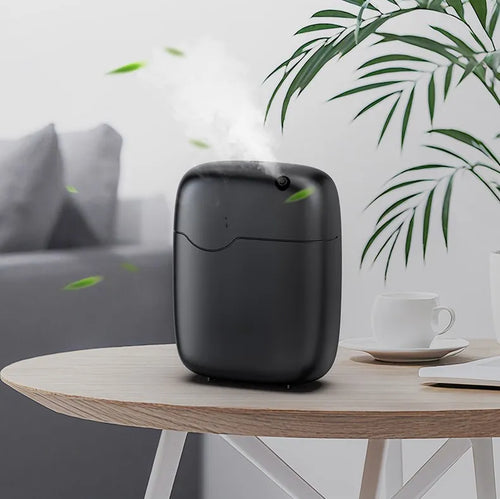
Under 38 dB, and on the right wall
SOSA Vaayu ₹11,999
Waterless cold-air nebulisation with no standing water tank, up to 1000 m³, a 400ml fill lasting about seventy-five days, Bluetooth app plus 1h/4h/8h/24h timers, under 38 dB, auto-stop and a key-lock, 0.9 kg at 165 × 80.5 × 215 mm, freestanding or wall or HVAC mounted. Under 38 dB is quieter than the split unit and the ceiling fan already running in the consultation cabin you are asking about, and the machine is not in that cabin — it is in the public volume behind a closed door and twenty metres of corridor. Fix the bracket to masonry at about two metres, or stand it on a solid shelf with rubber feet. One low setting, the opening hours, public areas only.
A note from Sonal
A facilities manager in Hyderabad put this question to me more precisely than anybody else has, and his version is the one I now use. He did not ask how loud the machine was. He said that a consultation cabin two metres from his reception wall hears the air conditioning and not the diffuser, and he wanted to know whether that would still be true in the monsoon when the air conditioning ran less. It was a good question and the honest answer involved admitting that the only variable that mattered was his wall. We went through it on a call: the partition was plasterboard on studs, it stopped at the false ceiling rather than going to the slab, and the tidy place to put the machine was exactly in the middle of it. We stood it on the counter-back on a solid shelf instead, with felt under it, and nobody has mentioned it since.
I keep that conversation in mind because it is the only acoustic problem I have ever actually had to solve, and it had nothing to do with the decibel figure. A machine that is quieter than the room it is in will still be heard if you screw it to a panel that a quiet room shares, and it will never be heard if you put it on masonry or a solid shelf. That is the entire subject, and it is worth four minutes of testing rather than an argument about numbers. The other thing I have learned to say early is that nobody asking me about diffuser noise has yet mentioned the queue announcer in their own waiting hall, which is almost always set loud enough to be heard over the hall it is making loud. I am not in a position to sell anybody a solution to that, which is probably why I feel comfortable raising it.
Everything is made and supported from Pune, and a part of every order funds girl-child education through Nanhi Kali. You get a space that smells like somewhere looked after; a girl gets a classroom. That equation has always felt right to me.
Frequently asked questions
How loud is a scent diffuser, and will it be heard from a consultation room?
The SOSA Vaayu runs under 38 dB and the Aangan under 42 dB. A consultation cabin already carries its own split or cassette unit — commonly quoted from the low thirties to the mid forties of decibels at a metre on low to medium — usually a ceiling fan as well, and a conversation at around 60 dB. The diffuser is quieter than the room's own air conditioning and it is not in the room: it sits in the public volume behind a closed door and ten to thirty metres of corridor. In normal siting it is not audible from a consultation room.
Where should a diffuser not be placed in a clinic?
Three places. Not bracketed to a lightweight partition — gypsum on studs, plywood or glazing — that a clinical room shares, because the panel radiates what the bracket feeds into it, and worse where the partition stops at the false ceiling and the void carries sound over the top. Not on a hollow reception counter or a thin unsupported shelf, which acts as a soundboard. And not within a metre of a registration or billing position, because an intermittent sound beside somebody concentrating gets noticed and then switched off.
How can I test it myself before buying?
Stand inside the consultation room with the door closed and the room's own air conditioning running as it normally does, and have a colleague switch the machine on and off in the lobby at random intervals without telling you when. If you cannot identify the starts, it is not audible from there. A phone sound-level app is not a calibrated instrument, but it will show you whether the machine moves the reading at all against the hall's existing background, which in most clinics it does not.
Why does the mounting surface matter more than the decibel rating?
Because a nebulising diffuser makes a short pulse each cycle rather than a continuous hum, and an intermittent sound is noticed more readily than a steady one at the same level. A bracket on masonry puts that pulse into a wall that does nothing with it. A bracket on a stud partition or a machine stood on a hollow counter couples it into a panel or a board that radiates it — which is how a machine rated under 38 dB becomes audible in the room next door. At 0.9 kg the fix is a masonry fixing or a solid shelf with rubber feet.
Does a diffuser help with noise or speech privacy at the reception desk?
No, and nothing should be claimed on its behalf. A diffuser is not a sound-masking device and is far too quiet to do anything of the kind. The loudest things in an Indian clinic's waiting hall are the token announcer and queue display, a television nobody chose, trolley wheels on a hard floor, the corridor itself and reception's telephones. If noise matters to you, the useful work is in the queue system's volume, the floor and ceiling finishes and the seating — none of which is fragrance work.
Under 38 dB, on the right wall
Test it in four minutes — then fix the bracket to masonry and leave the setting alone
The Vaayu is ₹11,999: waterless cold-air nebulisation with no standing water tank, up to 1000 m³ or roughly 2,000–3,000 sq ft, a 400ml tank lasting about seventy-five days for four refills a year, Bluetooth app control with 1h/4h/8h/24h timers, under 38 dB, auto-stop and a key-lock, 0.9 kg at 165 × 80.5 × 215 mm, freestanding or wall or HVAC mounted, supplied with four hotel-inspired fragrances. The Aangan is ₹25,999 for up to 3,000 m³, HVAC-connected or standalone, 800ml, metal body, programmable, under 42 dB. Free shipping above ₹499, and a portion of every order supports girl-child education through Nanhi Kali.
See the Vaayu · ₹11,999 All commercial scenting
Continue the read
More from SOSA
Editorial standards & sources
Product facts used in this guide. SOSA Vaayu Rs 11,999: waterless cold-air nebulising diffuser, no water reservoir, coverage up to 1000m3 (approximately 2,000-3,000 sq ft), 400ml refillable tank lasting up to about 75 days per fill, Bluetooth app plus onboard control, 1h/4h/8h/24h timer scheduling, adjustable intensity, under 38 dB, DC 12V/1A at 5W, 165 x 80.5 x 215 mm and 0.9 kg, freestanding or wall or HVAC mounted, auto-stop and key-lock, CE, RoHS and SGS certified, supplied with four hotel-inspired fragrances. SOSA Aangan Rs 25,999: HVAC-connected or standalone commercial nebulising diffuser, coverage up to 3,000m3 (roughly 8,000-10,000 sq ft), 800ml reservoir, metal body, programmable schedules, under 42 dB. Ultrasonic machines are water-based, hold standing water and consume 30-50 ml of water an hour: Sukoon Rs 1,899 (500ml, 270-320 sq ft, 16-18 hours on low, three 15ml Hotel Collection scents included), Boond Rs 899 (300ml), Megh Rs 3,499 (6 litres). Hotel Collection water-based fragrance 15ml Rs 299, 100ml Rs 999, 300ml Rs 1,799. Alcohol-free reed diffusers from Rs 749, requiring 24-72 hours to reach their working level. Free shipping above Rs 499. Coverage arithmetic: cubic metres equal floor area in square feet divided by 10.76 and multiplied by ceiling height in metres, counting only the volumes that are actually scented. This guide makes no medical, therapeutic or clinical claim of any kind for fragrance: a diffuser does not purify, disinfect or clean air, and does not treat, calm or affect any patient or condition. Fragrance is housekeeping and presentation. Clinical areas should be left fragrance-free, and a persistent odour should be traced to its source and corrected rather than covered. SOSA is not affiliated with or endorsed by any hotel brand. Prices subject to change - see the live product pages.

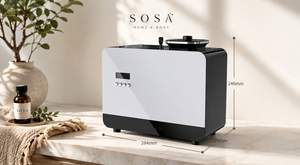

 Aangan · under 42 dB₹25,999Shop →