

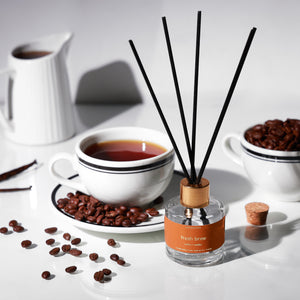
Skip for this brief: Fresh Brew. A coffee-vanilla gourmand is built to feel warm and enveloping — exactly the sensation you are trying to escape.
Free and non-negotiable: air the flat 8–10 minutes daily, dry out any damp source, keep the bottle off the sill and out of the fan's direct path. Damp is a smell no fragrance removes.
2. Choose a dry or citrus register over a sweet one. Sweet, vanillic and gourmand compositions gain apparent weight in wet air because the heavier base notes linger while the bright top notes disperse slowly — a balanced accord arrives as syrup instead. Dry woods and citrus do not have this problem; there is little base to linger.
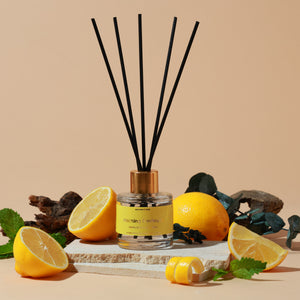
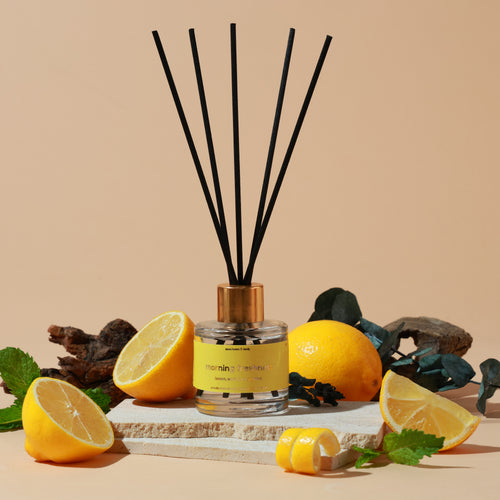
3. Morning Freshness 50ml ₹749 is the clearest choice. Malabar lemon, peppermint and eucalyptus — the lightest composition SOSA makes, and eucalyptus and mint read cool, which is the opposite of heavy.
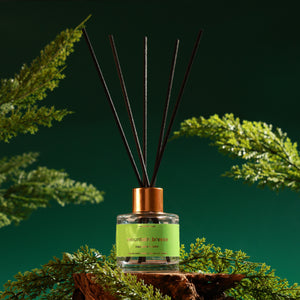
4. Mountain Breeze 50ml ₹849 if you want something more grown-up than citrus. Himalayan pine, sage and cedar — dry woods with no sweetness to gain weight, holding their shape through the wettest months.
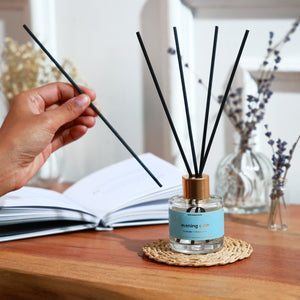
5. Evening Calm and Garden Bloom both work, with a caveat each — Fresh Brew is the one to skip. Evening Calm is soft rather than heavy, but so quiet in wet air it needs four reeds rather than three to register at all. Garden Bloom is pleasant but the jasmine gains weight in monsoon, so keep it at three reeds. Fresh Brew's coffee-vanilla is built to feel warm and enveloping — exactly the sensation you are trying to escape — and is the wrong choice for this brief specifically, not a bad bottle in general.
Whichever bottle you choose, do the free part too: air the flat 8–10 minutes daily, dry out any source of damp, and keep the bottle off the sill and out of the fan's direct path. Alcohol-free, IFRA-compliant, composed by an ISIPCA Versailles-trained perfumer and tested through 85% humidity and 45°C heat — and every purchase funds a girl's education through Nanhi Kali.
Why fragrance turns heavy in a Mumbai monsoon
Humidity does not change what is in the bottle. It changes how the air around the bottle behaves. Mumbai's monsoon air is already carrying a great deal of water, and fragrance molecules moving through saturated air disperse more slowly and sit lower than they do in dry air. A six-reed dose is calibrated for the drier months — it is meant to disperse and thin out. In July, that same dose does not thin; it pools. What reads as generous in December reads as oppressive in July, and the bottle has not changed at all. This is why the same fragrance can be genuinely lovely on your bedside table at Christmas and unbearable by the second week of July — the composition is identical, the air carrying it is not.
The second fault sits inside the composition itself, and it only shows up in wet air. Sweet, vanillic and gourmand fragrances are built from heavier base materials — vanilla, coffee, musk — layered under brighter top notes such as citrus or spice. In dry air, the bright top notes disperse quickly and the heavier base takes over gradually, so the whole thing reads as a balanced accord that opens crisp and settles warm. In humid air, that balance breaks: the bright top notes still disperse, but more slowly, while the heavy base materials linger even longer than usual, because water in the air actively slows the evaporation of heavier molecules more than it slows lighter ones. What should arrive as a balanced accord arrives instead as syrup — sweetness with nothing bright left to cut it.
Put the two faults together and you get the exact complaint in your title. A dose calibrated for dry air, in a register that gains weight in wet air, running in a Mumbai flat in August, reads as suffocating even though nothing about the bottle is faulty. Fix either one alone and the flat improves. Fix both — three reeds and a dry or citrus register — and most of the "heavy" complaint disappears without buying a different brand or a stronger machine.
The three things to check, in order
 Morning Freshness 50ml₹749Every SOSA bottle ships with six fibre reeds, and most people leave all six in year-round because that is how the box arrived. In a Mumbai monsoon that is the single most common cause of "heavy" — not the fragrance, the dose. Pull three reeds out and leave three in the bottle. This is the first thing to try, it costs nothing, and it solves the complaint for most people before they need to change the scent at all. Give it three days before judging; the room needs to reach a steady state, and the first evening after a change is never representative.
Every SOSA scent, rated for a heavy Mumbai monsoon
The table below runs all five SOSA reed fragrances against this specific brief — presence without weight, in Mumbai, in monsoon — at the reed count each one actually needs to work. Cost per week assumes 50ml bottles and the reed counts shown; see what it costs for the full working.
| Scent | Register | Reeds in monsoon | Verdict |
|---|---|---|---|
| Morning Freshness ★ | Malabar lemon, peppermint, eucalyptus | Three | Best pick — coolest register, clearest choice |
| Mountain Breeze ★ | Himalayan pine, sage, cedar | Three | Dry woods, no sweetness — holds shape all season |
| Evening Calm | Lavender, chamomile | Four | Soft, not heavy — but needs the fourth reed to register |
| Garden Bloom | British rose, night-blooming jasmine | Three only | Pleasant, but jasmine gains weight above three reeds |
| Fresh Brew | Coorg coffee, Kerala vanilla | Not for this brief | Built to feel warm and enveloping — the wrong sensation here |
| Any of the above, at six reeds | — | Six (dry-season default) | Correct in December, oppressive in a Mumbai July |
| Note: if the flat has a damp patch, wet laundry drying indoors or a musty bathroom seal, no scent in this table fixes that on its own — air the room and dry the source first, then judge the bottle. | |||
Morning Freshness · the clearest pick50ml ₹749Shop → 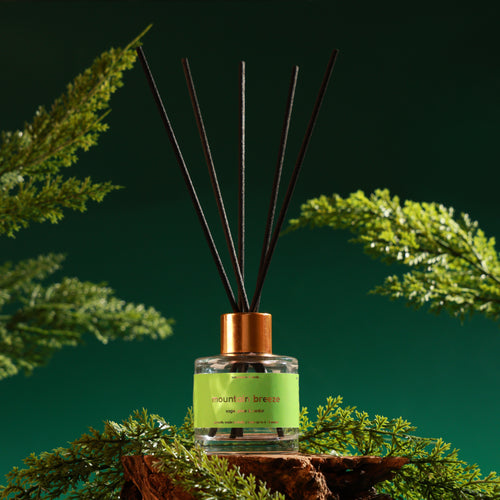 Mountain Breeze · the dry-wood pick50ml ₹849Shop →
 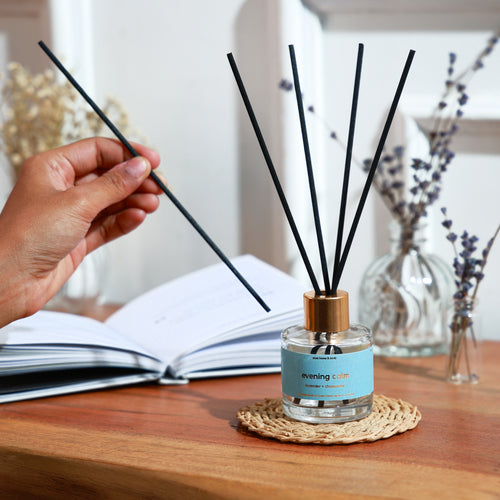 Evening Calm · needs four reeds50ml ₹799Shop →
Reeds, placement and the daily routine for a Mumbai monsoon
Three reeds is the right starting point for almost every scent in a Mumbai flat during monsoon, and it is the single biggest lever you have. Fibre reeds wick by capillary action, so halving the number of reeds roughly halves how much surface area is evaporating oil into the room at any moment — the room gets noticeably softer without the bottle itself changing. The two exceptions in this range both cut the other way: Evening Calm's lavender and chamomile are already so quiet that three reeds can under-perform in wet air, so give it four; and Garden Bloom's jasmine is exactly the kind of heavier floral that gains weight in humidity, so keep it at three and resist adding a fourth even if it feels faint on the first evening.
Placement does real work alongside dosage. Keep the bottle off the windowsill — monsoon rain fogs and cools the glass, which slows evaporation unevenly and can leave reeds sitting in condensation — and out of the direct path of a ceiling fan or a wall fan on high, both of which strip scent before it has a chance to fill the room rather than helping it spread. A console or shelf a metre or so off the floor, clear of direct airflow, is the right spot. Flip the reeds saturated-end up every three to five days regardless of scent or reed count; this is the entire maintenance routine and it is what keeps a bottle performing evenly for its full 10–14 weeks rather than fading unevenly.
The routine that costs nothing matters as much as the bottle. Open a window for eight to ten minutes each morning, even in the rain — a few minutes under an awning or a slightly open pane is enough to exchange the air without letting water in. Dry out any actual source of damp: a musty cupboard seal, wet towels left to dry indoors, a windowsill that never quite dries after a downpour. None of this is optional if the flat's underlying smell is damp rather than stale — a fragrance sitting on top of a damp smell reads as heavier than either problem alone, and no reed count or register fixes that.
What it actually costs, per week
Reed diffusers have no electricity cost and no consumable beyond the oil, so the only running cost is the bottle itself, spread across however many weeks it lasts. Every figure below is worked out by hand from the reed count and lifespan in the diagnostic above — three reeds in monsoon humidity runs 10–14 weeks, against 6–8 weeks at the default six.
| Bottle | Reeds | Lasts | Cost per week |
|---|---|---|---|
| Morning Freshness 50ml ₹749 ★ | Three | 10–14 weeks | ₹54–₹75 |
| Mountain Breeze 50ml ₹849 ★ | Three | 10–14 weeks | ₹61–₹85 |
| Garden Bloom 50ml ₹799 | Three (not more) | 10–14 weeks | ₹57–₹80 |
| Evening Calm 50ml ₹799 | Four | Shorter than 10–14 weeks — the fourth reed adds real consumption | higher than the ₹57–₹80 three-reed rate |
| Any bottle at six reeds, for comparison | Six | 6–8 weeks | ₹94–₹125 (on ₹749) |
Versailles
The question I get most often in June and July is some version of "what happened to my fragrance" — and it is almost never a faulty bottle. It is a dose that was right for dry air, still running unchanged into wet air. Six reeds is not a mistake in October. It is a mistake in July, in the same bottle, in the same flat, and the fix is pulling three of them out.
The register question took me longer to explain simply, because it sounds like a preference when it is actually chemistry. A gourmand — coffee, vanilla, warm musks — is built to feel enveloping, and it does that job very well in a dry, cool room. In a wet one, the same base materials that make it feel enveloping in December make it feel suffocating in July, because the air is no longer helping the bright top notes cut through. That is not a flaw in Fresh Brew. It is Fresh Brew doing exactly what it was composed to do, in the wrong season for it.
So the honest order is: reeds first, register second, and the flat itself last — air it, dry it, and do not expect any bottle to sit on top of a damp smell and win. Every purchase funds a girl's education through Nanhi Kali, not a percentage of one, not a quarterly figure. Every one.
Frequently asked questions
- What home fragrance actually lasts in Mumbai's humidity? — the registers that hold up all season.
- How many reeds should I use in a 150 sq ft bedroom during Mumbai monsoon? — the dosage question, room by room.
- Why does my reed diffuser stop smelling after a few days in Mumbai? — nose-blindness versus a genuine fade.
- Reed diffuser vs Sukoon for Mumbai's hot and humid weather — the always-on bottle against the on-demand machine.
- Brand: the SOSA founder story.
SOSA products & prices (verified August 2026): Scented candles from ₹379 (small, ~15–18 hrs) · candle duos ₹664 (~30–36 hrs) · wax melts ₹474 · woodenwick and ceramic jar candles ₹949. Reed diffusers: Morning Freshness 50ml ₹749 · 130ml ₹1,249 · Evening Calm 50ml ₹799 · 130ml ₹1,299 · Garden Bloom 50ml ₹799 · 130ml ₹1,299 · Fresh Brew 50ml ₹849 · 130ml ₹1,349 · Mountain Breeze 50ml ₹849 · 130ml ₹1,349; six fibre reeds and refillable glass with every bottle, 50ml lasts 6–8 weeks at six reeds and longer at three, 130ml 14–18 weeks. Reed duo sets 2 × 50ml ₹1,498–₹1,598 · 2 × 130ml ₹2,498–₹2,598. Reed refills 300ml ₹2,399 · 500ml ₹3,499. Ultrasonic diffusers: Boond ₹899 (USB) · Sukoon ₹1,899 (ships with three 15ml fragrances) · Megh ₹3,499; Hotel Collection water-based fragrance 15ml ₹299 · 100ml ₹999 · 300ml ₹1,799 — a fragrance for a machine, not a standalone product. Reed oil and the water-based Hotel Collection are not interchangeable. Alcohol-free, phthalate-free, paraben-free, IFRA-compliant; composed and handmade in small batches in Pune. Every purchase funds a girl's education through Nanhi Kali. Prices and availability subject to change — see the live product pages.