



- The direct answer
- Why an open door defeats a fragrance before it starts
- The three mechanisms behind an open door
- Door and boundary patterns, matched to the verdict
- What actually holds a register, in order
- What to buy, once a real boundary exists
- A note from Sonal
- Questions about open doors and fragrance
2. An open door isn't an occasional draught — it's a continuous exchange. For as long as the door stays open, the volume of outside air behind it is, for practical purposes, unlimited compared with the café's own air, so the room's air is being replaced by street air at a steady rate the whole time the door is open, not just at the moment someone walks through.
3. Turning up intensity does not fix an exchange-rate problem. A machine set higher simply puts more fragrance into a room that is losing it just as fast, or faster — it changes how much is being spent, not how much is staying behind.
4. A vestibule or lobby with its own door is a genuinely different air volume from the room behind it. The test isn't whether a space has a name like "entrance" — it's whether a real boundary, a door that actually closes, separates its air from the open room beyond it.
5. This is why the same product performs completely differently in two similar-looking cafés. One café's entrance has a self-closing door and holds a register reliably; another's identical-looking entrance is propped open all service and never will, whatever is placed inside it.
A fragrance that seems to have stopped working almost never has — the room around it has changed from a bounded space into an open one, and no amount of extra fragrance answers that.
Why an open door defeats a fragrance before it starts
A fragrance doesn't fill a room the instant it's released — it accumulates, molecule by molecule, until the concentration in that air reaches a level a nose can register. That accumulation depends entirely on the air staying more or less where it is long enough for the level to build. A closed room, or a room with only the ordinary, incidental air movement of people walking in and out, holds its air well enough for that build-up to happen. A room with a door standing open the whole service does not, because the air isn't staying in the room at all — it's being continuously traded for the air outside, and whatever the diffuser adds gets carried out with it almost as fast as it arrives.
This is worth separating clearly from the idea of a "leak" or a draught, because the two behave quite differently. A draught is intermittent — a door opens, some air exchanges, the door closes, and the room's air has a chance to recover and rebuild before the next opening. An open door held open for hours is not that. It's a continuous, one-way exchange for as long as it stays open, closer to the room having no fourth wall than to the room having a slightly leaky one. The distinction matters because the fix for a draught — a bit more fragrance, a bit more frequent refill — genuinely doesn't translate to the fix for a continuously open boundary, which has no fragrance-side fix at all.
This is precisely why identical products, installed identically, produce completely different results in cafés that look similar from the street. A reed diffuser in a small vestibule with a self-closing door will hold a light, steady register through a full service. The same reed diffuser in an identical-looking space, where the door is propped open with a chair for the lunch rush and the evening rush and most of the afternoon between them, will read as if it isn't working — not because the fragrance failed, but because the room it was placed in was never, in practice, a bounded space to begin with.
The three mechanisms behind an open door
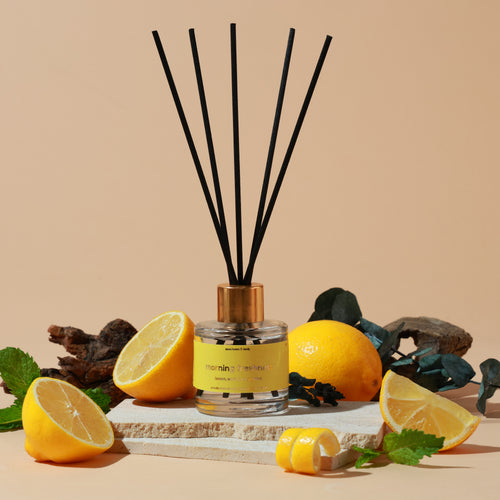
 Morning Freshness₹749A room and the street outside it become, functionally, one shared air volume the moment a door between them is held open, and a shared volume that size never reaches a detectable concentration from a diffuser sized for the room alone.
Door and boundary patterns, matched to the verdict
The pattern of how a door or opening actually behaves during service, not how the space is labelled on a floor plan, is what decides whether a bounded volume exists at all.
| Zone and door pattern | Effect on the room's air | Fragrance verdict | What this means practically |
| Entrance with a second door propped open to the street for most of service | Merges with outdoor air; no boundary exists while it's propped | Never, for as long as this is the pattern | Treat the zone as outdoor air, not as a separate room, until the door habit changes |
| Entrance with a self-closing door, opened only for through-traffic | The room's air re-establishes between openings, the way any normally used door behaves | Sometimes — the genuine case for a light register | This is the pattern the cluster's "sometimes" allowance is actually built for |
| Washroom door that closes automatically after each use | Volume rebuilds reliably between visits, even in a high-traffic café | Usually | Matches the cluster's standard washroom allowance without adjustment |
| Washroom door propped open for airflow on a humid or stuffy day | Behaves like an open zone for as long as it's propped, regardless of the room's usual pattern | Pause the expectation of a held register while it's propped | Resume once the door is closed again; nothing about the product itself needs to change |
| A genuinely enclosed corridor or lobby with its own door, separate from the main entrance | A real second boundary, distinct from either the street door or the dining room | Sometimes, tested from inside the dining room rather than assumed from the plan | The most reliable version of the "sometimes" zone in a larger café |
| Assuming a stronger machine or a higher intensity setting compensates for a door left open all service — no adjustment to a fragrance's own output changes the rate at which a room's air is being exchanged with the street outside it. | |||
Morning Freshness · a self-closing washroom door₹749Shop →  Sukoon · a washroom suite or enclosed corridor₹1,899Shop →
  Vaayu · a genuinely separated, multi-zone entrance₹11,999Shop →
What actually holds a register, in order
Never treat a fragrance that seems to have faded as a sign the product is too weak before checking whether the door to that room has actually been standing open — this single check resolves more "the diffuser stopped working" complaints than any change to the product itself.
Sometimes the fix is simply behavioural — a self-closing hinge, a habit of shutting the door between customers rather than propping it, or moving a diffuser from a doorway zone to a genuinely enclosed washroom instead, where the boundary is dependable.
Usually, once a real boundary is confirmed rather than assumed, a modest reed diffuser or ultrasonic machine sized correctly for that room's square footage holds a level perfectly well — the product was rarely the problem to begin with.
What to buy, once a real boundary exists
Matched to whether the door in question actually closes, not to the square footage of the room behind it.
| Route | Premises | Why | What it costs |
| No fragrance | Any zone with a door propped open for through-traffic or ventilation | The room's air is being exchanged faster than any machine can build a level | ₹0 |
| Reed diffuser, Mountain Breeze or Morning Freshness | A washroom with a self-closing door, under 150 sq ft | The door itself re-establishes a bounded volume between uses | ₹749–₹849 |
| Reed diffuser, 130ml | An entrance vestibule with its own door, 150–270 sq ft | Longer runtime for a small but genuinely separate room | ₹1,249–₹1,349 |
| Sukoon ultrasonic | A washroom suite or enclosed corridor, 270–320 sq ft | Steady coverage once the space reliably rebuilds a bounded volume between openings | ₹1,899 |
| Vaayu, wall or HVAC mounted, zoned | A genuinely separated entrance or lobby across a larger site, with its own door confirmed | Scheduling around known opening patterns once the boundary is real | ₹11,999 per unit |
I get versions of this question from owners who are convinced a product has stopped working, and almost every time the actual cause is sitting in plain sight at the front of the shop: a door that used to close between customers now stays open for the whole lunch rush, propped with a chair or a sandwich board because it's warmer that way or easier for trays to pass through.
It's an easy thing to miss because nothing about the fragrance itself has changed — the reed is still in the bottle, the oil is still the same blend, the room even still looks the same. What's changed is invisible: the room's air used to stay mostly in place long enough to hold a level, and now it doesn't, because it's being traded for the street's air continuously rather than occasionally.
This mechanism sits underneath a lot of the climate-specific questions I get asked across India, from a monsoon-soaked entrance in Pune to a fully open frontage in Bengaluru, and I'd rather set it out plainly once here than repeat it, half-explained, in every single one of those answers.
Questions about open doors and fragrance
- Can a Scent Machine Work in a Semi-Open Café? — the format-level version of this same air-exchange problem.
- Does Professional Scenting Make Sense in an Outdoor Café? — the outdoor extreme of the same mechanism.
- How Do Open Doors Affect Fragrance at a Café Entrance? — the same mechanism examined at a single entrance.
- How Does Mumbai Humidity Affect Odours Inside a Café? — the first of several city posts this mechanism sets up.
- Brand: the SOSA founder story.
SOSA products & prices (verified September 2026): Reed diffusers 50ml ₹749–₹849 (to 150 sq ft, 6–8 weeks at six reeds) · 130ml ₹1,249–₹1,349 (above 150 sq ft, 14–18 weeks) · reed refill 300ml ₹2,399. Ultrasonic: Boond ₹899 (~150 sq ft) · Sukoon ₹1,899 (270–320 sq ft, ships with three 15ml Hotel Collection fragrances) · Megh ₹3,499 (6L tank, ~100 hrs runtime, ~215 sq ft — a runtime machine, not a coverage upgrade). Waterless cold-air: Safar ₹3,999 (no published coverage figure) · Vaayu ₹11,999 (up to 1000 m³, roughly 2,000–3,000 sq ft; 400ml tank lasting about 90+ days; app and onboard control, 1h/4h/8h/24h run windows, adjustable intensity, key-lock, under 38 dB, freestanding or wall/HVAC mount, 5W, CE/RoHS/SGS) · Aangan ₹25,999 (8,000–10,000 sq ft). Hotel Collection water-based fragrance 15ml ₹299 · 100ml ₹999 · 300ml ₹1,799 is for ultrasonic machines; reed oil and Hotel Collection are not interchangeable. Reed diffusers are alcohol-free, phthalate-free, paraben-free, IFRA-compliant and low VOC, handmade in small batches in Pune. Every purchase funds a girl's education through Nanhi Kali. Prices and availability subject to change — see the live product pages.