





Why nothing cleared: a closed flat exchanges roughly 0.2–0.5 of its air an hour. Eight hours of shut windows is not ventilation, it is storage.
The overnight extras: dishes left soaking, the bin, the sink strainer, the sponge and a folded damp cloth all develop their own smell by morning and get blamed on dinner.
2. Because warmth in the morning drives it back out. Evaporation rises with temperature. Overnight the flat is at its coolest and the film releases slowly. As morning sun hits the windows, as the kitchen warms, as you switch things on, the same film starts releasing faster into a room that is still closed. That is why the smell can genuinely be stronger at eight than it was at one.
3. Because your flat barely breathed all night. A closed flat exchanges around 0.2–0.5 of its air per hour. Across eight shut-up hours that is not enough to clear anything, and if you sleep with an air conditioner running it is worse, because an AC recirculates: it cools the air, it does not replace it. Five to ten minutes of genuine cross-ventilation in the morning displaces more than the whole night did.
4. Because something wet has been quietly working all night. Dishes soaking in the sink, the pressure cooker left to stand, the sink strainer, a sponge or cloth folded damp, and the bin with last night's scraps in it. Bacterial breakdown carries on for eight uninterrupted hours in a warm kitchen, and by morning these produce a sour note that most people file under "last night's dinner" without separating it.
5. And your nose is finally telling the truth. Olfactory adaptation is essentially complete in about twenty minutes, so you stop registering your own home while you are in it. Sleep resets that. The first breath on waking, and the first breath when you come back from outside, are the only two honest readings you get. Fragrance goes in after all of the above — a reed diffuser or a Sukoon sets what the flat returns to, once there is nothing to return from.
Made in India, composed by an ISIPCA Versailles-trained perfumer — and a portion of every order supports girl-child education through Nanhi Kali.
Why the morning is when you notice it, and why that is not a coincidence
Three separate things line up at seven in the morning, which is why this question is so common and so specific. The first is the temperature cycle: the deposited film releases faster as the flat warms, so the source is genuinely stronger than it was at three. The second is the air-change rate: at roughly 0.2–0.5 changes an hour with everything shut, the flat has been accumulating whatever was released rather than clearing it. The third is your own nose. Olfactory adaptation resets during sleep, so you wake with the closest thing to a visitor's nose you will have all day. The smell is a little stronger and you are a lot more sensitive to it at the same moment.
It is worth being precise about what is releasing, because it decides what you do about it. If cooking odour were simply airborne molecules, an open window would end it and the problem would never last past midnight. The reason it does is that a meal cooked in hot oil puts a fine oil aerosol into the room, and those droplets are heavy enough to land. On glazed tile they sit on the surface and wipe off. On wall paint, wooden cabinet fronts and especially on textiles they sink in and bond, and they come back out slowly for days. The film, not the air, is the thing with a memory. Which is why a flat that has been thoroughly ventilated can still smell of dinner, and why the answer involves a cloth and a washing machine rather than a stronger fan.
Where last night actually spent the night
 Step fourFrom ₹749Run a fingertip along the tiles behind the hob, the underside of the chimney hood, the top of the wall cabinets and the side of the fridge. If it drags, that is deposited cooking oil. Left in place it oxidises over weeks and develops a stale, faintly rancid note that reads as generic "old cooking" rather than as any dish — and it releases most strongly when the kitchen warms up. Warm water with a little dish detergent lifts it; a dry cloth just spreads it. The hood underside and the tiles are worth a weekly wipe in a household cooking daily.
Symptom to cause: morning-after diagnosis
The point of this table is to separate the film from the wet sources, because they feel like one smell in the morning and they have completely different fixes.
| What you notice | Most likely cause | How to confirm it | What actually fixes it |
|---|---|---|---|
| Recognisably last night's dish, all through the flat ★ | Deposited oil film on fabric and hard surfaces re-releasing as the flat warms | Smell a cushion cover from the cupboard against one on the sofa | Wipe hard surfaces with warm detergent water; wash covers and curtains; purge on waking |
| Sour or fermented rather than like the dish | Something wet left overnight — sink, strainer, sponge, bin | Smell the sink strainer, the sponge and the underside of the bin lid in turn | Clear and wash all four at night; hang cloths to dry rather than folding them |
| Stronger at 8am than it was at midnight | The temperature cycle — warmth increasing release from the same film | Note the strength at bedtime and again on waking, two days running | Cross-ventilate for ten minutes on waking, before the flat warms further |
| Bedroom smells of it but the kitchen does not | The plume travelled and settled on bedding, the largest fabric load in the home | Smell a fresh pillowcase against the one on the bed | Shut the bedroom door before cooking; wash bedding weekly; air the quilt in sunlight |
| Worse when the AC ran all night | Recirculation — an AC cools the air, it does not replace it | Compare a night with the AC on against one with a window open | Purge properly before and after AC use; wash the AC filter monthly |
| A drain-like smell from the kitchen sink in the morning | A dry or failing trap — this is plumbing, not an odour problem | Run water down the drain and see whether it clears for a while, then returns | Refill the trap and have the seal checked. Do not fragrance a drain. |
| If none of these fit: check the fridge drip tray and the cabinet under the sink with a torch. Both are common overnight contributors that people never separate from the cooking smell, and both are minutes of work to fix. | |||
Reeds · always-on roomsFrom ₹749Shop →  Sukoon · when you want a switch₹1,899Shop →
  Hotel Collection · the scentFrom ₹299Shop →
The evening routine and the morning routine
The evening routine takes about six minutes and prevents most of it. Leave the chimney running for ten minutes after you finish cooking. While that runs, wipe the tiles behind the hob and the hood underside with warm detergent water — the film is easiest to remove while it is fresh and warm, and hardest once it has cooled and started to oxidise. Then deal with the wet list before bed: wash the dishes rather than leaving them soaking, clear and rinse the sink strainer, wring the sponge and stand it up to dry, hang the floor cloth rather than folding it, and take the bin out or at least tie the bag and wipe the lid. Every one of these is a smell that manufactures itself while you sleep.
The morning routine takes ten minutes and clears what is left. Open two windows on opposite sides of the flat as soon as you get up, before the day warms and before you start cooking again, and let air pass through rather than cracking one window. If only one side is usable, put a fan in it blowing outwards — that drags the flat's air out behind it instead of pushing street air in. Ten minutes of genuine cross-ventilation moves more air than the entire night did at 0.2–0.5 changes an hour. If a room was air-conditioned overnight, it especially needs this, because the AC recirculated all night without replacing anything.
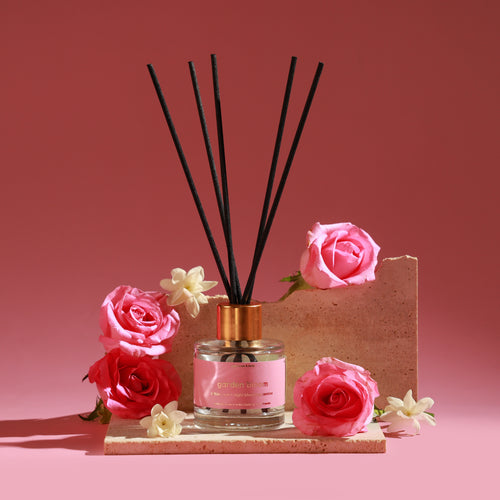
Then the weekly work, and only then fragrance. Cushion covers monthly, curtains seasonally, upholstery vacuumed with the brush head, bedding weekly, and the chimney filters degreased every three to four weeks. Once the flat reads neutral on the first breath of the morning — which is the only honest test — a fragrance layer is genuinely worth adding, because now it is defining a smell rather than arguing with one. A reed diffuser from ₹749 is the right tool for this specific problem, because it is working at six in the morning without anyone having switched anything on; Morning Freshness in Malabar lemon, peppermint and eucalyptus reads bright and awake in a hallway. If you would rather run something for an hour, the Sukoon at ₹1,899 with a Hotel Collection scent from ₹299 covers roughly 270–320 sq ft.
What to do, in order
The first three lines are habits and cleaning. The fourth is the purchase, and its job is to decide what the flat smells of at six in the morning, not to remove anything.
| Step | What to do | When | Cost |
|---|---|---|---|
| 1. Remove the source | Chimney run-on, wipe hood and tiles while warm, and clear the sink, strainer, sponge and bin before bed | Before anything else | ₹0 |
| 2. Move the air | Cross-ventilate for ten minutes on waking, two openings on opposite sides or a fan blowing outwards | Daily, five to ten minutes | ₹0 |
| 3. Deal with what holds it | Cushion covers monthly, curtains seasonally, bedding weekly, upholstery vacuumed, filters degreased | Weekly to monthly | ₹0 |
| 4. Then the always-on layer ★ | A SOSA reed diffuser — a background that is already working at six in the morning with nothing switched on | 50ml 6-8 weeks · 130ml 14-18 | from ₹749 |
| 5. Or the on-demand layer | Sukoon with a Hotel Collection scent — an hour-long reset when the flat needs one; covers roughly 270–320 sq ft | Run it when you want it | ₹1,899 |
Versailles
The question I get asked underneath this one is usually "how long should the smell take to go?" — and the honest answer is that the airborne part goes in minutes with proper ventilation, and the deposited part goes when you wash it. There is no waiting period that removes an oil film. If you are hoping it will fade on its own by lunchtime, what is actually happening is that your nose is adapting to it.
My own habit, and the one I recommend most often, is the six minutes at night rather than the twenty in the morning. Wipe the tiles while they are still warm, empty the sink, tie the bin. It is far easier than dealing with a cold, oxidised film and a fermenting sink at seven while you are also making chai.
Fragrance genuinely belongs in this article — but at the end. What I like about a reed diffuser for this particular problem is that it is on duty overnight without anyone deciding it should be. You are not switching it on when you wake up and hoping it catches up; it has been quietly setting the baseline for eight hours. That is the difference between a home that smells of something and a home that smells of nothing in particular. A portion of every order funds a girl's classroom through Nanhi Kali.
Frequently asked questions
- Why tadka reaches the bedroom — the sixty seconds that does the damage.
- Why the sofa absorbs cooking smell — the deepest reservoir in the room.
- Resetting the living room after a big cook — the recovery routine, timed.
- Can cushions and rugs hold cooking smell? — sorption and slow release.
- Brand: the SOSA founder story.
SOSA products & prices (verified August 2026): Hotel Collection water-based ultrasonic diffuser fragrance 15ml ₹299 · 100ml ₹999 · 300ml ₹1,799 · Pack of 7 (15ml, all fragrances) ₹1,799; refills 100ml from ₹999. Seven scents: The Ritz-Carlton-inspired (white tea · bergamot · cedar), Westin-inspired (white tea · aloe · cedar), 1 Hotels-inspired (cedarwood · vetiver · green leaves), The St. Regis-inspired (amber · violet · woods), Shangri-La-inspired (jasmine · green tea · white tea), Four Seasons-inspired (citrus · floral · sandalwood), W Hotels-inspired (citrus · pepper · amber). Diffusers: Boond 300ml ₹899 · Sukoon 500ml ₹1,899 · Megh 6L ₹3,499. Water-based, phthalate-free, composed to IFRA standards for home diffusion; 3–6 drops per tank. Made in India, Pune. The Hotel Collection scents are SOSA's own interpretations inspired by the world's finest hotels; all hotel names are trademarks of their respective owners and are used only to describe the scent style — SOSA is an independent Indian fragrance house, not affiliated with or endorsed by any hotel brand. Prices and availability subject to change — see the live product pages.