

Problem two, air exchange: fragrance leaves with the air it is suspended in. Ceiling fans, split AC units, an open balcony door and a kitchen extractor all replace room air faster than a passive source can re-scent it.
Problem three, absorption: sofas, rugs, curtains and cushions take fragrance out of the air and give it back slowly. A newly furnished room is the hardest room to scent.
The honest ladder: two reed diffusers from ₹749 for a small open room, a Sukoon at ₹1,899 for a normal one, and only past roughly 800–1,000 sq ft of connected volume does the Vaayu at ₹11,999 become the sensible answer.
2. Because the air keeps leaving. Fragrance is suspended in air; when the air goes, it goes with it. Ceiling fans, split AC units on high, an open balcony door, a stairwell and a kitchen extractor all move room air out and fresh air in. A passive source has one fixed rate of release and no way to increase it in response.
3. Because the furniture is a sink. Upholstery, rugs, curtains and cushions take up fragrance molecules and release them slowly. This is why a room you have just refurnished feels stubbornly neutral, and why the same room reads warmer six weeks later.
4. Because open plan has nothing to hold it. Walls and doors are not obstacles to scent, they are containers. Remove them and the fragrance keeps diluting into adjoining volume until there is not enough of it anywhere to notice.
5. Because your nose adapts fastest in your own home. Before you conclude the room is empty, step outside for fifteen minutes and walk back in. Guests are better witnesses than owners.
6. Because the fix is usually a category change, not more of the same. More reeds, a bigger bottle and a stronger scent all move the needle a little. Moving from a passive source to one with propulsion moves it a lot — a Sukoon at ₹1,899 for a normal room, a Vaayu at ₹11,999 only when the connected volume genuinely warrants it.
Our reed range is composed and handmade in small batches in Pune, the machines are made in India, and a portion of every order supports girl-child education through Nanhi Kali.
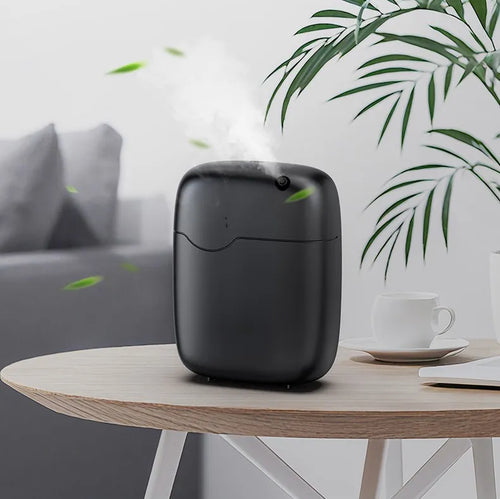
Part one — the three problems, taken one at a time
I want to separate these because they are usually experienced as one vague failure — "it just does not smell of anything" — and treated with one blunt instrument, which is a stronger fragrance. In practice most rooms have one dominant problem and two minor ones, and knowing which is dominant tells you whether the fix is free, cheap or a genuine change of category. Work through all three before you decide what to spend. None of what follows is a laboratory measurement; it is the plain physics of how a scented molecule gets from a source to your nose, and the arithmetic you can do yourself with a tape measure.
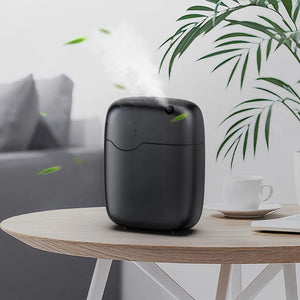
 Sukoon₹1,899 · 270–320 sq ftFragrance does not sit in a room like furniture. It is carried by air, and Indian homes move a great deal of air. Ceiling fans run for most of the year; split units cycle on high; balcony doors stand open in the evening; a kitchen extractor in an open-plan layout pulls a substantial column of air out of the shared space every time somebody cooks. Each replacement of room air takes the fragrance in it away and hands the source a fresh volume to start on. A reed diffuser cannot respond to that — its rate is set by reed surface, composition and temperature, and it has no capacity to surge. This is the single most under-appreciated reason a room that smells lovely at eight in the morning smells of nothing at nine. I am deliberately not quoting an air-change figure here; it varies far too much between a sealed AC flat and a Chennai house with the windows open to be worth pretending about.
Part two — what each format can honestly hold
Here is the same three-problem frame applied to every format we sell, so you can see which problem each one actually solves. The pattern worth noticing is that the cheap fixes address air exchange and distribution well and volume badly, and that only a change of category addresses volume at all.
| The problem | What it does to the room | Free or cheap response | The format that genuinely answers it |
|---|---|---|---|
| Volume ★ | Dilutes a fixed output across far more air than a bedroom holds | Two sources instead of one; close a door if there is one to close | A machine with propulsion — Sukoon to 320 sq ft, Vaayu to 1000m³ |
| Air exchange | Carries scented air out faster than the source can replace it | Move the source into passing air rather than under a vent; run fans on low | Anything schedulable — you scent when the room is closed, not when it is open |
| Absorption | Soft furnishing takes up a share of the output for the first few weeks | Patience — give any new setup a fortnight before you judge it | Continuous low output rather than short bursts |
| Distance from source | Concentration falls off sharply with distance from a point source | Reposition to the traffic route; two bottles at opposite ends | Propulsion, or more sources — there is no third option |
| Your own nose | Adaptation makes a working room read as an empty one within minutes | The fifteen-minute doorway test; ask a guest | Nothing — no machine fixes adaptation, and any that claims to is lying |
| The honest caveat: none of these formats cleans air, removes a smell or changes how anyone feels. They add fragrance to air that is already the way it is. If a room has a source smell — damp, drains, bins, last night's cooking — ventilate and clean first and scent afterwards, in that order. Layering fragrance over a problem produces a third smell that nobody designed and everybody notices. | |||
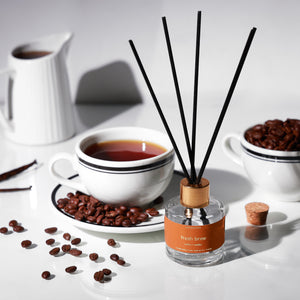
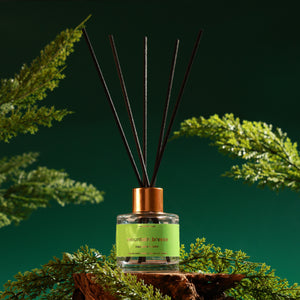
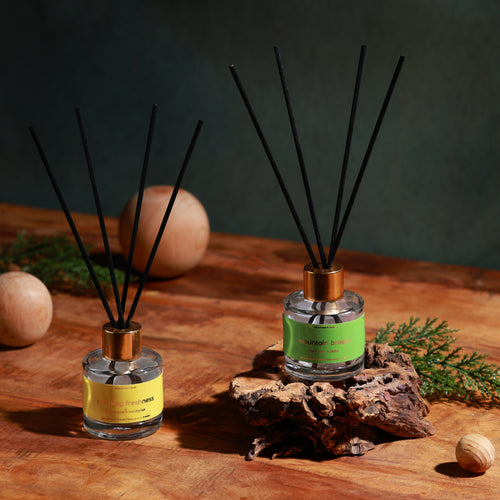 Two reed sources · under 300 sq ft₹1,548Shop →
  Sukoon · 270–320 sq ft₹1,899Shop → Vaayu · up to 1000m³₹11,999Shop →
Part three — when a machine is not the answer
I sell the machines, so take this in the spirit it is offered: most people reading a page like this do not need one. The commonest situation is a room that measures large on the floor plan but is not actually a single connected volume — a living-dining with a wide arch to a hallway that has a door at the end of it, or an L-shape where the dining leg is genuinely separate air. If you can close two doors and reduce the problem to a room of 300 sq ft or less, you do not have a large-space problem; you have a placement problem wearing a large-space costume. Move the source into the part of the room people actually sit in, close what closes, and try again for a fortnight before spending anything.
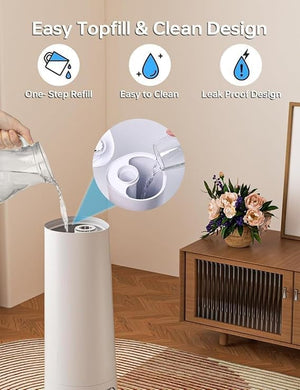
The second situation is wanting scent on some occasions rather than all the time. That is a control problem, not a volume problem, and it is solved at ₹1,899 rather than ₹11,999. A Sukoon gives you 270–320 sq ft, 16–18 hours on low from a 500ml fill, a remote and steady, two-hour and four-hour timers, with three 15ml water-based Hotel Collection scents in the box. In a normal 20 × 15 ft living room that is not a compromise, it is the correct machine. And while we are here: the Megh at ₹3,499 is not the next step up in coverage. It holds six litres and runs about a hundred hours, but it is rated at around 215 sq ft — less than the Sukoon. It is a runtime and humidity machine for people who are tired of refilling, and I would rather say that plainly than let the price tag imply a bigger room.
The third situation is the one I take most seriously. The Vaayu ships with 400ml of cold-air oil across four 100ml Hotel Collection fragrances, and that is 90 or more days of use at a mid intensity setting. SOSA does not currently sell a separate Vaayu refill oil. The 400ml in the box is the supply available today. That is an honest gap in the range and I would rather you heard it from me than discovered it in month four — so if uninterrupted long-term supply is a condition of the purchase for you, ask SOSA about current refill availability before you spend ₹11,999. It is also worth saying that the water-based Hotel Collection at ₹299 to ₹1,799, which is made for ultrasonic machines like the Sukoon, is a different product and does not go in a Vaayu, however similar the scent names look. Two oils, two machines, no crossover.
Part four — what to do, in the order I would do it
Arranged as a sequence rather than a shopping list, because the first four steps cost nothing and a good share of readers stop at step five.
| In this order | Which of the three problems it touches | Its honest limit | Price |
|---|---|---|---|
| 1. Measure length × width × height ★ | Volume — tells you which band you are actually in | None. Nothing else on this list is meaningful without it | Free |
| 2. Fifteen-minute doorway test | Your own adaptation, which mimics all three | Only tells you whether the room is genuinely empty | Free |
| 3. Move the source into passing air, away from vents | Air exchange and distribution | Cannot add output, only distribute what exists | Free |
| 4. Close whatever doors close; give it a fortnight | Volume and absorption | Useless in a genuinely open plan with no doors | Free |
| 5. A second reed source at the far end | Distance from source; adds real output | Two point sources, still no propulsion | From ₹749 · duos ₹1,548 |
| 6. Sukoon — scent on demand | Air exchange, by scenting on a schedule | 270–320 sq ft, water-diluted, adds a little humidity | ₹1,899 |
| 7. Vaayu — a change of category | Volume, properly, for the first time on this list | 400ml in the box and no refill oil currently sold | ₹11,999 |
| Not a step: Megh at ₹3,499 | Runtime and humidity — about 100 hrs from 6L | Around 215 sq ft, which is less than the Sukoon | ₹3,499 |
Versailles
The first large open room I failed to scent was my own. We had knocked two rooms together, the ceiling was higher than I had registered, and I put a 130ml bottle on the console with nine reeds in it and waited. It smelled wonderful within about four feet of the glass and of absolutely nothing at the sofa. I spent three months treating that as a fragrance problem before I accepted it was an arithmetic problem.
What changed my mind was measuring. Length, width, height, multiply. The room held more than three times the air of the bedroom where the identical bottle had been perfect. No composition I could make would have closed that gap, because the output of a reed bottle is fixed by physics I do not control — capillary rise up a fibre and evaporation off an exposed surface, and that is the whole machine.
So I would rather this page sent you to a tape measure than to a checkout. Most large-room complaints resolve into a room that is smaller than it looks, a source in the wrong place, or a nose that has adapted. The genuine large-volume cases are a minority, and for them the honest answer is a change of category rather than a bigger bottle. Everything in our reed range is composed and handmade in small batches in Pune, the machines are made in India, and part of every order funds a girl's classroom through Nanhi Kali.
Frequently asked questions
- Why does fragrance disappear in a double-height living room? — stratification, and why the scent is above your head.
- Best diffuser for a large open living and dining area — the answer by size band, from under 300 sq ft upwards.
- How airflow affects fragrance in large open spaces — why draught is the enemy of one format and the delivery system of another.
- The complete large open-space guide — this page and the eight around it, in one place.
- Brand: the SOSA founder story.
SOSA Vaayu specifications (verified from the live product page, August 2026): ₹11,999 (the product page displays a rounded ₹12,000). Waterless cold-air nebulisation — pressurised air atomises undiluted fragrance oil into a dry nano-mist; no water, no heat, residue-free. Coverage up to 1000m³, about 2,000–3,000 sq ft. 400ml refillable tank, 90+ days per fill at a mid intensity setting. Bluetooth app plus onboard buttons, 1h / 4h / 8h / 24h timers, adjustable mist intensity, auto-stop and key-lock. Under 38 dB. DC 12V / 1A, 5W. 165 × 80.5 × 215 mm, 0.9 kg, black or white. Freestanding or wall / HVAC mount. CE, RoHS and SGS certified. Ships with four SOSA Hotel Collection fragrances at 100ml each (400ml in total) in one of three combos chosen at checkout. SOSA does not currently sell a separate Vaayu refill oil; the 400ml supplied in the box is the fragrance available at the time of writing, and buyers who need long-term supply should confirm current refill availability with SOSA before purchasing. The cold-air oil supplied with the Vaayu is a different product from the water-based Hotel Collection sold for ultrasonic machines (15ml ₹299 · 100ml ₹999 · 300ml ₹1,799), which must not be used in a Vaayu despite sharing scent names. Other SOSA machines: Boond 300ml ₹899 (~150 sq ft) · Sukoon 500ml ₹1,899 (270–320 sq ft) · Megh 6L ₹3,499 (~215 sq ft — a runtime and humidity machine, not a coverage upgrade) · Aangan ₹25,999 (~8,000–10,000 sq ft) · Meenar ₹38,500 (12,000–18,000 sq ft) · Safar car diffuser ₹3,999. Reed diffusers 50ml ₹749–₹849 (6–8 weeks) · 130ml ₹1,249–₹1,349 (14–18 weeks) · duo sets ₹1,498–₹1,598 · oil-only refills 300ml ₹2,399 / 500ml ₹3,499. Runtime, consumption and coverage figures are manufacturer specifications and vary with intensity setting, run hours, ceiling height, ventilation and season; any per-month or per-day figure in this guide is arithmetic on those specifications, not a measurement. Electricity costs vary by state tariff. No claim is made that scenting affects ratings, reviews, bookings, occupancy, revenue, health, mood or air quality. Free shipping above ₹499. A portion of every order supports girl-child education through Nanhi Kali. Prices subject to change — see the live product pages.