


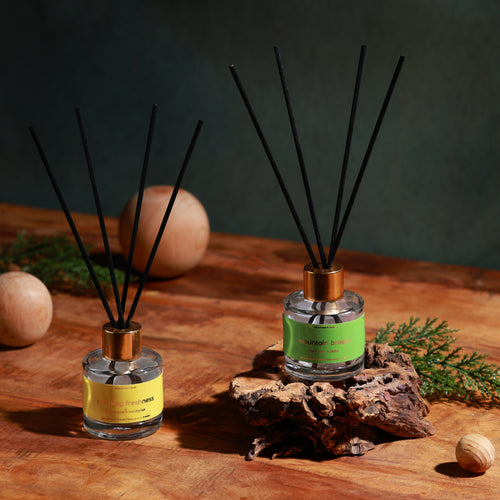
Cool stone and metal — concrete, terrazzo, pale marble, steel, glass: Mountain Breeze, Himalayan pine, sage and Indian cedar, ₹849.
Green and planted — terracotta, cane, jute, leaf, open windows: Morning Freshness, Malabar lemon, peppermint and Nilgiri eucalyptus, ₹749.
Soft textile — linen, pale oak, plaster, cotton, quiet everything: Evening Calm, Kashmir lavender and chamomile, ₹799. Cannot read it, or the palette is deliberately eclectic: Garden Bloom, ₹799.
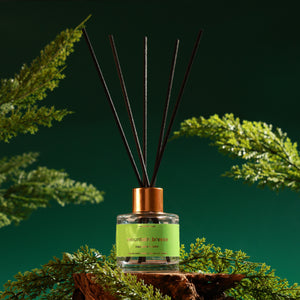
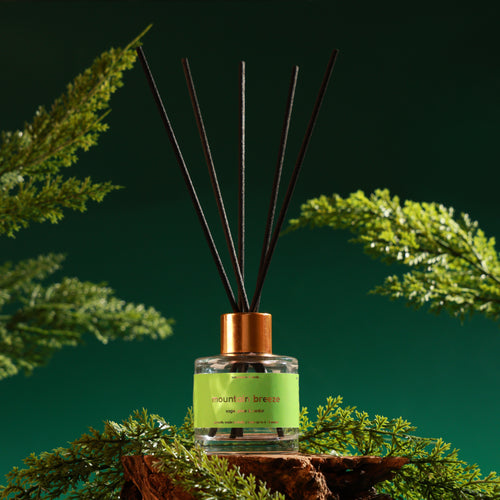
2. Cool stone and metal. Concrete, terrazzo, pale marble, lime plaster, steel, glass, a great deal of clear surface. Give Mountain Breeze, ₹849 — Himalayan pine, sage and Indian cedar at 9.4, dry with no sweetness anywhere in it. A gourmand in a mineral room reads as something spilled; a dry woody reads as part of the fabric.
3. Green and planted. Terracotta, cane, jute, unglazed ceramic, leaf, soil, windows open most of the day. Give Morning Freshness, ₹749 — Malabar lemon, peppermint and Nilgiri eucalyptus at 9.0, cold and bright, extending a register the room is already in. It also reads sharper than 9.0 suggests, because cold notes cut through humid air.
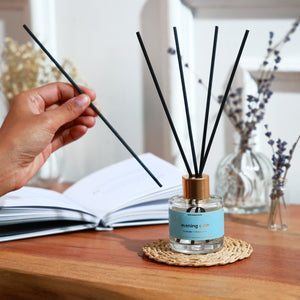
4. Soft textile. Linen, cotton, pale oak, plaster, low contrast, nothing shiny. Give Evening Calm, ₹799 — Kashmir lavender and chamomile at 8.9, deliberately the softest thing we make. Soft palettes are usually low-stimulus by intention, and a loud fragrance breaks the intention rather than the room.
5. Deliberately eclectic, or you have never seen it. Give Garden Bloom, ₹799 — British rose over night-blooming jasmine at 8.9, presence without insistence, and the least divisive composition in the range. A mixed palette has no dominant to match, so match nothing and choose for low divisiveness instead.
6. Two palettes in one home? Give two bottles that share a note. Fresh & Grounded ₹1,548 meets on green eucalyptus; Warmth & Bloom ₹1,598 meets on warmth and a soft musky base.
Composed and handmade in small batches in Pune, and a portion of every order supports girl-child education through Nanhi Kali.
Part one — the three readings that make up a palette
The method is borrowed from the way design people describe rooms to each other, which is in three terms rather than one. There is a dominant material that covers the most surface, an accent material used deliberately in small quantities, and a finish — matte, polished or raw — that decides how the whole thing behaves. You can take all three readings from four photographs on a phone, and you do not need to have any opinion about the person who lives there. That is what makes this usable as a gift method: you are answering a question about a place, not making a guess about a personality.
 Morning Freshness₹749 · 9.0/10The accent is the material used in small, deliberate quantities — brass on a pale room, black steel on an oak one, a single dark stone in a linen scheme, plants in a mineral flat. It breaks ties. A cool stone room with brass accents can carry warmth; the same room with black steel accents cannot. A warm oak room with a lot of plants leans greener than its dominant suggests, and Morning Freshness at ₹749 may beat the gourmand there. The accent also tells you how much presence the room will tolerate, because a person who accents sparingly is a person who edits, and editors generally want the quieter composition. When the accent and the dominant disagree, follow the dominant for the family and the accent for the volume.
Part two — the palette table
Four palettes, one default, and the composition each takes. Strength figures are positions on SOSA's own internal scale at six reeds in an ordinary Indian room — not an industry standard, not a concentration, and not a quality ranking. A 9.5 is louder than an 8.9; it is not better, and in a small polished room it is frequently worse.
| Dominant material | Typical accent | The fragrance family that agrees | Give | Where to stand it |
|---|---|---|---|---|
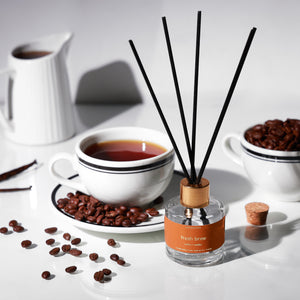
| Warm wood — teak, walnut, cane ★ | Brass, wool, leather, books | Gourmand — roasted, sweet, resinous | Fresh Brew · 9.5 · ₹849 | Where people sit, not where they cook |
| Cool stone — concrete, terrazzo, marble | Steel, glass, black metal | Dry woody — pine, sage, cedar, no sweetness | Mountain Breeze · 9.4 · ₹849 | A console or shelf in passing air, chest height |
| Green and planted — leaf, terracotta, jute | Cane, unglazed clay, open windows | Cold green — citrus, mint, eucalyptus | Morning Freshness · 9.0 · ₹749 | Near the balcony door, out of direct sun |
| Soft textile — linen, cotton, pale oak | Plaster, one dark stone, low contrast | Soft herbal-floral, deliberately quiet | Evening Calm · 8.9 · ₹799 | Bedside, reading corner; four reeds if it is small |
| Deliberately eclectic, or unseen | No dominant to read | Classic floral — the least divisive register there is | Garden Bloom · 8.9 · ₹799 | The entrance, where it becomes the smell of the home |
| The honest caveat: three palettes in this table have no answer in the range at all. There is no oud for a formal drawing room built around it, no musk-forward composition for a soft skin-scent scheme, and nothing aquatic for a coastal flat that wants salt and air. Stretching pine to stand in for oud, or lemon to stand in for sea air, produces a gift that is nearly right, which in fragrance is the least useful outcome there is. I would rather you bought from a house that makes the thing properly. | ||||
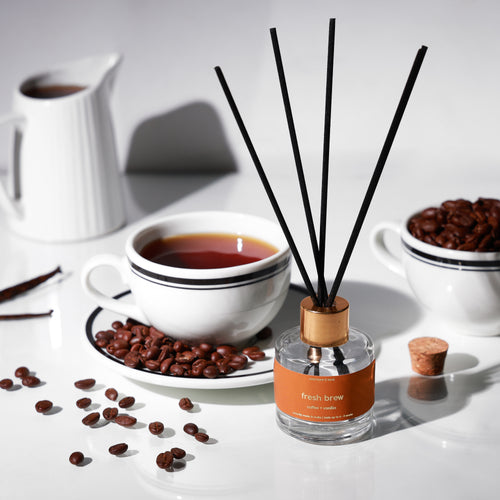 Fresh Brew · warm woodsfrom ₹849Shop → Mountain Breeze · cool stonefrom ₹849Shop →
 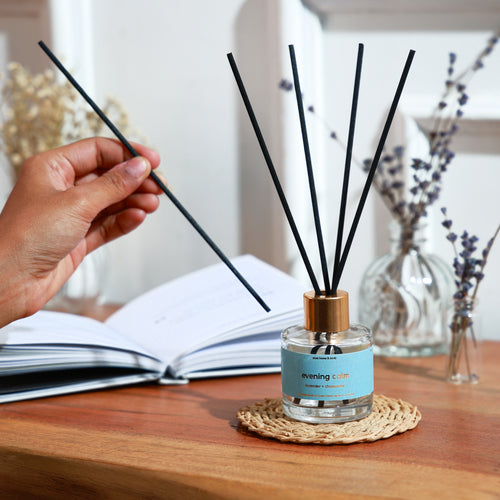 Evening Calm · soft textilefrom ₹799Shop →
Part three — where the method fails, and where the whole gift is wrong
The method has three failure modes and it is worth knowing them before you rely on it. The first is the palette you cannot actually see. A remembered room is not evidence, and a person's clothes or their car tell you nothing about their walls. If you have not been in the room and cannot get photographs, stop reading the palette and choose for low divisiveness instead — Garden Bloom at ₹799 — or hedge with a duo so that at least one of two bottles lands where it should. The second is the deliberately eclectic home, where mixing periods and materials is the point; there is no dominant to match, and trying to find one produces an arbitrary answer dressed as a method. The third is the palette that is genuinely between two registers — a warm oak flat full of plants, a stone room with brass everywhere. Follow the dominant for the family, the accent for the volume, and if you still cannot decide, the tie is telling you to give two bottles rather than one.
Then the refusals, which override every reading in this article. Do not give any of these to somebody who has said they dislike scented things. Mountain Breeze is the composition that gets furthest with sceptics because it reads as timber rather than as perfume, but it converts the undecided, not the decided. Do not give into a home with a newborn; for those first months the right quantity of added fragrance is none. Do not give where anybody is asthmatic, migraine-prone or scent-sensitive, and do not assume the subject would have come up — most people do not volunteer it. Do not give a second composition into a home already running a settled one, because two scents in a connected space that share no note produce a seam at the doorway rather than a blend; buy the oil-only refill of what they already use at ₹2,399 for 300ml, or step outside the category entirely.
And two things this recipient in particular will notice. The bottle stands out in the room for the whole of its life — six to eight weeks in 50ml, fourteen to eighteen in 130ml — so somebody with a trained eye assesses it as an object daily; look at the product photographs and make that judgement with your own eyes before you buy. And replacement reeds are not sold separately, so although our guidance is to refresh them every few months, the refill is oil only and they reuse their own vessel and reeds. Neither of those is a reason not to give this gift. Both are reasons to give it with your eyes open, and to say the useful sentence when you hand it over: this one is for the console by the door, on a tray, flip the reeds on Sundays.
Part four — pairing two palettes in one home
Most designed homes are not one palette; they are two, with a threshold between them. That is the honest case for giving two bottles, and it is also where the pairing rule matters: two compositions in one connected space must share a note, or the doorway becomes a seam. The duos exist because of that rule rather than as a merchandising exercise.
| The two palettes in their home | Give | The shared note that stops the seam | Price |
|---|---|---|---|
| A working half and a resting half ★ | Day & Night | Cold herbal — the mint and eucalyptus meet the lavender cleanly | ₹1,498 · 2 × 130ml ₹2,498 |
| Warm woods at one end, cool stone at the other | Fresh & Grounded | Green eucalyptus, which runs through both compositions | ₹1,548 · 2 × 130ml ₹2,548 |
| A hosting floor and a private one | Warmth & Bloom | Warmth and a soft musky base under both | ₹1,598 · 2 × 130ml ₹2,598 |
| One palette, one very long room | Two bottles of the same composition | No seam possible — and two sources beat one bigger bottle | From ₹749 each |
| One palette, one modest room | A single 130ml | Not applicable — buy duration rather than a second scent | ₹1,249–₹1,349 · 14–18 weeks |
| They already run a SOSA bottle | 300ml oil refill | Same composition, no seam, and no new object in the room | ₹2,399 · 8–11 months |
Versailles
Perfumery and material palettes share more vocabulary than either profession admits. We both talk about warmth and coolness, about dry and soft, about a dominant with an accent over it, about how much a composition can carry before it becomes noise. When an interior designer tells me a room is lime plaster with a single brass accent, I already know what it should smell of, and I have never once had to ask what the person who lives there is like.
That is why I compose for rooms rather than for personalities. It is the less romantic brief and it is far more accurate. A material has a smell in the imagination even when it has none in fact — teak reads warm and resinous, marble reads cold and mineral, linen reads dry and quiet — and a fragrance that agrees with that imagined smell gets absorbed into the room within a week. One that disagrees stays audible for the whole life of the bottle.
The gaps embarrass me and I print them anyway. No oud, no musk, nothing aquatic. Each of those is a palette somebody's home is genuinely built around, and a near miss in fragrance is worse than an honest absence. If that is the house you are buying for, take your money elsewhere with my blessing. What we do make is composed and handmade in small batches in Pune, tested through 45°C summers and 85% monsoon humidity, and a part of every order funds a girl's classroom through Nanhi Kali.
Frequently asked questions
- Why reed diffusers make good gifts for design lovers — the four structural reasons.
- Home fragrance for designer interiors — the visual audit, and the object that sits out and gets judged.
- Someone who loves interior design, someone obsessed with home interiors and the best gifts for a design lover.
- The complete 2027 guide — all nine articles in this cluster in one place.
- Brand: the SOSA founder story.
SOSA reed diffuser range & prices (verified August 2026): alcohol-free, phthalate-free, paraben-free and IFRA-compliant compositions on a heat-stable coconut-derived (CCT) carrier, low-VOC, supplied in a refillable glass bottle with six fibre reeds; 50ml lasts 6–8 weeks and 130ml lasts 14–18 weeks. Morning Freshness (Malabar lemon · peppermint · Nilgiri eucalyptus) 50ml ₹749 · 130ml ₹1,249 · 9.0/10; Garden Bloom (British rose · night-blooming jasmine) 50ml ₹799 · 130ml ₹1,299 · 8.9/10; Evening Calm (Kashmir lavender · chamomile) 50ml ₹799 · 130ml ₹1,299 · 8.9/10; Fresh Brew (Coorg coffee · Kerala vanilla) 50ml ₹849 · 130ml ₹1,349 · 9.5/10; Mountain Breeze (Himalayan pine · sage · Indian cedar) 50ml ₹849 · 130ml ₹1,349 · 9.4/10. Reed diffuser refills are oil only — you reuse your own vessel and reeds: 300ml ₹2,399 (roughly 8–11 months) · 500ml ₹3,499 (roughly 14–18 months), about ₹7–8 per ml against ₹15–17 per ml for a 50ml bottle. Duo sets ₹1,498–₹1,598 for 2 × 50ml and ₹2,498–₹2,598 for 2 × 130ml. Strength figures are positions on SOSA’s own internal strength scale, not an industry standard. Replacement reeds are not sold as a separate SKU; SOSA guidance is to refresh reeds every few months. The reed line is separate from the water-based Hotel Collection for ultrasonic machines (15ml ₹299 · 100ml ₹999 · 300ml ₹1,799) and the two are not interchangeable. Diffusers: Boond 300ml ₹899 · Sukoon 500ml ₹1,899 · Megh 6L ₹3,499 · waterless Vaayu ₹11,999. Composed and handmade in small batches in Pune, India; tested through 45°C summer heat and 85% monsoon humidity. Free shipping above ₹499. A portion of every order supports girl-child education through Nanhi Kali. Prices subject to change — see the live product pages.