



Why more reeds do not help: a reed moves no air. It creates a fragrant zone of roughly a couple of metres and nothing beyond it. Two passive sources in one room do not make a plateau, they make two hills with a valley between them — and the valley is where the chairs are.
What a machine actually buys you: transport, not a better smell. Vaayu ₹11,999 shatters undiluted oil into a dry nano-mist carried by the room’s own airflow, rated to up to 1000 m³. The fragrance can be identical; what you are paying for is getting it across the room.
Where a reed is still correct in a club: cloakrooms, washroom vanities, the secretary’s office, an anteroom off the hall, a desk console, a small committee room, a lift-lobby console. Small, closed, low-traffic volumes where two metres is the entire brief.
The honest gap: reed oil cannot go into an ultrasonic machine, and the water-based Hotel Collection oils cannot go into reeds or into a waterless nebuliser — the carrier decides the machine. No purchasable refill oil is listed for the waterless commercial machines; that fragrance is specified and quoted per property through the contact page.
2. When members dwell rather than pass. This is the test clubs forget. A passive device’s output is not controllable: it drifts with room temperature, with draught, with how full the bottle is, and with how many reeds are in it. For a thirty-second visit that variability is invisible. For somebody seated for four hours it is the difference between a room that is pleasant and a room that is heavy by the second hour, and you have no dial to correct it with. A long-dwell space needs a level you can set low and hold, which means a machine with an intensity setting, a schedule and a key-lock.
3. No quantity of reeds crosses the line, and the arithmetic is worth stating. Two passive sources in one room do not produce a plateau. They produce two hills with a valley between them, and the valley is exactly where the seating is, because the bottles went on the consoles at the edges of the room. Ten reeds in a four-thousand-square-foot lounge are ten small zones in a large unscented space. This is not a failure of quality or of the fragrance. It is the mechanism doing precisely what a capillary device does, and it is the single most expensive misunderstanding in club scenting because the money is spent in small amounts over years.
4. What changes is the mechanism, not the model. Waterless cold-air nebulising shatters undiluted oil into a dry nano-mist that the room’s own airflow carries: no water, no dilution, no added humidity, no residue. Vaayu at ₹11,999 is rated to up to 1000 m³ and will mount freestanding, on a wall, or into an HVAC return; Aangan at ₹25,999 is rated to up to 3,000 m³ when it is connected to the air system. Note what you are buying: not a better smell, but the ability to get the same smell across the room.
5. And keep the reeds. Do not let anybody sell you out of them. A properly specified club uses both, in different rooms, for different reasons. The cloakroom, the washrooms, the secretary’s office, the anteroom and the small committee room are genuine reed territory and will be better served by a reed than by anything with a plug. Alcohol-free, phthalate-free, paraben-free, IFRA-compliant, 0 ppm formaldehyde, six fibre reeds in a refillable glass bottle, composed in Pune. A portion of every order supports girl-child education through Nanhi Kali.
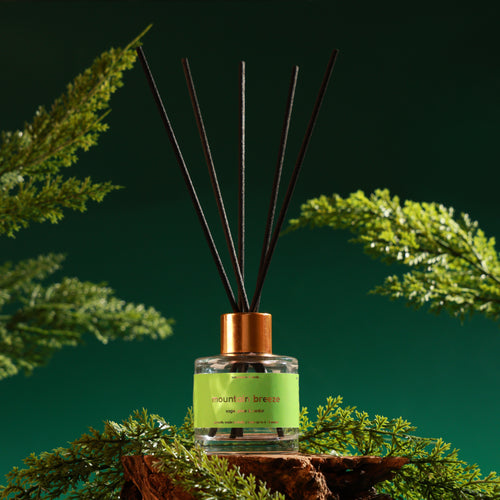
Why ten reeds are ten zones, and never one room
I want to be precise about this, because it is the part of the subject where a club loses the most money without ever making an obviously wrong decision. A reed diffuser is a passive capillary device. Oil climbs the fibre reeds by capillary action and evaporates from their exposed surface into whatever air happens to be touching them. There is no fan, no pump, no pressure and no energy input of any kind. So the fragrance does not travel; it accumulates in the air immediately around the bottle and is then carried away — or not — by whatever the room is already doing. The result is a fragrant zone of roughly a couple of metres. That is the specification working. A reed is not a weak room diffuser. It is a correctly functioning zone device, and in the right room it outperforms anything electrical because it is silent, needs no power and never needs a setting.
What follows from that is the arithmetic nobody does before buying the second bottle. Two passive sources in one large room do not add up to a plateau across the room. They produce two hills of concentration with a valley between them, and in practice the bottles go on the consoles and the side tables at the edges of a lounge, which means the valley is the middle of the room, which is where the chairs are. Add eight more bottles and you have ten hills and nine valleys. The total amount of fragrance in the building has gone up substantially, the amount reaching a seated member has barely moved, and the recurring cost is now significant. This is a mechanism limit, so it cannot be bought past. It is the same reason a bigger tank does not buy coverage anywhere in this subject: Megh at ₹3,499 holds six litres and covers only about 215 sq ft, less than the ₹1,899 Sukoon at 270–320 sq ft. Tank size buys runtime. It does not buy reach.
There is also a useful free diagnostic hiding in all this, and I give it to every general manager who tells me the fragrance is weak. Stand within a metre of the bottle or the machine. If the fragrance is clearly, unmistakably present there, then the composition is right and the dose is right and what you have is a distribution problem. Almost every “this fragrance is too weak” report in a large room is a distribution report wearing the wrong label, and the expensive mistake is to respond by buying a stronger fragrance or a larger bottle, both of which address the half of the problem that was never broken.
 Mountain Breeze₹849Stand where you would put the bottle and look around. If everything that has to smell of the club is within about two metres — the vanity and the two basins beside it, the desk and the two chairs in front of it, the console and the doorway it sits beside — a reed is the correct specification and nothing else is needed. A 50ml bottle is published at up to roughly 150 sq ft, which in practice describes a small closed room, and that is precisely the geometry a capillary device suits. Once the answer involves the far end of a lounge, the other side of a lobby, or a corridor you cannot see the end of, the question has changed from which bottle to which mechanism, and no bottle answers it.
 Vaayu₹11,999A space people walk through and a space people sit still in need different doses, and the commonest error in the whole subject is setting the sitting space at the walking-through level. For a long-dwell room you need to be able to choose a level deliberately, set it below what anyone would think to name, and hold it there across the occupied hours — which requires an intensity setting, a schedule and something stopping other people adjusting it. A reed has none of those. Its output rises in a warm room, falls in a cold one, changes with the number of reeds and declines as the bottle empties. Over thirty seconds that is irrelevant. Over four hours in a members’ lounge it is the whole experience.
Aangan₹25,999It is worth being blunt about what the jump in price is for, because a committee will ask and the honest answer is more persuasive than the vague one. With a commercial machine you are buying distribution, not quality. The fragrance can be as good in a ₹849 bottle as in anything a machine disperses; what the machine does is get it across a volume and keep it there at a chosen level. Waterless cold-air nebulising shatters undiluted oil into a dry nano-mist, which also means far more fragrance per unit of mist than the same oil diluted in water — that is the entire reason commercial scenting went waterless — and it adds no humidity and leaves no residue, which matters in an Indian club where humidity is usually the enemy.
Vaayu₹11,999A space people walk through and a space people sit still in need different doses, and the commonest error in the whole subject is setting the sitting space at the walking-through level. For a long-dwell room you need to be able to choose a level deliberately, set it below what anyone would think to name, and hold it there across the occupied hours — which requires an intensity setting, a schedule and something stopping other people adjusting it. A reed has none of those. Its output rises in a warm room, falls in a cold one, changes with the number of reeds and declines as the bottle empties. Over thirty seconds that is irrelevant. Over four hours in a members’ lounge it is the whole experience.
Aangan₹25,999It is worth being blunt about what the jump in price is for, because a committee will ask and the honest answer is more persuasive than the vague one. With a commercial machine you are buying distribution, not quality. The fragrance can be as good in a ₹849 bottle as in anything a machine disperses; what the machine does is get it across a volume and keep it there at a chosen level. Waterless cold-air nebulising shatters undiluted oil into a dry nano-mist, which also means far more fragrance per unit of mist than the same oil diluted in water — that is the entire reason commercial scenting went waterless — and it adds no humidity and leaves no residue, which matters in an Indian club where humidity is usually the enemy.
Where a reed is the correct specification in a club — and this list is longer than suppliers admit
I would rather a club bought six reeds and one machine than four machines, and I say that having sold both. The reed is not a consolation prize in a commercial property; it is the right answer for a particular geometry, and clubs are full of that geometry. The cloakroom is the clearest case: a small closed room, a short visit, a console or a vanity shelf, and a member standing within a metre of the bottle. Nothing electrical improves on that, and a machine there would be conspicuous consumption. Washrooms are the same, with the added point that a bright clean register works better than the woody one you are using elsewhere, so this is also the one place in the building where a slightly different direction is defensible.
The secretary’s or general manager’s office is reed territory for a different reason: it is a working room with a door, occupied by one person who can move the bottle or pull a reed out if it is too much, which is a form of control a machine with a key-lock deliberately removes. An anteroom, a small committee room or a cash office off the main hall is the same shape of problem. A console in a lift lobby or at the head of a stair is a legitimate place for a bottle if what you want is a small marker of identity at a decision point rather than a scented volume. And a small closed meeting room — if, against my general advice, a club decides to put any fragrance in a meeting room at all — is far better served by a 50ml reed that somebody can remove than by a machine that cannot be switched off from inside the room.
What a reed should not be asked to do is the lobby, the members’ lounge, the library reading room, a corridor run, a banquet hall or a floor. Not because the product is poor but because none of those is a two-metre brief. And there are two rooms where I would specify nothing at all, which is worth repeating in a page about buying: dining rooms, private dining and bar counters stay neutral, because ambient fragrance competes with the kitchen’s work and flattens wine, and a gourmand or edible note near food service reads as competition rather than luxury. The same applies to spa treatment rooms, which carry the therapist’s own oils, and to gym floors, which need air change rather than perfume. A scheme that names its exclusions is the one a house committee believes.
The crossover, space by space
This is the table I would put in front of a committee that has asked whether it can keep using reeds. It is organised by the two tests rather than by price, and it has deliberate “buy nothing” rows, because a specification that recommends a product for every room is a price list rather than advice.
| Space | Connected volume | How long a member stays | Correct mechanism | What to buy |
|---|---|---|---|---|
| Cloakroom, washroom vanity ★ | Small and closed — two metres is the brief | A few minutes | Passive capillary | A 50ml reed, ₹749–₹849, changed every 6–8 weeks |
| Secretary’s office, cash office, anteroom | Small and closed | A working day, but one occupant who can adjust it by hand | Passive capillary | 130ml reed at ₹1,249–₹1,349 for 14–18 weeks |
| Console at a lift lobby or stair head | A marker at a decision point, not a volume | Seconds | Passive capillary | A reed, deliberately as an object rather than a system |
| Entrance hall and main lobby | A whole volume, often double height | Seconds, fresh nose — the signal | Waterless nebulising | Vaayu ₹11,999, in the airflow path or an HVAC return |
| Members’ lounge, reading corners | A whole volume, usually open to the corridor | Two to four hours, seated | Waterless nebulising, set below naming level | A zone unit set low and key-locked |
| Corridor runs and circulation | Long and connected to everything | Passing through, repeatedly | Waterless nebulising | Vaayu — often the best value in the whole scheme |
| A floor, or several spaces on one air system | Beyond one zone; the ducts bypass the doors | Mixed | Waterless nebulising into the plant | Aangan ₹25,999 on the HVAC or AHU |
| Dining, private dining, bar counter | Irrelevant — it is a food question | An hour or more, eating | None | Nothing. Neither a reed nor a machine |
| Gym floor, spa treatment rooms, boardroom, heritage library | Varies | Thirty minutes to three hours, captive | None by default | Nothing. Carry the identity in the corridor outside |
 Zone · Vaayu₹11,999See it → Air system · Aangan₹25,999See it → Larger property · Meenar₹38,500See it →
What a commercial machine actually buys, and the two things to check before you spend
Having argued hard for the reed, let me be equally clear about what the machine does, because clubs sometimes buy one for the wrong reason and are then disappointed by the right outcome. A commercial nebuliser does not smell better than a bottle. It moves fragrance. Pressurised air shatters undiluted oil into a dry nano-mist that the room’s own airflow then carries, which produces a plateau across a volume rather than a hill around an object. That is also why you can never locate the diffuser in a well-scented building: there is no source to walk towards, because the fragrance was introduced into moving air rather than released from something on a table. Vaayu is the zone machine at ₹11,999, rated to up to 1000 m³, with a sealed residue-free 400ml tank lasting up to about 90+ days depending on intensity and hours, under 38 dB, a DC 12V / 1A 5W low-voltage point, three mounting options including into an HVAC return, a Bluetooth app alongside onboard buttons, and CE, RoHS and SGS certification. Aangan at ₹25,999 is the building machine, rated to up to 3,000 m³ when connected to the HVAC or air handling unit, with an 800ml reservoir, under 42 dB, DC 12V at 14W, a metal body of 3.9 kg at 284 × 125 × 246 mm and a programmable board with work and pause cycles and daily schedules rather than an app. Meenar at ₹38,500 is the larger-property option and is specified on enquiry.
Two checks before the money goes. The first is the building. If the club smells musty, a machine is the wrong purchase at the wrong time, and this is the part of the subject where a supplier’s interest and a club’s interest genuinely diverge. Musty is a building condition — moisture, low air change and a great deal of absorbent mass in carpet, underlay, curtains, upholstery and panelling — and fragrance laid over it produces a mixture that reads as a cover-up and sounds cheaper than the original problem did. Work in order: find the source, deal with the moisture, get the air changing, clean the absorbent surfaces, and only then buy fragrance. To be exact about what we claim: SOSA sells no air purifier and no dehumidifier, and no diffuser makes any health, air-quality or mould claim. Fragrance adds fragrance.
The second is the carrier, which is a compatibility question that catches people out. Reed oil cannot go into an ultrasonic machine, and the water-based Hotel Collection oils cannot go into reeds or into a waterless nebuliser — the carrier decides the machine, not the other way round, and the two systems are not interchangeable in either direction. The Hotel Collection oils go into the ultrasonic machines, three to six drops in the water tank: Sukoon at ₹1,899 for 270–320 sq ft, Boond at ₹899 for up to about 150 sq ft. I would generally keep ultrasonic machines out of a club altogether, because they dilute the oil in water, add humidity and can leave a fine white mineral deposit on dark surfaces — and in an Indian club humidity is the thing you are usually trying to reduce. Thick undiluted essential oils are also not recommended in a waterless nebuliser, because they clog the fine nozzle over time, which is another reason the fragrance for those machines is specified rather than picked off a shelf.
The scheme in buying order — and the two gaps
If a club with reeds everywhere asked me to rewrite the order, this is the sequence, and the first line is not a purchase. There are also two things this range does not contain which belong in the table rather than in a footnote, because both come up as soon as a committee starts pricing a commercial install.
| Step | What it is | Why it comes here in the order | Cost |
|---|---|---|---|
| 1. Fix the building before buying anything ★ | Moisture, air change, drain traps, carpet drying, a fresh-air purge before opening | Because fragrance over musty reads as a cover-up, and members raise it at committee by name | No purchase |
| 2. Run the two tests, room by room | Is everything within about two metres of one point? Does anybody sit here an hour or more? | It replaces a budget argument with a walk round the building and a pen | No purchase |
| 3. Keep the reeds where they are correct | Cloakroom, washrooms, secretary’s office, anterooms, consoles — 50ml for 6–8 weeks, 130ml for 14–18 weeks, six fibre reeds, refillable glass | Because a machine in a cloakroom is money spent to do worse than a bottle, and the saving funds the lobby | ₹749–₹1,349 |
| 4. Vaayu at the arrival zone first | Up to 1000 m³, in the airflow path or an HVAC return, DC 12V / 1A at 5W, under 38 dB, 400ml tank, key-locked after setting | The threshold carries the whole signal, so it is the first machine and in a smaller club sometimes the only one | ₹11,999 |
| 5. Aangan if several spaces share one air system | Up to 3,000 m³ on HVAC, 800ml reservoir, under 42 dB, programmable work and pause cycles and daily schedules | Only worth it where the plant genuinely serves the spaces you want scented, because the rating assumes that connection | ₹25,999 |
| 6. Write the unscented list down | Dining, private dining, bar counter, gym floor, spa treatment rooms, boardroom, heritage library | A fragrance is only a system when it is written down, and the exclusions are the part a chef and a sommelier will check | No purchase |
| No listed commercial refill, and no leather: the honest gaps | No purchasable refill oil is listed for the waterless commercial machines — that fragrance is specified and quoted per property. SOSA also publishes no leather fragrance in any format and no tobacco or smoky fragrance for any diffuser. Meenar ₹38,500 is the larger-property option, specified on enquiry | Said plainly, because a committee will check both, and because quoted fragrance is the norm in commercial scenting rather than an evasion | Quoted |
Versailles
A club in a large city sent me a spreadsheet once, and it was the most persuasive document I have ever been handed in this business. It was three years of reed purchases for a members’ lounge, a lobby and a stair hall — dozens of bottles, replaced on a cycle, with refills. The total was a great deal more than a commercial machine would have cost, and the lounge had never once smelled of anything beyond the four consoles the bottles stood on. Nobody had made a bad decision. They had made the same reasonable decision many times, because each individual bottle was cheap and each individual bottle worked exactly as it should within two metres of itself.
What I told them, and what I would tell any committee, is that the question is never how much fragrance you are buying. It is whether the thing you are buying can physically reach the chairs. A passive device cannot, and no quantity of passive devices can, because the limit is a property of the mechanism rather than of the spend. One machine at the threshold and one in the lounge set deliberately low did what forty bottles had not done, and the recurring cost went down rather than up.
But I also moved reeds into that club, not out of it. The cloakroom got a 50ml bottle. So did both washrooms, the secretary’s office and a small anteroom off the hall that nobody had thought about. Those rooms are better with a reed than with anything electrical, and the money saved by not putting a machine in them is roughly what the lobby machine cost. That is what a specification looks like when it is written honestly: two mechanisms, each in the rooms it suits, and a written list of the rooms that get nothing. Everything we make is composed in Pune, and a part of every order funds a girl’s classroom through Nanhi Kali.
Frequently asked questions
- How many machines a large club needs — the pillar of this family, and why the honest answer is a method rather than a number.
- One large machine or several zones — the next decision once you have crossed the mechanism line.
- Scenting 2,000 sq ft and the 5,000 sq ft fork — the smallest properties where a single machine is the whole scheme.
- The 10,000 sq ft case and zoning at 20,000 sq ft — where the question becomes zoning rather than product choice.
- The multi-floor club — what vertical connection does to any scheme, passive or active.
- Double-height lobbies — the volume a square-foot figure hides, and why a reed never had a chance in one.
- Central AC, corridors, lifts and stairs — the airflow a machine can use and a reed cannot.
- Brand: the SOSA founder story.
SOSA commercial scenting — facts verified August 2026: Vaayu ₹11,999, waterless cold-air nebulising, coverage up to 1000 m³ ≈ 2,000–3,000 sq ft, 400ml refillable sealed tank lasting up to about 90+ days depending on intensity and hours, Bluetooth app plus onboard buttons, run windows of 1h / 4h / 8h / 24h, day selection, adjustable intensity, auto-stop and key-lock, under 38 dB, freestanding, wall-mounted or HVAC-return mounting, DC 12V / 1A at 5W, CE, RoHS and SGS, black and white. Aangan ₹25,999, HVAC or AHU connection or standalone wall-mount or lay-flat, coverage up to 3,000 m³ ≈ 8,000–10,000 sq ft, 800ml reservoir, under 42 dB, DC 12V at 14W, intelligent PCB with programmable work and pause cycles and daily schedules, metal body 3.9 kg at 284 × 125 × 246 mm, black or white, one-year warranty, imported; it has no app and no Bluetooth, and no certifications are published for it. Meenar ₹38,500 is the larger-property option and is specified on enquiry; no coverage figure is published for it here. Ultrasonic machines: Sukoon ₹1,899 at 270–320 sq ft, Boond ₹899 at up to about 150 sq ft, Megh ₹3,499 with a six-litre tank and around 100 hours of runtime but only about 215 sq ft of coverage. Reed diffusers ₹749–₹849 for 50ml lasting 6–8 weeks and ₹1,249–₹1,349 for 130ml lasting 14–18 weeks, duos at ₹1,498, ₹1,548 and ₹1,598, refills at 300ml ₹2,399 and 500ml ₹3,499, six fibre reeds, alcohol-free, phthalate-free, paraben-free, IFRA-compliant, 0 ppm formaldehyde, heat-stable CCT carrier, refillable glass bottle, tested at 45°C and 85% RH, composed in Pune. The Hotel Collection fragrance oils are water-based and ultrasonic-only at 15ml ₹299, 100ml ₹999 and 300ml ₹1,799; they are not for reed diffusers and not for the waterless commercial machines, and there is no hotel-inspired reed diffuser for that reason. No purchasable refill oil is listed for the waterless commercial machines — that fragrance is specified and quoted per property. SOSA publishes no leather fragrance in any format and no tobacco or smoky fragrance for any diffuser. SOSA sells no air purifier, no dehumidifier and no room spray for interiors; every SOSA spray is a car perfume, and no health, air-quality, VOC or mould claim is made. No dealer programme, reseller margin, trade price, territory or service contract is published. Free shipping above ₹499. A portion of every order supports girl-child education through Nanhi Kali. SOSA is an independent Indian fragrance house; the Hotel Collection scents are SOSA’s own interpretations inspired by the world’s finest hotels, and SOSA is not affiliated with or endorsed by any hotel brand. Prices subject to change — see the live product pages.