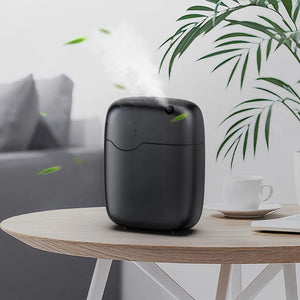
Founder Diaries · Clinics & Medical Centres · From Sprays and Reeds to the Machine
By Sonal Sahani · ISIPCA Versailles 11 min read Updated September 2026
Twelve hours a day, six days a week, is 3,744 running hours a year, and that single number disqualifies most of the products people consider.
What suits it is a machine that can be scheduled rather than remembered, locked so the setting survives, run quietly enough not to be heard through a consultation wall, stopped automatically at the end of the day, and kept going for a quarter at a time without anybody carrying anything to a sink. That is the
Vaayu at ₹11,999. This page works through the duty cycle hour by hour and then writes out the whole year's operating burden as a number of tasks, because that number is the honest way to compare the options and almost nobody calculates it.
Quick answers — read this first
The short answer: a waterless, timed, key-locked machine — the
Vaayu at ₹11,999. Up to 1000 m³, a 400ml fill lasting about seventy-five days, 1h/4h/8h/24h timers plus Bluetooth app scheduling, adjustable intensity, auto-stop, under 38 dB.
The duty cycle: an eight-to-eight clinic open six days a week runs 3,744 hours a year. The machine should start about thirty minutes before the first appointment and stop with the last one. The 24h setting is for buildings that never close, and a clinic is not one.
The annual burden: about ten events a year — five refills and four or five intensity checks. A water-based machine in the same building is around 624 tank operations a year, and five of them covering the same volume is about 3,120. That arithmetic is the whole comparison.
The short answer
Short answer: a waterless cold-air machine that can be scheduled and locked.
Twelve hours a day, six days a week, is 3,744 running hours a year, which rules out anything that has to be remembered, refilled daily, adjusted by hand or left running overnight. The
Vaayu at ₹11,999 runs the opening hours on a timer, holds one locked intensity and needs a refill about every seventy-five days.
The pick: the
Vaayu at ₹11,999 — up to 1000 m³, 400ml tank, app plus 1h/4h/8h/24h timers, adjustable intensity, auto-stop, key-lock, under 38 dB, freestanding or wall- or HVAC-mounted. The
Aangan at ₹25,999 only where the volume is genuinely 3,000 m³ or the tie-in is to a whole-floor air handler. A water-based
Sukoon at ₹1,899 only for a single administrative cabin with a named owner.
Shop: the
Vaayu ₹11,999 and the
Aangan ₹25,999. Ultrasonics are water-based and hold standing water:
Sukoon ₹1,899 with three 15ml scents included,
Boond ₹899,
Megh ₹3,499, running the
Hotel Collection from ₹299 at three to six drops per tank. Alcohol-free reeds from ₹749 for an office. Free shipping above ₹499.
Straight answer
What type of diffuser actually suits a medical facility that is open twelve hours a day?
1. One that runs on a schedule rather than on somebody's memory. Twelve hours a day, six days a week, is 3,744 hours a year. Anything that depends on a person switching it on at 7:30 and off at 8:00 will be switched on late and left on overnight, repeatedly, and neither of those is a small error.
2. One that can be locked. Twelve hours of public access is twelve hours of hands. In a waiting hall the key-lock is what keeps the intensity you set in week one from becoming somebody else's intensity in week three, and it is the single specification that makes a machine viable in a room full of people you have never met.
3. One quiet enough for the wall it shares. Under 38 dB is quieter than a consultation room's own air conditioning. A sound you can just hear is tolerable for five minutes and intolerable across a twelve-hour shift, and reception shares a wall with a cabin in most polyclinics.
4. One with a refill interval measured in months. The
Vaayu holds 400ml, which lasts about seventy-five days on a clinic's opening hours — four or five refill visits a year per unit. A water-based machine in the same building is a task at open and a task at close, about 624 operations a year.
5. One that stops by itself. Auto-stop plus a schedule means the machine does not run overnight into an empty building. Run the same unit around the clock and a 400ml fill drops from about seventy-five days to about thirty-seven, which is double the fragrance for nobody.
6. And the rules that do not change with the hours. If the building smells of something, that smell is information about a source — a dry drain trap, a bin schedule, a linen route, an air-conditioning drain pan — and the job is to find it and fix it rather than covering it. Consultation and examination rooms, procedure rooms, dressing rooms, sample collection, laboratories, dispensing, sterile stores, imaging, oncology day-care and paediatric clinical areas stay fragrance-free with the doors shut, twelve hours a day like everything else.
A portion of every order supports girl-child education through Nanhi Kali.
TL;DR: one that is scheduled, locked, quiet and waterless. Twelve hours a day, six days a week, is 3,744 running hours a year, so the machine has to start and stop on a timer, hold a locked intensity, run under 38 dB through a shared wall and go a quarter between refills. The
Vaayu at ₹11,999 is about ten operating events a year; a water-based machine in the same building is about 624.
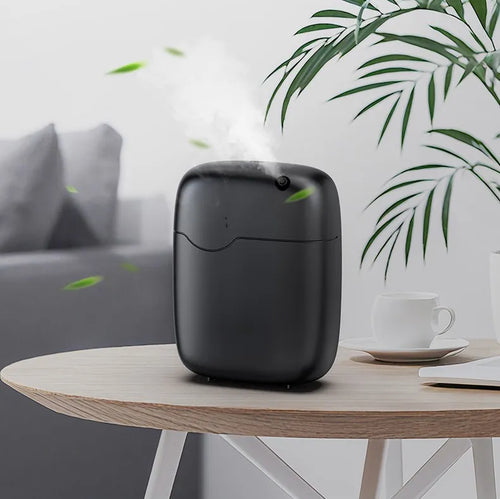
Twelve hours on, twelve hours off, by schedule rather than by memory
SOSA Vaayu · timers and app ₹11,999
1h, 4h, 8h and 24h onboard timers, Bluetooth app scheduling, adjustable intensity and auto-stop. An eight-to-eight clinic is 3,744 opening hours a year, and the only honest way to run a machine for 3,744 hours is on a schedule that starts before the first appointment and stops with the last one. The 24h setting exists for buildings that never close, and a clinic is not one of them. Run it around the clock instead and a 400ml fill goes from about seventy-five days to about thirty-seven, which is double the fragrance to scent an empty building for nobody. Under 38 dB, quieter than the reception's own air conditioning.
3,744 hours, and what that rules out
The useful way to specify a machine for a clinic is not by square feet, which is where every conversation starts, but by hours. An eight-to-eight facility open six days a week asks a small appliance to run 3,744 hours a year, every year, in a public room, unattended, while nobody thinks about it — and that is a duty cycle rather than a use case. A domestic diffuser is designed around a living room between seven and eleven in the evening, which is perhaps 1,400 hours a year with somebody in the room the whole time. Nearly everything that goes wrong in a clinic installation comes from applying the second kind of product to the first kind of building, so it is worth being precise about what twelve hours actually demands.
1
THE DUTY CYCLE
3,744 hours a year, unattended, in a room full of strangers
Start with the number and take it apart.
Twelve hours a day, six days a week, fifty-two weeks: 3,744 hours, against 8,760 in a year. The machine is running 43 per cent of all the time there is, and for every one of those hours there is nobody standing next to it. Three things follow. First, everything that requires a human action every day will eventually not happen, which is the whole of the standing-water argument and
it has a page of its own. Second, anything that can be reached will be adjusted: a bored twelve-year-old, a helpful relative who thinks the room smells strong, a new receptionist who found a dial. The key-lock is not a luxury on a machine at this duty cycle, it is the thing that makes the setting mean something a month later. Third, the machine has to stop.
A clinic is shut for 5,016 hours a year and there is no argument for scenting an empty building through any of them — the Vaayu has 1h, 4h, 8h and 24h onboard timers plus Bluetooth app scheduling, and the 24h setting exists for buildings that genuinely never close, which a polyclinic is not. Run it around the clock and a 400ml fill falls from about seventy-five days to about thirty-seven, so you double the fragrance bill to scent a locked corridor between ten at night and seven in the morning. Auto-stop is the backstop for the evening somebody changes the schedule and forgets, and
holding a consistent level from opening to closing is the whole objective the timers exist to serve.
2
THE CONTROLS THAT MATTER AT HOUR NINE
Noise through a shared wall, and a setting that stays put
Then the two specifications that only reveal themselves late in the day.
The first is noise, and it is underrated because showrooms are noisy and clinics at half past seven in the evening are not. The
Vaayu runs under 38 dB, which is quieter than a consultation room's own air conditioning, and the reason that threshold matters in this building type rather than in a hotel lobby is architectural: in most Indian polyclinics the reception desk shares a wall or a partition with at least one cabin, and a doctor who can hear a faint intermittent noise for eleven of their twelve hours will ask for the machine to be moved, then switched off, and that will be the end of your scenting programme. A sound you can just about hear is fine for five minutes and corrosive over a shift.
How loud a diffuser is, and whether it carries into a consultation room deserves its own straight answer.
The second is the key-lock plus adjustable intensity, which work as a pair: the intensity is what you set, and the lock is what makes it still be the setting in October. The routine I would follow is to set it in the first week by walking in from outside each morning before the building fills — your own nose acclimatises within a fortnight and the person who spends all day in the room is the worst possible judge of its level — then lock it and write the setting into the standard operating procedure. The instruction that goes with it is the one I repeat on every page in this cluster: nobody turns it up at midday because the waiting area got busy.
A shared waiting area fills and empties twice a day, and adding fragrance to a crowded room makes it worse rather than better. Busy is an air-change and occupancy problem.
3
THE ANNUAL BURDEN
Ten events a year, or six hundred and twenty-four
Now the arithmetic that settles the category question, and I would write it into any procurement note.
The Vaayu asks your building for about ten things a year: five refills, because a 400ml tank lasts about seventy-five days on twelve-hour days, and four quarterly walk-in checks on the intensity and the schedule. Call it ten events, each of them ten minutes, owned by one person. A water-based machine in the same building asks for two operations every trading day — empty, rinse and dry at close, refill at open — which is 624 a year at five to seven minutes each, or roughly fifty hours of somebody's time. And because one ultrasonic covers 270–320 sq ft against up to 1000 m³, holding the same public volume takes five or six machines, which is somewhere around 3,120 tank operations a year.
By coincidence that is almost exactly the number of hours the building is open, which is a useful thing to say out loud in a procurement meeting: you would be performing one tank operation for every hour the clinic trades. None of this makes the ultrasonic a bad machine. It makes it a machine for one room with one owner, and
the head-to-head sets out the two columns where it wins outright. The other number worth putting in the same note is fragrance: four or five fills a year per unit is a quarterly line item that procurement can model in ten minutes, and
whether you buy one machine per floor or one for the building changes that line more than anything else on this page.
The specification I would write for a twelve-hour facility, in one line: scheduled, locked, under 38 dB, auto-stopping, and refilled in months rather than days — and if a machine fails any one of those, it is a machine for a different building.
The twelve-hour day, hour by hour
What the building is doing, what the machine should be doing, and who is allowed to touch it, from the hour before opening to the hour after closing. This is the shape of the standard operating procedure I would write for a facility open eight to eight, and the two rows that matter most are the midday one and the last one.
Eight to eight
A twelve-hour clinic day, and what the machine does through it
| Time |
What the building is doing |
What the machine should be doing |
Who touches it |
| 07:00 · T-60m ★ |
Housekeeping opens up. Water down every drain trap in every toilet and unused sink |
Off. This hour is free work and no machine substitutes for it |
Nobody |
| 07:15 · T-45m |
Air conditioning on, so the building comes to temperature before the first patient |
Off |
Nobody |
| 07:30 · T-30m |
Front office opening, files out, the hall still empty |
Starts on the schedule, at the set intensity. It reaches its level well inside this window |
Nobody — the app schedule does it |
| 08:00 · T-0 |
First appointment. The lobby begins to fill |
Holding. The climb is over before anyone arrived |
Nobody |
| 10:30 · peak |
The hall is full, the queue is at its longest, doors opening constantly |
Unchanged |
Nobody. Busy is a ventilation problem, not a fragrance one |
| 13:00 · midday |
Occupancy peaks again after lunch; the room feels warmer and closer |
Unchanged, and this is the rule people break |
Nobody turns it up. Ever |
| 16:00 |
Second session, evening consultants arriving |
Unchanged |
A quarterly walk-in check happens at about this hour, four times a year |
| 19:45 |
Last appointments, hall emptying |
Still running on the schedule |
Nobody |
| 20:00 · close |
Bins out, dressing waste out, mops dried flat rather than left in buckets |
Stops on the schedule; auto-stop is the backstop |
Nobody. A water tank would need emptying, rinsing and drying here |
| 20:00–07:00 |
Locked and empty |
Off. There is no argument for scenting an empty building |
Nobody |
Shop this guide
The twelve-hour setup, in three products
The SOSA principle
Specify the machine by hours rather than by square feet. A living-room product runs about 1,400 hours a year with somebody in the room; a clinic asks for 3,744 with nobody in it.
Which is why the specification that matters is not mist output. It is the timer, the lock, the noise floor, the auto-stop and the interval between refills.
The annual operating burden, as a number of tasks
Start by writing the year out, because a number of tasks is the only comparison a facility manager can act on. One Vaayu in a clinic open eight to eight, six days a week: five refills a year, since a 400ml tank lasts about seventy-five days on that duty cycle, plus four quarterly checks on the intensity and the schedule. Ten events, one owner, perhaps two hours of somebody's year in total. Set against that, a water-based machine at the same duty cycle is a task at open and a task at close on every trading day — about 624 operations a year at five to seven minutes each, which is close to fifty hours — and because one holds 270–320 sq ft against up to 1000 m³, covering a public volume takes five or six of them and the number goes to somewhere around 3,120. That is one tank operation for roughly every hour the building is open. I would rather put that arithmetic on the page than have a clinic discover it in month four, and the question of who owns any of these tasks should be settled before the purchase order rather than after the machine arrives. The full annual cost of scenting a medical centre is worked out separately, and this task count is the half of it that never appears on a quotation.
Then the placement and the setting, which at this duty cycle are decisions you make once and live with for a year. Put the machine three to four metres inside the entrance rather than at the threshold, because a doorway is a pressure boundary and anything released there leaves immediately, which pushes people into raising the intensity until the first thing a patient meets is a wall of fragrance. Above waist height, because a cold-air mist falls rather than rises and a unit on the floor is scenting a skirting board. At the edge of the zone rather than in the traffic line. Out of the direct throw of an air-conditioning vent, which strips the light top off a composition and leaves the heavy end standing alone — that is how a level that was correct in the morning reads as thick by evening without anybody having changed it. In a public hall I would pay the fitting cost for the Vaayu wall or HVAC mount, which puts the machine out of reach for all 3,744 hours rather than only the ones somebody is watching. Then set the intensity in week one by walking in cold each morning, lock it, and write the setting down. Your own staff will stop being able to smell the building within a fortnight, because a nose reports change and discards constants, so the person who asks for it to be turned up is almost always the person least able to judge it. Ask somebody who walks in twice a month and ask them to be accurate rather than polite.
Then the scent, and the parts of the range that do not suit this duty cycle at all. A fragrance that is pleasant for ten minutes and one that is bearable for twelve hours are different briefs, and only the second is the brief here: clean, dry, quiet, unmemorable as a product and impossible for a patient, a relative or a visiting consultant to object to. The Westin-inspired White Tea Serenity — white tea, aloe and cedar — is the lightest of the seven and my default for a medical building; the Ritz-Carlton-inspired Quiet Luxury is a step more present; the 1 Hotels-inspired Forest Suite is the dry one for a hall that a café corner reaches. Avoid anything floral, sweet, gourmand or nameable as a perfume, because over twelve hours a distinctive scent stops being a background and starts being a fact about your clinic. On the rest of the range: an alcohol-free reed diffuser from ₹749 takes 24 to 72 hours to establish and falls away past about a metre, which makes it an administrative-cabin product rather than a waiting-hall one; candles are not appropriate in a healthcare facility because an open flame is a fire-safety and insurance matter; and SOSA does not make a room spray, because a morning spray is a twenty-minute product in a twelve-hour building. And none of this applies to consultation and examination rooms, treatment and procedure rooms, dressing rooms, sample-collection rooms, laboratories, dispensing, sterile stores, imaging, oncology day-care or paediatric clinical areas, which are fragrance-free for all twelve hours with their doors shut.
A domestic machine runs about 1,400 hours a year with somebody sitting next to it. A clinic asks for 3,744, unattended, in a room where anybody can reach it.
— Sonal Sahani, SOSA
The SOSA edit
Specified for a facility open twelve hours a day, six days a week. The middle rows are the four specifications that actually decide it — schedule, lock, noise floor and refill interval — and the last row is the product people ask for first and should not buy at this duty cycle.
The SOSA edit
A twelve-hour facility, in specification order
| Buy |
What it is |
Why it suits 3,744 hours a year |
Price |
| 1. Vaayu ★ |
Waterless, up to 1000 m³, 400ml lasting about 75 days, app plus 1h/4h/8h/24h timers, adjustable intensity, auto-stop, key-lock, under 38 dB |
About ten operating events a year against roughly 624 for a water tank. It runs the opening hours and stops |
₹11,999 |
| 2. Vaayu wall or HVAC mount |
The same machine fixed at height or tied into the air handling |
Out of reach for all 3,744 hours rather than only the ones somebody is watching |
fitting cost |
| 3. The scent: the lightest of the seven |
Westin-inspired White Tea Serenity — white tea, aloe and cedar; the 1 Hotels-inspired Forest Suite where a café corner reaches the hall |
Bearable for twelve hours is a different brief from pleasant for ten minutes |
from ₹299 |
| 4. Aangan only if the volume is genuinely there |
Up to 3,000 m³, 800ml, metal body, programmable schedules, under 42 dB, HVAC or standalone |
A double-height atrium or a whole-floor air-handler tie-in. Wrong for a 2,500 sq ft polyclinic |
₹25,999 |
| 5. Sukoon for one administrative cabin |
500ml, 270–320 sq ft, 16–18 hours on low, remote, steady/2H/4H timers, three 15ml scents included |
Only where one named person empties, rinses and dries the tank at close, six days a week |
₹1,899 |
| Wrong at this duty cycle: reeds in the hall |
Alcohol-free reeds from ₹749 need 24–72 hours to establish and fall away past about a metre |
Right in an admin cabin. In a forty-seat waiting hall nobody in the seating ever receives them |
from ₹749 |
Honest notes for buyers: fragrance in a medical facility is housekeeping and presentation, never treatment. Nothing on this page claims that a fragrance reduces anxiety, aids recovery, improves sleep, cleans or disinfects air, or has any clinical effect whatsoever, because it does not and a diffuser is not an air purifier. Scenting belongs to the entrance, reception, shared waiting areas, inter-departmental corridors and administrative rooms. Consultation and examination rooms, treatment and procedure rooms, day-care surgery, dressing rooms, blood- and sample-collection rooms, laboratories, pharmacy dispensing, sterile stores, imaging rooms, oncology day-care and paediatric clinical areas should be left fragrance-free. A persistent smell is information about a dry drain trap, a bin, a soiled-linen route or an air-conditioning drain pan: find it and fix it rather than covering it. On the machines: the
Vaayu at ₹11,999 is waterless cold-air nebulisation with no standing water tank, covering up to 1000m³ or roughly 2,000–3,000 sq ft, with a 400ml tank lasting about 75 days, Bluetooth app control, 1h/4h/8h/24h timers, under-38dB running, auto-stop and a key-lock for public areas. The
Aangan at ₹25,999 covers up to 3,000m³ and connects to HVAC for a whole floor or an atrium. The ultrasonic
Sukoon,
Boond and
Megh are water-based, hold standing water and add 30–50 ml of water an hour to the air, which makes them suitable for a single administrative cabin with a named person emptying and drying the tank daily, and unsuitable for public clinical property. An alcohol-free
reed diffuser needs 24–72 hours to establish and suits a small lobby rather than a large waiting hall. Candles are not appropriate in a healthcare facility because an open flame is a fire-safety matter. SOSA does not make a room spray. The Hotel Collection scents are SOSA's own interpretations inspired by the world's finest hotels; SOSA is an independent Indian fragrance house, not affiliated with or endorsed by any hotel brand. A portion of every order supports girl-child education through Nanhi Kali.

The scent nobody can name after twelve hours of it
Westin-inspired · White Tea Serenity ₹299 / 15ml
White tea, aloe and cedar — the lightest of the seven and the default for a medical building.
A fragrance that is pleasant for ten minutes and a fragrance that is bearable for twelve hours are different briefs, and only the second one is the brief here. Clean, dry, quiet, unmemorable as a product, and impossible for a patient, a relative or a visiting consultant to object to. The Ritz-Carlton-inspired
Quiet Luxury is a step more present and the 1 Hotels-inspired
Forest Suite is the dry one for a hall a café corner reaches. The water-based 15ml bottles at ₹299 run in the ultrasonic machines; the
Vaayu takes its own undiluted oil and arrives with four scents.
A note from Sonal
The number that changed how I specify for clinics came out of a spreadsheet rather than a nose. I was asked by a centre manager in Nashik to justify a ₹11,999 machine against a ₹1,899 one, and instead of talking about mist I counted tasks: ten a year against six hundred and twenty-four, and about three thousand once you accounted for the five machines it would take to cover his hall. He looked at it for a while and then said the thing that has stayed with me, which was that he could not put three thousand of anything into a housekeeping roster that was already losing an argument with the bins.
That is the whole case, and it is not a fragrance case at all. A building open twelve hours a day, six days a week, does not need a better-smelling machine. It needs one that can be scheduled, locked, heard by nobody, stopped automatically and forgotten about for seventy-five days at a time. Everything else — which of the seven scents, what intensity, where exactly it stands — is a week's work in the first month and then it is done. What I would not do is buy a machine that requires a small act of diligence every evening from a person who is also carrying the dressing waste out, because over 3,744 hours that act is going to lose, and the room will be the last thing in the building to tell you so.
Everything is made and supported from Pune, and a part of every order funds girl-child education through Nanhi Kali. You get a space that smells like somewhere looked after; a girl gets a classroom. That equation has always felt right to me.
Frequently asked questions
What type of diffuser suits a medical facility open twelve hours a day?
A waterless machine that can be scheduled, locked and left. Twelve hours a day, six days a week, is 3,744 running hours a year, so it needs timers rather than a switch, a key-lock so the intensity survives public access, under 38 dB for a shared consultation wall, auto-stop, and a refill interval in months. The
Vaayu at ₹11,999 holds up to 1000 m³ on a 400ml fill lasting about seventy-five days.
Should the diffuser run overnight in a clinic?
No. A clinic is closed for about 5,016 hours a year and there is nothing to be gained from scenting an empty building through any of them. Set the app schedule to start about thirty minutes before the first appointment and stop with the last one. Running around the clock takes a 400ml fill from about seventy-five days to about thirty-seven, which doubles the fragrance for nobody.
How many times a year does the machine actually need attention?
About ten. Five refills, because 400ml lasts roughly seventy-five days at twelve hours a day, plus four quarterly walk-in checks on the intensity and the schedule. A water-based machine at the same duty cycle is about 624 tank operations a year, and five of them covering the same public volume is somewhere near 3,120.
Will a diffuser be heard from a consultation room?
The
Vaayu runs under 38 dB, which is quieter than most consultation rooms' own air conditioning. It matters in a clinic because reception so often shares a wall or partition with a cabin, and a faint intermittent sound that is tolerable for five minutes is not tolerable across a twelve-hour shift.
Can we turn it up when the waiting hall is full in the afternoon?
No, and this is the rule most often broken. A full hall is an air-change and occupancy problem, and adding fragrance to a crowded room makes it worse rather than better. Set the intensity once in the first week by walking in from outside each morning, lock it, write it into the standard operating procedure, and leave it alone.
3,744 hours a year, unattended
Scheduled, locked, under 38 dB — and refilled four times a year
The Vaayu is ₹11,999: waterless cold-air nebulisation with no standing water tank, up to 1000 m³ or roughly 2,000–3,000 sq ft, a 400ml tank lasting about seventy-five days, Bluetooth app control with 1h/4h/8h/24h timers, adjustable intensity, under 38 dB, auto-stop and a key-lock for public areas, 0.9 kg, freestanding, wall-mounted or HVAC-tied, supplied with four hotel-inspired fragrances. The Aangan is ₹25,999 for up to 3,000 m³ and a whole-floor tie-in. Free shipping above ₹499, and a portion of every order supports girl-child education through Nanhi Kali.
See the Vaayu · ₹11,999 The seven scents · from ₹299
Continue the read
More from SOSA
Editorial standards & sources
About this guide: Written by Sonal Sahani, ISIPCA Versailles-trained founder and perfumer at SOSA Home & Body, on specifying a diffuser for a medical facility by duty cycle rather than by floor area — 3,744 running hours a year, the timers and key-lock that make that survivable, the under-38dB noise floor for a shared consultation wall, the seventy-five-day refill interval, and the full annual operating burden written out as a number of tasks.
Facts verified August 2026: Product facts used in this guide. SOSA Vaayu ₹11,999: waterless cold-air nebulising diffuser, atomises undiluted fragrance oil to a dry residue-free nano-mist with no water reservoir, coverage up to 1000m³ (approximately 2,000–3,000 sq ft), 400ml refillable tank lasting up to about 75 days per fill, Bluetooth app plus onboard control, 1h/4h/8h/24h timer scheduling, adjustable intensity, under 38 dB, DC 12V/1A at 5W, 165 × 80.5 × 215 mm and 0.9 kg, freestanding or wall or HVAC mounted, auto-stop and key-lock, CE, RoHS and SGS certified, supplied with four hotel-inspired fragrances. SOSA Aangan ₹25,999: HVAC-connected or standalone commercial nebulising diffuser, coverage up to 3,000m³ (roughly 8,000–10,000 sq ft), 800ml reservoir, metal body, programmable schedules, under 42 dB. Ultrasonic machines are water-based, hold standing water and consume 30–50 ml of water an hour: Sukoon ₹1,899 (500ml, 270–320 sq ft, 16–18 hours on low, 3–6 drops per tank, steady/2H/4H timers, three 15ml Hotel Collection scents included), Boond ₹899 (300ml), Megh ₹3,499 (6 litres). Hotel Collection water-based fragrance 15ml ₹299, 100ml ₹999, 300ml ₹1,799, Pack of 7 at 15ml ₹1,799 against ₹2,093 bought singly; the Vaayu and Aangan take their own undiluted oil rather than these water-based bottles. Alcohol-free reed diffusers from ₹749, requiring 24–72 hours to reach their working level. Free shipping above ₹499. Coverage arithmetic: cubic metres equal floor area in square feet divided by 10.76 and multiplied by ceiling height in metres, counting only the volumes that are actually scented. This guide makes no medical, therapeutic or clinical claim of any kind for fragrance: a diffuser does not purify, disinfect or clean air, and does not treat, calm or affect any patient or condition. Fragrance is housekeeping and presentation. Clinical areas should be left fragrance-free, and a persistent odour should be traced to its source and corrected rather than covered. SOSA is not affiliated with or endorsed by any hotel brand. Prices subject to change — see the live product pages.