



2. Cleanliness you can see. Floor edges, seat fabric, the toy box — and the toilet, which is the most closely inspected room in the clinic.
3. Acoustics. A shrieking waiting room reads as chaos.
4. Staff manner at the desk. Acknowledgement within five seconds.
5. Light temperature and seating comfort — for forty minutes, not for twenty seconds.
6. Ambient scent, a long way behind, and only if the five above are already right.
2. Cleanliness parents can see — and the toilet decides it. Not certified cleanliness, visible cleanliness: the floor at the edges and under the chairs, the front edge of the seat fabric, the state of the toy box, the glass on the door, the counter where a child’s hands go. And then the patient toilet, which is the single most diagnostic room in a paediatric clinic, because almost every parent with a toddler will end up in it and will look at it carefully. A clean, dry, well-stocked, well-ventilated toilet with a lidded bin quietly settles the question of how the whole place is run.
3. Acoustics. A waiting room finished in tile, glass and laminate holds sound, so one distressed child fills it and two sound like a crisis. Parents arriving into that read the clinic as not in control — and parents already in it become tenser, which makes their own children harder to settle. The fixes are cheap and unglamorous: an absorbent ceiling tile over the seating, a fabric panel behind it, the television turned down rather than up, and seating broken out of a single hard row. Sound is the third signal and the one most often left entirely undesigned.
4. The manner of the person at the desk. Acknowledgement within about five seconds of arrival, even when the desk cannot serve you yet. A name used. An answer to “how long” given without irritation, and given again when it changes. Reception staff in paediatrics are managing anxious adults and unwell children simultaneously and are usually under-supported in doing it; training and staffing that desk properly is a better spend than most of the fit-out. It is also the cheapest of all these signals to improve.
5. Light, seating — and, well below them, smell. Warm rather than cool light, layered rather than a flat ceiling grid; and a chair actually designed to be sat in for forty minutes by an adult holding a child, rather than linked steel that is chosen because it hoses down. Those are the fifth signal. Ambient scent is the sixth, and it operates only in the narrow band where the room is already odour-neutral and the fragrance is quiet enough not to be remarked on. If the room smells of disinfectant, a bin or closed air, that is a housekeeping and ventilation problem and it sits back up at rank two, not rank six.
Made in India, composed by an ISIPCA Versailles-trained perfumer — and a portion of every order supports girl-child education through Nanhi Kali.

Why the ranking looks like this, and why it surprises owners
Parents in a paediatric waiting room are not evaluating a hospitality experience. They are anxious, often about something they cannot assess themselves, and they are scanning for evidence that the people here are competent and in control. Every item at the top of the ranking is a control signal. A communicated wait says the clinic knows what is happening in its own building. Visible cleanliness says the routine work is being done properly, which is the closest thing a layperson has to evidence about the work they cannot see. A calm noise floor says the room is being managed. A desk that acknowledges you says somebody is watching the door. Ambient fragrance is not a control signal. It is a decorative one, and decorative signals sit below competence signals whenever a person is worried.
The reason clinic owners misrank it is that they are not experiencing their own clinic. An owner walks in through the back, does not queue, is never uncertain about the wait, and has been inside long enough that olfactory adaptation is complete within about twenty minutes — so the smell is the one variable they genuinely cannot judge, which paradoxically makes it feel like the one available lever. Meanwhile the wait, the noise and the desk are things they see every day and have stopped noticing. The correction is simple and slightly humbling: sit in your own waiting area, in an ordinary chair, for forty minutes at your busiest hour, having told nobody. Everything in this ranking becomes obvious inside ten minutes, and the fragrance question stops feeling urgent.
Where the money should actually go
 Sixth on the listFrom ₹749Put the current running delay somewhere a parent can see it and update it. Give the desk a script for saying it unprompted. Then take the cleaning from certified to visible: floor edges and under-seat areas on the daily list, seat fabric and the toy box on a written rota, glass wiped twice a day, and the patient toilet checked hourly with a lidded bin, working extract fan and stocked consumables. These two ranks are where a premium reputation is actually built, and neither of them requires a designer or a supplier.
Directions: dry and low-sweetness, such as Quiet Luxury or White Tea Serenity. No gourmand, no heavy floral.
Zone by zone, against the ranked signals
The right-hand column of this table is the sixth signal. The middle columns are the first five. Read it that way and the proportions look correct.
| Area of the clinic | Scented? | Why | What we would use |
|---|---|---|---|
| Entrance and reception desk ★ | Yes, low | Where the wait is communicated, the desk is manned and the sightline is set — scent is the finish | Reed from ₹749, or Sukoon ₹1,899 |
| Waiting seating and play area | Minimum only | Acoustics, seat comfort, visible cleanliness and the toy rota decide this room, not fragrance | Nothing separate from reception |
| Patient toilet and nappy-change | No | The most closely inspected room in the clinic — extract fan, lidded bin and hourly checks | Ventilation and a rota |
| Consultation and examination rooms | No | Premium here is punctuality, privacy and a clinician who has read the file — not ambience | Nothing |
| Vaccination, injection and procedure rooms | No | A distinctive scent paired repeatedly with an unpleasant procedure becomes associated with it | Nothing |
| Nebulisation, asthma and neonatal follow-up | Never | Respiratory patients and newborns; nothing added to the air, at any intensity | Nothing |
| Before any of this: sit in your own waiting room for forty minutes at the busiest hour before spending anything. The ranking above will rearrange itself in front of you, and it will not rearrange in fragrance’s favour. | |||
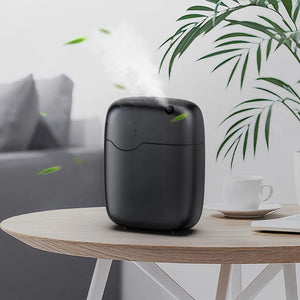
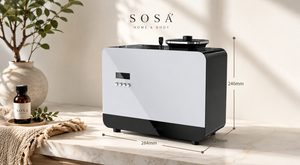
Small reception · no power neededFrom ₹749Shop →  Mid reception · has an off switch₹1,899Shop →
 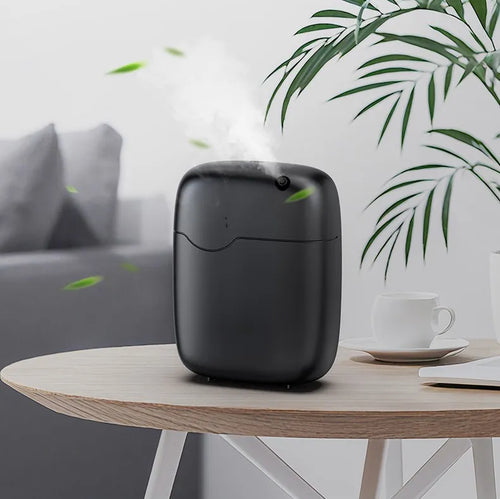 Large lobby · timed, dialable₹11,999Shop →
If you get as far as the sixth signal
Spend on it in proportion to its rank. A clinic that has put a whiteboard at the desk, written a cleaning rota, treated the ceiling and staffed reception properly has spent its money in the right order, and the fragrance line on that budget should be small. For most paediatric receptions that means reeds at ₹749 to ₹1,349 or a Sukoon at ₹1,899, not an eleven-thousand-rupee machine. The Vaayu is the right answer only where the reception is genuinely too large for passive diffusion or sits on its own duct zone.
Set the level for the longest occupant, not the shortest. The parent at the desk is there for twenty seconds; the child in the waiting area is there for thirty to sixty minutes. Every default setting in the scenting trade is written for the twenty seconds because it was written for hotel lobbies and retail. Start at the equipment minimum, schedule to clinic hours only, mount high and aim away from seating so the unit is out of the 0.8–1.2 m band where a child breathes, and calibrate with a nose that has been outside for thirty minutes.
And treat any comment as a signal to reduce. If a parent remarks on the fragrance — even kindly — the level has crossed from the sixth signal into something being evaluated, which is not what you wanted from it. Keep an off switch at the desk and use it without argument for a family with a scent-sensitive or asthmatic child. Every clinical area stays fragrance-free, and the decision as a whole belongs with your clinical governance, infection-control and housekeeping leads rather than with a fragrance supplier.
What we would actually install
Matched to reception size and to the sixth position on a six-item list. The last row is on the table because a clinic that has done ranks one to five has already won the argument.
| Option | Suits | Control you get | Price |
|---|---|---|---|
| Reed diffuser ★ | A small reception desk — a desk up to about 150 sq ft; the right size of spend for the sixth item on the list | Reed count only — no switch, no timer | from ₹749 |
| Sukoon 500ml | A reception up to ~320 sq ft — a reception up to about 320 sq ft, in intermittent mode on three drops, with a switch at the desk | On/off, intermittent mode, you control the drops | ₹1,899 |
| Vaayu | A large lobby or a zoned duct — a reception too large for passive diffusion, or one that genuinely has its own duct zone | Duty cycle in seconds, timer, app scheduling | ₹11,999 |
| Aangan | Whole-facility HVAC — a facility of 8,000–10,000 sq ft with ducting that can exclude every clinical room | Zone-level control, but only if the ducting is zoned | ₹25,999 |
| Nothing at all | A clinic that has fixed the wait, the cleaning, the acoustics and the desk — it is already being read as premium, and adding scent will not move the needle much | Complete — and the correct answer more often than the trade admits | ₹0 |
Versailles
I have sat in a lot of paediatric waiting rooms with a notebook, and the pattern is always the same. The parents who look most unhappy are not sitting in the ugliest room. They are sitting in the room where nobody has told them how long it will be. You cannot buy your way past that with anything I sell.
The second thing I notice is the toilet. Owners think of it as a service space; parents think of it as evidence. If a mother has taken a two-year-old in there and come out having touched a dirty flush handle, the reception can smell of whatever you like and the clinic has been judged. Hourly checks, a working extract fan, a lidded bin and stocked consumables cost less than one machine and matter more.
So when a clinic asks me what would make it feel more premium, I ask what their average running delay is, whether the desk says it out loud, and when the toy box was last washed. If those answers are good I am delighted to sell them a reed or a small diffuser for the entrance, dry and quiet, nothing clinical, off switch at the desk, signed off by their own governance leads. If those answers are bad, they should not be buying fragrance from anybody yet. A portion of every order funds a girl’s classroom through Nanhi Kali.
Frequently asked questions
- The first ten seconds, sequenced — door, sightline, sound, air.
- Improving the first impression without renovating — the cheap, high-yield list.
- Which sensory details matter — sound, touch, temperature, then smell.
- How much of “clean and premium” is fragrance? — a specific answer, with numbers.
- Brand: the SOSA founder story.
SOSA products & prices (verified August 2026): Hotel Collection water-based ultrasonic diffuser fragrance 15ml ₹299 · 100ml ₹999 · 300ml ₹1,799 · Pack of 7 (15ml, all fragrances) ₹1,799; refills 100ml from ₹999. Seven scents: The Ritz-Carlton-inspired (white tea · bergamot · cedar), Westin-inspired (white tea · aloe · cedar), 1 Hotels-inspired (cedarwood · vetiver · green leaves), The St. Regis-inspired (amber · violet · woods), Shangri-La-inspired (jasmine · green tea · white tea), Four Seasons-inspired (citrus · floral · sandalwood), W Hotels-inspired (citrus · pepper · amber). Diffusers: Boond 300ml ₹899 · Sukoon 500ml ₹1,899 · Megh 6L ₹3,499. Water-based, phthalate-free, composed to IFRA standards for home diffusion; 3–6 drops per tank. Made in India, Pune. The Hotel Collection scents are SOSA's own interpretations inspired by the world's finest hotels; all hotel names are trademarks of their respective owners and are used only to describe the scent style — SOSA is an independent Indian fragrance house, not affiliated with or endorsed by any hotel brand. Prices and availability subject to change — see the live product pages.