


The highest impact? Citrus — the W Hotels-inspired Lobby Bar. Fastest to register, least neutral.
The family to keep away from the door? Amber-oriental. Slow, heavy and the hardest to clear from a small hall.
2. The highest-impact answer: citrus. Nothing reaches a stranger faster. Citrus molecules are small, volatile and universally recognised, so they land inside the first breath. Choose this when you want the entrance actively noticed — W Hotels-inspired Lobby Bar is the crisp version.
3. The four tests. Legibility — can a stranger name what they are smelling. Speed — does it register in eight seconds. Neutrality — does it mean the same thing to a range of Indian guests. Door resistance — does it survive the air being replaced. A family has to pass all four; most pass two.
4. The family to keep away from the door: amber-oriental. Rich, slow and beautiful, and all three qualities are wrong at a threshold. Amber takes longer than eight seconds to open and much longer than an evening to leave a small hall. The St. Regis-inspired Old-World Glamour belongs in a bedroom or a dining room.
5. The setting. Three drops on a Boond (₹899), run low and continuously through the hours people arrive. The family choice decides what the visitor reads; the running pattern decides whether they read anything at all.
Made in India, composed by an ISIPCA Versailles-trained perfumer — and a portion of every order supports girl-child education through Nanhi Kali.
The four tests a doorway sets, and why they are not the usual ones
The tests that decide a bedroom scent — how it develops, how it accumulates, whether you still like it in the third week — do not apply at a front door, because nobody is there long enough for any of them to be measured. Four different tests apply instead. Legibility: can a stranger, in one breath, put a name to what they are smelling. Complexity is a virtue in a room and a liability at a door, where an unplaceable accord simply registers as "something". Speed: does the family land inside the first two or three breaths. Families differ enormously here — citrus and green notes are quick, ambers and heavy woods are slow, and a family that needs ten minutes to bloom has missed the appointment.
Neutrality: does it mean roughly the same thing to everyone who walks in. This test is sharper in India than the international literature admits. A guest arriving at your door may associate a heavy floral with a wedding, a temple or a funeral depending on their family and region; sandalwood and jasmine carry ceremonial weight for some visitors and none at all for others. A doorway is the worst possible place to discover which. Door resistance: can the family re-establish itself after the air has been replaced. A front door opening empties most of a small hall and refills it from the stairwell several times an evening, so the useful question is not how long a scent lasts in still air but how quickly a low dose rebuilds a level. Light families rebuild in a minute. Heavy ones never really left — which sounds like an advantage and is why a hall scented with amber smells of amber at midnight.
The families that pass, and the families that fail
 Hotel CollectionFrom ₹299Legibility: everyone reads it as clean, because it sits close to the vocabulary of laundry, linen and good hotels without belonging to any of them. Speed: tea notes are light and arrive in the first breath. Neutrality: this is where it wins outright — white tea carries no ceremonial, regional or festival association in India for anybody, which makes it the one family that cannot accidentally mean something. Door resistance: light and cheap to rebuild.
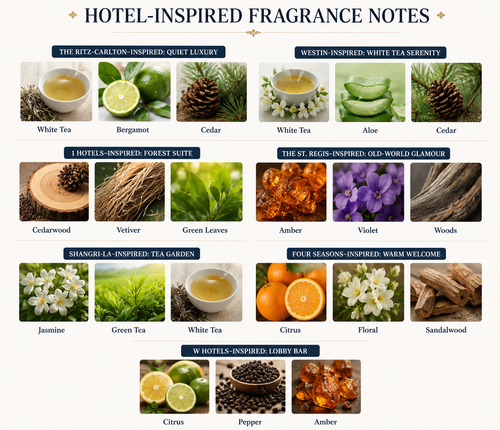
The two versions differ in temperature. The Ritz-Carlton-inspired Quiet Luxury adds bergamot and a firmer cedar and reads polished; Westin-inspired White Tea Serenity uses aloe and reads cooler.
Door resistance is the honest weakness, and at a threshold it costs little: citrus fades fast, but nobody stands in a foyer long enough to watch it. W Hotels-inspired Lobby Bar is the crisp, peppery version; Four Seasons-inspired Warm Welcome is citrus softened by floral and sandalwood.
All five families, scored for a doorway
One representative bottle per family, scored on the four tests rather than on quality — the two at the bottom are among the best blends SOSA makes and both are wrong in a hallway. The pack of seven 15ml testers at ₹1,799 settles this in your own entrance.
| Scent | Notes | Character | Best for |
|---|---|---|---|
|
The Ritz-Carlton-inspired ★ Quiet Luxury |
White tea · bergamot · cedar | Clean white-tea — passes all four; the safest first impression | Any entrance, any guest list. The default answer |
|
W Hotels-inspired Lobby Bar |
Citrus · pepper · amber | Citrus — fastest to register, highest impact, least durable | An entrance you want actively noticed; a bright flat, evening arrivals |
|
1 Hotels-inspired Forest Suite |
Cedarwood · vetiver · green leaves | Woody — neutral and door-resistant, but slow to make its point | A foyer that opens onto wood, stone or plants; congruence over impact |
|
Shangri-La-inspired Tea Garden |
Jasmine · green tea · white tea | Green-floral — quick and legible, weakest on cultural neutrality | A garden entrance, and a guest list whose associations you can predict |
|
The St. Regis-inspired Old-World Glamour |
Amber · violet · woods | Amber-oriental — richest, slowest to open, slowest to clear | Not a doorway family. A dining room or a bedroom, later in the evening |
| Not in this family, for reference: Westin-inspired White Tea Serenity is the softer clean white-tea, the quietest option of all; Four Seasons-inspired Warm Welcome is citrus rounded with floral and sandalwood — warmer at a door, and the sweetest-reading of the seven. See all seven. | |||
Hotel Collection · start with a 15mlFrom ₹299Shop →  Sukoon · a large or open entrance₹1,899Shop →
  Boond · the entrance machine₹899Shop →
Dose, timing, and the thing no family can fix
Three drops in a Boond whichever family you land on, with one adjustment: take a drop off for green-floral or amber. A foyer is small — often no more than fifteen cubic metres — so the temptation is to use two, and the front door is why you should not. Every time it opens, most of the scented air in that little volume leaves and the hall refills from the stairwell. Three drops survives being emptied and rebuilt several times in an evening.
Run it low and continuously through the arriving hours rather than as a burst before the doorbell — and this matters more for some families than others, which is the practical half of the door-resistance test. A light clean or citrus rebuilds within a minute or two of the door closing, so continuous running genuinely works. A heavy amber cannot, which is why people compensate with a bigger dose and end up with a hall that smells of last night. Set the machine going at six and leave it. It uses less fragrance than a pre-arrival blast, because holding a floor is cheaper than chasing a peak.
And the part no family solves. Shoes are the real smell in most Indian entrances, and fragrance does not touch them. Worn leather and canvas in a warm closed cabinet produce a bacterial odour that is chemically unrelated to anything in a diffuser, so you get both smells at once rather than one covering the other — and a clean white-tea makes it worse, because the contrast draws attention to it. The fixes are physical: move the rack out if the building allows, use an open rack, dry shoes before storing them, and clean the cabinet itself, which is usually the source. Then the usual housekeeping — rinse the tank between scents, filtered water in hard-water cities, and never raw essential oils in an ultrasonic, which are too viscous to atomise and will foul the plate.
Which diffuser to run it in
The family decides what your visitor reads. The machine decides whether the dose is sane for the volume you actually have — and an entrance is almost always the smallest volume in the plan.
| Diffuser | Best for | Drops | Price |
|---|---|---|---|
|
Boond 300ml, USB, night light |
The standard flat entrance — a console, a shoe cabinet, two metres of passage. The right machine | 3 drops | ₹899 |
|
Sukoon ★ 500ml, remote, mood light |
An entrance that opens into the living room, or a foyer with a staircase off it | 4–5 drops | ₹1,899 |
|
Megh 6 litre, large tank |
A double-height villa entrance or a lobby-scale hall | 5–6 drops | ₹3,499 |
| Hotel Collection 15ml | Testing two families side by side — two 15ml at ₹598, or the pack of seven at ₹1,799 | Many fills | ₹299 |
| Refills · 100ml & 300ml | The family that won, in the size that lasts a year — 300ml at ₹1,799 | Months of use | from ₹999 |
Versailles
Perfumers are trained to answer the question "which is better", and at a doorway that is the wrong question. The right one is "which is hardest to misread". Those pull in opposite directions, because the blends I am proudest of are the ones with something odd in them, and odd is exactly what a stranger has no time to decode.
The neutrality test is the one I underestimated for years. I composed a jasmine I still think is the most beautiful thing in the collection, and I have had two customers tell me, quite kindly, that in a hallway it reminded them of a funeral. Not a criticism of the material — a fact about what flowers have meant in their families. You cannot compose that away, and at a front door you do not get a chance to explain.
So my advice is to buy two 15ml at ₹598 rather than trusting a table, one from the clean family and one citrus, and run each for a week. Then walk out of the house and come back in after ten minutes, because your own nose stops reporting on your own hallway within twenty. A portion of whatever you spend funds a girl's classroom through Nanhi Kali.
Frequently asked questions
- Best fresh fragrance for a home entrance — the clean family, argued in one bottle.
- Best citrus fragrance for a bright and fresh foyer — why fast fade stops mattering at a door.
- Which fragrance is best for your entrance? — three questions, one bottle.
- The complete foyer and entrance guide — placement, sizing, dose and what to buy first.
- Brand: the SOSA founder story.
SOSA products & prices (verified August 2026): Hotel Collection water-based ultrasonic diffuser fragrance 15ml ₹299 · 100ml ₹999 · 300ml ₹1,799 · Pack of 7 (15ml, all fragrances) ₹1,799; refills 100ml from ₹999. Seven scents: The Ritz-Carlton-inspired (white tea · bergamot · cedar), Westin-inspired (white tea · aloe · cedar), 1 Hotels-inspired (cedarwood · vetiver · green leaves), The St. Regis-inspired (amber · violet · woods), Shangri-La-inspired (jasmine · green tea · white tea), Four Seasons-inspired (citrus · floral · sandalwood), W Hotels-inspired (citrus · pepper · amber). Diffusers: Boond 300ml ₹899 · Sukoon 500ml ₹1,899 · Megh 6L ₹3,499. Water-based, phthalate-free, composed to IFRA standards for home diffusion; 3–6 drops per tank. Made in India, Pune. The Hotel Collection scents are SOSA's own interpretations inspired by the world's finest hotels; all hotel names are trademarks of their respective owners and are used only to describe the scent style — SOSA is an independent Indian fragrance house, not affiliated with or endorsed by any hotel brand. Prices and availability subject to change — see the live product pages.