



- The direct answer
- Why the physical experience decides whether the price feels justified
- The five environmental details that carry the most weight
- Comparing what each detail signals against what it costs
- Where scent fits, and how much weight it should carry
- What to specify, by facility size
- A note from Sonal
- Questions operators ask about the premium experience
2. Seating and privacy. Comfortable, private seating that does not put one client's consultation or paperwork in earshot or eyeline of the next is worth more to the premium reading of a visit than almost anything else in the room.
3. The washroom's condition. Clients judge a facility's whole standard on the one room they use without staff present — a washroom that is spotless, stocked and checked on a schedule is a stronger signal of quality than any furnishing in the lounge.
4. Sound and temperature, held steady. A lounge that is too cold, too warm, or carries noise from a corridor or a procedure room undoes a well-designed interior faster than almost any other single factor, and both are cheaper to fix than most operators assume.
5. How long a client goes without information. Whether a client is mid-test or between appointments, a facility that tells them what happens next and roughly how long it will take reads as organised; one that leaves them guessing reads as ordinary, regardless of the interior spend.
Fragrance belongs on this list as one small, consistent detail — the sixth item, not the first — and it should never be asked to carry the weight the other five are responsible for.
Why the physical experience decides whether the price feels justified
A preventive-health package priced well above a standard diagnostic panel is not being bought for the tests alone — the same blood work and imaging exist at a fraction of the price elsewhere. What the premium price buys is the experience of being tested: organised, unhurried, and hosted rather than processed. A client who has paid for that experience reads the building for evidence of it from the moment they walk in, long before any result is discussed.
That reading happens fast and mostly at the margins most operators do not budget for. Interior spend goes on furniture, lighting and finishes that a client notices consciously; the five details in this post are the ones a client registers without naming them — whether the receptionist already had their file ready, whether the chair beside them is close enough to overhear a stranger's conversation, whether the washroom looks like it was checked an hour ago or a week ago.
None of this is a case for spending more. It is a case for sequencing correctly: fixing the ordinary, unglamorous details before adding anything decorative, fragrance included. A facility that gets arrival, seating, the washroom, sound and temperature, and information right will read as premium in a plain room; one that gets those wrong will not read as premium in a beautifully designed one.
The five environmental details that carry the most weight
 Vaayu₹11,999Give the receptionist the client's name, package and rough schedule before they arrive, so the greeting is personal rather than administrative — this is the single most heavily weighted detail on this list.
Comparing what each detail signals against what it costs
Every row below is an operational decision before it is a design one, and none of them requires a renovation to fix.
| Detail | What it signals | Who owns it | What it costs |
| Arrival and being expected | Organisation and hospitality, in the first ninety seconds | Front-of-house / practice management | Staff briefing, not a renovation |
| Seating and privacy | Discretion — whether the facility treats a client's visit as confidential | Interior layout, revisited without new furniture | Rearrangement, occasionally new dividers |
| Washroom condition | The ceiling on the facility's entire standard, set by its least-supervised room | Housekeeping, on a logged schedule | A checklist, not a budget line |
| Sound and temperature | Whether the lounge is genuinely restful or merely looks the part | Facilities / HVAC | Calibration, sometimes acoustic treatment |
| Information while waiting | Whether the client feels attended to or forgotten | Front-of-house protocol | A script, not a purchase |
| Fragrance is deliberately absent from the rows above — it belongs lower in this list than any of them, and is addressed on its own terms further down this page. | |||
 Vaayu · reception and lounge₹11,999Shop →
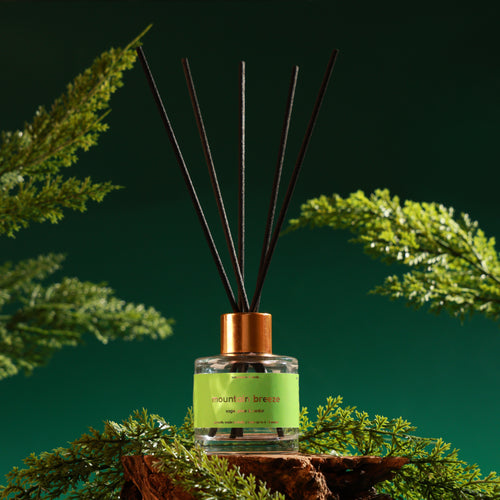
  Sukoon · one combined zone₹1,899Shop → Mountain Breeze · a single consultation suite₹849Shop →
Where scent fits, and how much weight it should carry
Once the five details above are genuinely in order, ambient fragrance earns a place as the sixth — a consistent, low-intensity presence in reception and lounge that a client notices once on arrival and stops registering within minutes. It is not the reason the visit feels premium; it is one small, steady part of an environment that already does.
Keep the register dry and restrained rather than sweet or floral, run it low, and confine it to hospitality areas only — consultation rooms sit lower again, and any space where a client is examined, undressed, fasting or unwell stays completely unscented, with staff able to switch the system off within seconds if anyone asks.
Resist the instinct to raise intensity because a client is spending three to four hours in the building. A stronger scent does not make the other five details better; it only makes the lounge stronger for people arriving while the seated client adapts to it and stops noticing it regardless. The gradient — noticeable at the threshold, essentially gone within the lounge — is the correct target, not a compromise.
What to specify, by facility size
Every route below assumes the five non-fragrance details above are already handled — fragrance is specified last, deliberately.
| Route | Facility | Why | What it costs |
| Vaayu, wall-mounted at reception, run low and on a fixed schedule | A multi-room premium centre with a staffed reception and separate lounge | Reaches the shared hospitality zone at a consistent, controllable level, switched off overnight | ₹11,999 |
| Two Vaayu units, one per hospitality zone | A facility with reception and lounge physically separated, or more than one client path | One point of control does not reach two separated zones evenly | ₹23,998 |
| Sukoon, single zone, run on the lower setting | A smaller premium practice with one combined reception-and-lounge room | Proportionate to a single room, adjustable without a fixed installation | ₹1,899 |
| Reed, one consultation suite | A single-room or single-suite premium offering | A small, low-key presence appropriate to one room, placed after seating and privacy are settled | ₹849–₹1,349 |
| Leave consultation and every clinical or examination space unscented | Any facility offering a premium package | Keeps the standing zoning rule intact regardless of how the hospitality areas are scented | — |
Operators come to me expecting a conversation about scent and usually get a longer one about the washroom first. I ask what the checklist looks like, who signs off on it, and how often it is actually followed — because no fragrance I can recommend will out-perform a washroom a client judges as neglected.
The honest version of my job in this category is telling a founder that fragrance is the smallest of the decisions on this list, not the largest, and that spending on it before the other five are settled is spending in the wrong order. I would rather a client leave our conversation with a washroom checklist and a seating plan than with a diffuser and nothing else changed.
When the other five details are genuinely right, the fragrance decision becomes easy — low, dry, confined to reception and lounge, switched off wherever a client is examined or unwell. It is the last decision in this list because it is meant to be the smallest, and that is exactly how I recommend treating it.
Questions operators ask about the premium experience
- How Can I Make a ₹10,000+ Executive Health Package Feel More Premium From the Moment the Client Arrives? — the arrival-moment version of this same sequencing question.
- If Customers Pay More for Executive Health Screening, Should the Physical Environment Feel Noticeably Different Too? — whether a higher price should mean a noticeably different environment.
- We've Spent Crores Building a Premium Preventive-Health Facility — Should Ambient Scent Be Part of the Experience? — the same question asked by an operator who has already spent heavily on the interior.
- How Can I Make an Executive Health Centre Feel More Premium Without Another Interior Renovation? — making the experience feel more premium without another renovation.
- Brand: the SOSA founder story.
SOSA products & prices (verified September 2026): Reed diffusers 50ml ₹749–₹849 (to 150 sq ft, 6–8 weeks at six reeds) · 130ml ₹1,249–₹1,349 (above 150 sq ft, 14–18 weeks) · reed refill 300ml ₹2,399. Ultrasonic: Boond ₹899 (~150 sq ft) · Sukoon ₹1,899 (270–320 sq ft, ships with three 15ml Hotel Collection fragrances) · Megh ₹3,499 (6L tank, ~100 hrs runtime, ~215 sq ft — a runtime machine, not a coverage upgrade). Waterless cold-air: Safar ₹3,999 (no published coverage figure) · Vaayu ₹11,999 (up to 1000 m³, roughly 2,000–3,000 sq ft; 400ml tank lasting about 90+ days; app and onboard control, 1h/4h/8h/24h run windows, adjustable intensity, key-lock, under 38 dB, freestanding or wall/HVAC mount, 5W, CE/RoHS/SGS) · Aangan ₹25,999 (8,000–10,000 sq ft). Hotel Collection water-based fragrance 15ml ₹299 · 100ml ₹999 · 300ml ₹1,799 is for ultrasonic machines; reed oil and Hotel Collection are not interchangeable. Reed diffusers are alcohol-free, phthalate-free, paraben-free, IFRA-compliant and low VOC, handmade in small batches in Pune. Every purchase funds a girl's education through Nanhi Kali. Prices and availability subject to change — see the live product pages.