

What stops a gift from moving on: it has already been opened or set up, it clearly belongs to their particular home, and it would look odd handed to somebody else. Those three properties matter more than price.
Non-food gifts that stay put: a plant chosen for their light, one piece of good serveware, a book with something written inside it, a well-made everyday object, or a home fragrance chosen for a specific room in their flat.
Do not give fragrance if: they have said they dislike scented things, the house already burns agarbatti or dhoop every morning, there is a newborn, or someone in the household reacts badly to fragrance.
2. Aim for a gift that cannot be passed on comfortably. That is the whole design brief. Not more expensive, not more elaborate — less transferable.
3. The non-fragrance options that pass that test. A plant chosen for the light they actually have, in a pot that is better than the plant. One good piece of serveware — a stoneware platter, a heavy jug — for a household that feeds people. A book with a line written inside the cover; the writing is what makes it stop. A well-made everyday object for a habit you have seen them have: a proper tea strainer, a good chopping board, a linen napkin set.
4. Home fragrance, chosen for one named room. A room fragrance is one of the few gifts where the choice itself is visible: bright lemon and mint for the kitchen, lavender and chamomile for the bedroom, rose and jasmine for the entrance. When you name the room as you hand it over, the gift becomes theirs in a way a sealed box never is. It is also unusually well-suited to a house where nobody wants more food, because it is a consumable with no appetite attached — 6–8 weeks on a 50ml, 14–18 on a 130ml.
5. Open it, if you are there. Take the seal off, put the six reeds in, stand it on a tray. A gift that has been set up in the house has effectively stopped travelling.
6. And the honest no. If they have said they dislike scented things, if the house already has a fragrance routine of its own, if there is a newborn, or if someone there reacts to fragrance — give the plant or the serveware and do not think twice about it.
Composed and handmade in small batches in Pune, and a portion of every order supports girl-child education through Nanhi Kali.

Part one — the politeness problem, and why you never get told
Indian gifting has an unusual property: the recipient has almost no way to decline. Refusing food is read as refusing the relationship, so the box is taken, thanked for, and dealt with later. This is not dishonesty — it is a functioning social system, and the passing-on is part of how it functions. But it means the feedback loop that tells you whether a gift worked has been cut. You will hear "so thoughtful of you" whatever happens next, which is why families give the same unwanted thing to each other for a decade.
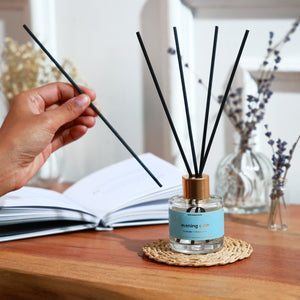
 Evening Calm₹799 · for a bedroomA sealed, unnamed, universally acceptable box is the most liquid asset in Indian gifting. It has no personal marking, it suits anyone, and it can be handed on within hours without a word of explanation. During festival weeks some boxes cover impressive distances. None of this is anybody behaving badly; it is what happens when a gift is designed to be interchangeable. The counter is specificity. A bottle chosen for their bedroom because you know they read at night, opened and set up on their side table, is not currency. It has their room's name on it. If you want a gift to stay, the property to buy is not cost — it is the awkwardness of re-gifting it.
Part two — what stays in the house and what quietly travels
This is the table I wish somebody had shown me at twenty-five. It is not about which gift is nicest; it is about where each one is likely to be a month later, and what you can honestly learn about whether it landed.
| The gift | Chance it leaves the house | Who ends up enjoying it | What you learn about whether they liked it |
|---|---|---|---|
| A fragrance chosen for one named room ★ | Very low — it has been set up and it belongs there | Everyone in the house, and every visitor | You find out; people mention it, or ask what it is |
| A sealed box of mithai | High during festival weeks | Often a third household you have never met | Nothing — the thanks are identical either way |
| A dry fruit tin | Moderate; it keeps, so it waits in a cupboard | Whoever it is eventually passed to | Nothing |
| A decorative object | Low — but it is kept out of politeness | Nobody, in most cases | Misleading: it is displayed when you visit |
| A plant chosen for their light | Very low | The household, if they wanted the job | Honest — it either thrives or it does not |
| A book with a line written inside | Almost nil; the writing fixes it in place | One person, deeply, or nobody | You will know within a month |
| The honest caveat: a reed diffuser only earns the top row if it is chosen with a room in mind and handed over with a reason. Left sealed in its box on a shelf, it is as transferable as anything else — glass, unopened, obviously giftable. And if the household has already told you they dislike scented things, or already scents the house with incense every morning, none of this applies: buy the plant or the serveware. | |||
Garden Bloom · entrancefrom ₹799Shop → 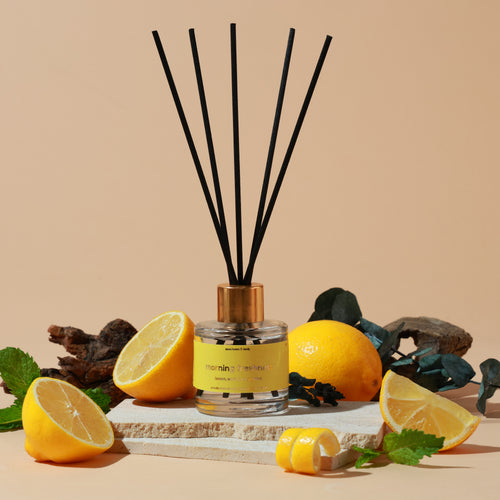 Morning Freshness · kitchenfrom ₹749Shop →
 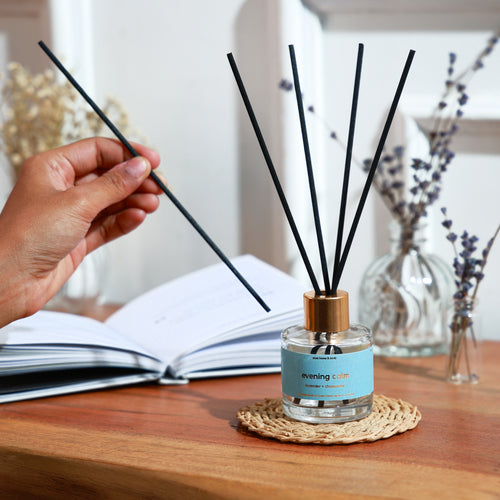 Evening Calm · bedroomfrom ₹799Shop →
Part three — when not to give this at all
The first case is the simplest and the one people over-think: if they actually like mithai, buy the mithai. This entire article is for the household where the box is being received politely and moved on, not for the family that waits for it. Do not solve a problem that is not there.
The second is anybody who has said, in any words, that they do not like scented things — candles, car perfumes, the smell of a hotel lobby. That is a stated position, not a gap in their education, and a gift that argues with it is uncomfortable to receive however good the product is. The third is a home with a fragrance routine already running. A great many Indian homes are scented every single morning: agarbatti at the shelf, dhoop after the floors are cleaned, camphor in the evening. That is not an empty category waiting for a diffuser; adding one produces a third smell that nobody designed, and the household will quietly stop using whichever came second. The fourth is a house with a newborn, or a nursery — not a room for a gift to enter unless the parents have asked. Keep any fragrance product away from children and pets in any case, and stand the bottle on a tray, because the oil marks wood and stone.
There is one more, subtler than the rest. If somebody in the house is sensitive to fragrance — the relative who gets a headache in the perfume aisle, the family member with asthma — a room fragrance is not something they can opt out of the way they can decline a perfume. That is a real reason to choose the plant instead, and it costs you nothing to ask a mutual family member first. Two practical gaps while I am being honest: SOSA has no gift card, and I cannot confirm gift wrapping, gift notes or delivery straight to the recipient — check what exists at checkout rather than planning your evening around it. What is in the box is a refillable glass bottle and six fibre reeds.
Part four — the gift edit, by who you are giving it to
The mithai box gets used across every relationship at once, which is its convenience and its weakness. A replacement has to be chosen by relationship, because what makes a gift stop with a neighbour is not what makes it stop with your mother-in-law.
| Who it is for | What to give | Price | The sentence to say when you hand it over |
|---|---|---|---|
| In-laws or an older relative ★ | Garden Bloom 50ml for the entrance hall | ₹799 | "For the hall — it is the first thing anyone notices when they come in." |
| A neighbour you like but do not know well | Morning Freshness 50ml | ₹749 | "Lemon and mint — I thought it would suit your kitchen." |
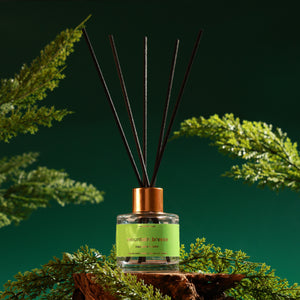
| A colleague or a boss | Mountain Breeze 50ml — dry woods, nothing sweet | ₹849 | "For a desk or a study. It is pine and cedar, not a perfume." |
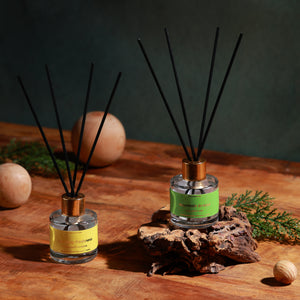
| A sibling or close friend who hosts | Warmth & Bloom duo | ₹1,598 | "One for the living room, one for the entrance." |
| A household that has just moved in | Fresh & Grounded duo, or 130ml bottles | ₹1,548 · ₹1,249–₹1,349 | "New flats smell of paint. These two will fix that for four months." |
| Someone who genuinely loves sweets | Buy the mithai. This is not a problem you need to solve | — | Nothing to explain |
| Not a gift | An oil refill at ₹2,399 — it needs a bottle they already own | ₹2,399 | Perfect for an existing owner, baffling as a present |
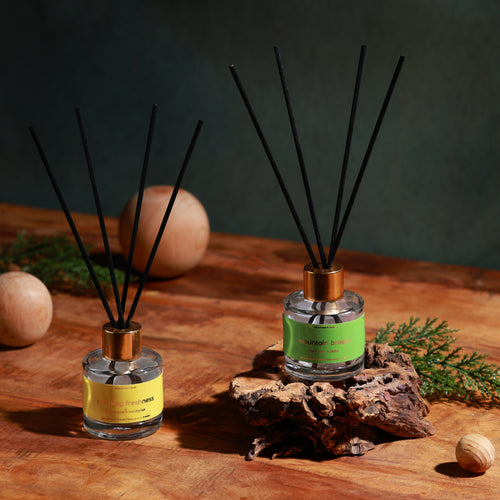
Versailles
One Diwali, a box I had taken to a family friend in the morning came back to my parents' house in the evening, in the hands of a third person. Same shop, same ribbon, same box. Nobody had done anything wrong. It had simply moved through three homes in a day, doing its job as currency and never once being a gift.
What struck me was not the waste — it was the silence. Every one of those houses had said thank you warmly. Not one of them had wanted it. When a gift cannot be refused, the polite response tells you nothing at all, and you can spend years being reassured by feedback that is not feedback.
So my rule now is to give something with a room attached, and to say the room out loud. It is a small change and it makes the exchange honest again — they can tell you it is not their thing, or they can put it on the side table that evening, and either way you have learned something. Everything we make is composed and handmade in small batches in Pune, and a portion of every order funds a girl's classroom through Nanhi Kali.
Frequently asked questions
- What to gift someone who does not eat sweets — the three assumptions inside a food gift.
- Non-edible gifts for Indian festivals — what survives being the twenty-first gift of the week.
- Which SOSA reed diffuser to gift instead of food — matching the warmth of a hamper without the hamper.
- The complete non-food gifting guide — this page and the eight around it in one place.
- Brand: the SOSA founder story.
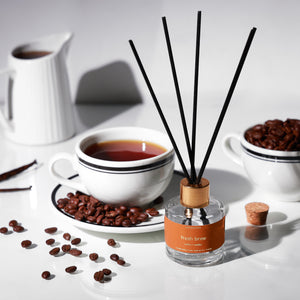
SOSA reed diffuser range & prices (verified August 2026): alcohol-free, phthalate-free, paraben-free and IFRA-compliant compositions on a heat-stable coconut-derived (CCT) carrier, low-VOC, supplied in a refillable glass bottle with six fibre reeds; 50ml lasts 6–8 weeks and 130ml lasts 14–18 weeks. Morning Freshness (Malabar lemon · peppermint · Nilgiri eucalyptus) 50ml ₹749 · 130ml ₹1,249 · 9.0/10; Garden Bloom (British rose · night-blooming jasmine) 50ml ₹799 · 130ml ₹1,299 · 8.9/10; Evening Calm (Kashmir lavender · chamomile) 50ml ₹799 · 130ml ₹1,299 · 8.9/10; Fresh Brew (Coorg coffee · Kerala vanilla) 50ml ₹849 · 130ml ₹1,349 · 9.5/10; Mountain Breeze (Himalayan pine · sage · Indian cedar) 50ml ₹849 · 130ml ₹1,349 · 9.4/10. Reed diffuser refills are oil only — you reuse your own vessel and reeds: 300ml ₹2,399 (roughly 8–11 months) · 500ml ₹3,499 (roughly 14–18 months), about ₹7–8 per ml against ₹15–17 per ml for a 50ml bottle. Duo sets ₹1,498–₹1,598 for 2 × 50ml and ₹2,498–₹2,598 for 2 × 130ml. Strength figures are positions on SOSA’s own internal strength scale, not an industry standard. Replacement reeds are not sold as a separate SKU; SOSA guidance is to refresh reeds every few months. The reed line is separate from the water-based Hotel Collection for ultrasonic machines (15ml ₹299 · 100ml ₹999 · 300ml ₹1,799) and the two are not interchangeable. Diffusers: Boond 300ml ₹899 · Sukoon 500ml ₹1,899 · Megh 6L ₹3,499 · waterless Vaayu ₹11,999. Composed and handmade in small batches in Pune, India; tested through 45°C summer heat and 85% monsoon humidity. Free shipping above ₹499. A portion of every order supports girl-child education through Nanhi Kali. Prices subject to change — see the live product pages.