

The half-life of novelty: a clever object peaks on the day it is opened and declines from there. A well-made ordinary object peaks in month two, when the recipient notices how good it is to use.
What genuinely works: hand-thrown ceramics from a studio you can name; a handloom throw with a weaver attached; one heirloom-grade kitchen tool; a plant of an unusual species that is nonetheless easy; and a composed home fragrance, which is ordinary as a category and rarely done properly.
Do not buy this if: they have said they dislike scented things, there is a newborn in the house, someone there is scent-sensitive, or they already own several diffusers.
2. Assume novelty has a half-life of about three weeks. Because a full house is a resolved system, a novel object is the one element in the room that has to keep justifying itself. That is exhausting for a permanent fixture, and the recipient cannot retire it without insulting you.
3. Look for the ordinary thing nobody does properly. Every home has half a dozen categories that everybody owns and almost nobody has bought a good version of: hand soap, table linen, the everyday bowl, the reading light, the way the place smells. Excellence in an ordinary category is far rarer than strangeness in an unusual one.
4. Some specific answers that are not fragrance. Hand-thrown stoneware from a studio you can name, one piece rather than a set. A handloom throw with a region and a weaver attached to it. A single heirloom-grade kitchen tool — a carbon steel pan, a heavy mortar — which is unremarkable to look at and transformative to use. A plant of an unusual species that is nonetheless forgiving. Each is ordinary in category and singular in execution.
5. Let the specification carry the uniqueness. The reason to say "Coorg coffee and Kerala vanilla" rather than "coffee-scented" is not marketing; it is that specificity is the thing that makes an ordinary category feel considered. A gift with a provenance is remembered. A gift with a concept is explained.
6. Apply the September test. Picture it in their house in an ordinary month with nobody visiting. Still working? Good gift. Only interesting when introduced? Novelty.
7. And know when not to. If they have said they dislike scented things, if there is a newborn or a scent-sensitive person in the home, if the flat is a single sealed room, or if they already run several diffusers, choose a different row from the table below.
Everything we make is composed and handmade in small batches in Pune, and a portion of every order supports girl-child education through Nanhi Kali.
Part one — why the search for "unique" goes wrong
I want to be fair to the impulse first. When somebody searches for a unique gift, they are not being frivolous — they are trying to signal effort, and novelty is the cheapest available signal of effort. The trouble is that it is a signal aimed entirely at the moment of opening, and the moment of opening lasts nine seconds. Everything after that is the object living in a room, and a room in a finished house has no unclaimed space for something that is interesting rather than good. Three things go wrong, and each has a straightforward correction.
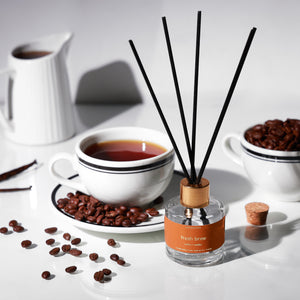
 Fresh Brew₹849 · coffee and vanillaHere is the hidden cruelty of the novelty gift: it is almost always an object, and objects in a full house are permanent. There is no graceful way to retire something odd that somebody gave you — you cannot use it up, and putting it away requires a decision that feels like a verdict on the giver. A gift with a stated life sidesteps the whole problem. A 50ml reed diffuser runs six to eight weeks and a 130ml fourteen to eighteen, after which the glass can be refilled if they liked it and quietly retired if they did not, with no verdict required from anybody. For a recipient whose home is finished, that exit is worth more than any amount of ingenuity at the point of purchase. It is also why consumables are chronically under-rated in gift guides: they look modest on the day and behave beautifully afterwards.
Part two — how each kind of "unique" home gift ages
The same gift ideas, tracked forward. Day one is where most gift guides stop; month six is where the recipient actually lives.
| The gift | Where its "uniqueness" comes from | Day one | Month six |
|---|---|---|---|
| A composed home fragrance ★ | Specification — named materials, a maker, a room chosen for it | Pleasant; not obviously clever | Finished, and asked about — or refilled |
| Hand-thrown stoneware, one piece | The hand of a named potter; no two identical | Quietly admired | In daily use, and better for it |
| A handloom throw | Region, weave, weaver | Handled, unfolded, approved | Softer, on the sofa, permanent in a good way |
| One heirloom-grade kitchen tool | Material and manufacture — carbon steel, stone, cast iron | Underwhelming to look at | The thing they reach for first |
| An unusual but forgiving plant | The species, not the styling | A talking point | Thriving, or dead. There is no third outcome |
| A "conversation piece" object | Concept — it is odd, and that is the whole idea | Genuine delight | Explained to visitors by a tired host |
| A novelty gadget | Function nobody had asked for | Demonstrated twice | In a cupboard, with its cable |
| Personalised anything — names, dates, faces | It is about them, which feels like effort | Touching | Impossible to retire, wherever it ends up |
| The honest caveat: the top row only ages well if the category is open. In a home where somebody has said they dislike scented things, where there is a newborn or a scent-sensitive resident, or where two diffusers are already running, a composed fragrance ages exactly like the novelty rows — unused, and awkward to retire. Rows two, three and four are the safest of the alternatives, and none of them are ours. | |||
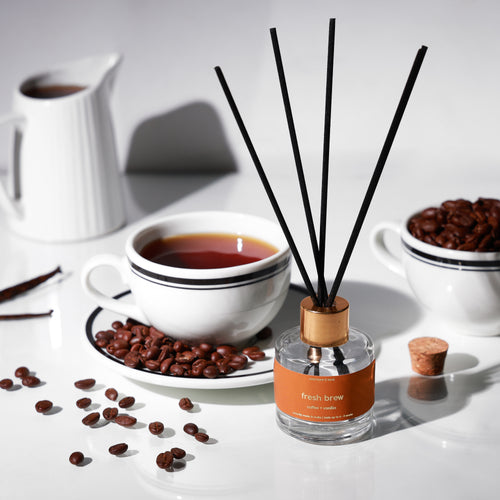 Fresh Brew · Coorg coffee, Kerala vanillafrom ₹849Shop →
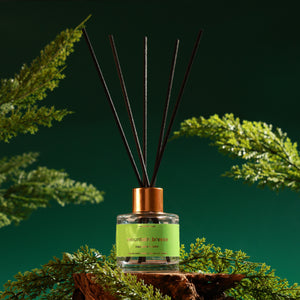
 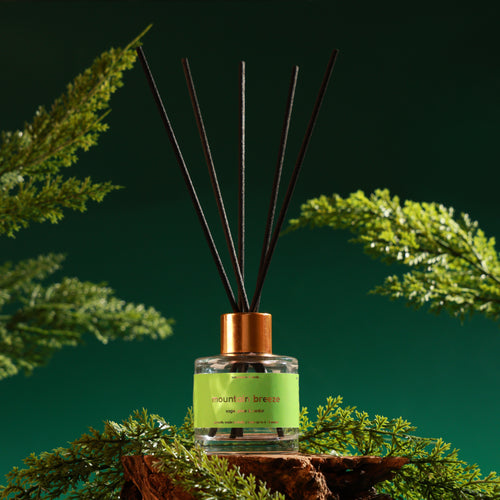 Mountain Breeze · pine, sage, Indian cedarfrom ₹849Shop →
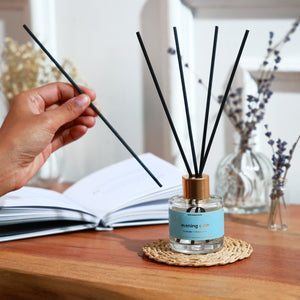
 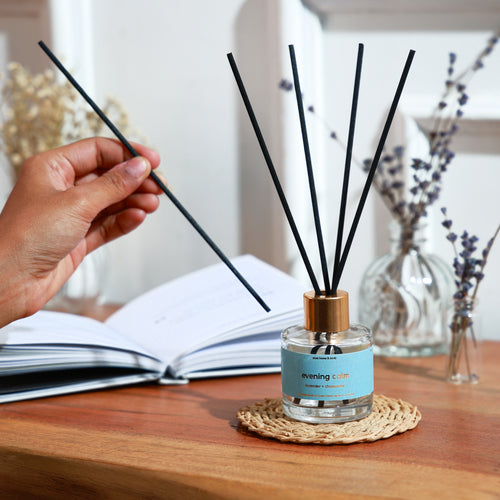 Evening Calm · Kashmir lavender, chamomilefrom ₹799Shop →
Part three — when this is the wrong gift
The exclusions first, plainly. Do not give home fragrance to anybody who has told you they dislike it. This one matters more here than anywhere else in the cluster, because the argument in this article — ordinary category, unusually good execution — is exactly the argument that tempts people to override a stated preference. It should not. Somebody who says they do not want their home to smell of anything is describing a preference, not a gap in their exposure, and a gift that runs continuously for six weeks is a poor place to make your case. The same applies to a home with a newborn, and to a household where somebody has asthma, migraine triggers or a diagnosed scent sensitivity. Our compositions are alcohol-free, phthalate-free, paraben-free, low-VOC and IFRA-compliant; none of that makes the decision yours.
Then two situations particular to this article's logic. A very small sealed flat — a studio, a single room, anywhere with one window and no through-draught — is a room where any constant fragrance stops feeling like a well-made ordinary thing and starts feeling like a decision imposed on the occupant. And a home where two or three diffusers are already running is not an unclaimed category; buying a fourth is precisely the shop-upward instinct that this whole sub-cluster exists to interrupt. In either case, take a different row from the ageing table: the stoneware, the throw and the kitchen tool all behave beautifully over six months and none of them are mine to sell.
One more warning, aimed at the word in this article's title. Do not go looking for a "unique" fragrance. The instinct to find something nobody has smelt before produces exactly the wrong outcome in a gift, because unusual accords are divisive accords — the whole reason they are unusual is that fewer people like them. Gift-safe fragrance runs the other way: familiar registers, executed carefully. It is also worth saying what we do not have, since somebody will ask. There is no oud in this range, no musk-forward composition, and nothing aquatic. Those are real gaps rather than editorial choices I am going to dress up, and if the person you are buying for loves any of the three, you should buy them from somebody who makes it well rather than accept the nearest substitute from us.
Part four — the gift edit, chosen by room
Since the uniqueness should live in the specificity, the useful way to choose is by the room you have actually stood in rather than by a personality you are guessing at. Prices are the whole reed range; there is nothing above ₹2,598 in it.
| The room you know about | What to give | What makes it specific | Price |
|---|---|---|---|
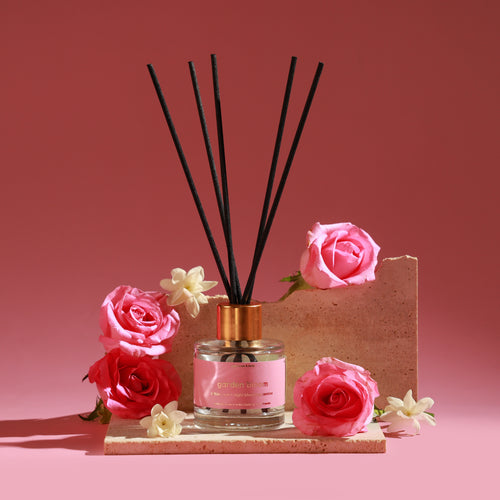
| An entrance or hallway ★ | Garden Bloom | British rose over night-blooming jasmine — the arrival note, done as an accord rather than a single sweetness | ₹799 · ₹1,299 / 130ml |
| A living room where people sit | Fresh Brew | Coorg coffee and Kerala vanilla; the fullest presence in the range at 9.5 | ₹849 · ₹1,349 / 130ml |
| A study, library or room of books | Mountain Breeze | Himalayan pine, sage, Indian cedar. Dry, with no sweetness at all | ₹849 · ₹1,349 / 130ml |
| A kitchen or a bathroom | Morning Freshness | Malabar lemon, peppermint, Nilgiri eucalyptus — cold enough to cut a humid room | ₹749 · ₹1,249 / 130ml |
| A bedroom, or a very small flat | Evening Calm | Kashmir lavender and chamomile; deliberately the softest thing we make | ₹799 · ₹1,299 / 130ml |
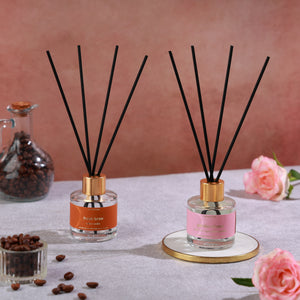
| Two rooms — you have seen the flat | A duo: Warmth and Bloom, Day and Night, Fresh and Grounded | Two scents that share a note, so adjoining rooms do not produce a seam | ₹1,498–₹1,598 · ₹2,498–₹2,598 / 130ml |
| A large open floor, or scent on demand | A Sukoon — a machine, not a reed product | 270–320 sq ft, 16–18 hrs on low, three 15ml Hotel Collection scents included | ₹1,899 |
| Not a gift | An oil refill | Sensible for an owner, meaningless to anybody else | ₹2,399 / 300ml |
Versailles
Early on, I was advised to give the range unusual names and unusual notes, because that is how a small brand gets noticed. It is good commercial advice and I did not take it, for a reason that has more to do with gifting than with perfumery. An unusual fragrance is by definition one that fewer people like — that is what makes it unusual — and a gift is precisely the wrong place to be running an experiment on somebody else's house.
So the five reed compositions are, in concept, entirely ordinary: coffee and vanilla, pine and cedar, lemon and mint, rose and jasmine, lavender and chamomile. Anybody could name those pairings. The work is not in the idea; it is in the execution — what the material is, how it behaves in a Pune summer at forty-five degrees, whether it is still itself in week six or has thinned into something sharp. We are phthalate-free on a heat-stable coconut base, and the trade that comes with is worth stating: a smaller opening than a solvent-heavy diffuser, and a longer, flatter plateau afterwards. That is not a novelty. It is just the ordinary thing done the way I would want it done in my own hall.
The gifts I remember receiving are all like this. A friend once gave me a plain wooden spoon, made properly, from a wood I had not cooked with. There was nothing clever about it whatsoever and I have used it for nine years. Everything we make is composed and handmade in small batches in Pune, and a part of every order funds a girl's classroom through Nanhi Kali.
Frequently asked questions
- What do you gift someone who has everything? — finding the empty category in a full house.
- Luxury gifts for a full house — why you cannot out-spend them, and what to do instead.
- Are reed diffusers a good gift for this person? — including the four recipients it is wrong for.
- The complete guide — this article and the eight around it, in one place.
- Brand: the SOSA founder story.
SOSA reed diffuser range & prices (verified August 2026): alcohol-free, phthalate-free, paraben-free and IFRA-compliant compositions on a heat-stable coconut-derived (CCT) carrier, low-VOC, supplied in a refillable glass bottle with six fibre reeds; 50ml lasts 6–8 weeks and 130ml lasts 14–18 weeks. Morning Freshness (Malabar lemon · peppermint · Nilgiri eucalyptus) 50ml ₹749 · 130ml ₹1,249 · 9.0/10; Garden Bloom (British rose · night-blooming jasmine) 50ml ₹799 · 130ml ₹1,299 · 8.9/10; Evening Calm (Kashmir lavender · chamomile) 50ml ₹799 · 130ml ₹1,299 · 8.9/10; Fresh Brew (Coorg coffee · Kerala vanilla) 50ml ₹849 · 130ml ₹1,349 · 9.5/10; Mountain Breeze (Himalayan pine · sage · Indian cedar) 50ml ₹849 · 130ml ₹1,349 · 9.4/10. Reed diffuser refills are oil only — you reuse your own vessel and reeds: 300ml ₹2,399 (roughly 8–11 months) · 500ml ₹3,499 (roughly 14–18 months), about ₹7–8 per ml against ₹15–17 per ml for a 50ml bottle. Duo sets ₹1,498–₹1,598 for 2 × 50ml and ₹2,498–₹2,598 for 2 × 130ml. Strength figures are positions on SOSA’s own internal strength scale, not an industry standard. Replacement reeds are not sold as a separate SKU; SOSA guidance is to refresh reeds every few months. The reed line is separate from the water-based Hotel Collection for ultrasonic machines (15ml ₹299 · 100ml ₹999 · 300ml ₹1,799) and the two are not interchangeable. Diffusers: Boond 300ml ₹899 · Sukoon 500ml ₹1,899 · Megh 6L ₹3,499 · waterless Vaayu ₹11,999. Composed and handmade in small batches in Pune, India; tested through 45°C summer heat and 85% monsoon humidity. Free shipping above ₹499. A portion of every order supports girl-child education through Nanhi Kali. Prices subject to change — see the live product pages.