
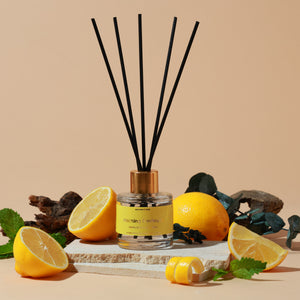
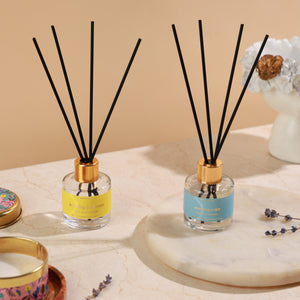

Why the corner and not the middle of the counter: the splash arc from a tap and the hands moving through it are both concentrated in the front-centre of a basin. The back corner sits outside that arc entirely.
Slide a saucer or small tray under the bottle. It costs nothing and stops the one damage complaint this placement actually produces — a ring on stone, marble or laminate.
2. The worst spot near the same basin is directly beside the tap, or between the taps and the mirror. Constant splash, constant hand movement, and water landing in an open bottle of a fractionated-coconut-oil composition makes the reeds wick unevenly — one side drinks, the other sits dry. It is also the position most likely to be knocked over while somebody reaches for the tap.
3. The floating shelf or mirror-cabinet ledge above the basin is acceptable, not ideal. Fine if it sits below the exhaust fan's pull and above splash height — but it is weaker than the counter because it sits above the zone you actually stand in, not within it.
4. The vanity's inner corner, beside a soap dispenser and a toothbrush stand, is where people actually put it — and it is fine, provided it is the corner furthest from the tap. That single condition is the difference between this working and this being the beside-the-tap mistake with a different name.
5. Two reeds in a small bathroom, three in a large one, and a saucer underneath. The saucer is not decoration — a reed diffuser is an open vessel of oil sitting on stone, marble or laminate, and this costs nothing while preventing the one damage complaint we actually hear about.
Alcohol-free, IFRA-compliant, composed by an ISIPCA Versailles-trained perfumer and handmade in small batches in Pune — and every purchase funds a girl's education through Nanhi Kali.
Why this two feet is both the best spot and one of the worst
A basin counter is unusual among reed diffuser locations because it fails and succeeds for the same reason: it is where you stand still. Every doctrine in this cluster says buy per place you stop moving, and a bathroom sink is one of the strongest stopping points in a home — brushing teeth, washing hands, shaving, the two-minute routines that happen at the same spot every single day. That is what makes any position on this counter worth considering. It is also what makes the wrong two feet of it worse than almost anywhere else in the flat, because you are close enough, and standing still long enough, to notice a fragrance doing its job badly.
The mechanism is simple. A tap throws water in a fairly consistent arc — down and slightly forward, with hands moving through that same arc dozens of times a day. Anything sitting inside that arc gets wet, gets knocked, and gets reached past. Anything sitting a foot or two outside it, at the back of the counter, gets none of that and still sits within the same stopping point. The basin does not have one placement quality; it has a gradient, and the difference between the best two feet and the worst two feet on the same counter is entirely about which side of that arc a bottle stands on.
This is also why "near the sink" as a piece of advice, on its own, is not quite honest. It is the correct room and the correct zone, but zone-level advice papers over a real difference in outcome. Two readers can both put a bottle "near the sink" — one in the back corner, one wedged beside the tap — and report completely different experiences of the same bottle, the same reeds and the same fragrance. The bottle is not the variable. The corner is.
The three things that decide it
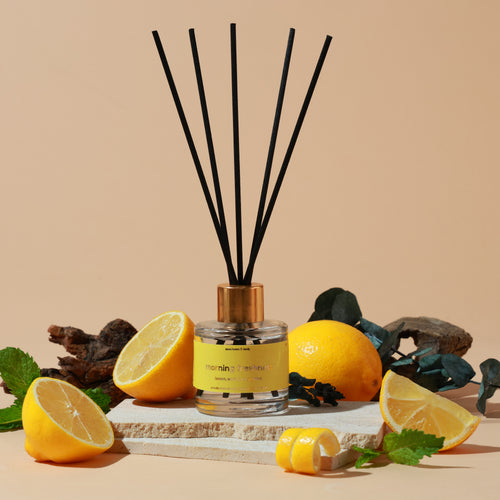
 Morning Freshness 50ml₹749Four things are true of the back corner at once, and each one alone would justify the placement. It is out of the splash arc, so the reeds wick evenly instead of one side drinking water and the other drying out. It is out of the way of hands and elbows reaching for the tap, soap or a towel. It sits at roughly the height a person is at when they are standing still at the basin, which is where a reed diffuser's soft radius does the most work. And it is against a wall, which means a knock sends the bottle into the wall rather than off the counter edge onto tile.
Every position on or near the basin, ranked
The table below covers the six spots people actually consider when a bottle needs to live near a sink, in the order of how far each sits from the splash arc and the traffic of hands. The back corner and the beside-the-tap spot can be less than two feet apart on a standard vanity — the ranking is about that gap, not about the room.
| Position | Verdict | Why |
|---|---|---|
| Back corner of the counter, against the wall, away from the tap | Best | Outside the splash arc, out of the way of hands, standing height, a knock lands on the wall |
| Vanity's inner corner, beside the soap dispenser, furthest from the tap | Good | Where people actually place it — fine as long as it is genuinely the far corner |
| Floating shelf or mirror-cabinet ledge above the basin | Acceptable | Below the exhaust pull, above splash height, but above the zone you stand in, so it reads quieter |
| Directly beside the tap | Avoid | Constant splash, uneven wicking, the spot most likely to be knocked reaching for water |
| Between the taps and the mirror | Avoid | Same splash zone as beside the tap, plus it is where hands cross reaching for anything on the shelf |
| On the windowsill above or beside the basin | Avoid | Direct sun heats and fades the oil regardless of how dry that spot stays — a separate reason, same verdict |
| Note: the ranking does not change with bottle size. A 130ml in the splash zone fails the same way a 50ml does — more oil does not protect against water, hands or a knock. Size the bottle to the room; site it by the arc. | ||
Morning Freshness · the back corner50ml ₹749Shop → Morning Freshness · large ensuite130ml ₹1,249Shop →  Refills · once it runs lowfrom ₹2,399Shop →
Reeds, the tray, and what actually protects the counter
Reed count at a basin follows the same rule as everywhere else in this cluster — reeds are a volume control, not a range control, and a bathroom is small enough that they should stay modest regardless of bottle size. Two reeds suit a small or shared bathroom; three suit a large one, typically an ensuite above 150 sq ft where the 130ml is also the right bottle size. Six reeds, the full set every bottle ships with, is calibrated for a living room with people moving through it — in an enclosed bathroom it is close to overkill, and the extra reeds mostly shorten the bottle's life without a proportionate gain in how noticeable it is.
Flip the reeds saturated-end up every three to five days, the same interval as any other room. A bathroom's higher humidity, especially straight after a shower, can slow evaporation slightly, so if the room runs damp, flipping at the longer end of that window rather than the shorter is usually enough correction — there is rarely a need to add a reed just because the air feels heavy.
The protection question is separate from placement and just as easy to get right. A reed diffuser is an open vessel of oil standing on a surface that gets touched, splashed and wiped daily, and stone, marble and laminate will all mark from prolonged contact with fractionated coconut oil, particularly around the base where a little oil tends to collect on the glass over weeks of use. A small tray, saucer or coaster underneath solves this completely and costs less than a coffee. It is not cosmetic — it is the single change that prevents the one damage complaint that actually reaches us about bathroom placements, and it takes less time to set up than reading this paragraph did.
What the sink bottle actually costs
One bottle, sized to the bathroom, is the entire spend here — there is no multi-room kit to build for a single sink. For context against the rest of a home, the standard whole-flat kits run 1BHK ₹2,847 · 2BHK ₹3,696 · 3BHK ₹4,445 · 4BHK ₹5,244, and the bathroom bottle below is one line inside every one of those totals.
| Bathroom | Bottle | Reeds | Cost |
|---|---|---|---|
| Small or shared, up to 150 sq ft ★ | Morning Freshness 50ml — back corner of the counter | Two · up to 12 weeks | ₹749 |
| Large ensuite, above 150 sq ft | Morning Freshness 130ml — same corner, wider counter allows it | Three · 14–18 weeks | ₹1,249 |
| Two bathrooms in the home | Two Morning Freshness 50ml, one per sink | Two each | ₹1,498 |
| Wrong bottle for this spot | Fresh Brew 50ml — good elsewhere, muddles against soap and toothpaste at a basin | — | avoid here, ₹849 |
| Running cost | A 300ml refill ₹2,399, or 500ml ₹3,499 (₹7/ml) | 500ml is ten 50ml fills for a bathroom bottle | from ₹2,399 |
Versailles
This is a question I answer with almost no hesitation, which is unusual for me — most placement questions in this cluster have a real "it depends." This one does not, quite. A bathroom sink is one of the strongest stopping points in a home, and a reed diffuser is built for exactly that kind of spot. The only genuine work is the two feet of precision, and that work is worth doing properly rather than gesturing at "somewhere near the basin" and hoping.
I have watched the same bottle get blamed for going quiet in three months when the actual fault was eighteen inches of tap spray it sat in the whole time. Move it to the back corner and nothing about the bottle changes — the fragrance, the reeds, the oil are identical — and it runs the way it was supposed to from week one. That is a placement fix, not a product fix, and it costs nothing.
The tray is the same story in miniature. A ₹40 saucer under a ₹749 bottle is such a small thing that it is easy to skip, right up until there is a ring on the counter that a saucer would have prevented for the price of a cup of tea. Every purchase funds a girl's education through Nanhi Kali — not a percentage, not a quarterly cheque. Every one.
Frequently asked questions
- How many reeds for a small bathroom? — the reed count in full, beyond the sink.
- How many reeds for a large bathroom? — when three earns its place over two.
- Reed diffuser in a bathroom with an exhaust fan — the other airflow question near a sink.
- Complete SOSA bathroom reed diffuser guide — every bathroom question in one place.
- Brand: the SOSA founder story.
SOSA reed diffusers & prices (verified August 2026): Morning Freshness (Malabar lemon · peppermint · eucalyptus) 50ml ₹749 · 130ml ₹1,249 · Evening Calm (lavender · chamomile) 50ml ₹799 · 130ml ₹1,299 · Garden Bloom (British rose · night-blooming jasmine) 50ml ₹799 · 130ml ₹1,299 · Fresh Brew (Coorg coffee · Kerala vanilla) 50ml ₹849 · 130ml ₹1,349 · Mountain Breeze (Himalayan pine · sage · cedar) 50ml ₹849 · 130ml ₹1,349. Duo sets: Day & Night 2 × 50ml ₹1,498 · 2 × 130ml ₹2,498; Fresh & Grounded 2 × 50ml ₹1,548 · 2 × 130ml ₹2,548; Warmth & Bloom 2 × 50ml ₹1,598 · 2 × 130ml ₹2,598. Refills 300ml ₹2,399 · 500ml ₹3,499. Six fibre reeds included with every bottle; refillable glass. 50ml suits rooms up to 150 sq ft and lasts 6–8 weeks; 130ml suits rooms above 150 sq ft and lasts 14–18 weeks. Fractionated coconut oil (CCT) carrier, alcohol-free, phthalate-free, paraben-free, IFRA-compliant, low VOC; tested through 45°C heat and 85% monsoon humidity. Composed and handmade in small batches in Pune. Ultrasonic machines quoted for comparison: Boond ₹899 · Sukoon ₹1,899 · Megh ₹3,499, which run the separate water-based Hotel Collection fragrances (15ml ₹299 · 100ml ₹999 · 300ml ₹1,799) — the two lines are not interchangeable. Every purchase funds a girl's education through Nanhi Kali. Prices and availability subject to change — see the live product pages.