



Four reasons: it is simpler to run across a portfolio; it is cheaper, since you buy one oil rather than five; it is the only way a signature can form, because a signature is made of repetition; and matching scent to a property's character does not survive contact with an actual viewing.
The two real exceptions: a warm flat or one with an open kitchen suits the drier 1 Hotels-inspired Forest Suite; and a listing shown alongside its own furnished show flat should match whatever runs in the show flat.
2. Reason one: it removes a decision from a moment when you have no time to take it. Choosing a fragrance per property means choosing one forty times a year, usually in a car, five minutes before a client arrives. A default eliminates that entirely.
3. Reason two: it costs less. One oil supports a whole portfolio; five means five bottles, five part-used, and a rotation you have to manage across a boot and an office cupboard.
4. Reason three: repetition is the only mechanism by which a signature exists. A buyer who meets white tea and cedar in your first listing, something citrus in your second and something woody in your third has met three fragrances and no signature.
5. Reason four: matching a scent to a property's character is a design exercise, and a viewing is not one. The brief here is to be unobjectionable rather than expressive, and unobjectionable does not have a coastal version and a colonial version.
6. The exceptions are real but small. A warm flat or an open kitchen genuinely suits the drier 1 Hotels-inspired Forest Suite, and a listing being shown beside its own furnished show flat should match that show flat. Both are adjustments inside a house style.
A portion of every order supports girl-child education through Nanhi Kali.

Why one, and why the other instinct is a designer's instinct
It is worth being fair to the position I am arguing against, because it comes from somewhere respectable. Interior design, hospitality and retail all use scent expressively, and in those disciplines matching a fragrance to a space is not only defensible, it is the job. A hotel lobby is a permanent environment with a brand behind it and a guest who will spend three days in it. A restaurant is composing an evening. A boutique is dressing a shelf you will stand at for eleven minutes. All three have time, repetition and an audience who came in order to have an experience. A property viewing has none of those things, and once you see why, the recommendation follows almost mechanically.
The arguments for varying it, tested one at a time
Every case for a fragrance per listing that I have been given falls into one of these rows. The table takes each seriously, states what it quietly assumes, and then says what happens to it during an actual viewing. The last row is the one that survives, and it survives as an adjustment rather than as a policy.
| The argument | What it assumes | What happens at an actual viewing | Verdict |
|---|---|---|---|
| One house scent across everything ★ | That the brief is to be unobjectionable rather than expressive | The buyer notices the property. On the third listing they have met your fragrance three times | The recommendation. Simpler, cheaper, and the only version that builds anything |
| A sea-facing flat wants something coastal | That a fragrance should describe the view | Marine and ozonic materials divide a room sharply, and the sea is already visible through the glass | No. The view does not need a soundtrack |
| A heritage building wants something traditional | That period architecture implies a period scent | Rich resinous notes in a closed older flat read as a cover-up, which is the last impression you want in a building with any age on it | No, and actively risky |
| A large villa needs something grander than a flat | That scale should scale the fragrance | Grandeur in a scent means more of it, and more of it is the one failure a viewing cannot recover from | No. Scale changes the machine and the setting, not the composition |
| Each listing should feel distinct | That the buyer is comparing your properties by smell | They experience one property at a time and cannot perceive the difference. Only you can | No. The distinction is invisible to the person it was for |
| A warm flat, or a kitchen with no door | That air temperature and cooking change what a composition does | They genuinely do — warmth lifts everything, and food gives a scent something to argue with | Yes. Hold Forest Suite as your single adjustment |
| A listing shown beside its own furnished show flat | That the two should not contradict each other | A buyer walks between them in ten minutes and the change is directly perceptible | Yes. Match the show flat, and treat it as that developer's house style rather than yours |
House default · Quiet Luxury₹299Shop → The adjustment · Forest Suite₹299Shop → 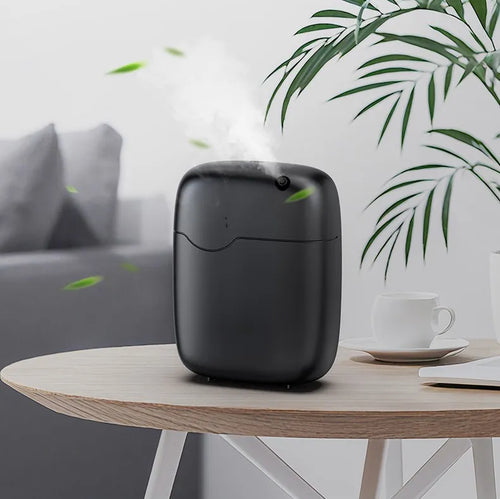 One machine, one setting₹11,999Shop →
Holding one scent across a portfolio, and the two adjustments
Start with choosing the composition, since everything else is downstream of it and you only do it once. The test for a house scent is not whether you like it — it is whether it survives being met for the fourth time by somebody who is not paying attention. That rules out anything distinctive, anything heavily floral, anything a buyer might place as a perfume they know, and anything sweet. It leaves the cool, dry, tea-and-wood register, which is why the Ritz-Carlton-inspired Quiet Luxury at ₹299 — white tea, bergamot and cedar — is the default I would give almost any brokerage. If your portfolio runs to smaller flats, the Westin-inspired White Tea Serenity at ₹299 is the lightest of the seven and the safer pick. Buy at 15ml first, run it in three or four properties, and only then commit to a 300ml 300ml refill at ₹1,799. The Vaayu at ₹11,999 runs its own undiluted oil rather than the water-based bottles, and arrives with four hotel-inspired scents, so in practice the machine itself gives you the shortlist to choose your house scent from. The Pack of 7 at 15ml is ₹1,799 against ₹2,093 singly if you would rather settle the question by nose across a week.
Then the two adjustments, and the discipline that keeps them from turning into a policy. The first is the warm flat and the open kitchen, and it is a physical argument rather than an aesthetic one. Heat lifts a composition — the same setting in a west-facing 3,000 sq ft flat at four in the afternoon with the air conditioning newly on reads considerably louder than it does in a cool morning apartment. And a kitchen without a door supplies its own materials into the same air. In both cases the 1 Hotels-inspired Forest Suite at ₹299 — cedarwood, vetiver and green leaves — behaves better, because dryness holds its shape at temperature and sits at a different address in the nose from food rather than competing with it. The second is the show flat: if the developer runs something in the furnished sample apartment and a buyer walks between the two in ten minutes, match theirs. That is not your signature being compromised, it is a recognition that in that building the house style is not yours. Beyond those two, hold the line. The setting is where you should be varying things instead — intensity down in a small or well-sealed flat, down again if the air conditioning has been running, and always downwards at the T-30m walk-in rather than upwards.
Then the parts that make holding a signature actually work, and the sentence that governs the lot. Within a fortnight you will stop smelling your own house scent entirely, because a nose reports change and discards constants — and the instinct that produces is to push the intensity up while every buyer is still receiving the level you originally set. The correction is not a setting, it is a person: ask a colleague who was not in the flat that morning to walk in from the lift and tell you the truth rather than something polite. Do that once a quarter and you will never drift. On the constraints, briefly and in one place: the water-based Hotel Collection bottles go in an ultrasonic — the Sukoon at ₹1,899, the Boond at ₹899, the Megh at ₹3,499 — and not in the Vaayu, which takes its own oil; ultrasonics add 30 to 50 ml of water an hour, which makes them wrong for a closed vacant flat and fine for an occupied one or for your own office; a reed diffuser from ₹749 needs 24 to 72 hours to establish, so it suits a long-listed property and not a viewing tomorrow; a candle must be attended, which rules it out of an empty listing; and we do not make a room spray for the home. Above all of it: none of this is for covering anything up. If a property has damp, a leak, a drain problem or smoke damage, that is a material fact — find it, fix it or disclose it. A house scent is something you apply to listings that are already sound, and it stops being a signature the moment it becomes a technique.
The SOSA edit
In buying order for a brokerage settling on a house scent. Two bottles is the whole fragrance side of this — a default and a single adjustment — and the last row prints the thing a per-property policy quietly costs you rather than leaving it to be discovered.
| Buy | What it is | When it earns its place | Price |
|---|---|---|---|
| 1. Ritz-Carlton-inspired · Quiet Luxury ★ | White tea, bergamot and cedar — cool, dry, nothing protruding | Your default in every listing. Buy at 15ml, prove it over three properties, then move to 300ml | ₹299 |
| 2. 1 Hotels-inspired · Forest Suite | Cedarwood, vetiver and green leaves — the driest of the seven | The single adjustment: a warm or west-facing flat, or a kitchen with no door | ₹299 |
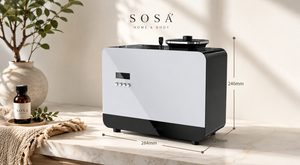
| 3. SOSA Vaayu | Waterless, 1000 m³, timers, key-lock, 0.9 kg, four hotel-inspired scents included | The machine that lets one scent run at one setting across a whole portfolio | ₹11,999 |
| 4. Westin-inspired · White Tea Serenity | White tea, aloe and cedar — the lightest composition in the range | As the default instead, if your listings run to smaller flats rather than large ones | ₹299 |
| 5. 300ml refill or Pack of 7 | About ₹6 per millilitre, against roughly ₹20 at 15ml; or all seven for ₹1,799 against ₹2,093 | The refill once the house scent is settled; the pack only if you would rather decide by nose first | ₹1,799 each |
| Not recommended: a scent per listing | Five compositions rotated by property type, view or building age | Printed rather than implied. It costs more, takes a decision you have no time for, and prevents the one thing it was meant to achieve | — |
Versailles
I want to be careful here, because the position I am arguing against is the one a perfumer is supposed to hold. Matching a composition to a space is the pleasant part of my trade, and if you asked me to scent five apartments as an exercise I would enjoy giving each one something of its own. But you are not asking me that. You are asking what should run in a property while a stranger walks through it deciding whether to commit a very large sum, and in that room my professional preferences are not relevant. What is relevant is that nothing in the air draws attention to itself, and that requirement is identical in a sea-facing flat and a garden apartment.
The part I would hold on to, if you take nothing else from this page, is the invisibility of the variation. Your buyer sees one property at a time. The care you put into giving the penthouse something warmer than the duplex is care that reaches nobody, and it is paid for out of the only budget that could have bought you a signature. Choose one composition. Use it for three years. Let the repetition do what repetition does, and spend the attention you saved on the lighting, which the buyer can actually see.
Everything is made and supported from Pune, and a part of every order funds girl-child education through Nanhi Kali. You get a space that smells like somewhere considered; a girl gets a classroom. That equation has always felt right to me.
Frequently asked questions
- Should a luxury realtor develop their own signature scent? — choosing one against commissioning one, and what each actually involves.
- Can I use one scent machine across different listings? — the operational half of the same decision.
- One signature across an office and selected viewings — where a house scent starts, and where it stops.
- Photography, styling, lighting and scent: what to invest in — the pillar guide for this group.
- Brand: the SOSA founder story.
Facts verified August 2026: Product facts used in this guide. SOSA Vaayu ₹11,999: waterless cold-air nebulising diffuser, atomises undiluted fragrance oil to a dry residue-free nano-mist, coverage up to 1000m³ (approximately 2,000–3,000 sq ft), 400ml refillable tank lasting up to about 75 days per fill, Bluetooth app plus onboard control, 1h/4h/8h/24h timer scheduling, adjustable intensity, under 38 dB, DC 12V/1A at 5W, 165 × 80.5 × 215 mm and 0.9 kg, freestanding or wall/HVAC mounted, auto-stop and key-lock, CE, RoHS and SGS certified, supplied with four hotel-inspired fragrances. SOSA Aangan ₹25,999: HVAC-connected or standalone commercial nebulising diffuser, coverage up to 3,000m³ (roughly 8,000–10,000 sq ft), 800ml reservoir, metal body, programmable schedules, under 42 dB. Ultrasonic machines are water-based and consume 30–50 ml of water an hour: Sukoon ₹1,899 (500ml, 270–320 sq ft, 16–18 hours on low, 3–6 drops per tank, steady/2H/4H timers, three 15ml Hotel Collection scents included), Boond ₹899 (300ml), Megh ₹3,499 (6 litres). Hotel Collection water-based fragrance 15ml ₹299, 100ml ₹999, 300ml ₹1,799, Pack of 7 at 15ml ₹1,799 against ₹2,093 bought singly; the Vaayu and Aangan take their own undiluted oil rather than these water-based bottles. Reed diffusers (separate alcohol-free line) from ₹749, requiring 24–72 hours to reach their working level. Scented candles from ₹379, scenting a room in roughly 15–20 minutes but requiring attendance. Free shipping above ₹499. Timings: a nebulising diffuser reaches a working level within minutes and a stated viewing level well inside two hours. This guide makes no claim that fragrance affects a property's price, offer level or time on market; it is presentation, in the same category as photography, styling and lighting. Fragrance must never be used to conceal a material defect. SOSA is not affiliated with or endorsed by any hotel brand. Prices subject to change — see the live product pages.