Founder Diaries · Clinics & Medical Centres · What a Signature Actually Is
By Sonal Sahani · ISIPCA Versailles 14 min read Updated November 2026
Yes, and the word is doing more work in that question than it can carry, so I want to define it operationally before I agree to it. A signature fragrance across a chain is eight documented things: one named oil with a part number, one target level with a recorded setting per site, one zone list, one fragrance-free list, one page of standard operating procedure, one supplier with a written price and a stated substitute policy, one named owner per site plus one person at group level who owns the standard, and one review date in the calendar. Six of those eight cost nothing. That is the whole of it, and a chain that has those eight has a signature. What a signature is not: a claim, a mood, a wellbeing story, a proprietary asset you can own, or anything you can put a number against in a board paper. And the honest caveat is uncomfortable: a chain whose branches have different housekeeping standards would not be standardising a signature. It would be standardising a problem, and putting its own name on it.
Quick answers — read this first
A signature, operationally, and six of the eight lines are free: one named oil with a part number rather than a description · one target level, defined as a patient being unable to tell you what the fragrance is, with the setting that achieves it recorded per site · one zone list — entrance, reception, shared waiting, inter-departmental corridors, lift lobbies, administration, the café corner · one fragrance-free list, identical, with no local exceptions · one page of SOP covering zones, setting, schedule, refill and review · one supplier with a written price, a minimum order quantity, a lead time, a validity date and a stated substitute policy · one named owner per site and one owner of the standard at group level · one annual review date.
What it is not, and what to strike from the brief: not a calming scent, not a reassuring atmosphere, not a wellbeing proposition, not air treatment of any kind, not a measurable differentiator, and not a proprietary asset you can own when the oil is a standard product from a supplier's range. A diffuser is not an air purifier. Every one of those phrases is either a clinical claim in a softer coat or something you will be asked to evidence.
The honest not-yet: a chain with uneven housekeeping across branches is not ready to name a signature, because the weakest branch will read as the signature plus its own problem. Level the free fixes first — trap round, bin collection times, wash hour, AC drain-pan scope — on an identical signed sheet at every site.
The purchase: one
Vaayu at ₹11,999 per public volume per branch, four branches at ₹47,996 on one order, about eight litres of oil a year across the group. Free shipping above ₹499, prices subject to change.
The short answer
Short answer: yes, and a signature is eight documented things rather than a feeling - one named oil with a part number, one target level with the setting recorded per site, one zone list, one fragrance-free list, one page of SOP, one supplier with a written price and a stated substitute policy, one named owner per site plus one owner of the standard at group level, and one annual review date. Six of the eight cost nothing. A chain that has those eight has a signature. A chain that has a chosen bottle and no document has a preference.
What a signature is not: not a calming or reassuring effect, not a wellbeing proposition, not air treatment, not a measurable differentiator and not a proprietary asset when the oil is a standard product from a supplier's range. A diffuser does not purify, disinfect or treat anything. Nothing here claims fragrance affects footfall, retention, satisfaction scores or revenue, and no percentage or study is relied on. What is claimable is narrower and sufficient: a facility that smells looked after reads as one, and several that smell the same read as one organisation.
The honest not-yet, and the cost: a chain whose branches have uneven housekeeping would be standardising a problem rather than a standard, because the weakest branch reads as the signature plus its own dry drain trap. Level the free fixes at every site on an identical signed sheet first. Then one Vaayu at Rs 11,999 per public volume per branch - Rs 47,996 for four, about eight litres of oil a year, roughly Rs 3,000 per unit per year before oil. Aangan Rs 25,999 for a large branch up to 3,000m3. Free shipping above Rs 499.
Straight answer
Should a multi-speciality clinic chain have a single signature fragrance across branches?
1. Yes, and here is what the word has to mean for the answer to be useful. A signature is a specification, not an impression. Eight lines: one named oil identified by a part number rather than by a description; one target level, defined as a patient being unable to tell you what the fragrance is, with the setting that achieves it recorded separately for each site because volumes differ; one zone list; one fragrance-free list; one page of standard operating procedure; one supplier with a written price, a minimum order quantity, a lead time, a validity date and a stated substitute policy; one named owner at each site plus one person at group level who owns the standard rather than the machines; and one review date in the calendar. Six of those eight are writing rather than spending.
2. Why it is worth having, stated as narrowly as I can make it. Your patients move between your branches because you refer them, and your consultants move between them because that is how a roster works. A referred patient sees two of your buildings inside a fortnight and a visiting physician sees two in the same week. A facility that smells looked after reads as one, and several that smell the same read as one organisation looking after all of them. That is the entire benefit and it is a presentation benefit.
The four-branches-in-one-city page makes the same case from the operational side.
3. What a signature is not, and this list matters more than the first one. It is not a calming scent, a reassuring atmosphere, a healing environment or a wellbeing proposition — every one of those is a clinical claim wearing a softer coat, and a phrase like “the waiting hall feels calmer” is the same claim as “it reduces anxiety” with the evidence removed. It is not air treatment: a diffuser does not purify, disinfect or clean air. It is not a measurable differentiator, because I have no figure for footfall, retention, satisfaction or revenue and will not offer you one. And it is not a proprietary asset you can own, because a standard scent from a supplier's range is available to the clinic across the road.
4. The supplier line, which is the one people leave out and the one that breaks first. A signature depends on the same oil arriving at four sites for years, so the agreement has to say what happens when it does not. Ask for the part number, the price per 400ml fill and per litre at your real annual volume, the minimum order quantity, the lead time, a validity date, and — explicitly — what the substitute is if the scent is discontinued or out of stock, and who is told. A chain that has not asked that question will discover the answer the first time somebody sensible at one branch orders something similar, and a signature survives exactly one of those.
5. The honest not-yet, which applies to more chains than not. If your branches have different housekeeping standards, do not name a signature yet. The best-run site will smell of nothing in particular and the weakest will smell of your signature plus a dry drain trap or a dressing bin staged in a service lobby on a Friday — and because the fragrance is now the group standard, the problem has been promoted and has your name on it. Level the four free fixes at every site on an identical signed sheet, run them a month, compare the sheets, fix what the comparison exposes, and then write the document.
The free list is the work, and it costs ₹0.
6. And the commissioning question, since it always follows. A bespoke oil is a separate purchase with its own minimum order quantity and lead time. At four branches and roughly eight litres a year, every operational benefit of a signature — consistency, one order, one setting, one document — is already fully delivered by a standard scent run identically. Exclusivity is the only thing commissioning adds, and whether exclusivity is worth a minimum order quantity is a question for your board rather than for me. The machines are the same either way: one
Vaayu at ₹11,999 per public volume, or an
Aangan at ₹25,999 where a branch has more than 1000 m³ of public volume or a genuine atrium.
A portion of every order supports girl-child education through Nanhi Kali.
TL;DR: yes — where a signature means eight documented things: one named oil, one target level with the setting recorded per site, one zone list, one fragrance-free list, one SOP page, one supplier with a substitute policy, one owner per site plus one owner of the standard, one review date. Six are free. It is not a claim, a mood or a measurable differentiator. And a chain with uneven housekeeping is not ready to name one.
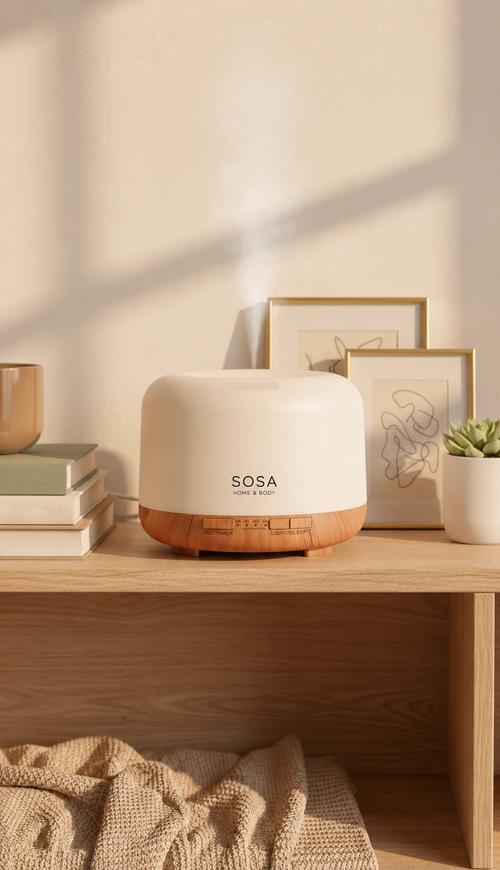
A signature is a specification, not an impression
SOSA commercial scenting from ₹899
Eight lines make a chain signature and six of them cost nothing:
one named oil with a part number, one target level with the setting recorded per site, one zone list, one fragrance-free list, one page of SOP, one supplier with a written price and a stated substitute policy, one named owner per site plus one owner of the standard, and one annual review date. The two that cost money are the machines — one
Vaayu at ₹11,999 per public volume, or an
Aangan at ₹25,999 where a branch has a genuine atrium — and the oil, at about two litres per unit per year. Free shipping above ₹499.
A signature, written down, for ₹0
The reason to write this before buying anything is that the document is the signature and the machines are only how it is delivered. A chain with four machines, one bottle and no document does not have a signature. It has a current preference, and preferences survive about one change of housekeeping supervisor, one stock-out and one centre head with a complaint — which in a four-branch group is roughly eighteen months. The document is one page and it takes an afternoon. Below are the eight lines in the order I would write them, and I have put the two that cost money last on purpose, because a group that writes the first six will have had at least one useful argument before it spends anything: usually about whether the paediatric branch is in scope, occasionally about whether the setting is a local decision, and almost always about who owns the standard as distinct from who owns the machines. Have those arguments on paper and for free, settle them once, and the purchase afterwards is a formality. The SOP page is the operating half of the same document, and the fragrance-free list is what the zone list has to be checked against before a medical director signs it.
1
WHAT IT IS
Eight lines, and the five that nobody writes down
Three of the eight are obvious and five are the ones that actually fail.
The obvious three: one named oil, one zone list, one page of SOP. Now the five.
The target level, expressed as a test rather than a number — walk in from outside, and a patient should not be able to tell you what the fragrance is, only that the place did not smell of anything unpleasant — with the setting that achieves it recorded per site, because a 400 m³ lobby and a 900 m³ lobby on identical settings do not read identically. The fragrance-free list, identical at every branch with no local exceptions: consultation and examination rooms, treatment and procedure rooms, day-care surgery, dressing rooms, blood and sample collection, laboratories, pharmacy dispensing, sterile stores, imaging, oncology day-care and paediatric clinical areas.
The supplier line: part number, price per 400ml fill and per litre at your real annual volume, minimum order quantity, lead time, validity date, and a stated substitute policy with a named person to be told. The ownership line: one person at each site doing the physical work, and one person at group level owning the standard, with the authority to tell a centre head that the setting is not a local decision.
And the review date, which is the cheapest control in the whole scheme: one calendar entry a year at which somebody walks into every reception from outside in the same week and writes one line about each.
The departmental version is what to take to the medical director.
2
WHAT IT IS NOT
Six phrases to strike from the brief before it leaves the room
I would go through the brief with a pen before anybody circulates it, because the words cost more than the machines. Strike “calming”, “reassuring” and “soothing”, because they are clinical claims in a softer coat and the softer coat does not help: “the waiting hall feels calmer” asserts exactly what “reduces anxiety” asserts, with the evidence quietly removed. Strike “wellbeing”, “therapeutic”, “aromatherapy” and “spa”, which do not belong anywhere near a medical facility's documentation. Strike anything about air — a diffuser does not purify, disinfect, clean or freshen air, and it is not an air purifier, and a brief that implies it will be read by somebody who knows that. Strike “proprietary” and “exclusive” unless you have actually commissioned an oil, because a standard scent from a supplier's range is available to the clinic across the road and claiming otherwise is a problem waiting for a competitor to notice. And strike every number attached to an outcome. Footfall, retention, satisfaction scores, dwell time, revenue per visit: I have no figure for any of them, there is no study I would stand behind, and a brief carrying one will eventually be read by a board member who asks for the source. What survives the pen is short and sufficient: a facility that smells looked after reads as one, and several that smell the same read as one organisation looking after all of them. Write that, stop, and the brief will still be true in five years.
3
THE NOT-YET
The chain that would be standardising a problem
This is the part I would put at the front of a board paper rather than in a footnote, because it is the commonest reason a chain signature disappoints.
Four branches running one fragrance over four different housekeeping standards do not read the same. The best-run site smells of nothing in particular, which is the result you were buying. The weakest smells of your signature and something else — a dry drain trap in a barely used toilet, a dressing bin staged in a service lobby on a Friday afternoon, a mopping hour that lands at nine with the doors shut — and that compound is worse than either component alone, because the problem now carries your group's standard on top of it. So the honest answer to a chain that has not levelled its housekeeping is not yet, and the work in between is free: the trap round sixty minutes before opening by a named person with a sheet to sign, bin collection times with lids that close, the public floor washed in the quiet half-hour with a neutral cleaner specified for public areas, and the air-conditioning drain pan, condensate line and blower wheel named in the maintenance scope at every site. Identical sheets, one month, then compare the four.
A branch whose sheet is complete and whose building still has a smell has a source, and a source is a facilities job that no signature will survive being asked to cover. Three weeks of that work will also tell you something a brand exercise never would, which is which of your four branches is actually well run.
The full-year cost page is the sheet to build once the answer is yes.
The instruction I would give a group chief executive: read the brief with a pen before you read the quotation. If the document still says calming, wellbeing or air-freshening after the pen has been through it, the problem is not the supplier, and the signature will be defended by somebody who did not write it.
What people mean by signature, and what it actually is
The left-hand column is what arrives in briefs. The second column says whether it is part of a signature or something to strike. Everything in the yes rows is a line in a one-page document, and most of them cost nothing to write.
Print this
Eight lines that make a signature, and five phrases that unmake one
| What is in the brief |
Part of a signature? |
What it actually takes |
Cost |
| One named oil ★ |
Yes — the first line, and it is a part number rather than a description such as “a white tea sort of thing” |
One group decision, one purchase order, one scheduled annual delivery into one store |
₹0 to specify |
| One target level |
Yes, and it is a test rather than a dial: a patient should not be able to name the fragrance |
Walk in from outside at each site, set to the test, record the setting per site in the SOP |
₹0 |
| One zone list and one fragrance-free list |
Yes, both, identical at every branch with no local exceptions |
Signed off with the medical director. The list in full
|
₹0 |
| One SOP, one owner per site, one owner of the standard, one review date |
Yes — four lines, and the second owner is the one nobody creates |
One page from a group template, plus one calendar entry a year. What goes in it
|
₹0 |
| One supplier agreement with a substitute policy |
Yes, and it is the line that breaks first when it is missing |
Part number, price per fill and per litre at volume, MOQ, lead time, validity date, and what happens on a stock-out |
₹0 to agree |
| “A calming, reassuring scent for our patients” |
No. That is a clinical claim in a softer coat, and the coat does not help |
Strike it from the brief. A facility that smells looked after reads as one — that is the whole claim |
— |
| “A proprietary brand asset” or a number for footfall or satisfaction |
No. A standard scent from a range is available to the clinic across the road, and there is no study to quote |
Strike both. If exclusivity is genuinely wanted, commissioning is a separate purchase with its own MOQ |
— |
| Never |
A signature declared across branches whose housekeeping has not been levelled, or a setting left as a local decision |
Never. The weakest branch would read as your signature plus its own problem, with your name on it |
— |
Shop this guide
One oil, one machine per volume, and the large-branch exception
The SOSA principle
A signature is one oil, one setting, one SOP, one supplier and one review date, documented. It is not a claim, a mood or a wellbeing story. And a chain whose branches have different housekeeping standards would not be standardising a signature — it would be standardising a problem, under its own name.
Six of the eight lines cost nothing to write. The two that cost money are the machines and the oil, and they are the easy part.
The claims to strike, and the honest not-yet
Start with the language, because in a chain the language outlives the equipment. A brief that says the signature is calming, reassuring or part of a wellbeing proposition will be circulated to four centre heads, quoted back by a marketing agency, printed in an induction pack and eventually read by a medical director who asks on what basis the group is making a clinical assertion about its patients. At that point the person defending it will not be the person who wrote it. So strike it early and strike it completely: calming, soothing, reassuring, therapeutic, aromatherapy, wellbeing, spa, healing, and anything about purifying, disinfecting, cleaning or freshening air, because a diffuser is not an air purifier and does none of those things. Strike implied versions too — “the waiting hall feels calmer” is the same assertion with the evidence removed. And strike every outcome number. I have no figure for footfall, retention, satisfaction scores, dwell time or revenue per visit, there is no study I would put my name to, and a brief carrying one invites a request for the source. What is left is short, true and enough: a facility that smells looked after reads as one, and several that smell the same read as one organisation looking after all of them. The procurement checklist has the questions to put to a supplier who offers you more than that.
Then the not-yet, which is the part of this page I would most want a group chief executive to read. If the four branches do not currently run the same housekeeping, naming a signature is premature and it will cost ₹47,996 to find out. The strongest branch will smell of nothing in particular; the weakest will smell of your signature plus a dry drain trap, a bin staged in a service lobby, or a mopping hour landing at nine with the doors shut — and that compound is worse than the original problem, because it now carries your standard. The work in between is free and it takes a month: the trap round sixty minutes before opening by a named person with a sheet to sign at every site; bin collection times with lids that close; the public-area floor washed in the quiet half-hour between the two peaks with a neutral cleaner specified for public floors; and the air-conditioning drain pan, condensate line and blower wheel named in the maintenance scope rather than left in a generic visit. Use identical sheets at all four sites, compare the four at the end of the month, and treat the comparison as the most useful management information the exercise produces. A branch whose sheet is complete and whose building still smells has a source, and a source is a facilities job that no signature survives being asked to cover. This is also the point at which to decide, on purpose, whether any branch is out of scope — a predominantly paediatric site, or one where oncology day-care sits off the main waiting area, may correctly be fragrance-free in public, written into the standard with the reason beside it.
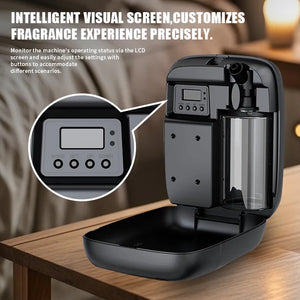
And then the purchase, which is the smallest part of the decision by the time you reach it. One Vaayu at ₹11,999 per public volume per branch: waterless cold-air nebulisation with no standing water tank, up to 1000 m³ each, a 400ml fill lasting about seventy-five days, app plus 1h/4h/8h/24h timers so one facilities person holds four branch schedules, under 38 dB, auto-stop and a key-lock so the recorded setting stays the recorded setting. Four branches at one unit each is ₹47,996 on a single purchase order and about eight litres of oil a year, which is where the per-litre price is actually negotiable. Count the units from each branch's own volume sum rather than assuming one per site — square feet divided by 10.76, multiplied by ceiling height, counting only the volumes a closed door bounds — because a floor is not automatically a volume and a branch with a lobby and a far waiting hall behind two sets of doors needs two. Where a branch has a genuine double-height atrium or more than 1000 m³ of public volume, the Aangan at ₹25,999 is the right machine for that branch and the signature is unaffected, because the signature is the oil and the target level rather than the hardware. And put the whole thing in the facilities budget alongside housekeeping rather than in marketing, which the budget-line page argues at length and which also, usefully, keeps the business case away from the outcomes nobody can evidence. The four-polyclinic worked example costs a specific version of this end to end.
A signature is one oil, one target level, one zone list, one SOP, one supplier, one named owner per site and one review date — written down. Everything else sold under that word is either a claim you will have to defend or a mood you cannot specify.
— Sonal Sahani, SOSA
The SOSA edit
The same decision as five tiers in the order a group board works through them, with three free tiers at the top and the thing nobody should sign off at the bottom.
The SOSA edit
Level it, strike it, write it, then buy it
| Tier |
What is in it |
When it earns its place |
Cost |
| 1. Level the housekeeping ★ |
The trap round, bin collection times with lids, the wash hour and the AC drain-pan scope, on identical signed sheets at every branch for a month, then compare them |
Before the word signature is used. Otherwise the weakest branch reads as your signature plus its own problem |
₹0 |
| 2. Take a pen to the brief |
Strike calming, soothing, reassuring, therapeutic, aromatherapy, wellbeing, spa, anything about purifying or freshening air, and every outcome number |
Before it is circulated. In a chain the language outlives the equipment |
₹0 |
| 3. Write the eight lines |
One named oil by part number, one target level with the setting recorded per site, one zone list, one fragrance-free list, one SOP page, one supplier agreement with a substitute policy, one owner per site plus one owner of the standard, one review date |
An afternoon, and it settles the arguments before any money moves. The SOP
|
₹0 |
| 4. Vaayu — one per public volume |
Waterless, no standing water tank, up to 1000 m³, 400ml ≈ 75 days, app and 1h/4h/8h/24h timers for four branch schedules, under 38 dB, auto-stop, key-lock |
Counted from each branch's own volume sum, not one per site by default |
₹11,999 each |
| 5. Aangan — the large branch |
HVAC-connected or standalone, up to 3,000 m³, 800ml reservoir, metal body, programmable, under 42 dB. The signature is the oil, not the hardware |
A branch with a genuine atrium or more than 1000 m³ of public volume. One fragrance or several
|
₹25,999 |
| Not at any price |
A signature declared over uneven housekeeping, a clinical or wellbeing claim attached to it, an exclusivity claim on a standard scent, or a setting left to each centre head |
Never. The target is a level, not a dial, and no study is being quoted here because there is none worth quoting
|
— |
Honest notes for buyers: on this page specifically, a signature fragrance across a chain is a specification — one named oil, one target level with the setting recorded per site, one zone list, one fragrance-free list, one page of SOP, one supplier agreement with a substitute policy, one named owner per site plus one owner of the standard, and one review date. It is not a claim, a mood, a wellbeing proposition, air treatment or a proprietary asset, and no figure for footfall, retention, satisfaction or revenue is offered or relied on anywhere here. A chain whose branches have uneven housekeeping should level that first, because it would otherwise be standardising a problem under its own name. In general, fragrance in a medical facility is housekeeping and presentation, never treatment. Nothing here claims that a fragrance reduces anxiety, aids recovery, improves sleep, cleans or disinfects air, or has any clinical effect whatsoever, because it does not and a diffuser is not an air purifier. Scenting belongs to the entrance, reception, shared waiting areas, inter-departmental corridors and administrative rooms. Consultation and examination rooms, treatment and procedure rooms, day-care surgery, dressing rooms, blood- and sample-collection rooms, laboratories, pharmacy dispensing, sterile stores, imaging rooms, oncology day-care and paediatric clinical areas should be left fragrance-free. A persistent smell is information about a dry drain trap, a bin, a soiled-linen route or an air-conditioning drain pan: find it and fix it rather than covering it. On the machines: the
Vaayu at ₹11,999 is waterless cold-air nebulisation with no standing water tank, covering up to 1000m³ or roughly 2,000–3,000 sq ft, with a 400ml tank lasting about 75 days, app control, 1h/4h/8h/24h timers, under-38dB running, auto-stop and a key-lock for public areas. The
Aangan at ₹25,999 covers up to 3,000m³ and connects to HVAC for a whole floor or an atrium. The ultrasonic
Sukoon,
Boond and
Megh are water-based, hold standing water and add 30–50 ml of water an hour to the air, which suits a single administrative cabin with a named person emptying and drying the tank daily and is unsuitable for public clinical property. An alcohol-free
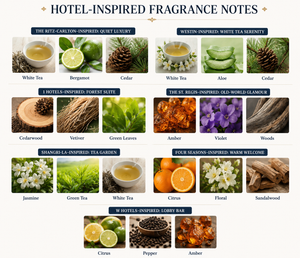
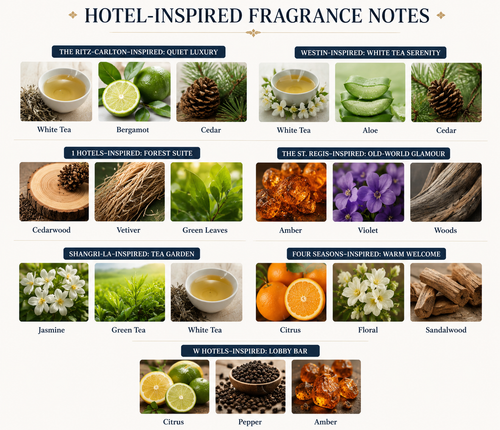
reed diffuser needs 24–72 hours to establish and suits a small lobby rather than a large waiting hall. Candles are not appropriate in a healthcare facility because an open flame is a fire-safety matter. SOSA does not make a room spray. The Hotel Collection scents are SOSA's own interpretations inspired by the world's finest hotels; SOSA is an independent Indian fragrance house, not affiliated with or endorsed by any hotel brand. A portion of every order supports girl-child education through Nanhi Kali.
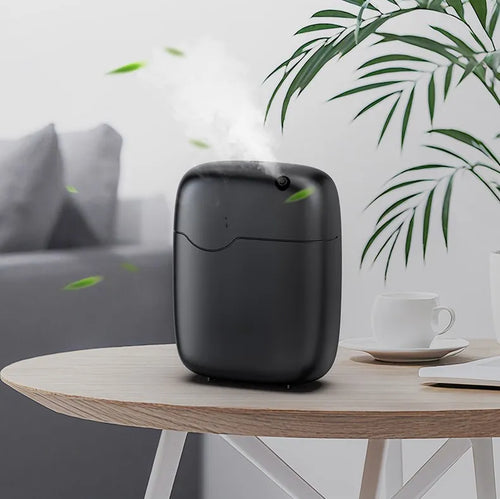
How a written signature is actually delivered
SOSA Vaayu ₹11,999
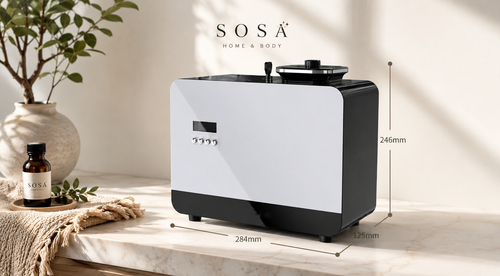
One unit per public volume per branch, at ₹11,999 each. Waterless cold-air nebulisation with no standing water tank, up to 1000 m³, a 400ml fill lasting about seventy-five days, Bluetooth app plus 1h/4h/8h/24h timers so one facilities person holds every branch's schedule, under 38 dB, auto-stop, and a key-lock — which is what keeps the recorded setting the recorded setting rather than a local preference. 0.9 kg at 165 × 80.5 × 215 mm, freestanding or wall or HVAC mounted, four hotel-inspired scents included. The signature is the oil and the target level; the machine is only how both get delivered. Public areas only, on low, for the opening hours.
A note from Sonal
The brief that changed how I answer this arrived from a four-branch group in Mumbai and it was three pages long. It described a signature that would be calming for patients, reassuring for families, part of a wellbeing proposition, and a proprietary brand asset. It did not mention which rooms were in scope, who would refill anything, what the setting should be, or what would happen if the scent went out of stock. I wrote back with eight lines and asked them to replace their three pages with it, and the honest part of that exchange was telling them that four of the phrases in their brief were claims I could not support and would not be putting on my own invoice. They were not pleased, and they rewrote it, and the version we worked to afterwards was one page and still describes what those four clinics do today.
What I have come to think is that the word signature is useful precisely because it can be specified, and that most of the disappointment around it comes from using it as though it could not be. One oil with a part number, one target level tested by walking in from outside, one zone list, one fragrance-free list, one page of SOP, one supplier who has told you in writing what the substitute is, one named person per site and one person at group level who owns the standard, and one date in the calendar. Six of those eight cost nothing and they are the six that fail. The two that cost money — the machines and the oil — are the two that never fail, which is the opposite of what most briefs assume.
The one thing I would add is the part I least enjoy saying to a group that has already decided. A chain with uneven housekeeping that names a signature has not created a standard; it has put its own name on its weakest branch's problem, and it will cost it the price of four machines to find that out. Everything is made and supported from Pune, and a part of every order funds girl-child education through Nanhi Kali. You get a space that smells like somewhere looked after; a girl gets a classroom. That equation has always felt right to me.
Frequently asked questions
Should a multi-speciality clinic chain have a single signature fragrance across branches?
Yes, where a signature means a specification rather than an impression: one named oil identified by part number, one target level with the setting recorded per site, one zone list, one fragrance-free list, one page of standard operating procedure, one supplier agreement with a written price and a stated substitute policy, one named owner at each site plus one person at group level who owns the standard, and one annual review date. Six of those eight cost nothing to write. A chain with a chosen bottle and no document has a preference, not a signature.
What is a signature fragrance not?
It is not calming, soothing, reassuring, therapeutic or part of a wellbeing proposition - those are clinical claims in softer language, and an implied version such as saying the waiting hall feels calmer is the same assertion with the evidence removed. It is not air treatment: a diffuser does not purify, disinfect or clean air. It is not a measurable differentiator, because there is no figure for footfall, retention, satisfaction or revenue being offered here. And it is not a proprietary asset when the oil is a standard product from a supplier's range.
When is a chain not ready to name a signature?
When its branches do not yet run the same housekeeping. The strongest site will smell of nothing in particular and the weakest will smell of the signature plus a dry drain trap or a dressing bin staged in a service lobby, which is worse than the original problem because it now carries the group's standard. Level the free fixes at every site on identical signed sheets for a month - the trap round, bin collection times with lids, the public-floor wash hour and the air-conditioning drain-pan scope - compare the sheets, fix what they expose, and then write the document.
Does a signature mean every branch runs the same machine and setting?
The same oil and the same target level, yes. The same machine count and the same intensity number, no. The count comes from each branch's own volume sum - square feet divided by 10.76, times ceiling height in metres, counting only public volumes a closed door bounds with clinical rooms removed entirely - so a small branch may need one unit and a two-floor branch two. The setting is whatever hits the target level in that volume, recorded per site, because a 400 cubic metre lobby and a 900 cubic metre lobby do not read the same on identical settings.
Do we need a bespoke fragrance, or will a standard scent do?
At four branches and roughly eight litres of oil a year, every operational benefit of a signature - consistency, one order, one recorded setting, one document - is already fully delivered by a standard scent run identically. Commissioning adds exclusivity and brings its own minimum order quantity and lead time, and whether that is worth it is a board question rather than a fragrance question. What matters either way is the supplier line: part number, price per 400ml fill and per litre at your real volume, minimum order quantity, lead time, validity date and a stated substitute policy.
Eight lines, six of them free
Write the signature before you buy it — and level the housekeeping before you write it
The Vaayu is ₹11,999 per public volume: waterless cold-air nebulisation with no standing water tank, up to 1000 m³ or roughly 2,000–3,000 sq ft, a 400ml tank lasting about seventy-five days, Bluetooth app control with 1h/4h/8h/24h timers so one facilities person holds every branch's schedule, under 38 dB, auto-stop and a key-lock that keeps the recorded setting the recorded setting, 0.9 kg at 165 × 80.5 × 215 mm, supplied with four hotel-inspired fragrances. The Aangan is ₹25,999 for a branch above 1000 m³ of public volume. Free shipping above ₹499, prices subject to change, and a portion of every order supports girl-child education through Nanhi Kali.
See the Vaayu · ₹11,999 All commercial scenting
Continue the read
More from SOSA
Editorial standards & sources
Product facts used in this guide. SOSA Vaayu Rs 11,999: waterless cold-air nebulising diffuser, no water reservoir, coverage up to 1000m3 (approximately 2,000-3,000 sq ft), 400ml refillable tank lasting up to about 75 days per fill, Bluetooth app plus onboard control, 1h/4h/8h/24h timer scheduling, adjustable intensity, under 38 dB, DC 12V/1A at 5W, 165 x 80.5 x 215 mm and 0.9 kg, freestanding or wall or HVAC mounted, auto-stop and key-lock, CE, RoHS and SGS certified, supplied with four hotel-inspired fragrances. SOSA Aangan Rs 25,999: HVAC-connected or standalone commercial nebulising diffuser, coverage up to 3,000m3 (roughly 8,000-10,000 sq ft), 800ml reservoir, metal body, programmable schedules, under 42 dB. Ultrasonic machines are water-based, hold standing water and consume 30-50 ml of water an hour: Sukoon Rs 1,899 (500ml, 270-320 sq ft, 16-18 hours on low, three 15ml Hotel Collection scents included), Boond Rs 899 (300ml), Megh Rs 3,499 (6 litres). Hotel Collection water-based fragrance 15ml Rs 299, 100ml Rs 999, 300ml Rs 1,799. Alcohol-free reed diffusers from Rs 749, requiring 24-72 hours to reach their working level. Free shipping above Rs 499. Coverage arithmetic: cubic metres equal floor area in square feet divided by 10.76 and multiplied by ceiling height in metres, counting only the volumes that are actually scented. This guide makes no medical, therapeutic or clinical claim of any kind for fragrance: a diffuser does not purify, disinfect or clean air, and does not treat, calm or affect any patient or condition. Fragrance is housekeeping and presentation. Clinical areas should be left fragrance-free, and a persistent odour should be traced to its source and corrected rather than covered. SOSA is not affiliated with or endorsed by any hotel brand. Prices subject to change - see the live product pages.

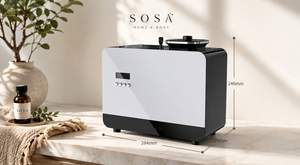
 Refills · one oil, one order₹1,799Shop →
 Aangan · the large branch₹25,999Shop →