



2. This is the second-clearest "no" in this cluster, right behind specialty coffee. A bakery's own aroma is arguably the strongest natural scent signature in food retail, which means the case against adding anything to it is nearly as absolute as the case against scenting a coffee tasting floor.
3. An edible-adjacent register is the specific mistake to avoid, wherever it's placed. Vanilla, caramel, bakery or honey notes anywhere near actual baking give the customer's nose the real thing to compare against in the same breath, and the manufactured note reads as artificial the instant that comparison happens.
4. A genuinely separated entrance is the one place a signature fragrance might apply. Only where a real air boundary exists between the entrance and the baking and display areas — never where the entrance simply opens straight onto the counter.
5. The washroom remains the honest opportunity, in a strictly non-edible register. A clean, dry, non-bakery-adjacent scent avoids the comparison problem entirely and is the safest fragrance decision anywhere in this format.
A bakery café's own aroma is a genuine asset that a manufactured fragrance placed nearby can only compete with, never add to — the honest fragrance decisions sit in the washroom and, sometimes, a genuinely separated entrance.
Why adding fragrance next to real baking backfires
Fresh baking produces an aroma that changes constantly and convincingly — bread smells different coming out of the oven than it does twenty minutes later, and a pastry counter's aroma shifts through the day as different items are baked, cooled and restocked. That constant, believable variation is exactly what makes it read as real to a customer's nose, and it's precisely what a manufactured fragrance, however well made, cannot replicate — a diffuser produces the same profile continuously, which is a strength in a washroom and a liability anywhere the real, shifting thing is also present.
The specific failure mode is comparison. A vanilla, caramel or bakery-adjacent fragrance placed near actual baking gives the customer's nose the genuine article and the manufactured one in the same breath, and noses are very good at telling the two apart once they're offered side by side. The result isn't a stronger bakery smell — it's a bakery smell that now reads as partly synthetic, because the comparison has revealed which parts of what the customer is smelling are real and which aren't.
This is a sharper version of the same mechanism that rules fragrance out of a specialty coffee tasting floor, and it's why a bakery café sits second on this cluster's list of clearest "no" verdicts. The aroma being sold is already doing the job an added fragrance would be hired to do, and the only thing a second scent can add near it is the risk of undermining the very quality that made the format worth visiting.
The three zones, honestly assessed
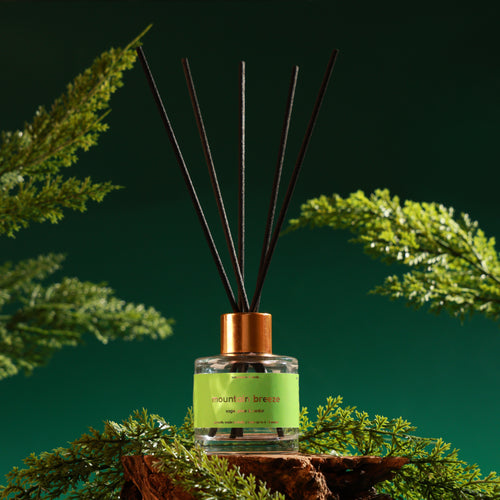
 Mountain Breeze₹849The real aroma is already the strongest asset in the room; nothing added near it improves on that, and an edible-adjacent register specifically invites the comparison that makes the real thing read as less genuine.
Zone by zone, the verdict
The register question matters as much as the zone question in a bakery café — an edible-adjacent fragrance fails even in a zone where fragrance is otherwise appropriate.
| Zone | Fragrance verdict | Why | What this means practically |
| Ovens and baking area | Never | The source of the real aroma being sold — nothing added here does anything but compete with it | No fragrance of any kind near the ovens or prep area |
| Display counter and dining area | Never | The aroma is meant to reach the customer cleanly from the baking itself, not alongside a manufactured version | Leave entirely unscented, regardless of how premium the fit-out is |
| Entrance or vestibule | Sometimes | Only where a genuine air boundary keeps the baking aroma from reaching it at all | Test whether the bakery aroma is already noticeable there before treating it as separated |
| Washroom | Usually | The genuine commercial opportunity in this format, exactly as in every other café type this cluster covers | A strictly non-edible register — Mountain Breeze over Morning Freshness where a choice is needed |
| Retail area selling packaged goods, not fresh baking | Usually | No aroma comparison in play once the products aren't the same fresh-baked items sold at the counter | A reed diffuser or Sukoon at a modest, non-edible register |
| Fresh Brew, or any vanilla, caramel or bakery-adjacent register, appears in no zone of a bakery café at any price point — it's the single fastest way to make a genuinely good bakery smell synthetic. | |||
Mountain Breeze · washroom, non-edible₹849Shop →  Sukoon · washroom suite or retail₹1,899Shop →
  Vaayu · separated entrance, zoned₹11,999Shop →
How much fragrance the honest zones need
Never place an edible-adjacent fragrance anywhere near a bakery's ovens, counter or dining area — vanilla, caramel, bakery and honey notes are the specific registers most likely to be directly compared against the real thing, and the comparison is one the added fragrance always loses.
Sometimes a genuinely separated entrance can carry a light, strictly non-edible register, provided the separation is real and the baking aroma genuinely doesn't reach it — tested by standing there, not assumed from the floor plan.
Usually, the washroom is where the honest fragrance decision sits, and Mountain Breeze's dry, woody profile is the safer of the two clean registers here specifically because it sits furthest from anything a bakery counter might be selling that day.
What to buy, if anything
Matched to the two zones this cluster's own rules actually permit — never the ovens, counter or dining area, whatever the bakery's scale or positioning.
| Route | Premises | Why | What it costs |
| No fragrance at all | Ovens, display counter, dining area — every bakery café | The real baking aroma is already the strongest asset in the room, and nothing added improves on it | ₹0 |
| Reed diffuser, Mountain Breeze | A washroom under 150 sq ft, most bakery cafés | The dry, non-edible register furthest from anything the bakery sells | ₹849 |
| Sukoon ultrasonic | A washroom suite or a small retail corner, 270–320 sq ft | Steady coverage for a larger non-dining space, still strictly non-edible | ₹1,899 |
| Vaayu, wall or HVAC mounted, zoned | A genuinely separated entrance or a larger retail section in a flagship bakery café | Independent scheduling once real air boundaries exist between zones | ₹11,999 per unit |
| Fresh Brew, or any vanilla, caramel, bakery or honey register, any format | No bakery café, at any scale | The exact register most likely to be compared directly against real baking, and the comparison it always loses | Not recommended at any price |
This is the second easiest "no" I give in the whole cluster, right behind specialty coffee, and for a closely related reason. Fresh baking produces one of the most complex, constantly shifting aromas I encounter in any commercial space, and it does it entirely on its own — there's nothing a manufactured fragrance adds to that except the risk of exposing which parts of the room's smell are real.
I've had bakery owners specifically request a vanilla or caramel register to "round out" the smell of the room, and I always talk them out of it. Placed anywhere near actual baking, that register doesn't round anything out — it gives the customer's nose a direct comparison, and the real bread and butter always wins that comparison at the cost of making the whole room smell slightly less convincing.
Where I'll sell into a bakery café without hesitation is the washroom, in a strictly non-edible register — Mountain Breeze, specifically, because its pine, sage and cedar profile shares nothing with anything on the counter. That's the entire difference between a fragrance decision that helps and one that quietly undermines the best thing the bakery already has.
Questions about fragrance in a bakery café
- Should a Luxury Specialty Coffee Shop Use Ambient Fragrance? — the clearest no in this block, for a closely related reason.
- What Should a Premium Dessert Café Smell Like? — the next format in this block, facing a similar aroma-led question.
- Should a Chocolate Café Add Ambient Fragrance? — the same comparison problem applied to a different strong food aroma.
- I Run a Bakery Café Where Bread, Coffee and Desserts Already Smell Amazing — Is There Any Reason to Use Ambient Fragrance in the Dining Area? — the same question, asked directly by an owner.
- Brand: the SOSA founder story.
SOSA products & prices (verified September 2026): Reed diffusers 50ml ₹749–₹849 (to 150 sq ft, 6–8 weeks at six reeds) · 130ml ₹1,249–₹1,349 (above 150 sq ft, 14–18 weeks) · reed refill 300ml ₹2,399. Ultrasonic: Boond ₹899 (~150 sq ft) · Sukoon ₹1,899 (270–320 sq ft, ships with three 15ml Hotel Collection fragrances) · Megh ₹3,499 (6L tank, ~100 hrs runtime, ~215 sq ft — a runtime machine, not a coverage upgrade). Waterless cold-air: Safar ₹3,999 (no published coverage figure) · Vaayu ₹11,999 (up to 1000 m³, roughly 2,000–3,000 sq ft; 400ml tank lasting about 90+ days; app and onboard control, 1h/4h/8h/24h run windows, adjustable intensity, key-lock, under 38 dB, freestanding or wall/HVAC mount, 5W, CE/RoHS/SGS) · Aangan ₹25,999 (8,000–10,000 sq ft). Hotel Collection water-based fragrance 15ml ₹299 · 100ml ₹999 · 300ml ₹1,799 is for ultrasonic machines; reed oil and Hotel Collection are not interchangeable. Reed diffusers are alcohol-free, phthalate-free, paraben-free, IFRA-compliant and low VOC, handmade in small batches in Pune. Every purchase funds a girl's education through Nanhi Kali. Prices and availability subject to change — see the live product pages.