

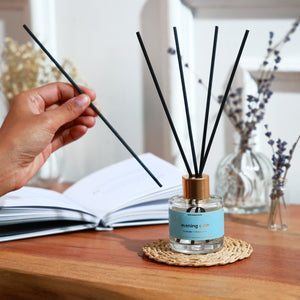

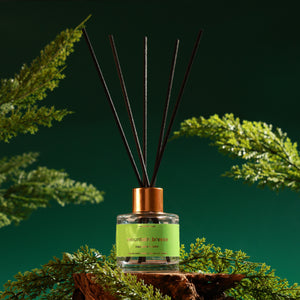
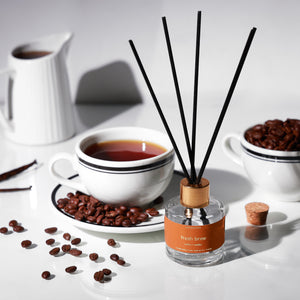
Then, in order: the calendar (under 48 hours means it has not started), the reed count (six is full strength), the placement, and the age of the reeds.
Buy last, not first. Four of the five fixes are free; the fifth uses the spare reeds you already own.
2. Check the date before you touch the bottle. Under 48 hours old and it has not finished starting. Two good months followed by a slow fade is clogged fibre. Weak from the very first week points at count or placement.
3. Put all six reeds in. Six fibre reeds come in the box and six is full strength. If you began with three or four, you set the volume low on purpose. Never go past the six supplied — extra sticks do not make it louder, they just drain it.
4. Move it to where air actually moves. A console near a doorway, a shelf on the route between two rooms, roughly waist to chest height. Out of a cabinet, out from behind furniture, off the floor, away from direct sun and away from an AC vent.
5. Then swap the reeds, and only then consider buying. If the set is over two months old, fit the fresh six that came with your last bottle. If a visitor still finds the room quiet after all of that, the room is simply larger than one bottle covers.
Made in India, composed by an ISIPCA Versailles-trained perfumer — and a portion of every order supports girl-child education through Nanhi Kali.
Why three different faults all arrive under the word weak
A reed diffuser has only three places it can go quiet, and telling them apart is most of the work. The first is perception: the room is properly scented and your receptors have stopped reporting a signal that never changes, which happens to almost everybody within days. The second is transport: the reeds are producing steadily but the air around them is still, so the fragrance hangs in a small volume near the bottle instead of spreading. The third is supply: too few reeds, a set clogged with the heavier molecules that build up over weeks, or a bottle that was never given its forty-eight hours to saturate. Only the third is anything like a product problem, and even that one is usually fixed with parts already in your house.
Which is why the order matters more than the individual fixes. Change five things at once and you cannot tell which one worked, so you carry the whole set of superstitions to your next bottle — and typically buy a larger one to be safe. Work down by cost instead, one change at a time, and give each two full days before judging, because a reed that has just been moved or flipped takes that long to settle into a new steady state. The triage below is deliberately arranged so that everything free happens before anything paid. If you reach the end and the room is genuinely faint to somebody who has just walked in, then you have a real answer worth spending on, and you will know exactly what you are spending it on.
The ten-minute triage
The run sheet, minute by minute
Ten minutes with a phone timer, in this order. The point of the order is that you never spend money to solve something a two-minute walk outside would have settled.
| When | What you do | Stop here if |
|---|---|---|
| 0–2 min ★ | Go outside, wait two minutes, come back in and breathe once at the door | You can smell it at the door — nothing is wrong |
| 2–3 min | Check the date you set it up | It is under 48 hours old — it has not started yet |
| 3–4 min | Count the reeds in the neck | Fewer than six and you want it louder — add the rest |
| 4–6 min | Move it to a console near a doorway, waist to chest height, on a tray | It was in a cabinet, behind furniture or on the floor |
| 6–7 min | Flip the reeds saturated-end up, using a tissue | Throw lifts immediately — repeat every 3–5 days, not daily |
| 7–10 min | Note the date on the base, then leave it entirely alone for two days | Judge it then, with a visitor, not tonight |
| If the run sheet ends with a faint room: the reeds are over two months old and need replacing, or the space is larger than the roughly 150 sq ft one bottle covers. See all five reed diffusers. | ||
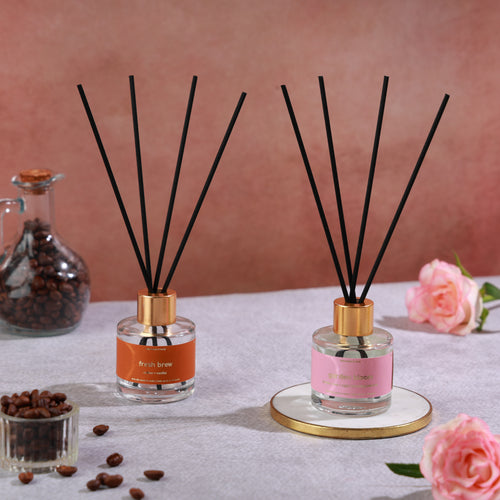
The reed range · five scentsFrom ₹749Shop → 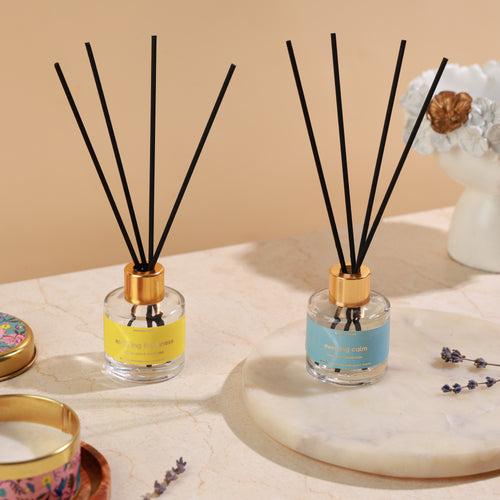 Day & Night duo · two rooms₹1,498Shop →
  Refills · 300ml₹2,399Shop →
Reeds, placement and flipping — the three things you control
Reed count is the volume setting and the quickest thing to correct. Six fibre reeds come with every SOSA bottle: all six for a hall, a living room or a kitchen; four for a bedroom; two or three for a small bathroom. A weak-feeling room very often turns out to be a four-reed setup in a space that wanted six. Do not go beyond six — the neck is sized for that number, extra sticks wick unevenly and the only reliable effect is a bottle that empties sooner. Reed count trades directly against weeks in the glass, so treat every reed you add as a deliberate exchange.
Placement is the fix people skip because it feels too simple, and it routinely outperforms anything you could buy. Fragrance leaves a reed by evaporating from the exposed tips; if the air around those tips does not move, the scent sits in a small pocket and the rest of the room gets nothing. Put the bottle where people and air pass — a hallway console, a shelf beside a doorway, an open sideboard — at roughly waist to chest height rather than on the floor. Keep it out of direct sunlight and out of the direct blast of a vent or fan, and stand it on a tray, because reed oil marks polished wood and untreated stone permanently if it is knocked. Out of reach of children and pets, always, and never decanted into another container.
Flipping is your short-term lever. Turn the reeds saturated-end up every three to five days and you get a real refresh, because the loaded end of each reed is suddenly exposed to open air — useful the morning before people come round. Flip daily and you will notice both the extra strength and the shorter bottle, which is a genuine trade rather than a free upgrade. What flipping will not do is rescue clogged fibre. After two or three months the heavier fragrance molecules have built up inside the reed and the wicking has slowed for good; the answer is the fresh set of six that came with your last bottle. A 300ml refill at ₹2,399 fills a 130ml roughly twice and is the natural moment to fit them.
What to buy, and when
Only reach this table if the triage above has genuinely run out. When it has, here is what the money actually buys — and what it does not.
| Buy | What it is | Lasts | Price |
|---|---|---|---|
| Try one ★ | A 50ml reed diffuser — 6 fibre reeds included | 6–8 weeks | from ₹749 |
| The proper size | A 130ml — any room you use daily — longer, not louder, than the 50ml | 14–18 weeks | from ₹1,249 |
| Two rooms | Day & Night duo — two rooms at once, cheaper than two bottles bought separately | 6–8 weeks each | ₹1,498 |
| Refill, do not rebuy | 300ml refill — refills a 130ml roughly twice; the glass is the durable part | Roughly 2 × 130ml fills | ₹2,399 |
| Fresh reeds | The commonest real fix after two months — replace the reeds, never the liquid | Replace at each refill | Included with each bottle |
Versailles
When somebody writes to say their diffuser is weak, I ask for a photograph of where it is standing. About half the time the picture answers the question by itself: a bottle at the back of a shelf, a bottle inside a closed cabinet, a bottle on the floor beside a sofa. Nothing pushes scent out of a reed, so a bottle with no air around it has nowhere to put its fragrance.
The other half divides into people who have adapted, people who set up two days ago, and people running four reeds because a magazine told them six looked cluttered. Each of those has a free answer. Genuinely faulty throw — a bottle doing everything right and still producing nothing — is the rarest outcome by a distance.
So my request is simple: give the free list ten minutes before you give anybody money, including me. If it ends with a second person telling you the room is quiet, buy with confidence, because you will know precisely what you are correcting. A portion of every order supports girl-child education through Nanhi Kali.
Frequently asked questions
- Why can I not smell my reed diffuser? — the full diagnostic, adaptation first.
- Why does it only smell up close? — source strength versus dispersal.
- How to make a reed diffuser smell stronger — every lever, ordered by cost.
- The complete scent throw guide — placement, count and reed condition.
- Brand: the SOSA founder story.
SOSA products & prices (verified August 2026): Hotel Collection water-based ultrasonic diffuser fragrance 15ml ₹299 · 100ml ₹999 · 300ml ₹1,799 · Pack of 7 (15ml, all fragrances) ₹1,799; refills 100ml from ₹999. Seven scents: The Ritz-Carlton-inspired (white tea · bergamot · cedar), Westin-inspired (white tea · aloe · cedar), 1 Hotels-inspired (cedarwood · vetiver · green leaves), The St. Regis-inspired (amber · violet · woods), Shangri-La-inspired (jasmine · green tea · white tea), Four Seasons-inspired (citrus · floral · sandalwood), W Hotels-inspired (citrus · pepper · amber). Diffusers: Boond 300ml ₹899 · Sukoon 500ml ₹1,899 · Megh 6L ₹3,499. Water-based, phthalate-free, composed to IFRA standards for home diffusion; 3–6 drops per tank. Made in India, Pune. The Hotel Collection scents are SOSA's own interpretations inspired by the world's finest hotels; all hotel names are trademarks of their respective owners and are used only to describe the scent style — SOSA is an independent Indian fragrance house, not affiliated with or endorsed by any hotel brand. Prices and availability subject to change — see the live product pages.