

2. No to one machine — two floors are two air systems, not one. Stack effect moves air vertically through a stairwell in its own pattern, largely independent of either floor's own air conditioning, and most buildings run separate cooling loops for each level; a source placed upstairs has no reliable route to reach downstairs air at all.
3. The physiotherapy floor's own treatment area stays unscented, exactly as it would on a single floor. Treatment and rehabilitation spaces — mats, plinths, exercise equipment — fall under this cluster's standard zoning doctrine whichever floor they sit on; being downstairs changes nothing about that rule.
4. If the downstairs floor has its own entry or waiting area for physiotherapy patients, that is a genuinely scentable zone in its own right. A patient-facing transit or waiting space downstairs is treated exactly like reception upstairs — briefly occupied, not a treatment room — and deserves its own source rather than relying on anything upstairs.
5. Where downstairs has no separate waiting area at all, it may need no fragrance decision of its own. A physiotherapy floor that is entirely treatment space, with patients arriving directly from the stairwell into the treatment area, has no scentable zone to place a source in — the honest answer there is to leave it unscented rather than force a placement that has nowhere appropriate to go.
Keep the strategy identical on both floors and treat the machine as a per-floor decision — a stairwell is not a distribution route, and each floor's own scentable zone, if it has one, needs its own source.
Why two floors behave as two air systems, not one
Stack effect is the tendency of warmer air to rise through a building's vertical openings — stairwells chief among them — while cooler air settles toward the ground floor, and it operates almost entirely independently of whatever each floor's own air conditioning is doing at the time. It is a genuine, physical air movement, but it is not a movement any fragrance source can rely on for distribution: its strength and direction vary with outside temperature, how often doors and windows are opened, and the season, in ways a corridor's steady AC supply never does. Treating a stairwell as a reliable route from an upstairs source to a downstairs room is optimism, not engineering.
Most multi-floor clinic buildings also run separate air conditioning for each level, whether that is a dedicated central plant per floor or simply separate split units installed floor by floor over time. That means upstairs and downstairs are not just physically distant — they are, in the fullest sense this cluster uses the term, separate distribution zones with no shared supply air at all. A single source's rated coverage figure describes what it can fill given access to that floor's own moving air; it says nothing about a floor it has no mechanical connection to whatsoever.
None of this means the two floors should feel like different decisions to a patient moving between them. The fragrance strategy — which register, how strong, which zones count as scentable — should be identical on both levels, applied by whoever is responsible for each floor's own source. What changes is not the thinking behind the plan, only the fact that the plan needs to be executed twice, once per floor, rather than once for the whole building.
The three decisions a two-floor plan forces
 Vaayu₹11,999Reception upstairs is almost always scentable; downstairs depends entirely on whether physiotherapy has a genuine transit or waiting space of its own, separate from the mats and treatment equipment.
Comparing floor-by-floor options
Every row treats the two floors as separate air systems from the start, and compares options only within that constraint.
| Option | What it assumes about the stairwell | What it actually does | What it costs |
| One Vaayu upstairs only, relying on the stairwell to reach downstairs | Stack effect will carry fragrance down to the physio floor | Rarely delivers a consistent result; downstairs reads as unscented most of the time | ₹11,999, under-delivering |
| Vaayu upstairs, Vaayu downstairs at its own waiting area | The stairwell is a visual link only, not an air route | Each floor's scentable zone reaches the same register and intensity independently | ₹23,998 |
| Vaayu upstairs only, no separate waiting area downstairs | Downstairs has no scentable zone at all | The correct answer where physiotherapy is entirely treatment space | ₹11,999 |
| Reed or Sukoon downstairs, Vaayu upstairs | Downstairs has a small, self-contained waiting nook rather than a full reception | A proportionate answer where the downstairs zone is genuinely modest | ₹11,999 plus ₹849–₹1,899 |
| Fragrance placed inside the treatment or mat area downstairs | Scenting the treatment space itself will improve the floor's overall impression | Breaks this cluster's zoning doctrine and should never be done, on either floor | — |
| A stairwell connects two floors visually and by stack effect, not by any air movement a fragrance source can rely on — each floor needs its own source, sized to its own scentable zone, or none at all where that zone does not exist. | |||
 Vaayu · one per floor's scentable zone₹23,998 for twoShop →
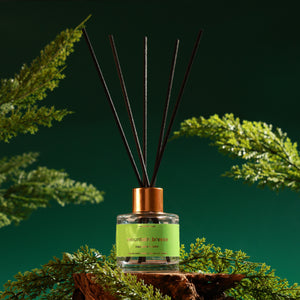
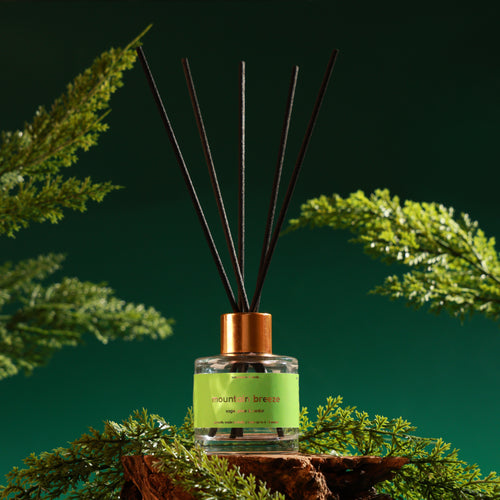
  Sukoon · a modest downstairs nook₹1,899Shop → Mountain Breeze · same nook, lower cost₹849Shop →
What stays unscented on the physiotherapy floor
Treatment and rehabilitation space — mats, plinths, exercise and treatment equipment — stays completely unscented under this cluster's standard zoning doctrine, on the ground floor exactly as it would on any other. Being downstairs, or physically separate from reception, does not create an exception to this rule, and no downstairs placement should target the treatment area directly.
Where physiotherapy has its own entry, reception desk or waiting bench distinct from the treatment floor itself, that specific space is scentable on the same terms as reception upstairs — noticed briefly on arrival, forgotten within a minute, never carried into the treatment area beyond a genuinely faint trace at the threshold between the two. If that trace reads as more than faint inside the treatment space, the fix is to reduce the downstairs unit's intensity or reposition it further from that threshold.
If a patient undergoing physiotherapy raises the fragrance as noticeable at any point, reduce the downstairs setting or switch it off immediately — the same rule this cluster applies everywhere a patient spends an extended period in one place applies just as firmly to a ground-floor treatment space as to an upstairs consultation cabin.
What to buy, floor by floor
Every route below is decided independently for each floor, since the two levels do not share air and do not share a fragrance budget by default.
| Route | Floor and condition | Why | What it costs |
| Vaayu, wall or duct-mounted upstairs | Reception, waiting area or corridor on the upper floor | The clinic's primary patient-facing zone, sized like any single-floor reception | ₹11,999 |
| Vaayu, wall-mounted downstairs at its own entry or waiting area | Physiotherapy has a genuine transit or waiting space distinct from the treatment floor | Its own scentable zone, on its own air, needs its own source to reach the same standard as upstairs | ₹11,999 |
| Sukoon or reed, downstairs, small waiting nook | A modest downstairs entry rather than a full reception | A proportionate answer where the downstairs zone is genuinely small | ₹849–₹1,899 |
| No source downstairs at all | Physiotherapy is entirely treatment space with no separate waiting or entry area | There is no scentable zone to place a unit in — leaving it unscented is the honest answer | — |
| No fragrance placed inside the treatment or mat area, either floor | Standard zoning doctrine for treatment and rehabilitation space | Applies identically upstairs and downstairs, whatever else is installed | — |
The question I get from two-floor clinics almost always arrives phrased as 'should the smell be different upstairs and downstairs, or the same' — a fragrance-identity question. The answer to that part is easy: the same, always. What most owners have not yet worked out is that the identical answer above and below still needs two separate sources to deliver it, because the two floors are not, in any air-movement sense, one space.
I ask for a photograph of the stairwell and a description of what happens downstairs the moment a patient reaches the bottom of it — do they walk into a waiting bench, or straight onto the treatment floor. That single detail decides whether downstairs needs a source at all, and it is very often the part of the brief an owner has not thought to mention until asked directly.
The clinics that get this layout right are the ones willing to buy two units rather than one and hope. It is a larger initial decision, but it is the only version of the plan that actually delivers the same result on both floors, rather than a good upstairs and a forgettable downstairs.
Questions clinic owners ask about two-floor clinics
- My clinic is 1,800 sq ft with central AC and several closed cabins — would one waterless scent machine work or should I think in zones? — the general zoning logic this post applies specifically to two separate floors.
- How does central AC affect fragrance distribution in an orthopaedic clinic? — why separate AC systems, floor by floor, behave as separate distribution zones.
- One scent machine vs multiple smaller fragrance points for an orthopaedic clinic — the general case behind this post's two-unit recommendation.
- How should I scent a sports orthopaedic clinic attached to a physiotherapy centre? — the zoning boundary between consultation and rehab space this post applies across floors.
- Brand: the SOSA founder story.
SOSA products & prices (verified September 2026): Reed diffusers 50ml ₹749–₹849 (to 150 sq ft, 6–8 weeks at six reeds) · 130ml ₹1,249–₹1,349 (above 150 sq ft, 14–18 weeks) · reed refill 300ml ₹2,399. Ultrasonic: Boond ₹899 (~150 sq ft) · Sukoon ₹1,899 (270–320 sq ft, ships with three 15ml Hotel Collection fragrances) · Megh ₹3,499 (6L tank, ~100 hrs runtime, ~215 sq ft — a runtime machine, not a coverage upgrade). Waterless cold-air: Safar ₹3,999 (no published coverage figure) · Vaayu ₹11,999 (up to 1000 m³, roughly 2,000–3,000 sq ft; 400ml tank lasting about 90+ days; app and onboard control, 1h/4h/8h/24h run windows, adjustable intensity, key-lock, under 38 dB, freestanding or wall/HVAC mount, 5W, CE/RoHS/SGS) · Aangan ₹25,999 (8,000–10,000 sq ft). Hotel Collection water-based fragrance 15ml ₹299 · 100ml ₹999 · 300ml ₹1,799 is for ultrasonic machines; reed oil and Hotel Collection are not interchangeable. Reed diffusers are alcohol-free, phthalate-free, paraben-free, IFRA-compliant and low VOC, handmade in small batches in Pune. Every purchase funds a girl's education through Nanhi Kali. Prices and availability subject to change — see the live product pages.