





The mechanism: open-cell foam is an interconnected air lattice. It absorbs through the cover, stores deep, and releases back out slowly for weeks.
The timing tells you: a return in three to seven days is a deeper layer coming back through clean fabric. Same-day return is a different source entirely.
The fix: airflow through the core — cushions on edge, fan on them, sunlight if you have it.
2. Foam is a superb reservoir. Open-cell foam is a three-dimensional lattice of interconnected pockets — the structure that makes it comfortable is also an enormous internal surface area with air moving freely between the cells. Volatiles diffuse in easily and diffuse out slowly, and because the cushion is compressed under a cover with a person on it most evenings, almost no air passes through it to carry anything away.
3. The timing is the proof. Pay attention to how long the clean period lasts. Three to seven days is the classic signature of a deeper layer re-equilibrating through fresh fabric. A smell that comes back within hours is not the foam — that is a live source somewhere else in the room, most often a wet trap. A smell that takes three weeks is probably new contamination from cooking or damp.
4. Wet cleaning frequently makes it worse. Shampooing an upholstered sofa at home puts water and detergent into the foam. Some of it dissolves the residue and carries it deeper rather than out, and all of it has to leave again. A core that stays damp for days in an Indian summer or a monsoon week will smell distinctly worse than it did before you started. If a sofa genuinely needs wet cleaning, it needs a service that extracts the moisture, not a bucket and a brush.
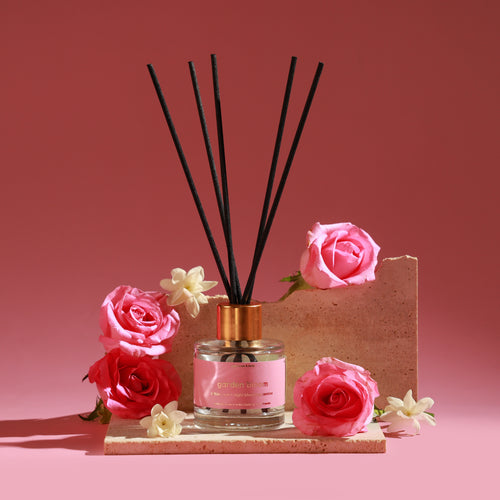
5. Airflow is the actual tool. Foam gives up what it holds to moving air, slowly, and in stages. Cushions standing on edge with a fan on them for two hours, repeated over several days and combined with sunlight where you can get it, will do what no single cleaning session does. Fragrance comes after that — a reed diffuser or a Sukoon, both of which add and remove nothing.
Made in India, composed by an ISIPCA Versailles-trained perfumer — and a portion of every order supports girl-child education through Nanhi Kali.
Covers versus cores: the ratio nobody thinks about
Cleaning tends to follow accessibility rather than importance. A cover unzips, fits in a machine and comes out visibly cleaner, so it feels like the sofa has been cleaned. Measure the two parts and the picture changes completely. A woven upholstery cover is around two millimetres thick. A seat cushion is typically a hundred to a hundred and fifty millimetres of foam, and the back cushions and the deck padding add more. By volume, you cleaned somewhere between one and two per cent of the sofa. Everything else — the part with the greatest storage capacity, sitting directly beneath the surface you just refreshed — was untouched, and it has been absorbing through that cover since the day the sofa arrived.
What follows is a diffusion problem, and diffusion has a characteristic timescale. The foam is not releasing into the room directly; it is releasing into the cover, which then releases into the air. Put a clean cover onto a loaded core and there is a steep concentration difference across that boundary, so transfer runs faster than usual until the two come back into balance. That is why the room is genuinely lovely for a few days and then is not: you were watching an equilibrium re-establish itself. It also explains why the second wash of the covers buys you less time than the first, and the third less again. Each cycle removes a little from the core indirectly, but nothing like enough, and you can keep doing this indefinitely without ever getting ahead.
The three layers you did not clean
 Step fourFrom ₹749This is the main event. Open-cell foam is an interconnected lattice with a vast internal surface, and it has been absorbing through the cover for the life of the sofa. It cannot be washed and it should not be soaked. What it responds to is air moving through it, over time. Take the cores out of their covers entirely, stand them on edge with a hand's width of space around each, and run a fan at them for two hours. Repeat daily for a week. In sunlight it goes faster, because heat and UV drive absorbed volatiles out of the material rather than just carrying away what has already surfaced.
Symptom to cause: reading the return
How long the good period lasts is the most useful single piece of information you have. Match your interval to a row before you clean anything again.
| What you notice | Most likely cause | How to confirm it | What actually fixes it |
|---|---|---|---|
| Fresh for three to seven days, then back ★ | The foam core re-equilibrating through a clean cover | Smell a bare core at the cut face and compare with the washed cover | Cores out, on edge, fan on them two hours daily for a week |
| Fresh for a few hours only | A live source elsewhere — the sofa was never the problem | Run the wet-trap check: unused drains, bin lid, gasket, damp cloths | Fix the trap; water down unused drains weekly; dry cloths flat |
| Worse a week after a wet clean than before it | Moisture left in the foam, plus residue driven deeper by the water | Press the back of your hand deep into the core for ten seconds | Dry the cores hard with fans and sun; use extraction cleaning in future |
| Returns each time it rains, regardless of cleaning | Humidity in the fibre and foam accelerating release | Compare a dry week and a wet week with no cleaning in between | Fan the cores in every dry gap; ventilate; do not dry laundry in the room |
| Smell is strongest at the deck, under the cushions | The uncovered platform and frame, which no wash cycle reaches | Lift the cushions out, leave the deck exposed an hour, smell it directly | Crevice-vacuum the deck, corners, behind the arms and the underside |
| Musty earth note and dark speckles on the wall behind | Damp or mould in the wall — a health issue, not an odour | Pull the sofa right out and inspect plaster, skirting and the sofa back | Find the moisture source and remove the growth. Do not fragrance this. |
| If none of these fit: put the freshly washed covers onto a different sofa or a spare chair for a week. If they stay fresh there and the original sofa still smells with bare cores, the answer is unambiguously the foam. | |||
Reeds · always-on roomsFrom ₹749Shop →  Sukoon · when you want a switch₹1,899Shop →
  Hotel Collection · the scentFrom ₹299Shop →
Cleaning a sofa to depth
Strip it right down before you wash anything. Covers off, cores out, cushions stacked separately, and the sofa itself vacuumed properly with the crevice and brush tools — deck, corners, behind and under the arms, the outer back, and the underside if you can tip it safely. Most sofas have never had this done. Only then wash the covers, at the warmest temperature the labels allow, with no fabric softener, and dry them completely. Softener leaves a coating that slows how readily fibre releases what it holds, which is precisely the wrong direction when you are trying to get something out.
Then work the cores with air, over days rather than in one session. Stand each bare core on edge with space around it and point a pedestal fan at the group for two hours. Do it again the next day, and the next. If you have a balcony with afternoon sun, put them there instead — heat and UV drive absorbed volatiles out of foam and fabric considerably faster than air alone, and moving air carries them off once they surface. Turn them halfway. A week of this changes a sofa in a way that a single Sunday never does, and it costs the running cost of a fan.
Be careful with wet cleaning, and add fragrance only at the end. Do not soak an upholstered sofa at home. Water carries residue deeper into foam and then has to leave again, and a core that stays damp for several days in Indian heat or monsoon will smell worse than the problem you started with. If wet cleaning is genuinely needed, use a service that extracts the moisture mechanically, and insist on drying time with the windows open and fans running afterwards. Once the room passes the honest test — leave for thirty minutes, judge your first breath back — add the ambient layer. A reed diffuser from ₹749 gives a living room a constant background with no electricity, six reeds for full strength or four in a smaller room. The Sukoon at ₹1,899 with 3–6 drops of a water-based Hotel Collection scent from ₹299 gives you a switch instead. Neither of them cleans foam.
The order that works
The expensive-looking fix — professional shampooing — is often the one that backfires. The cheap fix, a fan and a week, is the one that works.
| Step | What to do | When | Cost |
|---|---|---|---|
| 1. Remove the source | Strip the sofa fully, crevice-vacuum deck, frame and underside, and check the wall behind it for damp | Before anything else | ₹0 |
| 2. Move the air | Cross-ventilate ten minutes twice daily and keep the sofa a hand's width off the wall permanently | Daily, five to ten minutes | ₹0 |
| 3. Deal with what holds it | Bare cores on edge with a fan for two hours daily for a week; sun them when the weather allows | Weekly to monthly | ₹0 |
| 4. Then the always-on layer ★ | A SOSA reed diffuser — a steady living-room background once the foam has actually been aired out | 50ml 6-8 weeks · 130ml 14-18 | from ₹749 |
| 5. Or the on-demand layer | Sukoon with a Hotel Collection scent — scent on demand before guests rather than all day; covers roughly 270–320 sq ft | Run it when you want it | ₹1,899 |
Versailles
This is the most common follow-up question I get about upholstery, and the answer disappoints people because it is not a product. It is a fan, some patience and a week. Foam does not give things up quickly and there is no bottle that changes that. I would rather tell you plainly than let you buy a diffuser and conclude in five days that it stopped working.
The mistake I would most like to prevent is the enthusiastic home shampoo. It feels thorough and it is often the thing that turns a stale sofa into a musty one, because water goes into foam easily and comes out of it very slowly. If a sofa genuinely needs wet cleaning, use someone with an extraction machine and then dry it hard with windows open and fans running for two full days.
Once the cores are actually clean, the same fabric that was working against you starts working for you — porous material holds a pleasant scent as readily as it held the stale one and gives it back gently all day. That is the point of doing the boring part first. A portion of every order funds a girl's classroom through Nanhi Kali.
Frequently asked questions
- Mopped, and it still smells closed — why the floor is the wrong target.
- Fabric in humid weather — moisture in the fibre and the foam.
- How often soft furnishings need cleaning — a cadence you will actually keep.
- Fragrance before or after cleaning? — the order, and why it matters.
- Brand: the SOSA founder story.
SOSA products & prices (verified August 2026): Hotel Collection water-based ultrasonic diffuser fragrance 15ml ₹299 · 100ml ₹999 · 300ml ₹1,799 · Pack of 7 (15ml, all fragrances) ₹1,799; refills 100ml from ₹999. Seven scents: The Ritz-Carlton-inspired (white tea · bergamot · cedar), Westin-inspired (white tea · aloe · cedar), 1 Hotels-inspired (cedarwood · vetiver · green leaves), The St. Regis-inspired (amber · violet · woods), Shangri-La-inspired (jasmine · green tea · white tea), Four Seasons-inspired (citrus · floral · sandalwood), W Hotels-inspired (citrus · pepper · amber). Diffusers: Boond 300ml ₹899 · Sukoon 500ml ₹1,899 · Megh 6L ₹3,499. Water-based, phthalate-free, composed to IFRA standards for home diffusion; 3–6 drops per tank. Made in India, Pune. The Hotel Collection scents are SOSA's own interpretations inspired by the world's finest hotels; all hotel names are trademarks of their respective owners and are used only to describe the scent style — SOSA is an independent Indian fragrance house, not affiliated with or endorsed by any hotel brand. Prices and availability subject to change — see the live product pages.