

The mechanism: the nose reports change far better than steady state. A seated member adapts to a constant background and stops registering it; a burst re-crosses their threshold and is perceived in full. The room is therefore judged at its peaks and lived at its average, and bursts make those two numbers very different.
A work and pause cycle is not a burst. The distinction that matters is amplitude, not intermittency. A short low cycle in a room with normal air movement is smoothed into something close to continuous. A high-amplitude release is a distinct event however the timer is set.
Where bursts genuinely belong: thresholds and entrances, banquet and event rooms before an event rather than during one, and spaces occupied for an hour twice a week. Not lounges, and not anywhere food is served.
The honest gap: no peak concentration, duty ratio, cycle length in minutes or falloff figure is published for any SOSA machine, so the balance is set by observation over a week rather than calculated. And the ultimate burst device is not on our shelf at all — SOSA sells no room spray for this purpose; every SOSA spray is a car perfume.
2. Understand that members judge the peak, not the average. A seated member adapts to a steady background within a short time and the fragrance recedes into the room, which is exactly what a signature is supposed to do. A burst reinstates it as a change event and is experienced at full value. Two installations using identical quantities of oil will be described as “beautifully done” and “overpowering” purely on the basis of distribution.
3. Do not confuse a work and pause cycle with a burst. What makes a burst a burst is amplitude, not the fact that the machine pauses. A short, low cycle in a room with ordinary air movement is averaged into something close to continuous. A high-amplitude release is a distinct event whatever the timer says, and the longer the gap between releases, the more completely it is perceived.
4. Reserve intervals for places people move through. A threshold, an entrance vestibule, a lift lobby, a banquet room before an event begins. Those are all spaces where nobody is sitting for hours, where a clear signal is appropriate and where adaptation never has time to set in. Dining rooms, private dining and bar counters stay neutral regardless of the delivery pattern.
5. Remember what a complaint costs. Clubs almost never respond to a fragrance complaint with a small reduction; they switch the machine off. A burst pattern is a complaint generator, so the delivery decision is also a decision about whether the installation survives its first year. Everything SOSA makes is alcohol-free, phthalate-free, paraben-free, IFRA-compliant and 0 ppm formaldehyde, composed in Pune, and a portion of every order supports girl-child education through Nanhi Kali.

Why the same quantity of oil produces two entirely different rooms
This is the part worth understanding properly, because once it is clear the recommendation follows by itself and a club stops arguing about it in committee. The quantity of fragrance released across an afternoon tells you almost nothing about how the room will be described. What decides that is the shape of the release, and three separate effects push a burst pattern toward the complaint and a continuous one toward the compliment.
 Vaayu₹11,999Consider two lounges using the same oil over the same afternoon. The first holds a steady low level all the way through. The second releases nothing for a stretch and then delivers a strong interval. Averaged across the afternoon the two rooms are equivalent; asked to describe them, members will not be. The first room will be described in terms of the club — comfortable, well kept, nice atmosphere — and quite often without mentioning fragrance at all, which is the ideal outcome for a signature. The second will be described in terms of the fragrance, because the fragrance repeatedly announced itself, and the adjective attached to it will be the one that fits the peak. Nobody in that room is averaging anything. They are reporting the loudest moment of their afternoon, and it is very hard to argue with somebody about an experience they actually had.
Aangan₹25,999The second effect is spatial and it is the one specifiers miss. Fragrance leaves a machine at a point and is carried outward by the room’s air, diluting as it goes. A continuous low delivery gives that process time: the air has many passes in which to distribute a small amount, and the difference between the concentration beside the unit and the concentration at the far seat is modest. A burst has to arrive at the far end in one push, which means the near end receives a great deal more than the far end while the burst is happening. The member sitting nearest the machine is therefore the one who complains, and the club frequently misdiagnoses this as a placement problem and moves the unit, which simply relocates the complaint to a different armchair. In a hard-surfaced room with no soft furnishings to buffer the peak, the effect is sharper still.
Vaayu₹11,999Consider two lounges using the same oil over the same afternoon. The first holds a steady low level all the way through. The second releases nothing for a stretch and then delivers a strong interval. Averaged across the afternoon the two rooms are equivalent; asked to describe them, members will not be. The first room will be described in terms of the club — comfortable, well kept, nice atmosphere — and quite often without mentioning fragrance at all, which is the ideal outcome for a signature. The second will be described in terms of the fragrance, because the fragrance repeatedly announced itself, and the adjective attached to it will be the one that fits the peak. Nobody in that room is averaging anything. They are reporting the loudest moment of their afternoon, and it is very hard to argue with somebody about an experience they actually had.
Aangan₹25,999The second effect is spatial and it is the one specifiers miss. Fragrance leaves a machine at a point and is carried outward by the room’s air, diluting as it goes. A continuous low delivery gives that process time: the air has many passes in which to distribute a small amount, and the difference between the concentration beside the unit and the concentration at the far seat is modest. A burst has to arrive at the far end in one push, which means the near end receives a great deal more than the far end while the burst is happening. The member sitting nearest the machine is therefore the one who complains, and the club frequently misdiagnoses this as a placement problem and moves the unit, which simply relocates the complaint to a different armchair. In a hard-surfaced room with no soft furnishings to buffer the peak, the effect is sharper still.
 Evening Calm₹799The third effect is the counter-intuitive one, and it is the reason clubs that adopt burst delivery to save oil end up with the strongest-smelling room in the district. Sensitivity to a constant stimulus declines while it is present and recovers while it is absent. A long silence between releases is therefore a period of recalibration: the member’s nose returns toward full sensitivity, and the next release meets an instrument that has been freshly reset. The system delivers the least oil at exactly the moments of greatest perceived intensity, which is efficient in the way a car alarm is efficient. A continuous low delivery does the opposite: the room holds a constant background, members adapt into it as they would to the temperature, and the fragrance becomes an attribute of the club rather than a recurring interruption. Restraint costs nothing and it is the only luxury signal that cannot be faked with a larger machine.
A work and pause cycle is not a burst — and the difference is amplitude
This needs saying plainly, because Aangan is controlled by an intelligent PCB with programmable work and pause cycles, and a reader could reasonably ask whether that is not exactly the burst pattern this page has spent several hundred words arguing against. It is not, and the distinction is worth a committee understanding. Intermittency is a property of the machine; a burst is a property of the room. What decides which one you have is amplitude relative to the room’s volume and air movement. A short pause at a low intensity is smoothed by the air in the space before anybody notices a discontinuity: the concentration wobbles below the threshold at which perception reports anything, and the lounge experiences a steady level. A high output separated by long silences produces excursions well above and well below the average, and the room experiences events.
The practical consequence is that the intensity setting and the cycle have to be considered together rather than separately. A cycle is a way of holding a low level economically; it is not a way of making a low setting feel stronger. A club that has correctly chosen continuous-feeling delivery and then raised the intensity to compensate for staff who cannot smell it has reintroduced the peaks it was trying to avoid. The sequence I recommend is therefore: set the lowest intensity that survives the busiest hour of the week, then shape the cycle so that the level holds through the day without accumulating, and then stop adjusting.
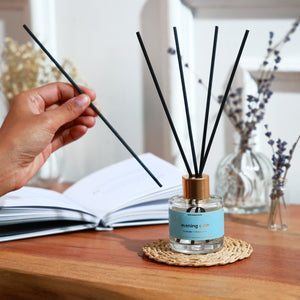
One note on mechanism, since clubs sometimes propose achieving continuity with passive devices instead. A reed diffuser is genuinely continuous — it has no cycle at all — but it is a fragrant zone rather than a fragranced room. Oil climbs six fibre reeds and evaporates, with no energy used and no air moved, so it scents the couple of metres around the bottle and nothing beyond. Putting ten of them along a lounge produces ten small zones with gaps between them, not one even room, and that is the mechanism working correctly rather than a quality failure. Continuity is necessary but not sufficient; the room also needs something that moves the fragrance. And at the other extreme, the purest burst device of all is not something we can sell you for this job: SOSA sells no room spray for interior scenting, and every SOSA spray is a car perfume — a spray is an event rather than a system, which is the whole of the argument on this page expressed as a product decision.
Delivery patterns, and what members actually report
Five ways a club can deliver fragrance into a lounge, what each produces in the room and where each belongs. The last two rows are the ones worth refusing, and the final row describes something SOSA does not supply for this purpose at all.
| Pattern | What the room does | What members say | Where it belongs |
|---|---|---|---|
| Continuous, low ★ | Peak and average nearly identical; no discontinuities | They describe the club, often without mentioning scent | Every long-dwell room. The default for a lounge |
| Short work and pause cycle, low intensity | Wobble below the threshold of perception; reads as steady | Indistinguishable from continuous | Lounges and whole floors; economical and effectively continuous |
| Long cycle, high intensity | Large excursions; sensitivity recovers between releases | “Too strong” — reported from the peak, not the average | Nowhere members sit. This is the pattern to avoid |
| Timed strong release at fixed moments | A clear event, felt most by whoever sits nearest the unit | “It keeps coming in waves” | Thresholds, vestibules, lift lobbies — places people cross |
| Pre-event release, then nothing | The room is scented before occupation and left alone during it | Usually nothing, which is the point | Banquet and event rooms — never during food service |
| Passive reeds along the room | Continuous, but several small zones with gaps between them | “You can only smell it near the table” | Small rooms and desks. Not a lounge-scale answer |
| Spray, by hand or on a timer | The largest possible peak from the smallest possible quantity | The complaint that reaches the house committee in writing | Nowhere. SOSA sells no room spray for interior use; every SOSA spray is a car perfume |
One lounge · Vaayu₹11,999See it → A whole floor · Aangan₹25,999See it → 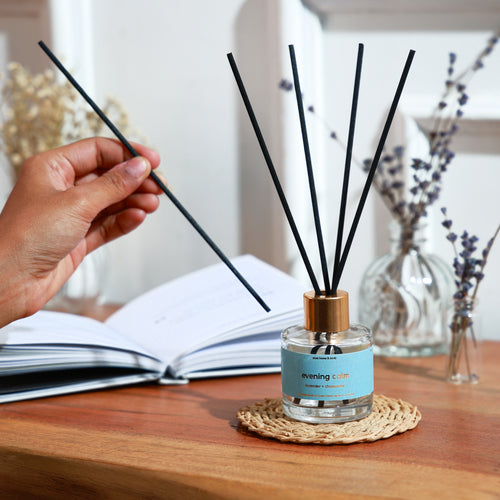 The quietest register · reeds₹799See it →
Where a burst is the right answer, and where nothing is
It would be dishonest to leave this as a blanket rule, because intervals of higher output are correct in several places and a club that bans them everywhere will under-serve its entrance. The test is dwell time. Where nobody stands for long, adaptation never sets in, the peak is the whole of the experience and a clear signal is appropriate: the threshold, the entrance vestibule, a lift lobby, the corridor turn where members first see the club properly. Those spaces are crossed rather than occupied, and a pattern that would be intrusive in a lounge is simply legible there. The arrival carries the signal; everywhere members settle sits underneath it.
The second legitimate case is the event room. A banquet or function space can be scented before an event and then left alone during it, which gives the room a character on entry without putting fragrance into an occasion where food will be served and people will stay for hours. That is a burst in the useful sense — a preparation rather than an accompaniment — and it is much the best way to handle a space that is empty for most of the week. It also avoids the standing rule that food and ambient fragrance do not belong together.
Which brings me to the places where the answer is not a pattern at all, and where the honest recommendation is nothing. Dining rooms, private dining and bar counters stay neutral, continuously or otherwise — ambient fragrance in a dining room competes with the kitchen, flattens wine and is the one intervention a chef and a sommelier will both object to. Spa treatment and massage rooms carry their own therapy oils and should not be given a second fragrance. Gym floors need air change rather than perfume, and the honest move is to scent the wellness reception lightly instead. Boardrooms and private meeting rooms are small closed volumes holding people who did not choose to be there, so the default is unscented and the corridor outside carries the identity. And in a heritage club, the library, the card room and the reading room already smell of paper, timber and decades of use, which is the club’s own character and worth protecting rather than overwriting. Naming those rooms is what makes the rest of a scenting proposal believable.
The delivery edit — and what is not published, stated twice
How I would set the delivery for a members’ lounge, in order, with the free decisions first. The last two rows name what not to buy and what figures do not exist.
| Step | What it is | Why it works | Cost |
|---|---|---|---|
| 1. Decide by dwell time, room by room ★ | Continuous and low where members stay; intervals only where they pass through | Adaptation never sets in on a crossing, so the peak is the whole experience there and a nuisance everywhere else | No cost |
| 2. Set intensity for the busiest hour, then leave it | The lowest setting that survives the evening peak, judged by walking in from outside | Setting for a quiet hour guarantees a peak in a busy one, and the busy hour is when members are there | No cost |
| 3. Shape the cycle after the intensity, never instead of it | A short low work and pause cycle reads as continuous; a long high one reads as waves | Amplitude decides whether intermittency is perceptible at all | No cost |
| 4. Buy the machine that can hold a level | Vaayu: adjustable intensity, 1h / 4h / 8h / 24h run windows, day selection, auto-stop, key-lock, under 38 dB, up to 1000 m³ ≈ 2,000–3,000 sq ft | Waterless nebulising distributes a small quantity continuously with no water, no humidity and no residue | ₹11,999 |
| 5. For a floor on one air system, programme it once | Aangan on a mechanical HVAC or AHU connection, up to 3,000 m³ ≈ 8,000–10,000 sq ft, with work and pause cycles set at the unit | The building’s own air smooths the delivery further, which is why hotels feel even without anything visible in the room | ₹25,999 |
| 6. Keep the intervals for the threshold | A clear, legible signal at the entrance, with the lounge sitting demonstrably below it | The arrival carries the identity so the lounge does not have to repeat it every quarter of an hour | No extra |
| Do not buy: anything chosen for maximum output | A machine specified on its peak capability, or a timed spray device, will produce exactly the complaint that ends the installation | Clubs respond to a fragrance complaint by switching the system off, not by turning it down | Saves the whole budget |
| The honest gaps: what is not published | No peak concentration, duty ratio, cycle length in minutes, recovery time, adaptation time in minutes, falloff curve or consumption rate is published for any SOSA machine, and no machine count exists as a formula. SOSA sells no room spray for interior scenting — every SOSA spray is a car perfume. No purchasable refill oil is listed for the waterless commercial machines; that fragrance is specified and quoted per property | Said plainly, because the balance between level and cycle is arrived at by observation over a week rather than by arithmetic | Quoted |
Versailles
The word members reach for when a delivery pattern is wrong is almost always waves. Not “strong”, not “unpleasant” — waves. I have heard it from a club in Pune and a club in Delhi in the same month, about two different fragrances and two different machines, and both times the composition was fine and the schedule was the culprit. When somebody tells you a room comes in waves, they are telling you about the shape of the release, and no change of scent will fix it.
What I find genuinely satisfying about this is that the better answer is also the cheaper one. A continuous low delivery uses no more oil than an intermittent strong one and frequently less, because it is not spending its budget on excursions that nobody wanted. The club pays the same and gets a room that members describe as comfortable rather than as scented, which is the only review worth having.
The temptation, always, is to want the fragrance to be noticed — the club has paid for it, and something that goes unremarked feels like something wasted. I would ask a committee to resist that, because in a lounge being noticed is the failure mode. The arrival is where the club is allowed to speak clearly. The lounge is where it should simply be a good room, and let the members give the credit to the building. Everything we make is composed in Pune, and a part of every order funds a girl’s classroom through Nanhi Kali.
Frequently asked questions
- The pillar: the long-stay register — why the lounge is the hardest room in the club.
- All-day consistency as a schedule and dosing for the fourth hour.
- Why staff stop smelling it and how to keep a setting where you put it.
- The business lounge register and the minimal room with no soft mass.
- Lounge versus lobby and the leather-and-wood lounge.
- Brand: the SOSA founder story.
SOSA commercial scenting — facts verified August 2026: Vaayu ₹11,999, waterless cold-air nebulising, up to 1000 m³ ≈ 2,000–3,000 sq ft, 400ml refillable sealed tank lasting up to about 90+ days depending on intensity and hours, Bluetooth app plus onboard buttons, run windows of 1h / 4h / 8h / 24h, day selection, adjustable intensity, auto-stop and key-lock, under 38 dB, freestanding, wall-mounted or HVAC-return, DC 12V / 1A at 5W, CE, RoHS and SGS, black and white. Aangan ₹25,999, HVAC or AHU connection or standalone wall-mount or lay-flat, up to 3,000 m³ ≈ 8,000–10,000 sq ft, 800ml reservoir giving weeks between refills on business-hours schedules, under 42 dB, DC 12V at 14W, intelligent PCB with programmable work and pause cycles and daily schedules, metal body 3.9 kg at 284 × 125 × 246 mm, black or white, one-year warranty, imported; it is not app-controlled, has no Bluetooth, and no certifications are published for it. Meenar ₹38,500 is the larger-property option, specified on enquiry; no coverage figure is published for it here, and it should not be assumed to reach further than Aangan. Ultrasonic machines: Sukoon ₹1,899 at 270–320 sq ft with a 500ml tank and 16–18 hours on low, Boond ₹899 with a 300ml tank at up to about 150 sq ft, Megh ₹3,499 with a six-litre tank and around 100 hours of runtime but only about 215 sq ft of coverage. Hotel Collection fragrance oils are water-based and ultrasonic-only at 15ml ₹299, 100ml ₹999 and 300ml ₹1,799, taking three to six drops in the water tank; they are not for reed diffusers and not for the waterless commercial machines. No purchasable refill oil is listed for the waterless commercial machines; that fragrance is specified and quoted per property. SOSA publishes no leather fragrance in any format and no tobacco or smoky fragrance for any diffuser. SOSA sells no air purifier, no dehumidifier and no room spray for interior scenting; every SOSA spray is a car perfume. No SOSA machine offers Wi-Fi, Alexa, Google Assistant, KNX, Crestron, Control4, Modbus, BACnet, an API, a dry contact or any building-management integration; the Aangan HVAC connection is mechanical. Reed diffusers 50ml ₹749–₹849 lasting 6–8 weeks and 130ml ₹1,249–₹1,349 lasting 14–18 weeks, six fibre reeds, alcohol-free, phthalate-free, paraben-free, IFRA-compliant, 0 ppm formaldehyde, heat-stable CCT carrier, refillable glass bottle, tested at 45°C and 85% RH, composed in Pune. No dealer programme, reseller margin, trade price, territory or service contract is published. Free shipping above ₹499. A portion of every order supports girl-child education through Nanhi Kali. SOSA is an independent Indian fragrance house; the Hotel Collection scents are SOSA’s own interpretations inspired by the world’s finest hotels, and SOSA is not affiliated with or endorsed by any hotel brand. Prices subject to change — see the live product pages.