
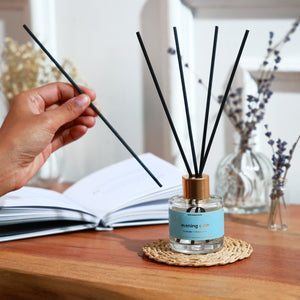


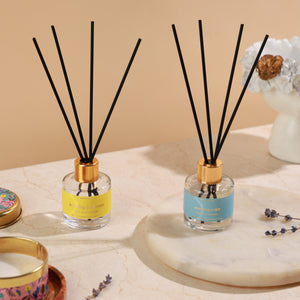

What that means in practice: the fragrance is leaving the room, not failing to arrive. Projection is a balance between how fast the reeds release and how fast the air departs, and only one side of that balance is a product.
The three fixes, in order of how much they change: move it off the airflow line and onto the sheltered side of the room; buy for the closed hours rather than the open ones; then, and only then, adjust the reed count — six for full projection, three for a soft level that roughly doubles the life.
The honest gap: adding reeds does not beat a cross-breeze. It empties the bottle faster into the same moving air, and you will notice the cost long before you notice the fragrance. That is the single most common mistake people on high floors make, and it is expensive.
2. A cross-breeze is a second, separate problem on top of the first. Two openings on different sides do not ventilate a room; they scour it, because the air travels in a fairly direct line between them. A bottle standing anywhere on that line is being stripped continuously and delivering its fragrance to the sky. The same bottle, moved to the sheltered wall two metres off that line, behaves like a different product without anything about it changing.
3. You are also the least reliable instrument in the flat. Olfactory receptors adapt to a constant, unchanging smell within minutes, which is why nobody smells their own home. On a high floor the level in a room genuinely does rise and fall, so both things are true at once and they get blamed on each other. The test is not to sniff harder. Leave for a quarter of an hour and walk back in, or ask somebody arriving from outside.
4. Almost certainly you did not get a weak bottle. A 50ml is built for rooms up to about 150 sq ft and a 130ml for above that, so a 50ml in a large open-plan living end will read as quiet while performing exactly to specification. Reed count is the volume dial and it is free: six reeds for full projection, three for a soft bedside level that roughly doubles how long the bottle lasts. Change the dial and the placement before you change the bottle.
5. Then buy for the closed hours rather than the open ones. A high, breezy flat is not a fragrance environment while the openings stand open, and it becomes one the moment they shut. Work out, room by room, the block in which the room is both closed and occupied. That block is the product. If a room has no such block, it does not need a bottle, and saying so saves more money than any recommendation on this page.
Alcohol-free, phthalate-free, paraben-free, IFRA-compliant, 0 ppm formaldehyde, six fibre reeds in a refillable glass bottle, composed in Pune. Free shipping above ₹499, and a portion of every order supports girl-child education through Nanhi Kali.
The three things happening at once, separated
Most people describing this problem are describing three mechanisms stacked on top of each other and attributing all of them to the product. They are worth pulling apart, because two of them are free to fix and one of them is not a fault at all. Height changes the exchange rate. A cross-breeze changes the shape of the airflow. Your own nose changes what you can detect. None of the three is a property of the oil.
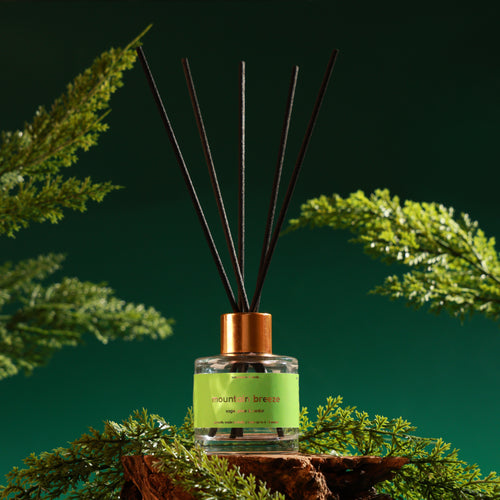
 Mountain Breeze₹849Wind moves faster the further it is from the ground, because there is less in the way of it — no buildings, no trees, no street furniture breaking it up. That is the entire reason a twentieth-floor flat feels different from a second-floor one on the same afternoon, and it is why residents of high towers describe doors slamming and curtains standing horizontal in a wind that is barely noticeable on the pavement. For a reed diffuser this matters in one specific way: a faster wind at the opening means the room's air is replaced more times, and every replacement carries the accumulated fragrance out with it. I will not put a figure on that, because we have not measured one and an invented number would be worth less than the reasoning. Qualitatively it is not subtle, and anybody who has moved from a low floor to a high one already knows it in their body.
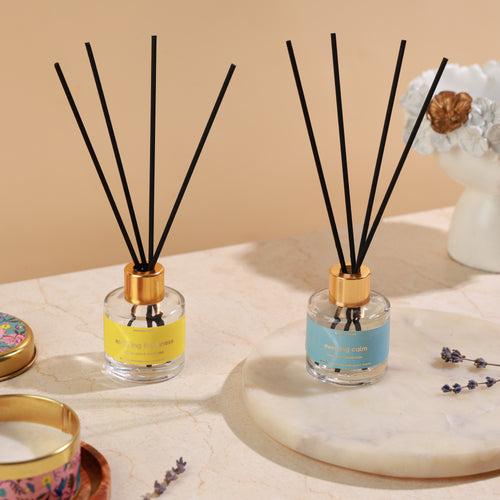
 Evening Calm₹799One opening lets air in and out of the same aperture, which is comparatively gentle. Two openings on different walls create a through-route, and air takes the shortest reasonable path between them. This is the difference between a ventilated room and a scoured one, and it is also good news, because a line is a thing you can stand beside. Walk the room with a light scarf or a sheet of paper on a windy afternoon and you will find the path in about a minute. Everything within it is being emptied outward at the maximum rate the room can manage; everything a couple of metres to the side of it, on the sheltered wall, is in comparatively still air. Moving a bottle from the first zone to the second is the largest single improvement available to you and it costs nothing.
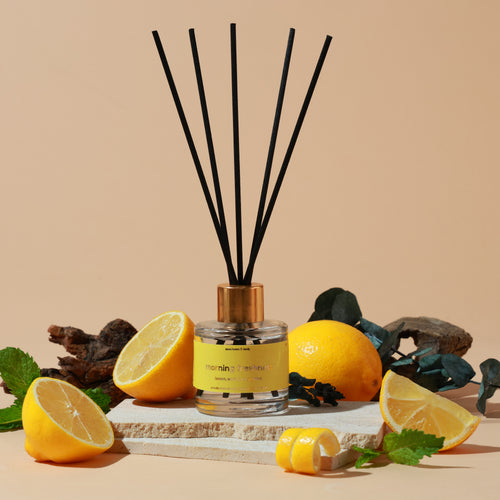
 Morning Freshness₹749Olfactory receptors adapt to a steady, unchanging stimulus within minutes. The signal is still arriving; the brain has stopped reporting it because nothing about it is new. This is why you can smell somebody else's house from the doorway and never your own, and it is the reason a visitor is a better instrument than the person who lives there. On a high floor it tangles with the real mechanism, because the level in the room honestly does rise and fall as the doors open and shut, and the two get blamed for each other. Separate them deliberately: leave the flat for fifteen minutes, come back, and judge the first three seconds. If guests remark on a fragrance you cannot detect, the diffuser is working for everybody but you, and that is expected rather than a fault — sensitivity to individual materials varies enormously between people.
Why adding reeds is the wrong lever here
This is the instinct everybody has and it is worth talking through, because it is the one that costs money. More reeds means more wicking surface, which means a faster release rate — that part is true. But the room is losing fragrance at a rate set by the air exchange, not by the bottle, and in a genuinely breezy room the loss side of that balance is the larger number by some distance. Six reeds into a scoured room mostly buys you a faster-emptying bottle, not a stronger room. You pay for the increase and the breeze takes it. The reed count is a real and useful dial — three reeds gives a soft bedside level and roughly doubles how long a bottle lasts, six gives full projection — but it is a dial for adjusting a room you already control, not a lever for overpowering one you do not.
There is a related worry worth answering while we are here, because people ask it in a slightly ashamed way: is the oil simply evaporating into thin air, or do you get the whole bottle? Both, and that is the design. A reed diffuser holds nothing back — every millilitre eventually leaves the glass through the reeds and enters the room. Nothing is thrown away in the sense of being wasted. The only genuine waste in this product category is oil evaporating into a room that nobody is in, or one whose air is on its way outside, and both of those are placement and timing questions rather than product ones. That is why this page spends its effort on where the bottle stands and which hours you are buying, and comparatively little on which scent to choose.
One more thing to rule out before you conclude anything is wrong. If the bottle ran hot for the first week and quieter by the third, that is not the breeze and it is not a fault: the reeds saturate over the first days and the lightest, most volatile materials leave first, so what you smell later is the heart and base — the composition as it was designed to sit. Flipping the reeds every three to five days restores projection without opening anything new. Separate that settling effect from the airflow effect before you spend, or you will solve the wrong problem twice.
| Factor | Does height change it? | Why | What you can do |
|---|---|---|---|
| Air exchange through an opening | Yes, substantially | Wind speed rises with height, so the same aperture moves more air | Buy for the closed hours; shut the doors for a period when you want to notice it |
| The shape of the airflow inside the room | Yes, where there are two openings | A cross-breeze travels a fairly direct line between them and scours what sits on it | Place on the sheltered wall, off the line, never on the sill or threshold |
| How long a bottle lasts in that room | Yes, in practice | Through airflow, not through altitude — a faster-flushing room consumes a bottle sooner | Three reeds instead of six roughly doubles it; resite to a room that closes |
| The oil, the carrier, the reeds | No | Nothing about the composition or the wicking behaves differently at height | Nothing. This is the part people replace, and it is the part that was never the problem |
| What a diffuser can do about an existing smell | No — and it never could | Fragrance sits alongside an odour rather than removing it. The order is source, then ventilation, then fragrance | Deal with the source and air the room first. A high floor at least gives you excellent ventilation for that step |
Living end · Mountain Breeze₹849Shop → 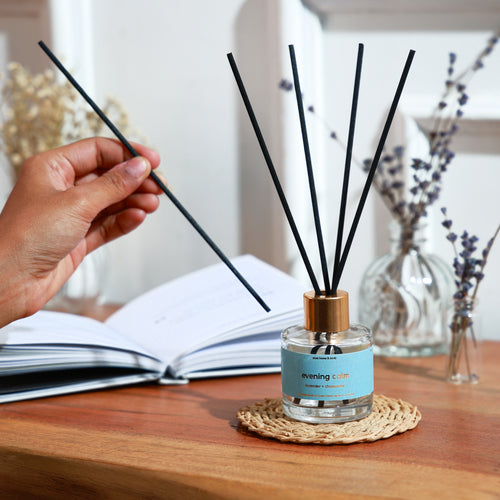 Bedroom · Evening Calm₹799Shop →
  Bathroom · Morning Freshness₹749Shop →
What to actually do, in order
Start with the free things, because on a high floor they are also the effective ones. First, find the airflow path and get out of it. On a windy afternoon, with the flat in its usual open state, hold a light scarf at chest height and walk the room slowly. Where it lifts and holds, that is the line between your two openings. Move the diffuser to the wall furthest from the balcony or window, ideally with a piece of furniture or a return wall between it and the opening, at or slightly below nose height, out of direct sunlight and well away from any flame. Fragrance oil is flammable, so a diya, an agarbatti or a lit candle should never share a surface with a diffuser, and on a windy floor a curtain moving near an open flame is its own reason to keep them apart.
Second, be honest about the hours. Go room by room and write down the block in which the room is genuinely closed and somebody is in it. A bedroom on a high floor usually has a clean overnight block. A bathroom has several short ones and, being small and enclosed, holds fragrance through them — which is why two or three reeds in a 50 sq ft bathroom can make a 50ml run close to three months, and why it is the best value in the range for a flat that is otherwise open to the sky. A living room with balcony doors may have three evening hours, or none. Rooms with no block get nothing; that is a decision rather than a failure, and it is the cheapest advice on this page.
Third, and only third, choose the size, the dose and the scent. A 50ml suits up to about 150 sq ft and lasts 6–8 weeks at roughly ₹13 to ₹15 a day; a 130ml suits above that and lasts 14–18 weeks. Six reeds for the closed hours of a living room, three for a bedroom. Register matters more than strength in a moving room, which is why Mountain Breeze at 9.4 — pine, sage and cedar, dry and resinous — is my choice for the living end. Evening Calm at 8.9 is the softest thing we make and belongs in the sealed bedroom, where six reeds most often overshoots. Morning Freshness at ₹749 goes in the bathroom, and there is a composition reason as well as a room reason: ordinary citrus is made of small light molecules that leave first and usually fade within a fortnight, while its eucalyptus globulus base slows that evaporation three to four times, which turns a fortnight into six to eight weeks. In a flat that is already losing fragrance to the wind, a composition that also gives up early is the wrong purchase twice over.
What to buy for a high, breezy flat — and the honest gap
In the order I would actually buy it, for a household that has already moved the bottle off the airflow line and worked out its closed hours. The last row is not a product, and on this particular page it is the most useful line in the table.
| Buy | What it is | When it is the right answer | Price |
|---|---|---|---|
| 1. Evening Calm 50ml ★ | Kashmir lavender and chamomile at 8.9, the softest in the range, on three reeds | The bedroom, because it is the one room on a high floor with a reliable closed block | ₹799 |
| 2. Morning Freshness 50ml | Malabar lemon, peppermint and eucalyptus at 9.0, on two or three reeds | The bathroom — small, enclosed, sheltered, and can run close to three months | ₹749 |
| 3. Mountain Breeze 130ml | Pine, sage and cedar at 9.4 — the most presence in a room that keeps flushing | A living end above 150 sq ft with a genuine evening block, placed on the sheltered wall | ₹1,349 |
| 4. Sukoon | 500ml tank, 270–320 sq ft, 16–18 hours on low, three 15ml Hotel Collection scents included | Instead of row three, if the block is short and somebody will reliably switch it on | ₹1,899 |
| 5. Day & Night duo | Two 50ml bottles — rows one and two bought together, not a boxed set or a hamper | If the bathroom and bedroom are being done at the same time | ₹1,498 |
| The honest gap: more reeds, a bigger bottle or a bigger machine | None of the three beats a cross-breeze. Extra reeds empty the bottle faster into the same moving air; a 130ml in a scoured room is a larger version of the same experiment; and the Megh at ₹3,499 covers about 215 sq ft, which is less than the Sukoon at ₹1,899 — it is a runtime and humidity machine, never a coverage upgrade. A 300ml refill at ₹2,399 is oil alone and not a first purchase | Never. Move the bottle and buy the closed hours instead | ₹0 |
Versailles
The letters that begin my reed diffuser has stopped working are, more often than not, letters from people who have recently moved somewhere higher. The same bottle that was perfect in a second-floor flat reads as almost nothing on the twentieth, and the natural conclusion is that something has gone wrong with the product. Nothing has. The room changed, and the room was always the larger half of the equation.
I find it helps to say what a reed diffuser actually is, mechanically. It is a slow, steady release with no fan, no timer and no power — its entire job is to add fragrance to the air of a room and then to let that room hold it. On a high floor with two openings, the room is not holding air; it is passing it through. That is a wonderful thing to live with and it is genuinely a poor environment for ambient fragrance while it is happening, and I would rather write that sentence on our own page than let somebody discover it after buying a second bottle.
So the advice I would give a friend on the twentieth floor is unglamorous. Move the bottle to the sheltered wall. Notice which hours your doors are shut. Put the money into the bedroom and the bathroom, which are small and enclosed and reward it, and give the living room a bottle only if it truly closes in the evening. That is a smaller purchase than most people arrive intending to make, and it is the one that works. Everything is composed in Pune, and a part of every order funds a girl's classroom through Nanhi Kali.
Frequently asked questions
- Floor-to-ceiling balcony doors — the placement page, and why the sill is the worst shelf in the flat.
- Should I close the balcony door? — yes, and it is a way to use the product rather than a workaround.
- 800 sq ft, reeds or Sukoon? — the honest comparison, including what a machine wastes.
- A balcony attached to the bedroom — three reeds, the far wall, and the hours that work.
- Does a higher floor shorten bottle life? — yes, through airflow rather than altitude.
- A breezy Mumbai high-rise and a Bengaluru one with an open balcony — two cities, two different answers.
- Fresh air by day, fragrance at night — the split setup, in full.
- Sukoon only in the evening — exactly the case a machine exists for.
- Brand: the SOSA founder story.
SOSA facts verified August 2026: Five reed scents, all alcohol-free on a heat-stable CCT (caprylic/capric triglyceride) carrier rather than DPG, phthalate-free, paraben-free, IFRA-compliant, 0 ppm formaldehyde, six fibre reeds in a refillable glass bottle, composed in Pune, India, and tested at a 45°C heat soak and 85% relative humidity. Morning Freshness 50ml ₹749 · 130ml ₹1,249 · 9.0, with a eucalyptus globulus base that slows lemon evaporation three to four times. Evening Calm 50ml ₹799 · 130ml ₹1,299 · 8.9, the softest in the range. Garden Bloom 50ml ₹799 · 130ml ₹1,299 · 8.9. Mountain Breeze 50ml ₹849 · 130ml ₹1,349 · 9.4. Fresh Brew 50ml ₹849 · 130ml ₹1,349 · 9.5, the deepest. 50ml suits rooms up to about 150 sq ft and lasts 6–8 weeks; 130ml suits rooms above that and lasts 14–18 weeks; six reeds give full projection and three a soft level that roughly doubles the life; two or three reeds in a 50 sq ft bathroom can make a 50ml last close to three months. Cost per day approximately ₹13–₹15 on a 50ml. Duos: Day & Night ₹1,498, Fresh & Grounded ₹1,548, Warmth & Bloom ₹1,598, each two 50ml bottles. Refills 300ml ₹2,399 · 500ml ₹3,499, oil only and not a first purchase. Machines: Boond ₹899 (300ml, up to about 150 sq ft, around 6 hours), Sukoon ₹1,899 (500ml, 270–320 sq ft, 16–18 hours on low, three 15ml Hotel Collection scents included), Megh ₹3,499 (six-litre tank, around 100 hours of runtime, about 215 sq ft — a runtime and humidity machine, never a coverage upgrade). Hotel Collection oils are water-based and ultrasonic-only; reed oil and Hotel Collection oil are not interchangeable in either direction and there is no hotel-inspired reed diffuser. SOSA sells no room spray, air purifier, dehumidifier, odour eliminator, plug-in, timer or subscription; every SOSA spray is a car perfume. Free shipping above ₹499. A portion of every order supports girl-child education through Nanhi Kali. SOSA is an independent Indian fragrance house and is not affiliated with or endorsed by any hotel brand. Prices subject to change — see the live product pages.