


As a rate: that is roughly 7ml a week from a 50ml and 8ml from a 130ml — about a millilitre a day.
What moves it: reed count first, then draught, then heat, then flipping frequency. Everything else is a rounding error.
2. Convert them into a weekly rate. Fifty millilitres over seven weeks is roughly 7ml a week; 130ml over sixteen is roughly 8ml. Around a millilitre a day, in other words. Once you think in millilitres a week, you can watch the level and forecast the bottle yourself.
3. Reed count moves the rate more than anything else. Six reeds expose twice the wicking surface of three, and the bottle drinks accordingly. This is the one variable that is entirely yours, costs nothing and works immediately in both directions.
4. Then air movement, then heat. A doorway, an open window or a fan is the fastest way to empty a bottle — faster than a hot day. A Chennai or Delhi summer takes weeks off a bottle that would have coasted through December. Neither is a fault; both are the mechanism.
5. Flipping is a withdrawal, not a top-up. Turning the reeds refreshes throw by exposing saturated fibre, and spends the bottle faster. Every three to five days is the sensible rhythm. Daily flipping is the commonest reason a 50ml finishes in five weeks.
Made in India, composed by an ISIPCA Versailles-trained perfumer — and a portion of every order supports girl-child education through Nanhi Kali.

Why the answer is a rate rather than a lifespan
Nothing in a reed diffuser measures time. Oil climbs the porous core of each reed, reaches the exposed tip and evaporates, and the bottle empties at whatever speed that process happens to run. So the useful question is not how long it lasts but how fast your room drinks it. Fifty millilitres over the seven-week middle of its band is about 7ml a week; 130ml over sixteen weeks is about 8ml — which is worth noticing, because the larger bottle holds two and a half times the liquid but does not last two and a half times as long. A wider neck exposes a little more surface, so the 130ml runs slightly hotter. It still wins comfortably on money, since it costs about 1.7 times as much for about 2.3 times the weeks.
Once you are thinking in millilitres a week, the variables sort themselves into an order of size. Reed count comes first, because it directly sets how much loaded fibre is exposed to the air, and it is the only one you change by hand in ten seconds. Air movement comes second and is closer to the first than most people expect: a bottle by a doorway, an open window or a ceiling fan is being actively ventilated all day. Temperature comes third — a hot month costs real weeks, an air-conditioned room gives some back. Flipping frequency comes fourth. Room size and openness come fifth, and matter less than the draught in that room. Everything else people worry about, including the blend they chose, does not register.
The three things that decide your number
 SOSA reedsFrom ₹749Six fibre reeds come in every box, and every published life figure assumes all six are in. Pull two out and a 50ml commonly runs nine or ten weeks rather than six to eight; pull three and it can reach eleven or twelve. A 130ml on four reeds in a bedroom passes twenty weeks without difficulty. The catch is exactly what you would expect: the room is quieter. Only the six-reed bands are SOSA's tested figures — the rest follow from the mechanism, because fewer wicks expose less saturated fibre. Store the spare reeds dry in the box; you can put them back at any point.
The five SOSA reed diffusers
The longevity band is identical across all five — 6 to 8 weeks at 50ml, 14 to 18 at 130ml, on six reeds in a room up to about 150 sq ft. Choose on character and on the room, because the clock is the same whichever you pick.
| Reed diffuser | Notes | Character | Best for |
|---|---|---|---|
|
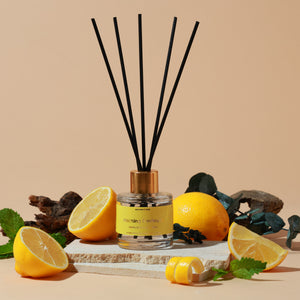
Morning Freshness ★ ₹749 / ₹1,249 |
Malabar lemon · peppermint · eucalyptus | Bright, cool, waking — the most volatile top notes in the range | Bathrooms and kitchens; the freshest of the five at ₹749/₹1,249 |
|
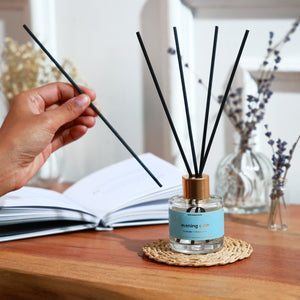
Evening Calm ₹799 / ₹1,299 |
Kashmir lavender · chamomile | Soft, herbal, settling | Bedrooms, where four reeds stretch the same bottle much further |
|
Mountain Breeze ₹849 / ₹1,349 |
Himalayan pine · sage · cedar | Dry, green, grounded | Halls and living rooms, including draughty ones near a front door |
|
Garden Bloom ₹799 / ₹1,299 |
British rose · night-blooming jasmine | Floral, romantic, dressed | Living rooms and guest rooms kept for company |
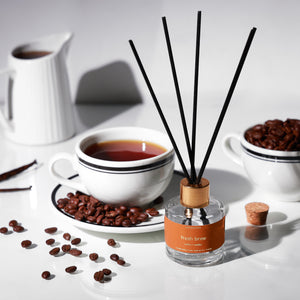
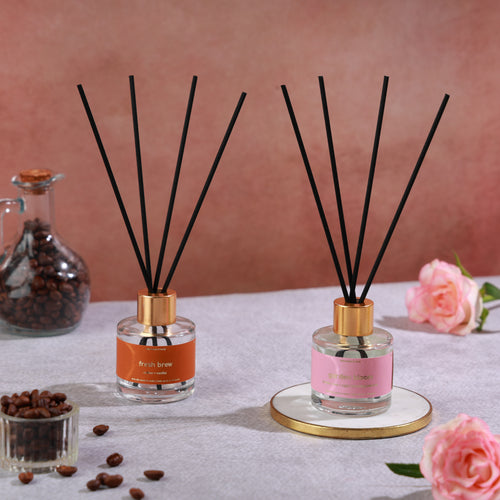
| Also in the range: Fresh Brew (₹849 / ₹1,349) is warm, roasted and cosy — a study or a winter sitting room rather than a bedroom. See all five reed diffusers. | |||
The reed range · five scentsFrom ₹749Shop → 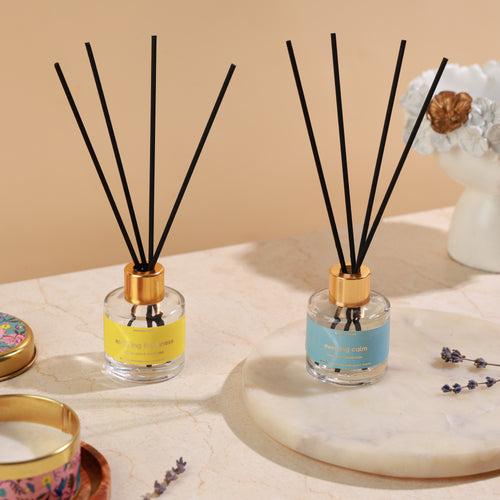 Day & Night duo · two rooms₹1,498Shop →
  Refills · 300ml₹2,399Shop →
Reeds, placement and flipping — the three things you control
Start with the reed count that suits the room rather than the one that fills the neck. Six for a hall, a kitchen or an entrance; four for a standard bedroom; two or three for a small bathroom, where a 50ml on that setting can run close to three months. Then wait forty-eight hours before you form any opinion at all, because the fibre has to saturate along its whole length before it throws and day one tells you nothing.
Placement decides how hard the room works the bottle. If weeks matter to you, choose a still interior position — a shelf inside the room rather than a console in the through-draught — and accept slightly less reach. If reach matters more, take the doorway and expect the lower end of the band. Three placements are simply wrong whichever you are optimising for: direct sunlight, which fades the fragrance and heats the oil; the direct blast of an AC vent or a fan, which empties the bottle fast and scents one wall; and bare polished wood or untreated stone, because reed oil marks a finish permanently if the bottle is knocked. Stand it on a tray, keep it away from children and pets, and never decant it.
Flip on a rhythm rather than on impulse. Every three to five days is the setting that gives you the refresh without materially shortening the bottle; every day gives you a louder room and a noticeably shorter one. Then plan for the other end of the bottle's life. Reeds clog: after two or three months the heavier, less volatile molecules build up in the fibre and the wicking slows, so throw drops even though there is liquid left. Fresh reeds fix that, and six come with every bottle — which is why fitting new ones at each refill is a maintenance fact rather than an upsell.
What to buy
Read this as a rate table rather than a price list. Only the six-reed rows are SOSA's published bands; the reduced-reed figures follow from the same mechanism and are what owners typically see.
| Setting | What it changes | A 50ml (₹749) runs | A 130ml (₹1,249) runs |
|---|---|---|---|
| Six reeds ★ | The published setting — full strength, room up to about 150 sq ft | 6–8 weeks | 14–18 weeks |
| Four reeds | A standard bedroom — clearly softer, clearly longer | 9–10 weeks | 20–24 weeks |
| Two or three reeds | A small bathroom or a bedside — soft, and close to three months on a 50ml | 11–13 weeks | 26–36 weeks |
| By a doorway or open window | Continuous ventilation — the biggest accelerator there is | Bottom of the band or below | Bottom of the band or below |
| A hot month | Faster evaporation across the whole day, all reed counts | Closer to 6 than 8 | Closer to 14 than 18 |
| Flipped daily | A louder room and the fastest handling error there is | Five weeks is common | Twelve weeks is common |
Versailles
The question I am asked most often about reed diffusers is how long they last, and the version of it people really mean is: will mine behave like the number on the box. Sometimes yes. But a bottle is not a battery with a rating — it is an open system, and the room is half of it.
I would rather give people a rate than a promise. A millilitre a day, more or less, on six reeds. If your bottle is dropping faster than that, something in the room is doing the work — a door, a fan, a hot afternoon wall — and you can usually see it in the first fortnight if you mark the glass and look once a week.
The one thing I would ask is that nobody treats a shorter bottle as a fault. A reed that empties in five weeks has been throwing beautifully for five weeks. If you want more time, take out two reeds or move it out of the draught, and understand that you are trading a little presence for it. A portion of every order supports girl-child education through Nanhi Kali.
Frequently asked questions
- How long should a 50ml last? — six to eight weeks, and when it is five.
- How long should a 130ml last? — fourteen to eighteen, and why it is the default.
- How to make a reed diffuser last longer — what each method costs you.
- The complete longevity and usage guide — the whole cluster in one page.
- Brand: the SOSA founder story.
SOSA products & prices (verified August 2026): Hotel Collection water-based ultrasonic diffuser fragrance 15ml ₹299 · 100ml ₹999 · 300ml ₹1,799 · Pack of 7 (15ml, all fragrances) ₹1,799; refills 100ml from ₹999. Seven scents: The Ritz-Carlton-inspired (white tea · bergamot · cedar), Westin-inspired (white tea · aloe · cedar), 1 Hotels-inspired (cedarwood · vetiver · green leaves), The St. Regis-inspired (amber · violet · woods), Shangri-La-inspired (jasmine · green tea · white tea), Four Seasons-inspired (citrus · floral · sandalwood), W Hotels-inspired (citrus · pepper · amber). Diffusers: Boond 300ml ₹899 · Sukoon 500ml ₹1,899 · Megh 6L ₹3,499. Water-based, phthalate-free, composed to IFRA standards for home diffusion; 3–6 drops per tank. Made in India, Pune. The Hotel Collection scents are SOSA's own interpretations inspired by the world's finest hotels; all hotel names are trademarks of their respective owners and are used only to describe the scent style — SOSA is an independent Indian fragrance house, not affiliated with or endorsed by any hotel brand. Prices and availability subject to change — see the live product pages.