



- The direct answer
- Why Mumbai's humidity is a materials problem before it's a smell problem
- The three decisions that matter in a coastal café
- Materials and zones, matched to the honest fix
- What actually holds up in Mumbai's climate
- What to buy, once materials are addressed
- A note from Sonal
- Questions about humidity and café odour in Mumbai
2. Those same materials hold onto odour compounds dissolved in the moisture they're carrying. Cooking vapour, spilled milk, damp cloth — whatever produced a smell in the first place doesn't disperse and dilute the way it would in a drier climate; it lingers at a low level for as long as the moisture carrying it stays put.
3. Many Mumbai café buildings rarely reach a fully dry baseline, even between monsoons. Older building stock, ground-floor units facing directly onto humid streets and tight retail footprints with limited ventilation paths mean the starting point is already higher, not just spiking seasonally.
4. The honest first fix is a cleaning and drying cadence, not a fragrance. A deeper or more frequent clean of upholstery and soft furnishings, reviewed specifically for the climate, addresses the actual cause; no SOSA product dries a material or changes how much moisture it's holding.
5. A washroom register is the second, honest step — never a substitute for the first. Once materials are on a proper drying and cleaning schedule, a modest, dry register in the washroom or a retail corner behaves predictably, unaffected by what the dining room's upholstery is doing.
Humidity doesn't create a fragrance gap in a Mumbai café — it creates a materials problem that happens to smell like one, and the two need entirely different answers.
Why Mumbai's humidity is a materials problem before it's a smell problem
Mumbai's coastal position keeps ambient humidity higher across most of the year, and porous materials in a café's dining room — upholstery, curtains, cushions, wood veneer, plaster — absorb moisture from that air continuously. They don't do this only during a downpour; they do it as a steady, ongoing exchange with whatever the surrounding air is carrying, which for a coastal city is, for most of the year, a fair amount of moisture. A material holding that moisture isn't inert while it does — it's also holding, and slowly releasing, whatever is dissolved in it.
That's the part that reads as a smell problem rather than a humidity problem. A spill, a batch of frying, a damp cloth left too long — in a drier climate, the moisture from any of those events evaporates and disperses fairly quickly, taking the odour compounds it's carrying with it. In a material that's already saturated and slow to dry, that same moisture doesn't leave on the same schedule, and neither does what it's carrying. The room doesn't smell of any one obvious event; it smells faintly of an accumulation of small ones that never quite finished evaporating.
This is why many café buildings in Mumbai — older stock, ground-floor units with limited ventilation paths, sites that face directly onto humid streets — rarely reach a fully dry baseline even between monsoons. The building isn't recovering to a genuinely dry state between events; it's working from a permanently higher starting point. That distinction matters because it changes where the fix has to sit: not in reducing any single smell event, but in reviewing how well the room's materials are being dried and cleaned on an ongoing basis, given the climate they actually sit in.
The three decisions that matter in a coastal café
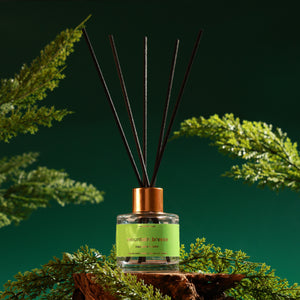
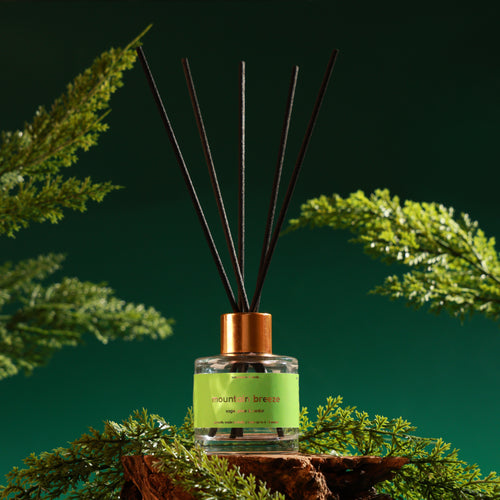
 Mountain Breeze₹849Soft, porous surfaces hold moisture and odour longest; hard, sealed surfaces such as tile, glass and treated wood hold almost none of either.
Materials and zones, matched to the honest fix
The zone rule in this series doesn't change because of humidity — what changes is which mechanical fix actually addresses the smell each zone is producing.
| Material or zone | How Mumbai's humidity affects it | What actually addresses it | Where fragrance fits |
| Upholstered seating and cushions in the dining room | Absorbs moisture and holds odour longer than any other material in the room | A cleaning and drying schedule agreed with the upholsterer or cleaning contractor | Never — this is the dining room, regardless of the materials question |
| Curtains and soft furnishings near an open frontage | The same absorption problem, worsened by direct exposure to humid street air | Regular washing and drying, reviewed each year for the climate | Never — the same zone rule applies |
| Wood, plaster and paint in a ground-floor unit that rarely dries fully between monsoons | A permanently higher moisture baseline that never fully resets | A fit-out review of ventilation and moisture paths with a qualified professional | Not fragrance, in any zone |
| Washroom with tiled, sealed surfaces and working extraction | Holds far less moisture than fabric, so a register behaves predictably | The cluster's usual washroom allowance, at a dry register | A reed diffuser or Sukoon here, once cleaned and ventilated properly |
| Retail corner selling packaged beans or merchandise, away from soft furnishings | Minimal moisture-holding material, closer to a dry retail environment | The cluster's usual retail allowance | A dry, non-edible register at a modest scale |
| Assuming a fragrance in the dining room will resolve a materials problem — no SOSA product dries a material or reduces how much moisture it's holding; that is a cleaning and ventilation question for whoever maintains the space. | |||
Mountain Breeze · dry, sealed washroom surfaces₹849Shop →  Sukoon · a washroom suite or retail corner₹1,899Shop →
  Vaayu · washrooms and retail across a larger site₹11,999Shop →
What actually holds up in Mumbai's climate
Never treat a lingering smell in a humid coastal café as a fragrance gap before auditing which materials are actually holding moisture — the dining room stays unscented regardless of what that audit finds.
Sometimes the honest fix is entirely a maintenance one — a deeper or more frequent clean of upholstery and curtains, agreed with whoever maintains the space, once humidity is named as the driver rather than guessed at.
Usually, once materials are on a proper drying and cleaning cadence, the washroom and any retail corner are where a modest, dry register belongs, sized to the room the same way it would be in any other city.
What to buy, once materials are addressed
Matched to a sealed, ventilated zone — never to the upholstered dining room a coastal café's humidity is actually affecting.
| Route | Premises | Why | What it costs |
| No fragrance, only a cleaning and drying review | Any upholstered or soft-furnished zone in a humid coastal café | Materials holding moisture and odour need drying and cleaning, not scent | No purchase — a maintenance schedule |
| Reed diffuser, Mountain Breeze | A washroom with sealed, tiled surfaces and normal extraction, under 150 sq ft | A dry register unaffected by the dining room's materials problem | ₹749–₹849 |
| Reed diffuser, 130ml | A larger washroom or retail corner, 150–270 sq ft | Longer runtime for the same dry register | ₹1,249–₹1,349 |
| Sukoon ultrasonic | A washroom suite or retail area, 270–320 sq ft | Steady coverage for a bigger non-dining space | ₹1,899 |
| Vaayu, zoned | Washrooms and retail across a Mumbai flagship or small chain, once ventilation is reviewed | Independent scheduling once each zone's own moisture question has been separately addressed | ₹11,999 per unit |
I trained in Versailles, not on the coast, and the first thing that struck me the first time I worked with a Mumbai café's fit-out was how differently the room's own materials behaved compared with a similar space inland. Fabric that would dry out overnight elsewhere simply doesn't, and a room can be cleaned properly and still carry a faint note the next morning that has nothing to do with how it was cleaned.
The instinct I see most often from owners is to reach for a stronger fragrance to answer that faint note, and I understand the instinct, but it doesn't touch the actual cause. Fragrance doesn't dry anything out. If the upholstery is holding moisture, it will go on holding moisture, and whatever is dissolved in it, regardless of what's diffusing nearby.
Where I do sell happily into a Mumbai café is the washroom, once I know the room is genuinely sealed and ventilated rather than sharing the dining room's own materials problem. A dry register on tile and glass behaves exactly the way it would in any other city — humidity simply isn't the same kind of factor once fabric isn't involved.
Questions about humidity and café odour in Mumbai
- Why Does Fragrance Disappear When Café Doors Stay Open? — the underlying mechanism this city's answer builds on.
- Why Do Sofas, Curtains and Upholstery Hold Food Smells in a Café? — the materials question Mumbai's humidity sharpens.
- Why Does My Café Smell Musty During Monsoon? — the same climate mechanism, considered city-wide rather than for one city.
- We Operate Cafés in Mumbai, Pune, Bengaluru and Delhi — How Should Humidity, Exhaust, Open Doors and HVAC Change Our Odour-Control Strategy? — the multi-city version of this same question.
- Brand: the SOSA founder story.
SOSA products & prices (verified September 2026): Reed diffusers 50ml ₹749–₹849 (to 150 sq ft, 6–8 weeks at six reeds) · 130ml ₹1,249–₹1,349 (above 150 sq ft, 14–18 weeks) · reed refill 300ml ₹2,399. Ultrasonic: Boond ₹899 (~150 sq ft) · Sukoon ₹1,899 (270–320 sq ft, ships with three 15ml Hotel Collection fragrances) · Megh ₹3,499 (6L tank, ~100 hrs runtime, ~215 sq ft — a runtime machine, not a coverage upgrade). Waterless cold-air: Safar ₹3,999 (no published coverage figure) · Vaayu ₹11,999 (up to 1000 m³, roughly 2,000–3,000 sq ft; 400ml tank lasting about 90+ days; app and onboard control, 1h/4h/8h/24h run windows, adjustable intensity, key-lock, under 38 dB, freestanding or wall/HVAC mount, 5W, CE/RoHS/SGS) · Aangan ₹25,999 (8,000–10,000 sq ft). Hotel Collection water-based fragrance 15ml ₹299 · 100ml ₹999 · 300ml ₹1,799 is for ultrasonic machines; reed oil and Hotel Collection are not interchangeable. Reed diffusers are alcohol-free, phthalate-free, paraben-free, IFRA-compliant and low VOC, handmade in small batches in Pune. Every purchase funds a girl's education through Nanhi Kali. Prices and availability subject to change — see the live product pages.