
How Do I Transition From Morning Incense to a Fresh Evening Home Fragrance?

How Do I Transition From Morning Incense to a Fresh Evening Home Fragrance?

★ Burn · ventilate · let it clear · then the reed has the rest of the day on its ownMorning Freshness ₹749 · Evening Calm ₹799 · Day & Night duo ₹1,498 · free shipping above ₹499A portion funds girl-child education
★ SOSA reed diffusers · the day after the agarbatti
You do not switch a reed diffuser on at noon — it has been running all along. What changes at noon is the room, and the only two things you control are the window and the reed count
★ ★ ★ ★ ★
★★★★★
"This is in my bathroom and it's basically how I want to start every day. Smells exactly like a spa — clean, breathable, not floral."
Tanya K. Pune
Morning Freshness · verified buyer
★★★★★
"Finally a lavender that doesn't smell like fabric softener. My bedroom feels calm the moment I walk in after work."
Ananya K. Bengaluru
Evening Calm · verified buyer
★★★★★
"Most citrus reed diffusers smell like dishwashing liquid. This one smells like an actual cut lemon. Lasted 7 weeks with 4 reeds."
Devika S. Mumbai
Morning Freshness · verified buyer
★★★★★
"This is now part of my bedtime routine. Soft, quiet, never overpowering. Exactly what I wanted by the bed."
Rhea M. Pune
Evening Calm · verified buyer
★★★★★
"Bought this for my home office and it's genuinely changed how I feel sitting down at my desk in the morning. Six weeks in and still going strong."
Riya M. Bengaluru
Morning Freshness · verified buyer
★★★★★
"I was worried it would be too strong at night. It's the opposite — soft and gentle, just there in the background."
Meera D. Delhi
Evening Calm · verified buyer
★★★★★
"This is in my bathroom and it's basically how I want to start every day. Smells exactly like a spa — clean, breathable, not floral."
Tanya K. Pune
Morning Freshness · verified buyer
★★★★★
"Finally a lavender that doesn't smell like fabric softener. My bedroom feels calm the moment I walk in after work."
Ananya K. Bengaluru
Evening Calm · verified buyer
★★★★★
"Most citrus reed diffusers smell like dishwashing liquid. This one smells like an actual cut lemon. Lasted 7 weeks with 4 reeds."
Devika S. Mumbai
Morning Freshness · verified buyer
★★★★★
"This is now part of my bedtime routine. Soft, quiet, never overpowering. Exactly what I wanted by the bed."
Rhea M. Pune
Evening Calm · verified buyer
★★★★★
"Bought this for my home office and it's genuinely changed how I feel sitting down at my desk in the morning. Six weeks in and still going strong."
Riya M. Bengaluru
Morning Freshness · verified buyer
★★★★★
"I was worried it would be too strong at night. It's the opposite — soft and gentle, just there in the background."
Meera D. Delhi
Evening Calm · verified buyer
Alcohol-free · phthalate-free · 0 ppm formaldehyde · composed in Pune by an ISIPCA-trained perfumer No switch, no socket, no water — six fibre reeds and a flip every 3–5 days is the whole routine Fragrance oil is flammable — keep the bottle well away from the agarbatti stand and any diya


Founder Diaries · Real Indian Homes · Puja, Incense & Home Fragrance
By Sonal Sahani · ISIPCA Versailles 10 min read Updated August 2026
The word transition makes this sound like something you perform. It is not. A reed diffuser has no switch and no schedule — it has been running the whole time, including through the agarbatti, quite inaudibly. What changes over the course of the day is not the diffuser but the room: the smoke leaves, the deposited fraction on the curtains works its way out, and at some point in the early afternoon the reed becomes the loudest thing left. The only two things you actually control are when you open the window and how many reeds are in the bottle. Everything else is the room doing it by itself.
Quick answers — read this first
The daily shape: light the agarbatti · open a window or balcony door through it and for a few minutes after · let the room clear · the reed carries the afternoon and evening with no further action.

The one thing worth timing: flip the reeds after the airing, not before. Flipping releases a burst, and you want that burst landing in a room that has just been cleared rather than one about to be ventilated. Cadence is every three to five days, not daily.

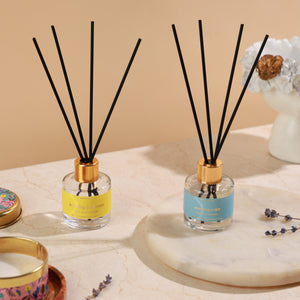
The two-bottle version: Morning Freshness ₹749 where the day happens and Evening Calm ₹799 by the bed — bought together as the Day & Night duo at ₹1,498.

The honest cost: a reed cannot be switched off, so it does spend the incense hour being inaudible. If that genuinely bothers you, a machine is the alternative — but it has water, power and refills that a reed does not.
The short answer
Short answer: you do not transition the diffuser, you transition the room. Burn the incense as usual, ventilate through it and for a short while afterwards, and allow a clearing interval before you expect the fragrance to register. In an airy flat that interval is short; in a curtained one with a single window it is a good deal longer, because part of the smoke deposits on soft furnishings and re-releases over hours. Once the room is clear, the reed is simply the only thing still running.
What to run in those hours: Morning Freshness ₹749 is the cleanest contrast — Malabar lemon and peppermint on a eucalyptus globulus base that slows the lemon's evaporation three to four times, so the 50ml runs 6–8 weeks rather than a fortnight. For the bedroom at the end of the day, Evening Calm ₹799 at 8.9 is the softest thing we make.
What not to expect: fragrance does not remove incense, smoke or anything else. The order is source, then ventilation, then fragrance, and a diffuser started into a smoky room is simply spending oil on an hour it cannot be heard in. 50ml suits rooms up to about 150 sq ft, 130ml above that. Six fibre reeds included — six for full projection, three for a soft level and roughly double the life. Free shipping above ₹499.
Straight answer
What is the actual daily sequence from morning agarbatti to an evening home fragrance?
1. Ventilate during the incense, not after it. Open a window, a balcony door or both while the agarbatti is burning and leave them open for a few minutes after it goes out. Moving air is the only thing that removes smoke; fragrance does not, and never has. Airing during rather than afterwards shortens the whole sequence by a considerable margin because it takes the airborne fraction out as it is produced.

2. Give the room a clearing interval before you expect anything from the diffuser. In a cross-ventilated flat this may be twenty minutes; in a curtained one-window room it can be most of the morning, because the deposited fraction on fabric releases slowly. This is not the diffuser failing. It is the room still being an incense room.

3. Do nothing to the reed. That is the entire appeal of the format — no switch, no socket, no water, no timer. It has been evaporating quietly all morning and it will simply become audible as the competition leaves. If you want to help it along once, flip the reeds after the airing rather than before, so the burst lands in a room that has just been cleared.

4. Let the register do the signalling. Morning Freshness ₹749 — lemon, peppermint, eucalyptus — is the furthest thing in the range from combustion, which is exactly why the room feels reset when it takes over. For the bedroom at ten at night, Evening Calm ₹799 at 8.9 is the quiet end of the day.

5. Keep the two apart physically. Fragrance oil is flammable. The diffuser bottle, its refill and any candle belong on a different surface from the agarbatti stand and any diya — not adjacent, not in the path of a lit stick, and never where one can be knocked into the other.

Alcohol-free, phthalate-free, IFRA-compliant, 0 ppm formaldehyde, six fibre reeds, refillable glass. Composed in Pune. A portion of every order supports girl-child education through Nanhi Kali.
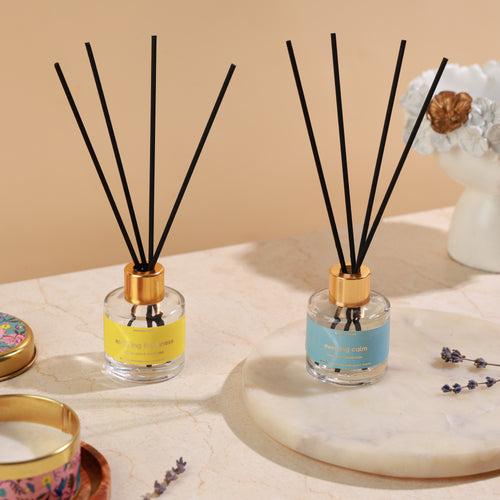
TL;DR: ventilate during the agarbatti, allow a clearing interval, and then leave the reed alone — it has been running all along and becomes the room's character as the smoke leaves. Flip the reeds after the airing, not before. Morning Freshness ₹749 for the afternoon, Evening Calm ₹799 for the bedside, ₹1,498 for both.
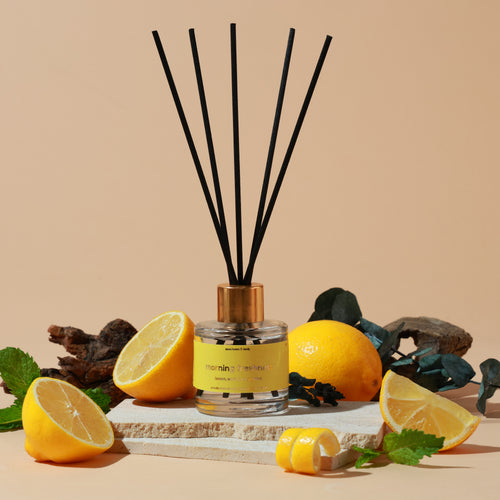
SOSA Day & Night reed diffuser duo
The sequence, as two bottles
Day & Night duo · Morning Freshness + Evening Calm ₹1,498
Two 50ml bottles rather than a boxed set or a discount structure: bright lemon and eucalyptus in the room where the afternoon happens, soft lavender and chamomile where the day ends. In a house with a fixed morning routine this is the pairing that maps most naturally onto the day, because the two halves of it have genuinely different jobs. Six fibre reeds in each, 6–8 weeks apiece, or 130ml × 2 at ₹2,498.

The day in three phases, and what is happening in each

It helps to stop thinking of this as one continuous fragrance situation and to see it as three quite different ones, back to back, with the diffuser present but not equally relevant in all of them. Nothing in this sequence asks you to change the morning routine, and none of it involves a product doing anything clever. It is mostly a matter of knowing which phase you are in before you judge the result.

1
PHASE ONE · COMBUSTION
The morning belongs to the incense, entirely
Burning material puts smoke particulates and heavy resinous volatiles into a room at a rate that evaporation does not approach. During this phase the diffuser is not competing, not clashing and not blending — it is simply inaudible, and no scent choice changes that. The useful thing to do in this phase is not fragrance at all: it is airflow. Open something, keep it open a little longer than feels necessary, and accept that this hour is not the diffuser's.
The honest cost: a reed cannot be switched off, so it does spend this hour releasing oil into a room where nobody can detect it. That is a real limitation of the format and worth knowing before you buy.
2
PHASE TWO · CLEARING
The interval nobody accounts for
Ventilation removes what is still airborne fairly quickly. What it does not remove is the fraction that has settled onto curtains, cushions, upholstery, rugs and walls, and that fraction comes back off slowly for hours afterwards. This is the same mechanism that makes a kitchen smell of last night's cooking after a thorough airing, and it is the reason a household can air the flat properly at eight and still find it reads as an incense room at eleven. Nothing is wrong. The room is still emptying.
What to do: judge the fragrance in phase three, not phase two. And if you want the interval shorter, more airflow through the fabric-heavy end of the room does more than any product.
3
PHASE THREE · HANDOVER
The reed becomes the room, without being touched
By early afternoon in most flats the room is neutral again and the diffuser is the loudest thing in it — not because it has got stronger, but because everything else has gone. This is the phase the bottle was bought for and it runs, unattended, until bedtime. It is also the phase in which the reed format is at its best: no filling, no switching, no power, and nothing to remember. The only maintenance is flipping the reeds every three to five days, and even that is optional.
What to do: nothing. If it feels too strong in this phase, remove reeds rather than moving the bottle or buying a lighter scent.

Why the clearing interval varies so much between two identical routines

Two households can light the same agarbatti at the same hour and have completely different afternoons, and it has nothing to do with the incense. It is a question of what the room is made of and how often its air is replaced. A living room with full curtains, a fabric sofa, cushions and a rug holds a great deal of deposited material and gives it back slowly. A room of tile, glass and hard furniture holds very little. Add air exchange on top: a flat with openings on two walls turns its air over many times faster than one with a single window on a still lane, and that difference is larger than any difference between fragrance products.

This is why I am reluctant to give a clock time for the handover. Twenty minutes is realistic in an airy flat on a higher floor with a balcony door open; two or three hours is realistic in a curtained ground-floor room. What I would suggest instead of a number is a test you can run once, for free: air the flat as usual, then leave the house for fifteen minutes and walk back in. Whatever you smell on the way through the door is what the room honestly smells like, because your nose has been reset by being outside it. Do that on two different days and you will know your own clearing interval better than any guide can tell you.

There is one more variable that people forget: frequency. A single morning agarbatti gives the reed a long uninterrupted run. A morning and an evening one means phase three is the middle of the day rather than the end of it, and in that household the bedroom becomes the more useful place for the diffuser than the living room. Count what is lit in a day before deciding which room gets the bottle.

The daily sequence, laid out

The shape of an ordinary day in a house that burns incense every morning, with what is actually happening at each point and what, if anything, you should do about it. No clock times, because the clearing interval is a property of your flat rather than of the practice.

The sequence
From the agarbatti to the end of the evening
Point in the day What is in the air What the diffuser is doing What you should do
The agarbatti burns Smoke particulates and heavy resinous volatiles, at high concentration Running, and completely inaudible Open a window or balcony door. Keep the bottle away from the flame
Immediately after Airborne fraction leaving; deposited fraction beginning to re-release Still inaudible Leave the opening a few minutes longer than feels necessary
The clearing interval Fabric giving back what it absorbed — minutes in an airy room, hours in a curtained one Becoming faintly detectable underneath If you are flipping reeds this week, this is the moment — after the airing, not before
Early afternoon Room essentially neutral The loudest thing in the room, without having changed at all Nothing. If it is too much, take out reeds rather than move the bottle
Evening and night Whatever the household adds — cooking, visitors, a closed AC room Continuous, at whatever dose the reed count sets A softer scent in the bedroom is worth more here than a stronger one anywhere
Shop this guide
The afternoon, the night, and both
The SOSA principle
Nothing about the diffuser changes between eight in the morning and two in the afternoon. What changes is what it is standing next to.
Which is why the useful lever in this house is the window, and the useful adjustment is the reed count — not the scent.

Why you will stop noticing all of this, and what to do about that

Here is the thing nobody asks out loud and everybody worries about. Within minutes of being in your own home you will stop smelling any of it — the residual incense, the diffuser, the whole arrangement. Olfactory receptors adapt to a constant, unchanging stimulus very quickly; the signal is still arriving, but the brain stops reporting it because nothing about it has changed. This is why you can only smell your own house after being away from it, and it is the single commonest reason people conclude a diffuser has stopped working when nothing at all has happened to the bottle.

The correction is not to sniff harder or to buy something stronger, and buying stronger is how flats end up over-scented in a way visitors notice and residents cannot. Leave for fifteen minutes and walk back in, or wait for somebody who does not live there to say something. A guest arriving in the evening is a far better instrument than anybody in the household. If a visitor remarks on the fragrance and you cannot detect it, the diffuser is working for everyone but you, which is exactly what a home fragrance is supposed to do — be noticed on arrival and at transitions rather than continuously.

Two related things worth knowing while you are calibrating. The first week of a new bottle always runs hot, because the reeds are saturating and the lightest, most volatile materials leave first; by week three you are smelling the heart and base, which is the composition as it was designed to sit. That is settling, not fading, and flipping the reeds restores projection without opening a new bottle. And every millilitre eventually leaves the bottle through the reeds — nothing is held back and nothing is thrown away. The only real waste in this house is the oil that leaves during the hour when the room is full of smoke, and there is no way to recover that with a reed. It is the price of a format that asks nothing of you the rest of the time.

The transition is not something you do at noon. It is something the room finishes doing, and the diffuser is simply what is left when it has.
— Sonal Sahani, SOSA

What to buy for the hours after the incense

In the order I would buy it for a house with a fixed morning routine. The last row is the case in which the correct answer costs nothing at all, and in a good number of these households it is the right one.

The daily-sequence edit
What to buy for the afternoon and the evening, and when to buy nothing
Buy What it is When it is the right answer Price
1. Morning Freshness 50ml Malabar lemon, peppermint, eucalyptus — the furthest register from combustion The living room, for the whole stretch between the clearing interval and bedtime ₹749
2. Evening Calm 50ml Kashmir lavender and chamomile — 8.9, the softest thing we make The bedroom at the end of the day, where quiet matters more than projection ₹799
3. Day & Night duo Both of the above as two 50ml bottles — not a boxed set, not a discount structure When two rooms have genuinely different jobs at different hours ₹1,498
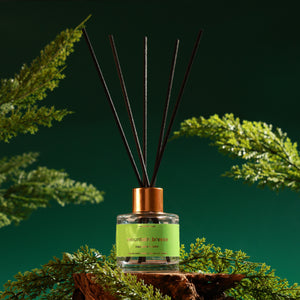
4. Mountain Breeze 50ml Pine, sage, Indian cedar — dry and resinous, continuous with the smoke's woody core A flat that never fully clears, where a clean break would feel like an interruption ₹849
Buy nothing: the honest gap If the complaint is that the afternoon still smells of the morning, the fix is ventilation timing, not a bottle. Open earlier, keep it open longer, and air the fabric-heavy end of the room First, always. Fragrance is the last twenty per cent of this problem, not the first ₹0
Honest notes for buyers: fragrance does not remove smoke or any other odour — source, then ventilation, then fragrance, in that order. A reed diffuser has no off switch, which in a house with a fixed morning routine is a genuine limitation; an ultrasonic machine such as the Sukoon ₹1,899 can be switched off but brings water, power and refills that a reed does not, and its water-based Hotel Collection oils cannot go into reeds in either direction. Reeds are alcohol-free on a heat-stable CCT base, phthalate-free, paraben-free, IFRA-compliant, 0 ppm formaldehyde, six fibre reeds in a refillable glass bottle, composed in Pune. Fragrance oil is flammable — keep diffusers and refills away from agarbatti, diyas and open flame. Free shipping above ₹499. A portion of every order supports girl-child education through Nanhi Kali.
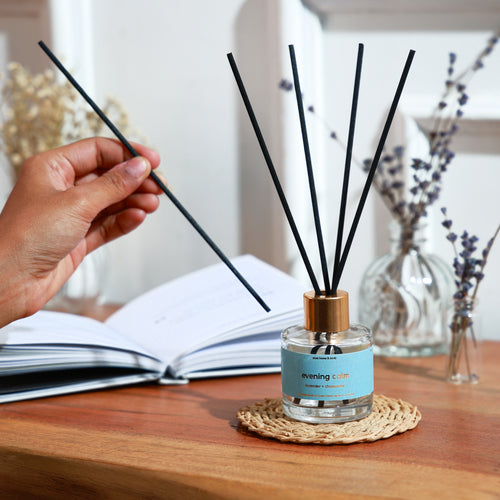
SOSA Evening Calm lavender and chamomile reed diffuser
The end of the sequence
Evening Calm · Kashmir lavender, chamomile ₹799 / 50ml
At 8.9 it is deliberately the softest thing in the range, which is what a bedroom at the end of a long day actually wants — present without taking over, and quiet enough that nobody in a shared flat objects to it. Three reeds by a bedside rather than six; that halves the projection and roughly doubles the life of the bottle. 6–8 weeks on the 50ml, and it pairs with Morning Freshness in the Day & Night duo at ₹1,498.
SS
ISIPCA
Versailles
A note from Sonal

I like this question because the person asking it has already worked out most of the answer. They have noticed that the morning and the evening are two different rooms, and they are looking for the mechanism that joins them. The mechanism is time and moving air, and the product is only the thing that happens to be running when both have done their work.

What I would gently push back on is the idea that the diffuser should be doing something during the incense. It cannot, and asking it to is how households end up buying deeper and deeper scents and then finding their flat overwhelming to a visitor. The reed's job starts when the room is clear. In the meantime the honest cost of the format is that oil leaves the bottle during an hour when nobody can detect it — a reed has no off switch, and I would rather state that than pretend it is free.

The two adjustments I would actually make in this house are both small. Air during the agarbatti rather than after it, which shortens everything. And flip the reeds after the airing, on whatever day of the week suits you, so the burst lands in a room that has just been cleared. Neither costs anything. Keep the bottle well away from the stand, because fragrance oil is flammable and no diffuser belongs beside something lit. Everything is composed in Pune, and a part of every order funds a girl's classroom through Nanhi Kali.

Frequently asked questions

How long should I wait after the morning incense before the home fragrance takes over?
There is no single figure, because it is a property of your flat rather than of the practice. In a cross-ventilated room with a balcony door open it can be twenty minutes; in a curtained room with one window it can be several hours, because part of the smoke settles onto fabric and re-releases slowly. Air during the agarbatti rather than after it, and judge the room by leaving the house for fifteen minutes and walking back in.
Should I move the reed diffuser out of the room while the incense burns?
Not for fragrance reasons — a reed diffuser is not harmed by being in a room with incense, and moving a bottle daily makes it perform worse and increases the chance of a spill. There is, however, a placement rule: fragrance oil is flammable, so the bottle should live well away from the agarbatti stand and any diya in the first place, on a different surface and out of the path of anything lit. Choose the spot once and leave it there.
When should I flip the reeds if we burn incense every morning?
After the airing, not before. Flipping releases a burst of fragrance and you want it landing in a room that has just been cleared rather than one that is about to have the windows opened. The cadence is every three to five days, not daily — flipping more often does not make the room stronger, it only empties the bottle faster.
Which fresh fragrance works best for the evening after morning incense?
Morning Freshness ₹749 in the room where the afternoon and evening happen — Malabar lemon and peppermint over eucalyptus globulus, which is the furthest register in our range from combustion and therefore the clearest signal that the room has been reset. For the bedroom at the end of the night, Evening Calm ₹799 at 8.9 is softer and better suited to a room you sleep in. Both together are ₹1,498.
Why can I not smell my diffuser in the evening even though guests can?
Because you are adapted to it. Olfactory receptors stop reporting a constant, unchanging stimulus within minutes, which is why nobody can smell their own home. It is also why sensitivity varies so much between people in the same room. If a visitor remarks on it and you cannot detect it, the diffuser is doing its job for everyone but you — and the correct response is not to buy something stronger, which is how a flat becomes over-scented without anybody living there noticing.
Puja, incense and home fragrance
Ventilate, wait for the room to clear — then the reed has the rest of the day, with nothing left to do
Morning Freshness ₹749 is the cleanest contrast for the afternoon and evening; Evening Calm ₹799 at 8.9 is the softest thing we make and belongs by the bed. Both together in the Day & Night duo at ₹1,498. 50ml lasts 6–8 weeks with six fibre reeds; 130ml from ₹1,249 lasts 14–18 weeks. Alcohol-free, phthalate-free, 0 ppm formaldehyde, composed in Pune. Free shipping above ₹499, and a portion of every order supports girl-child education through Nanhi Kali.
Shop Morning Freshness ₹749 → See the Day & Night duo ₹1,498
Continue the read
More from homes that burn incense every day
Editorial standards & sources
About this guide: Written by Sonal Sahani, ISIPCA Versailles-trained founder and perfumer at SOSA Home & Body, on the practical daily sequence in a household that burns incense in the morning and wants a fresh home fragrance for the rest of the day. This page makes no claim about the ritual suitability, purity or auspiciousness of any product; SOSA has no ritual product line and a diffuser is not an offering or a replacement for incense. No health, air-quality or smoke-removal claim is made or implied — fragrance does not remove a smell, and the sequence recommended here is source, then ventilation, then fragrance. No clearing time is stated as a figure because it is a property of the individual room. Review quotations are from verified SOSA buyers.

SOSA reed diffusers — facts verified August 2026: Morning Freshness (Malabar lemon · peppermint · eucalyptus globulus) 50ml ₹749 · 130ml ₹1,249 · 9.0 on the SOSA strength scale; the eucalyptus base slows lemon evaporation three to four times, turning a 10–14 day citrus fade into 6–8 weeks. Evening Calm (Kashmir lavender · chamomile · soft musk) ₹799 · ₹1,299 · 8.9, the softest in the range. Garden Bloom (British rose · night-blooming jasmine) ₹799 · ₹1,299 · 8.9. Mountain Breeze (Himalayan pine · sage · Indian cedar) ₹849 · ₹1,349 · 9.4. Fresh Brew (Coorg coffee · Kerala vanilla · caramel) ₹849 · ₹1,349 · 9.5, the deepest. 50ml suits rooms up to about 150 sq ft and lasts 6–8 weeks; 130ml suits above that and lasts 14–18 weeks. Six fibre reeds, not rattan — six for full projection, three for a soft level and roughly double the life; flip cadence every 3–5 days. Day & Night duo ₹1,498 (two 50ml) · ₹2,498 (two 130ml). All alcohol-free on a heat-stable CCT carrier, phthalate-free, paraben-free, IFRA-compliant, 0 ppm formaldehyde, refillable glass, composed in Pune, tested at 45°C and 85% RH. Sukoon ultrasonic ₹1,899 (500ml, 270–320 sq ft, 16–18h on low); Hotel Collection oils are water-based and ultrasonic-only and are not interchangeable with reed oil in either direction. Fragrance oil is flammable; keep diffusers and refills away from agarbatti, diyas and open flame. Free shipping above ₹499. A portion of every order supports girl-child education through Nanhi Kali. SOSA is an independent Indian fragrance house and is not affiliated with any hotel brand. Prices subject to change — see the live product pages.
ブログに戻る