


The fix is structural, not aesthetic: one composition per connected volume, introduced into moving air rather than released from an object on a console, at a level chosen for the person sitting down rather than the person walking in.
The counter-intuitive part: two bottles in one room are worse than one, not better. Two passive sources make two concentration peaks with a valley between them, and members walking the room meet an uneven, lurching field rather than an even one.
The honest gap: a reed diffuser cannot help you here, and I sell reed diffusers. A reed is a fragrant zone of about two metres with a locatable source, which is the exact geometry of a shop counter. In a lobby it is the wrong mechanism, however good the oil is. SOSA also sells no room spray for interiors at all — every SOSA spray is a car perfume.
2. Remove the sources a member can stand next to. Proximity is the second condition. Anything on a table gives the nose a gradient to walk up and a source to locate, and a member who can find the object will always meet it at its strongest. Fragrance introduced into moving air has no findable centre, which is why you can rarely locate the diffuser in a well-run building — often because there is not one in the room to find.
3. Halve whatever dose you think is right. A composition at high concentration loses its structure at the nose and collapses into one sweet or one sharp impression. That collapse is the shop-counter smell, and it is a concentration effect rather than a quality one. Set the machine for the member sitting in the armchair at four in the afternoon, not for the empty room at nine in the morning.
4. Choose a register that survives being quiet. Dry materials separate as they get fainter; sweet materials merge. Cedar, vetiver, white tea and a light citrus stay legible at low level. A gourmand or a heavy floral run low tends to read as a vague sweetness of unknown origin, which is the thing a member describes as cheap.
5. Leave several rooms alone entirely. Dining rooms and bar counters stay neutral; so do spa treatment rooms, gym floors and boardrooms. A club that scents everything smells like a business that scents things. Everything is alcohol-free, phthalate-free, paraben-free, IFRA-compliant and 0 ppm formaldehyde, composed in Pune, and a portion of every order supports girl-child education through Nanhi Kali.

The three conditions that manufacture the effect
I want to be precise about this because the usual advice — choose something subtle — is not wrong so much as useless. Subtlety is a consequence of the arrangement, not a property you can buy in a bottle. Here are the three conditions that produce the shop-counter impression, each of which a club can remove independently.
 Aangan₹25,999The most common version in a club is unintentional. Nobody decided to run four fragrances in the lobby; they accumulated. A candle somebody liked, a bottle a member donated, a housekeeping block in the cloakroom, a machine installed two years ago. Each is defensible on its own and together they produce a field that changes character every three paces, which the brain reads as a shop rather than a room. The rule is one composition per connected volume, where a connected volume is whatever air can move freely between. A closed door is a boundary; an open plan, a galleried stair or a lobby that runs into a lounge is one volume however many names it has on the floor plan. Start by taking things away, and do the audit at nose height with a notebook rather than from memory.
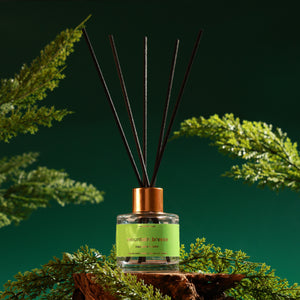
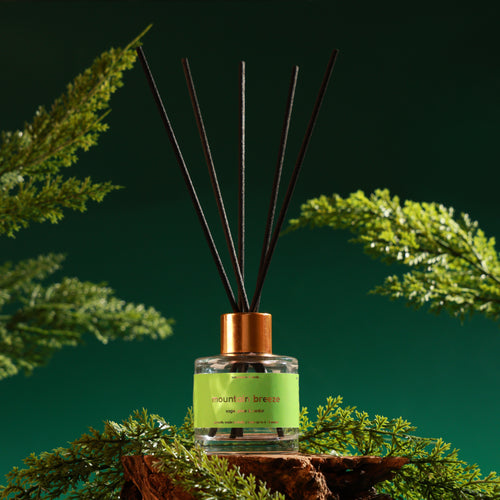
 Mountain Breeze₹849Concentration falls steeply with distance from a passive source, which means a bottle on a reception console is delivering something close to neat fragrance to the person checking in and almost nothing to the person eight feet away. That difference is the whole sensation of a fragrance counter: a series of intense local fields separated by comparatively empty air. The cure is to stop putting fragrance where people stand. Put it in the air that is already moving — wall-mounted above the sightline, in the return of the air system, or set back from the door in the path the draught already takes but not at the door line itself, which is the most turbulent point in the building.
Vaayu₹11,999A composition is a structure: materials arranged so that some arrive first, some hold the middle and some stay. At a sensible level in a room you perceive that structure and it reads as a considered thing. Push the level up and the structure disappears — the materials stop resolving separately and what reaches the nose is one flat impression, usually sweet, sometimes sharp. That flattening is what the phrase “it smells like a shop” actually describes, and it happens to good compositions and bad ones alike. So the intensity dial in a club is a quality control rather than a loudness control, and the correct direction is nearly always down. A club that halves its dose usually reports that the fragrance became better, which is a strange sentence until you know the mechanism.
Mountain Breeze₹849Concentration falls steeply with distance from a passive source, which means a bottle on a reception console is delivering something close to neat fragrance to the person checking in and almost nothing to the person eight feet away. That difference is the whole sensation of a fragrance counter: a series of intense local fields separated by comparatively empty air. The cure is to stop putting fragrance where people stand. Put it in the air that is already moving — wall-mounted above the sightline, in the return of the air system, or set back from the door in the path the draught already takes but not at the door line itself, which is the most turbulent point in the building.
Vaayu₹11,999A composition is a structure: materials arranged so that some arrive first, some hold the middle and some stay. At a sensible level in a room you perceive that structure and it reads as a considered thing. Push the level up and the structure disappears — the materials stop resolving separately and what reaches the nose is one flat impression, usually sweet, sometimes sharp. That flattening is what the phrase “it smells like a shop” actually describes, and it happens to good compositions and bad ones alike. So the intensity dial in a club is a quality control rather than a loudness control, and the correct direction is nearly always down. A club that halves its dose usually reports that the fragrance became better, which is a strange sentence until you know the mechanism.
Why two bottles are worse than one, and why this surprises people
Here is the piece of physics that changes a specification, and it is the one house committees most often get backwards. Faced with a large lounge that seems under-fragranced, the instinct is to add a second bottle or a second machine. With a passive device this makes the room less even, not more. Two passive sources create two concentration peaks with a valley between them, because neither device moves any air; the midpoint of the room is the farthest point from both, and a member sitting there is in the weakest air in the space while a member standing by either console is in the strongest. You have not raised the average so much as increased the variation — and variation across a room is precisely the shop-counter sensation.
The same logic explains why adding bottles to a members’ lounge never solves a lounge. Ten reed diffusers in a four-thousand-square-foot room are ten small zones of about two metres each, not one large fragranced room. This is not a quality failure and it is not a fault in the oil; it is what a passive capillary device does, and no amount of money spent on better oil changes the mechanism. The honest answer for a large connected volume is a machine that moves fragrance into the air the building is already circulating, so that the field is even and there is no peak for anybody to stand in.
There is one more thing worth saying, because it delays the sale and it is true. If a room already smells of something — damp carpet, an old closed lounge, a monsoon that has been into the upholstery — then fragrance on top does not replace that smell. It produces a mixture, and the mixture almost always reads as cheaper than the original did, because it announces that something is being covered. The order is fixed: source, moisture, air change, cleaning, and only then fragrance. SOSA sells no air purifier and no dehumidifier, and makes no air-quality claim of any kind; fragrance adds fragrance. A club with a moisture problem should spend the first part of its budget on the building.
The shop counter and the club, side by side
The point of this table is that not one line of it is about which fragrance was chosen. Every row is an arrangement decision, which means every row is available to a general manager with a floor plan and no new purchase.
| Variable | The perfume-store arrangement | The club arrangement | Why it matters |
|---|---|---|---|
| Compositions per volume ★ | Many, all at once | Exactly one | Mixtures change character every few paces |
| Distance from the nose | Arm’s length, sometimes closer | Above the sightline or inside the air system | Concentration falls steeply with distance from a source |
| Concentration | Calibrated for skin, not for a room | Set for the fourth hour of occupancy | High dose flattens a structure into one impression |
| Delivery | Point sources on surfaces | An even field carried by moving air | No gradient to walk up and no centre to find |
| Evenness across the room | Peaks and valleys | Consistent within the volume | Variation is what the brain reads as a shop |
| Rooms left unscented | None — the whole floor is selling | Dining, spa treatment rooms, gym floor, boardrooms | Restraint is what makes the scented rooms believable |
| What a visitor says afterwards | “It smelt very strongly of something” | “It felt well-kept” — with no note named | The second is the whole objective |
The register that survives being run low
Having said that the choice of fragrance is not the cause, there is still a choice to make, and one criterion matters more than taste: how the composition behaves when it is quiet. Dry, structured materials separate as they fade — at low level you can still tell cedar from tea from citrus, and the room reads as specific. Sweet and heavy materials merge as they fade, so a gourmand or a big floral at low level becomes an unattributable sweetness, which members describe as stuffy or as smelling of something they cannot place. That is why I steer clubs towards clean woods, vetiver, white tea, a restrained citrus and a dry green — not because those notes are inherently more expensive, but because they remain legible at the low dose a club actually needs.
Two things that do not exist at SOSA are worth saying out loud, because they come up in this conversation constantly. SOSA publishes no leather fragrance in any format, and no tobacco or smoky fragrance for any diffuser. Clubs ask for both, and my honest answer is that a leather-and-timber room already contains its own leather and its own timber, supplying a smell no accord reproduces; putting a leather note on top of real leather is the one combination that reliably reads as artificial. Sit beside the room instead of imitating it — clean woods, cedar, vetiver, tea — and the material in the furniture does the rest. The second thing: SOSA sells no room spray for interiors at all. Every SOSA spray is a car perfume. A spray is in any case an event rather than a system, which is why it disappears from a lobby within minutes and why nobody should be solving a club with one.
On the fragrance supply itself, the honest position for a club buyer. For the waterless commercial machines the fragrance is specified and quoted per property through the contact page; no refill oil for them is listed on the store and no price for one is published. That is normal in commercial scenting and it is also the only accurate thing I can write. The Hotel Collection oils that are listed — Quiet Luxury, Forest Suite, White Tea Serenity, Tea Garden and the rest — are water-based, take three to six drops in a water tank, and are not for reed diffusers and not for the waterless machines. They belong to the ultrasonic range, and in most Indian clubs added humidity is working against you rather than for you, which is why the ultrasonic answer is usually the wrong one at building scale.
What to do, in order — and the honest gap
The first three steps cost nothing and between them they solve most of the problem. I put them first deliberately, because a club that buys a machine before doing them has bought a fourth fragrance for a room that already had three.
| Step | What it is | Why it is in this position | Cost |
|---|---|---|---|
| 1. Count the fragrances in each volume ★ | Walk the property at nose height and write down every scented object | Candles, blocks, donated bottles and liners are usually the real cause | No purchase |
| 2. Reduce each connected volume to one | Remove the rest, including every scented cloakroom block and bin liner | Mixtures change character across a room; single compositions do not | No purchase |
| 3. Move the survivor out of reach | Off consoles and desks; above the sightline or into the air system | Proximity produces the peak a member can stand in | No purchase |
| 4. Halve the dose and live with it a week | Lowest setting first, raised only at the threshold if at all | High concentration flattens structure into a single impression | No purchase |
| 5. Vaayu per volume, or Aangan on the air system | Up to 1000 m³ per Vaayu; up to 3,000 m³ on an Aangan connected to HVAC | An even field with no findable source is the whole objective | ₹11,999 / ₹25,999 |
| What this cannot fix: the honest gap | A reed diffuser will not scent a lobby, whatever is in it — it is a two-metre zone by mechanism. SOSA publishes no leather, tobacco or smoky fragrance for any diffuser, sells no room spray for interiors, and lists no refill oil for the waterless commercial machines; that fragrance is specified and quoted per property | Said plainly, because the alternative is a club discovering it after the invoice | Quoted |

Versailles
I trained in a building full of people evaluating fragrance all day, and the first thing you learn there is how quickly a room becomes unusable. Not because anything smelled bad — because too much of it was present at once, at close range, and nobody had counted. A perfume hall is that condition made permanent and lit well. It is also, exactly, what a club lobby becomes when four well-intentioned decisions are allowed to accumulate over two years.
So when a general manager tells me they are frightened of the club smelling like a shop, I am not worried about their taste. I am worried about their inventory. The audit takes an afternoon: walk the property, write down every candle, block, bottle, liner and machine, and mark which ones share air with which. Almost every club I have done this with finds at least three things in one volume, and at least one that nobody in the building can account for.
Then take the dose down. It is the least intuitive advice in this trade and the most reliable: the same oil at a fraction of the level reads as more expensive, because at that level you can still hear the individual materials rather than one blur. If you do only two things from this page, count your sources and halve your setting. Neither costs anything. Everything we make is composed in Pune, and a part of every order funds a girl’s classroom through Nanhi Kali.
Frequently asked questions
- The pillar: what a club should smell like — the whole sequence, room by room.
- How strong it should be — the gradient from the threshold to the armchair.
- Smelling expensive and woody, leathery, fresh or hotel-like.
- The business-club direction and the signature fragrance.
- Whether to have a signature at all, how to choose one, and how it becomes an identity.
- Brand: the SOSA founder story.
SOSA commercial scenting — facts verified August 2026: Vaayu ₹11,999, waterless cold-air nebulising, up to 1000 m³ ≈ 2,000–3,000 sq ft, 400ml refillable sealed tank lasting up to about 90+ days depending on intensity and hours, Bluetooth app plus onboard buttons, run windows of 1h / 4h / 8h / 24h, day selection, adjustable intensity, auto-stop and key-lock, under 38 dB, freestanding, wall-mounted or HVAC-return, DC 12V / 1A at 5W, CE, RoHS and SGS, black and white. Aangan ₹25,999, HVAC or AHU connection or standalone wall-mount or lay-flat, up to 3,000 m³ ≈ 8,000–10,000 sq ft, 800ml reservoir, under 42 dB, DC 12V at 14W, intelligent PCB with programmable work and pause cycles and daily schedules, metal body 3.9 kg at 284 × 125 × 246 mm, black or white, one-year warranty, imported; it is not app-controlled, has no Bluetooth, and no certifications are published for it. Meenar ₹38,500 is the larger-property option, specified on enquiry; no coverage figure is published for it here, and it should not be assumed to reach further than Aangan. Ultrasonic machines: Sukoon ₹1,899 at 270–320 sq ft with a 500ml tank and 16–18 hours on low, Boond ₹899 with a 300ml tank at up to about 150 sq ft, Megh ₹3,499 with a six-litre tank and around 100 hours of runtime but only about 215 sq ft of coverage. Hotel Collection fragrance oils are water-based and ultrasonic-only at 15ml ₹299, 100ml ₹999 and 300ml ₹1,799, taking three to six drops in a water tank; they are not for reed diffusers and not for the waterless commercial machines. No purchasable refill oil is listed for the waterless commercial machines; that fragrance is specified and quoted per property. SOSA publishes no leather fragrance in any format and no tobacco or smoky fragrance for any diffuser. SOSA sells no air purifier and no dehumidifier, and every SOSA spray is a car perfume rather than an interior product. No SOSA machine offers Wi-Fi, Alexa, Google Assistant, KNX, Crestron, Control4, Modbus, BACnet or any building-management integration; the Aangan HVAC connection is mechanical. Reed diffusers 50ml ₹749–₹849 lasting 6–8 weeks and 130ml ₹1,249–₹1,349 lasting 14–18 weeks, six fibre reeds, alcohol-free, phthalate-free, paraben-free, IFRA-compliant, 0 ppm formaldehyde, heat-stable CCT carrier, refillable glass bottle, tested at 45°C and 85% RH, composed in Pune. No dealer programme, reseller margin, trade price, territory or service contract is published. Free shipping above ₹499. A portion of every order supports girl-child education through Nanhi Kali. SOSA is an independent Indian fragrance house; the Hotel Collection scents are SOSA’s own interpretations inspired by the world’s finest hotels, and SOSA is not affiliated with or endorsed by any hotel brand. Prices subject to change — see the live product pages.