



- The direct answer
- Why arrival is a system, not a single decision
- The three non-scent elements that do most of the work
- Arrival elements, what each one actually controls
- Where scent fits once the rest is in order
- What to add, and in what order
- A note from Sonal
- Questions about building an arrival experience
2. Address sound before scent. A doorway that's acoustically chaotic — a bell, a queue, kitchen noise carrying straight through — undermines an arrival no fragrance can compensate for; quieting or softening that noise is a design decision, not a scenting one.
3. Give the eye somewhere considered to land — the sightline from the door. What a customer sees first on entering, whether it's a counter in disarray or a deliberately composed view, shapes the arrival more immediately than smell does, simply because sight registers faster.
4. The first surface a customer touches matters more than owners expect. A door handle, a host stand or a counter edge that feels considered — clean, solid, well maintained — closes the loop on an impression that light and sightline started building.
5. Scent joins this list last, and only where an entrance genuinely qualifies as a separated zone. Where it does qualify, a restrained, non-edible register adds a final, quiet layer — it was never designed to carry the whole impression on its own, and asking it to do that is where most 'premium' entrance projects go wrong.
Get light, sound, sightline and touch right first — fragrance, where a qualifying zone allows it, is the last five per cent, not the first fifty.
Why arrival is a system, not a single decision
It's tempting to treat 'premium arrival experience' as a single problem with a single fix, and fragrance is an appealing candidate because it's fast to install and easy to point to. But arrival is genuinely a system — several senses registering information in quick succession, each one shaping how the others are interpreted. Light arrives first, because sight is faster than smell; sound registers almost as quickly, often before a customer has consciously noticed anything visual; touch and scent both come slightly later, once the customer has already formed a rough impression from the first two.
This ordering matters because it means fragrance is working on an impression that's already partly formed by the time it's noticed. A beautifully judged entrance fragrance in a space with harsh overhead lighting, a jarring door alarm and a scuffed counter edge doesn't rescue that impression — it simply becomes one more detail in a space the customer has already, half-consciously, filed as ordinary. The reverse is also true: a genuinely well-lit, quiet, considered entrance can feel premium with no fragrance at all, because the other four elements have already done the job scent is often asked to do alone.
None of this is an argument against scent — it's an argument against sequencing. Where an entrance genuinely qualifies as a separated zone, a light, restrained fragrance is a legitimate final layer, exactly as this cluster has argued elsewhere. The point of this page is simply that it's the last layer, not the first, and owners who reach for it first are usually trying to solve a lighting or acoustics problem with the wrong tool. A useful test is to imagine the entrance with the fragrance switched off entirely: if the space still feels considered — well lit, quiet, visually composed, solidly finished — the fragrance is doing exactly the job it should. If the entrance feels bare or unfinished the moment the diffuser stops, the actual gap was never the fragrance in the first place.
The three non-scent elements that do most of the work
 Morning Freshness₹749Warm, layered lighting at the threshold — rather than a single harsh overhead source — reads as considered before a customer has processed anything else about the space; cold, flat, overly bright entrance lighting undercuts every other decision that follows it.
Arrival elements, what each one actually controls
Five elements that make up a premium arrival, ranked roughly by how quickly a customer registers each one after stepping through the door.
| Element | When it registers | What it controls | Typical cost |
| Light | Immediately, before conscious thought | Warmth, tone, whether the space reads as considered or utilitarian | Design and fitting cost, assessed by an interior professional |
| Sound | Within the first few seconds | Whether the entrance feels quiet or chaotic, regardless of appearance | Acoustic or equipment adjustments, assessed on site |
| Sightline | Within the first few seconds | The first visual impression a customer forms of the space beyond the door | Layout and merchandising decisions, no fixed cost |
| First touch | As the customer enters or is greeted | Whether physical details feel maintained and deliberate | Maintenance and fixture quality, no fixed cost |
| Scent, where the entrance genuinely qualifies | A few seconds after entry, layered on the rest | A final, restrained addition — never the whole impression on its own | ₹749–₹11,999 depending on zone and scale |
| Every element above scent shapes the impression before fragrance is even noticed, which is exactly why an arrival project that starts with a diffuser and skips the rest usually underperforms one that gets the first four right and adds scent last, if it qualifies at all. | |||
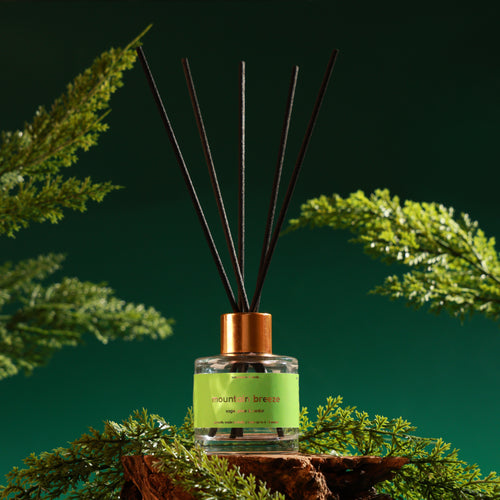
Mountain Breeze · the quiet final layer₹849Shop →  Sukoon · one qualifying zone, held steady₹1,899Shop →
  Vaayu · a considered standard, several zones₹11,999Shop →
Where scent fits once the rest is in order
Never introduce fragrance as a first step in an arrival project, before light, sound, sightline and touch have been reviewed — a diffuser installed into an otherwise unconsidered entrance is solving the wrong problem, however well the fragrance itself is chosen.
Sometimes the non-scent elements are already strong, and the only thing missing is a final, quiet layer — that's exactly the situation a light, non-edible register in a genuinely qualifying entrance is built for, and it tends to read as intentional precisely because it arrives last, on top of everything else that's already working.
Usually, an owner who works through light, sound, sightline and touch first finds that the fragrance decision becomes simpler by the time they reach it — a single, restrained, non-edible register, chosen to complement rather than rescue an entrance that already does most of the work on its own. It also tends to be a smaller, cheaper decision than the one an owner arrives expecting to make, because a reed diffuser or a single Vaayu unit is genuinely enough once the rest of the arrival is already carrying most of the impression.
What to add, and in what order
Ordered by when each element registers with a customer, not by cost — light and sound come before any fragrance decision, regardless of budget.
| Route | Premises | Why | What it costs |
| Review lighting at the threshold first | Any café entrance, before any fragrance decision | Sets the tone before any other sense registers | Assessed by an interior professional |
| Address acoustic clutter — alarms, queue systems, kitchen noise | Any entrance where sound carries through from service areas | No fragrance compensates for a chaotic-sounding arrival | Assessed on site, no fixed cost |
| Compose the sightline from the door | Any entrance where the first view is cluttered or unplanned | Shapes the first visual impression before fragrance is noticed | Layout adjustment, no fixed cost |
| Check the first surface a customer touches | Any host stand, handle or entrance counter edge | A small maintenance detail that closes the impression the first three elements build | Maintenance cost, case by case |
| Reed diffuser or Vaayu, restrained non-edible register | Only once the entrance genuinely qualifies as separated and the elements above are addressed | The final, quiet layer — never the starting point | ₹749–₹11,999 |
Owners frequently open our conversation by asking what fragrance would make their entrance feel premium, and I usually answer with a question of my own: what does the entrance look like under its own lighting, and what does it sound like during a normal morning rush? Most of the time, the honest answer to their original question is that fragrance isn't the first project worth doing.
I've walked into entrances with a genuinely well-chosen fragrance running, undermined completely by a fluorescent tube overhead and a door alarm that goes off every four seconds. No amount of careful formulation competes with that combination — the fragrance decision was right, and it still didn't matter.
When I do recommend a diffuser for an entrance, it's almost always the last thing I suggest in the conversation, not the first — after light, after sound, after the sightline and the door handle. That ordering isn't caution for its own sake; it's simply where fragrance actually sits in how a customer experiences arriving somewhere. Owners who follow the order usually end up buying less scenting equipment than the ones who started there, not more — once the rest of the arrival is doing its share, a single reed diffuser or one Vaayu unit is nearly always sufficient.
Questions about building an arrival experience
- Should the Entrance of a Premium Café Have a Signature Scent? — the narrower scent-only version of this page's broader question.
- Can I Scent My Café Entrance Without Fragrancing the Dining Area? — the boundary test this page's fragrance layer still depends on.
- Can a Scent Machine Be Used Only Near a Café Entrance? — the settings that make the fragrance layer workable once it qualifies.
- When Does Professional Scenting Make Sense for a Café's Non-Dining Areas? — the wider case for where scent belongs at all in this system.
- Brand: the SOSA founder story.
SOSA products & prices (verified September 2026): Reed diffusers 50ml ₹749–₹849 (to 150 sq ft, 6–8 weeks at six reeds) · 130ml ₹1,249–₹1,349 (above 150 sq ft, 14–18 weeks) · reed refill 300ml ₹2,399. Ultrasonic: Boond ₹899 (~150 sq ft) · Sukoon ₹1,899 (270–320 sq ft, ships with three 15ml Hotel Collection fragrances) · Megh ₹3,499 (6L tank, ~100 hrs runtime, ~215 sq ft — a runtime machine, not a coverage upgrade). Waterless cold-air: Safar ₹3,999 (no published coverage figure) · Vaayu ₹11,999 (up to 1000 m³, roughly 2,000–3,000 sq ft; 400ml tank lasting about 90+ days; app and onboard control, 1h/4h/8h/24h run windows, adjustable intensity, key-lock, under 38 dB, freestanding or wall/HVAC mount, 5W, CE/RoHS/SGS) · Aangan ₹25,999 (8,000–10,000 sq ft). Hotel Collection water-based fragrance 15ml ₹299 · 100ml ₹999 · 300ml ₹1,799 is for ultrasonic machines; reed oil and Hotel Collection are not interchangeable. Reed diffusers are alcohol-free, phthalate-free, paraben-free, IFRA-compliant and low VOC, handmade in small batches in Pune. Every purchase funds a girl's education through Nanhi Kali. Prices and availability subject to change — see the live product pages.