



The hotel lobby is a large open volume with constant door traffic and mechanical ventilation. Presence there is only achievable by feeding atomised oil into the air-handling system at a rate that keeps up with the air leaving. This is an engineering problem, not a shopping problem.
The mechanism in both cases is the same: waterless cold-air nebulising, in which pressurised air shatters undiluted oil into a dry mist. The machines differ in scale, not in principle.
At home: reeds from ₹749 for a fragrant zone with no power and no maintenance; Sukoon ₹1,899 for genuine room coverage of 270–320 sq ft, accepting water and humidity; Safar ₹3,999 for the hotel mechanism at personal scale, named and sold as a car and travel diffuser with no published room-coverage figure; Vaayu ₹11,999 only when the space is genuinely 2,000–3,000 sq ft.
The honest gap: between Safar and Vaayu, SOSA has no mid-sized waterless bedroom nebuliser. There is no product in the range that is a Vaayu built for one room, and saying so is more useful than pretending the ladder is complete.
2. The lobby is a throughput problem and it is the hard one. A lobby is a large volume with doors that open every few seconds, mechanical ventilation moving air continuously, and a population that changes all day. Fragrance is being removed from that space as fast as it is introduced. The only way to hold a concentration is to introduce it continuously, at a rate matched to the air leaving, which is what a commercial nebuliser feeding an air-handling system exists to do.
3. Both use the same mechanism, and that is the genuinely useful thing to know. Waterless cold-air nebulising — pressurised air shattering undiluted fragrance oil into a dry micro-mist — is what a hotel uses at both scales. It is not a water diffuser, it is not a reed, and it is not a spray. The hotel smell is a diffusion-technology outcome, not a fragrance-oil outcome, and that single sentence explains more disappointment than any note list ever will.
4. Your bedroom is a room, not a lobby — and that is good news. A closed 120 sq ft bedroom is closer to the guest room than to the atrium, which means the effect you liked is the achievable one. Shut the door for an hour before you want it, place the source in the path air already takes rather than on the threshold, and you have done most of the work for nothing.
5. Buy for the problem, not for the memory. A reed at ₹749 to ₹849 gives you a fragrant zone in silence with no socket and nothing to fill. Sukoon at ₹1,899 gives 270–320 sq ft of genuine room coverage and accepts water, humidity and refilling. Safar at ₹3,999 gives the hotel mechanism at personal scale — and it is named and sold as a car and travel diffuser with no published room coverage. Vaayu at ₹11,999 is for 2,000–3,000 sq ft and is the wrong purchase for one bedroom.
Alcohol-free, phthalate-free, paraben-free, IFRA-compliant, 0 ppm formaldehyde. Free shipping above ₹499, and a portion of every order supports girl-child education through Nanhi Kali.

The two problems, described properly
It is worth slowing down on what each space actually is, because the vocabulary we all use flattens them into one thing called “hotel smell”. They are not one thing. They differ in volume, in how fast the air is replaced, in where the fragrance is introduced, and in how long it has to be held. Change any one of those and the equipment changes with it. Below is each of the three cases you might be remembering, and what each would actually take in a home.
 Evening Calm₹799A guest room is the gentlest scenting environment in the building. The door is shut, the windows generally do not open, the air is conditioned and recirculated rather than exchanged with outside, and the space is small. Fragrance introduced into it is not being carried away, so a low, steady release accumulates to something perceptible and holds. Very often there is no machine in the room to find, and guests who go looking never locate one — the scent has arrived from the corridor, or through the air handling, or from a single small device out of sight. That absence of a findable source is a surprisingly large part of why the effect reads as designed rather than added: there is no gradient to walk up and no object to attribute it to.
 Hotel Collection₹999A lobby is the opposite case in every variable. The volume is enormous, frequently double or triple height. The entrance doors open constantly, so outside air is being drawn in all day. Mechanical ventilation is running continuously by design. Fragrance in that space is disappearing the moment it arrives, which means the only workable strategy is to introduce it continuously and to introduce it into the airflow rather than into the room — typically a nebulising unit ducted into the air-handling system, dosing undiluted oil as a dry mist so that the building’s own circulation distributes it. It runs on a schedule, at a set intensity, in the same fragrance for years. Consistency is as much of the effect as strength is, and it is the part nobody remembers to want.
 Garden Bloom₹799The third case is the one that confuses people most, and it is the reason the two problems get conflated in the first place. A great deal of what a guest experiences on a hotel floor is carry-over: the corridor is scented as part of the building’s system, the room door opens onto it several times, and the fragrance you notice in your room arrived with you. You then attribute to the room an effect that belongs to the building. At home there is no corridor doing this work for you, which is why a bedroom that has been closed all day can smell of nothing at all until you introduce a source into it directly. The building was doing half the job and sending you no invoice.
The two variables that actually separate them
Strip away the architecture and there are only two numbers that matter, and every difference between a room and a lobby follows from them. The first is volume: how much air there is to fragrance. A bedroom holds a few tens of cubic metres. A lobby holds hundreds or thousands. Concentration is quantity divided by volume, which means the identical output that saturates a small room disappears in a large one — and, read in the other direction, the output required to hold a lobby would be preposterous inside a bedroom.
The second is air exchange: how fast that air is replaced. This is the variable almost nobody thinks about and it is frequently the dominant one. Fragrance molecules go where the air goes. A closed bedroom with a running split air conditioner is recirculating its own air, so what you release stays in circulation and distributes evenly — that is why a sealed bedroom smells strongest at night, and it is also why an open window is not a small adjustment but a completely different experiment. A lobby, by contrast, is engineered for high air exchange, because a large public space must be ventilated. Every one of those air changes takes the fragrance with it. The commercial machine is not there because lobbies need stronger scent; it is there because lobbies lose scent faster than any passive source can replace it.
Once you see it this way, the domestic decision becomes much less about money. If your room is small and closed for a predictable stretch of hours, you are in the favourable case on both variables at once, and you need a source rather than a system. If your space is large, open-plan, or ventilated hard — a whole floor, a living-dining that runs into a balcony, a villa — then you are gradually moving toward the lobby case, and at some point a machine rated for the volume becomes the only honest answer. Vaayu exists for precisely that point, at 1000 m³ or roughly 2,000 to 3,000 sq ft. It does not exist for a bedroom, and I will say so on every page in this family.
| The hotel room | The hotel lobby | Your bedroom | |
|---|---|---|---|
| The problem | Containment — hold a modest concentration in a small closed space | Throughput — replace fragrance as fast as ventilation removes it | Containment. It is the room problem, not the lobby one |
| Volume of air | Small | Very large, often double height | Small — usually the smallest of the three |
| Air exchange | Low. Sealed windows, recirculating conditioning | High by design. Constant door traffic, mechanical ventilation | Low with the door shut and the AC on; high with a window open |
| Where scent is introduced | Lightly in the room, or carried over from the corridor | Into the air-handling system, so the building distributes it | Into the room itself. There is no corridor helping you |
| Equipment | Small or none visible — often nothing to find | Commercial waterless nebuliser, ducted, scheduled, running for years | Reed, Sukoon ₹1,899, or Safar ₹3,999 at personal scale |
| What it feels like | Understated, even, present without being noticeable | An arrival. Concentration at a threshold, held all day | Whatever you set it to — and it is easy to overshoot |
| Hardest part | Nothing much. It is the easy case | Everything. It is a building-services problem | Believing the easy case is enough |
| The honest gap, stated plainly: if you want the hotel mechanism — waterless, undiluted, dry — in one ordinary bedroom, SOSA does not have a product built for that. Safar is personal scale, named and sold as a car and travel diffuser, with no published room-coverage figure. Vaayu is rated to 2,000–3,000 sq ft. There is no mid-sized waterless bedroom nebuliser between them. | |||
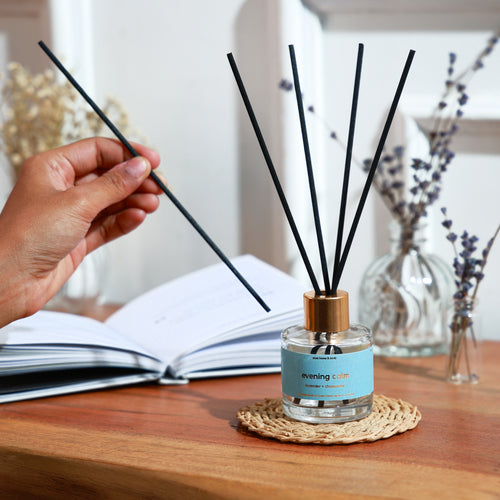 Passive · Evening Calm₹799Shop → Active · Sukoon₹1,899Shop →
  Ultrasonic-only · Hotel Collection₹999Shop →
Which one were you actually remembering?
This is worth being honest with yourself about, because the answer changes the budget by an order of magnitude. If the memory is of walking into the building — the doors, the lobby, the immediate wall of fragrance — you are remembering the throughput problem, and what produced it was a machine dosing a ventilation system. That effect at home lives at the front door of a large flat, on a schedule, and it is the one situation where a machine rated for a floor is a reasonable purchase. If the memory is of the room — putting the key card down, the quiet, the fact that everything smelled clean and consistent — you are remembering the containment problem, and you can have that for a fraction of the money.
There is a third possibility and it deserves saying out loud, because it is true more often than the category likes to admit. Part of what you are remembering is not reproducible by any equipment: you arrived at that hotel from outside, with a nose that had not spent the day adapting to that particular set of smells. Olfactory receptors adapt to a constant, unchanging stimulus within minutes — the signal still arrives, and the brain stops reporting it because nothing has changed. It is the reason you can smell your own home only after being away from it, and the reason a visitor is a far better instrument than you are. When people tell me their diffuser “stopped working”, the honest answer is very often that they stopped noticing. The test is not to sniff harder or to buy stronger; it is to leave the room for fifteen minutes and walk back in, or to ask one person who has just arrived.
And if a guest tells you the room smells lovely while you can detect nothing from the bed, nothing is broken and you should not spend a rupee. Sensitivity to individual materials varies enormously between people, and on top of that you are adapted to your own home. Buying a larger machine at that moment raises the room to a level that is too much for everybody else while you continue to notice nothing — which is the commonest way this problem gets worse rather than better. A diffuser you perceive continuously in your own home is set too strong for its volume, not calibrated correctly.
What to buy for each problem — and the rung that does not exist
The ladder in the order I would work through it, sorted by which problem you are actually solving rather than by price. The last row is the honest gap in the range, named because it is the reason this decision ends in a trade-off rather than a clean upgrade path.
| Buy | What it is | When it is the right answer | Price |
|---|---|---|---|
| 1. Nothing yet — close the door and test ★ | Shut the bedroom door for an hour before you want the effect, place the source out of the draught rather than on the threshold, and ask one person arriving from outside what they notice | Always first. It costs nothing and it settles a surprising share of these questions | ₹0 |
| 2. The room problem, passively | A reed diffuser — oil climbing six fibre reeds by capillary action, refillable glass, 50ml up to ~150 sq ft for 6–8 weeks, 130ml above that for 14–18, about ₹13–₹15 a day | When you want silence, no socket, nothing to fill or charge, and an object rather than an appliance. It gives a fragrant zone, not an evenly fragranced room | ₹749–₹1,349 |
| 3. The room problem, actively | Sukoon — ultrasonic water mist, 500ml, 270–320 sq ft, 16–18 hours on low, three 15ml Hotel Collection scents included | The value answer for a real bedroom. You accept dilution in water, added humidity, refilling and a plug | ₹1,899 |
| 4. The hotel mechanism, at personal scale | Safar — waterless cold-air nebulising of undiluted oil, 20ml bottle, 2000 mAh Type-C, up to 10h continuous or ~30h intermittent, 3 speeds, 1/2/3-hour auto-off, 6.9 cm. Named and sold as a car and travel diffuser, with bedside and hotel room among its stated uses | When water is the deal-breaker and you want it off when you leave. No published room-coverage figure — personal and small-space scenting, and it needs recharging | ₹3,999 |
| 5. The lobby problem, honestly | Vaayu — up to 1000 m³ or roughly 2,000–3,000 sq ft, 400ml tank up to ~90+ days, app plus onboard control, 1h/4h/8h/24h windows, key-lock, under 38 dB, 5W, freestanding or wall and HVAC mount | A whole floor, an open-plan living-dining, a large home, a villa, a clinic, a salon, a showroom or a reception — or one machine scenting the entire flat on a schedule. Not for one bedroom | ₹11,999 |
| Never as a coverage upgrade: Megh | 6L tank, around 100 hours of runtime, about 215 sq ft of coverage | Less coverage than the ₹1,899 Sukoon. A runtime and humidity machine — the biggest tank is not the strongest machine | ₹3,499 |
| The honest gap | No mid-sized waterless bedroom nebuliser exists at SOSA — nothing sits between Safar’s personal scale and Vaayu’s 2,000–3,000 sq ft | Said plainly, because it is why the truthful answer for one bedroom is sometimes Sukoon, sometimes Safar correctly understood, and sometimes the reed already on the shelf | — |
Versailles
The single most useful sentence I can give anybody who has come to this cluster is that they have been shopping with two memories fused into one. The lobby and the room are both real, both lovely, and they were produced by completely different arrangements of equipment. Nobody tells you that, because the industry sells in the language of strength, and strength is the wrong axis for both problems.
What I find genuinely interesting — and it is the thing I would want a reader to repeat at dinner — is how much of the room experience is not equipment at all. A hotel room is small, sealed, conditioned and cleaned, and a good part of its fragrance arrived from the corridor when the door opened. The building did the work. At home, there is no corridor, so the room has to be its own system, and the cheapest tool in that system is a door. I would rather a reader spent an hour with the bedroom door shut before spending three thousand rupees, and a lot of them find the hour was the answer.
I also want to be plain about where our own range is weakest, because this family is going to keep coming back to it. If you want the hotel mechanism in one bedroom — waterless, undiluted, dry, no humidity — we do not have a machine built for that size. Safar is personal scale and is named and sold as a car and travel diffuser with no published room coverage. Vaayu is a machine for a floor and would be nine-tenths wasted in a bedroom. The missing rung is real, and pretending otherwise would cost more trust than it could ever earn in sales. Everything is composed in Pune, and part of every order funds a girl’s classroom through Nanhi Kali.
Frequently asked questions
- Lobby smell in my bedroom — do I need a commercial machine? — no, and the answer is in the first sentence.
- Lobby intensity without scenting the whole house — containment and control.
- 120 sq ft against a lobby — the arithmetic, done honestly.
- Safar or Vaayu for a small room? — the head-to-head, sized properly.
- Do I need Vaayu for one bedroom? — no, said plainly.
- When Safar makes more sense than a large machine — small volume, occupied hours.
- When a home is genuinely large enough for Vaayu — thresholds, not adjectives.
- Intensity versus coverage — two different specifications.
- Safar vs Vaayu, the family pillar — chosen by space, not by spend.
- Brand: the SOSA founder story.
Facts verified August 2026: Three diffusion mechanisms are described — passive capillary (reed diffusers), ultrasonic water mist (Boond ₹899, 300ml, up to ~150 sq ft, ~6 hours, USB, night light; Sukoon ₹1,899, 500ml, 270–320 sq ft, 16–18 hours on low, three 15ml Hotel Collection scents included; Megh ₹3,499, 6L tank, ~100 hours runtime, ~215 sq ft, which is less coverage than Sukoon) and waterless cold-air nebulising (Safar ₹3,999, 20ml bottle, 2000 mAh Type-C battery, up to 10 hours continuous or around 30 hours intermittent, 3 speeds, 1/2/3-hour auto-off timer, 6.9 cm, named and sold as a car and travel diffuser with car, handbag, desk, bedside and hotel room among its stated uses, no published room-coverage figure; Vaayu ₹11,999, coverage up to 1000 m³ or roughly 2,000–3,000 sq ft, 400ml refillable tank lasting up to about 90+ days, Bluetooth app and onboard buttons, 1h/4h/8h/24h run windows, choice of days, adjustable mist intensity, key-lock, under 38 dB, freestanding or wall/HVAC mount, 5W, CE, RoHS, SGS). Aangan ₹25,999 and Meenar ₹38,500 are commercial HVAC systems for 8,000–10,000 and 12,000–18,000 sq ft respectively and are never a home recommendation. SOSA reed diffusers: five scents, 50ml ₹749–₹849 lasting 6–8 weeks and suiting rooms up to ~150 sq ft, 130ml ₹1,249–₹1,349 lasting 14–18 weeks and suiting above 150 sq ft, six fibre reeds included and flipped every 3–5 days, about ₹13–₹15 a day, heat-stable CCT carrier rather than DPG, alcohol-free, phthalate-free, paraben-free, IFRA-compliant, 0 ppm formaldehyde, refillable glass bottle, climate-tested at 45°C and 85% RH, composed in Pune. Duos are two 50ml bottles at ₹1,498–₹1,598; 130ml duos ₹2,498–₹2,598; refills 300ml ₹2,399 and 500ml ₹3,499, oil only and never a first purchase. SOSA strength scale: Evening Calm 8.9, Garden Bloom 8.9, Morning Freshness 9.0, Mountain Breeze 9.4, Fresh Brew 9.5. Hotel Collection fragrance oils are water-based and ultrasonic-only at 15ml ₹299 (a refill), 100ml ₹999, 300ml ₹1,799 and a pack of seven at ₹1,799; they cannot be used in reed diffusers and reed oil cannot be used in ultrasonic machines, so no hotel-inspired reed diffuser exists. Between Safar and Vaayu there is no mid-sized waterless bedroom nebuliser in the SOSA range. No health, air-quality, allergy, asthma or antimicrobial claims are made, and fragrance does not remove a smell — source, then ventilation, then fragrance. Free shipping above ₹499. A portion of every order supports girl-child education through Nanhi Kali. SOSA is an independent Indian fragrance house; the Hotel Collection scents referenced here are SOSA’s own interpretations inspired by the world’s finest hotels, and SOSA is not affiliated with, endorsed by or a supplier to any hotel brand. Prices subject to change — see the live product pages.