



2. Reception is the zone owners most want scented, but not always the zone with the most air movement. A reception desk set off to one side, on its own split AC loop, with the front door some distance away, can be a comparatively still pocket of air — scenting it well sometimes means placing the source at its entrance rather than at the desk itself.
3. The corridor is the strongest distribution route once fragrance is already in the air. Nearly every patient, visitor and staff member in a clinic walks the corridor at some point, and corridors typically funnel more consistent air movement — from doors, from AC supply runs, from the sheer volume of foot traffic — than any single room does on its own.
4. The right starting zone is the one that feeds the other two, not the one that feels most important. Placing a unit at the entrance or corridor mid-point, where its output can travel onward into reception and the waiting area, usually outperforms placing it inside reception and hoping the scent finds its own way back out to the corridor.
5. All three zones can eventually be covered, but they are rarely covered by the same single point. A clinic beyond a single small footprint typically needs either a duct-mounted unit feeding a shared air supply, or more than one unit — one per zone that does not share air with the others.
Start at the entrance or corridor, wherever the most air actually moves, and treat reception as a beneficiary of that airflow rather than assuming it is automatically the best place to put the source.
Why entrance, reception and corridor behave so differently
An entrance door is, mechanically, the single strongest source of air movement most clinics have. Each time it opens, it exchanges a volume of indoor and outdoor air; each time it closes, that exchanged air has to settle somewhere. A source placed at or just inside the entrance is releasing its output directly into that exchange, which is why entrances tend to carry fragrance further, and more reliably, than rooms with no comparable air movement of their own. This has nothing to do with the entrance being the 'first impression' — it is simply the zone where the most air, moved by the most consistent mechanical force, happens to pass through.
Reception, by contrast, is often a room built for a different purpose entirely — a desk, seating, sometimes its own dedicated split AC unit — and its air movement depends entirely on that layout. A reception that sits directly in the path between the entrance and the waiting area benefits from the entrance's airflow as a matter of geography. A reception set off to one side, behind a turn, or served by its own separate AC loop, can be comparatively still, and scenting it well may mean placing the source nearer its own entrance rather than at the desk where staff sit.
A corridor is different again, and usually the most forgiving of the three. It is, by definition, a through-route — nearly every person in the clinic walks it at some point in the day, which means both foot traffic and, in most fit-outs, a fairly continuous AC supply run serve it more evenly than a single enclosed room. Once fragrance is genuinely in a clinic's air, the corridor is usually the zone that carries it onward to the rooms either side of it — which is exactly why corridor placement, not reception placement, is often the quieter, more effective choice for a clinic trying to cover more than one zone with a single unit.
The three decisions behind where to start
 Vaayu₹11,999This is rarely reception by default. An entrance door opening and closing repeatedly, or a corridor carrying continuous foot traffic and AC supply, usually moves more air than a reception desk tucked to one side, however central that reception feels to the clinic's layout.
Comparing the three zones as starting points
Every row compares a zone's actual air movement against how well a single source placed there is likely to reach the other two.
| Zone | Typical air movement | How well it feeds the other two | What it costs |
| Entrance, just inside the door | Strong — a door opening and closing repeatedly exchanges air continuously | Usually feeds reception and the corridor as a direct side effect | ₹11,999 |
| Reception, central desk position | Variable — strong only where it sits directly in the entrance's air path | Rarely feeds back out to the entrance or corridor on its own | ₹1,899–₹11,999 |
| Reception, off to one side or its own split AC loop | Weak — a comparatively still pocket of air, isolated from the entrance and corridor | Does not feed the other two zones at all | ₹1,899, placed at reception's own entrance |
| Corridor, mid-point | Strong — a through-route for foot traffic and, usually, a continuous AC supply run | Feeds rooms and zones on both sides as a matter of geography | ₹11,999 |
| Corridor, duct-mounted into shared central AC | Strongest — distribution handled by the building's own fan | Feeds every room the ducting serves, including reception and the waiting area | ₹11,999 plus contractor fitting |
| A zone's air movement, not its perceived importance to the clinic's image, is what decides whether a single source placed there will reach the other two — reception is often the weakest of the three, not the strongest. | |||
 Vaayu · entrance or corridor₹11,999Shop →
  Sukoon · an isolated reception zone₹1,899Shop → Mountain Breeze · a single small entrance₹849Shop →
Intensity and zoning across all three
Entrance, reception, waiting area and corridors are all zones this cluster's standard doctrine treats as scentable — patients pass through or sit briefly in each of them, and none are rooms where a patient is held for an extended period. Every consulting, treatment or diagnostic room stays completely unscented, whatever zone the source is ultimately placed in to reach the other three. Which of entrance, reception or corridor a unit is physically mounted in does not change this rule; it only changes how evenly the scentable zones actually get covered.
Because an entrance or corridor placement often does more work per unit than a reception placement, it is worth keeping intensity conservative even where the result reaches further than expected — the aim is a register noticed on arrival and forgotten within a minute, not a stronger presence simply because the placement is more effective. Adjustable intensity exists precisely so a well-placed unit can be dialled back rather than swapped for a weaker one.
Where reception genuinely sits apart from the entrance's airflow — its own alcove, its own split AC loop — treat it as its own small zone rather than assuming an entrance or corridor unit will eventually reach it. A modest Sukoon or reed placement at reception's own doorway, rather than at the desk, is usually enough to bring it up to the same standard as the rest of the clinic without adding a second full Vaayu unit.
What to buy, and where to start
Every route below follows from which zone actually carries the most air, not from which zone feels most central to the clinic's identity.
| Route | Premises | Why | What it costs |
| Vaayu, entrance-mounted | Any clinic where the door is the strongest air movement in the building | Feeds reception and the corridor as a side effect of the entrance's own airflow | ₹11,999 |
| Vaayu, corridor mid-point | A clinic where the corridor is the main through-route for foot traffic and AC supply | Reaches rooms and zones on both sides as a matter of geography, not extra placement work | ₹11,999 |
| Vaayu, duct-mounted at the corridor's central AC supply | Any clinic where central or ducted AC already serves the public zones | The building's own fan distributes output through entrance, reception and corridor together | ₹11,999 plus contractor fitting |
| Sukoon, at reception's own doorway | A reception genuinely isolated from the entrance's airflow, under roughly 300 sq ft | A proportionate, self-contained answer for a zone the main unit will not reach on its own | ₹1,899 |
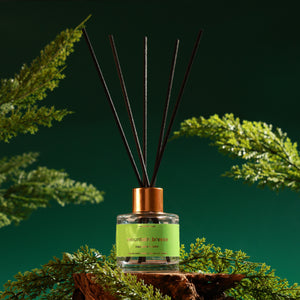
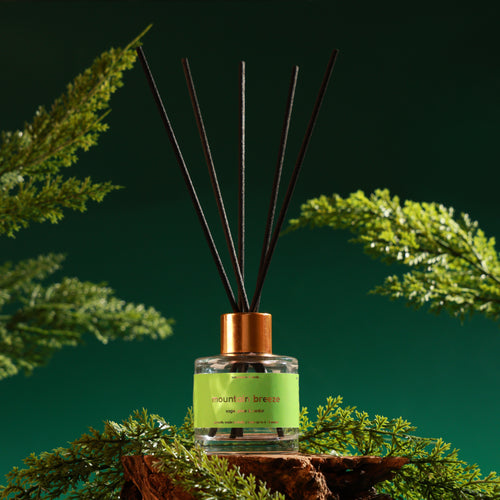
| Reed, Mountain Breeze, at a single small entrance | A clinic with one door, one short run into reception, no real corridor to solve for | The one context where a single passive point at the entrance is genuinely adequate | ₹749–₹1,349 |
The question I hear most often is phrased as if reception were obviously the right place to start — 'where should we put it, we want people to notice it as soon as they walk up to the desk.' I understand the instinct completely. Reception is where a clinic feels most watched, most judged, most in need of presenting well.
But when I actually walk a clinic, I am not looking at the desk first. I am looking at the door — how often it opens, how far the draught travels, whether reception sits directly in that path or off to one side with its own separate cooling. More often than owners expect, the honest recommendation is to mount the unit at the entrance or along the corridor, and let reception receive its scent as a consequence of that airflow rather than as the direct target.
The clinics that get this right are usually the ones willing to place the machine somewhere other than the desk they were picturing. It is a small adjustment in expectation, and it is almost always the difference between a clinic that reads as consistently scented throughout and one where reception smells fine and everywhere else does not.
Questions clinic owners ask about where to start
- Where should I place a scent machine in an orthopaedic clinic? — the mounting-height and supply-side mechanics behind this post's zone comparison.
- How does central AC affect fragrance distribution in an orthopaedic clinic? — how ducted AC changes which of these three zones is easiest to feed.
- I have a 700 sq ft orthopaedic clinic and patients wait 20–30 minutes — how do I make reception smell premium without heavily scenting my consultation room? — a worked example of reception placement on a small footprint.
- My reception smells great but the corridor and consultation rooms don't — why? — what happens when reception is scented well and the other zones are not.
- Brand: the SOSA founder story.
SOSA products & prices (verified September 2026): Reed diffusers 50ml ₹749–₹849 (to 150 sq ft, 6–8 weeks at six reeds) · 130ml ₹1,249–₹1,349 (above 150 sq ft, 14–18 weeks) · reed refill 300ml ₹2,399. Ultrasonic: Boond ₹899 (~150 sq ft) · Sukoon ₹1,899 (270–320 sq ft, ships with three 15ml Hotel Collection fragrances) · Megh ₹3,499 (6L tank, ~100 hrs runtime, ~215 sq ft — a runtime machine, not a coverage upgrade). Waterless cold-air: Safar ₹3,999 (no published coverage figure) · Vaayu ₹11,999 (up to 1000 m³, roughly 2,000–3,000 sq ft; 400ml tank lasting about 90+ days; app and onboard control, 1h/4h/8h/24h run windows, adjustable intensity, key-lock, under 38 dB, freestanding or wall/HVAC mount, 5W, CE/RoHS/SGS) · Aangan ₹25,999 (8,000–10,000 sq ft). Hotel Collection water-based fragrance 15ml ₹299 · 100ml ₹999 · 300ml ₹1,799 is for ultrasonic machines; reed oil and Hotel Collection are not interchangeable. Reed diffusers are alcohol-free, phthalate-free, paraben-free, IFRA-compliant and low VOC, handmade in small batches in Pune. Every purchase funds a girl's education through Nanhi Kali. Prices and availability subject to change — see the live product pages.