
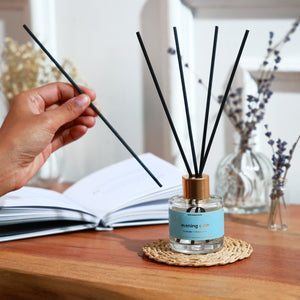

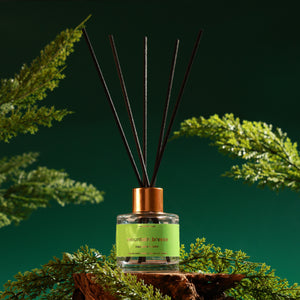
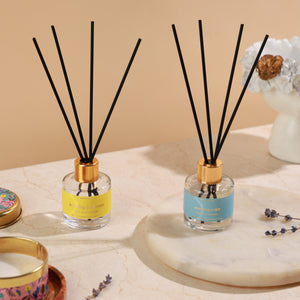
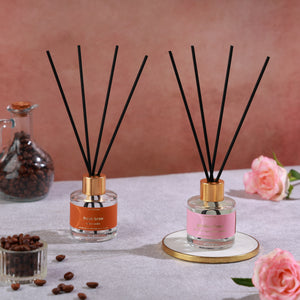
What you give up: presence, and some of the composition's brightness — a smaller evaporating surface favours the heavier materials.
Where it works: a bedroom with the door shut at night, a study, a reading corner. Small, quiet, sealed-ish rooms with gentle air.
The adjustment nobody mentions: at four reeds you can flip fortnightly rather than weekly, because each reed accumulates residue more slowly than a crowded set does.
2. You are paying for those weeks with presence. This is the honest half of the sentence. A four-reed room is quieter, and it also reads a little softer and rounder, because a smaller surface favours the slower, heavier materials in a composition.
3. Four is the sensible floor for a real room. Three works in a small sealed space. One or two falls below the level an ordinary room can hold on to, and at that point you are not conserving the fragrance, you are simply not receiving it.
4. Match the composition to the setting. Evening Calm and Garden Bloom hold their shape at four reeds better than a bright citrus does, because they lean on materials that were never in a hurry.
5. Adjust the flip cadence. Weekly is the default at six. At four you can go fortnightly — fewer reeds accumulate heavy residue more slowly — but do not abandon it, because a stalled reed at any count is a bottle that has stopped working rather than one that is lasting.
6. Protect the setting from the room. A draught from an AC or fan will strip four reeds faster than it strips six as a share of the whole, and direct sun heats the oil. Both undo the saving completely.
Composed and handmade in small batches in Pune, and a portion of every order supports girl-child education through Nanhi Kali.
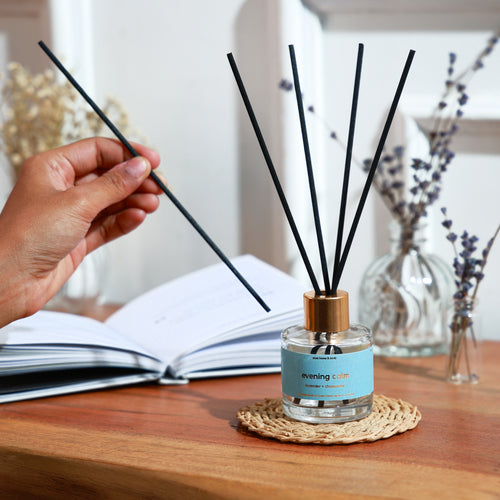
Part one — the trade, and the three things that make it work
Running four reeds is not simply running six badly. It is a different setting with its own maintenance, its own choice of fragrance and its own failure modes, and the people who are happiest with it are the ones who treat it that way. Conservation and strength are the same dial turned opposite ways, so the question is not whether you are giving something up — you are — but whether what you are giving up is something that room ever needed.
 Garden Bloom₹799 · 8.9/10Weekly flipping is calibrated around six reeds. At four, each reed is moving less material per day and accumulating heavy residue more slowly, so a fortnightly flip is usually enough — gloves on, all four, bottle standing on a tray. What you must not do is stop flipping altogether on the theory that a slow bottle should be left alone. A stalled reed is not a bottle lasting longer; it is a bottle that has quietly stopped working, and the extra weeks it appears to gain are weeks of nothing. Use the wet-line test to tell the difference: lift a reed and find the boundary between oil-soaked and dry fibre. High and dark means saturated and stalled, so flip. Barely above the oil means it is not wicking, and at a low count that usually points to reeds at the end of their life. Normal line but a silent room means airflow or your own adaptation.
Part two — a four-reed bedroom bottle, week by week
This is what the configuration actually feels like over a season, written for a 50ml in a closed bedroom of ordinary size. The three-phase curve every reed diffuser follows is still there at four reeds; it is simply flatter and longer.
| Stage | What the room smells like | What the bottle looks like | What to do |
|---|---|---|---|
| Days 1–3 ★ | A brief spike — dry reeds drinking hard, top notes leaving at once | A visible drop as the fibre saturates | Nothing. This is not the level you have bought |
| Weeks 1–2 | Settling down; noticeably softer each evening | Falling slowly and evenly | First flip at the end of week two |
| Weeks 3–8 | The plateau — quiet, steady, present when you come in from outside | Roughly a third to a half gone | Fortnightly flip; ignore your own nose, ask a guest |
| Weeks 9–12 | Still on the plateau; rounder and more base-led than at six reeds | Low, but the reeds are still climbing well | Check the wet line; refresh reeds if dark or stiff |
| The end | Fading over days rather than stopping | Reeds no longer fully submerged | Refill with oil to the neck, return the reeds, flip once |
| The honest caveat: the weeks in this table are a picture of a well-placed bottle in an ordinary closed bedroom, not a promise. Heat, draught, ceiling height and how often the door is open move it substantially, and a bottle in a draught can undercut the six-reed figure even at four reeds. Bottle-life figures are SOSA's working guidance from in-house testing and customer correspondence, not laboratory measurements. | |||
Evening Calm · 8.9/10from ₹799Shop → 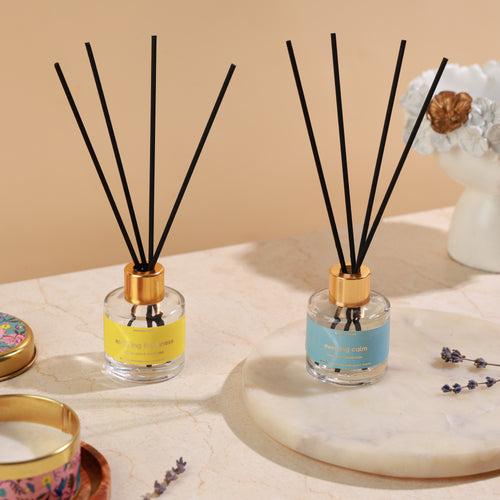 Day & Night duo · 2 × 50ml₹1,498Shop →
 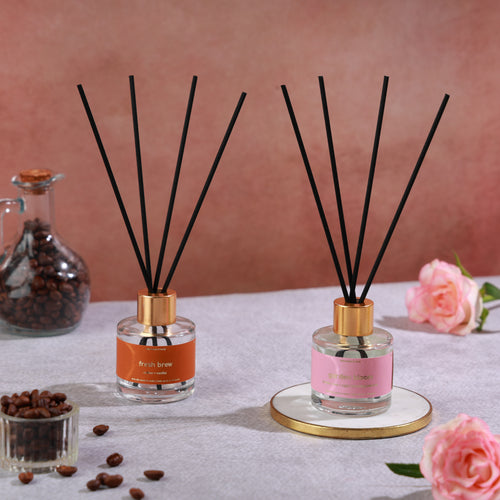 Oil refill · 300ml₹2,399Shop →
Part three — the long slow bedroom, in practice
Here is the configuration as I run it at home, because it is the one arrangement in this whole cluster I would describe as a genuine recommendation rather than a permitted deviation. A 50ml of Evening Calm at ₹799, four reeds instead of six, on a chest of drawers at roughly chest height, three or four feet from the doorway, on a small tray, with nothing overhanging it and no sun reaching it at any hour. The door is shut most of the night, so the room holds what little is delivered instead of trading it constantly with the corridor. The bottle gets flipped every second Sunday, gloves on. It runs well past the stated eight weeks — and the room is not perfumed in the way a hall is perfumed, it is faintly, consistently pleasant when you walk in from outside. That last clause is the important one, because it is also the only reliable way you will ever judge it.
Your nose will not help you here. Olfactory adaptation is the commonest cause of the sentence it has stopped working, and it bites hardest at low counts in a room you sleep in — you stop reporting a constant within minutes, and you enter that room a dozen times a day. So the honest test is the doorway one: leave the flat for fifteen minutes, come back in without preparing yourself for it, and notice what you notice. Or ask somebody who does not live there. If a guest can tell the bedroom smells of lavender and you cannot, the configuration is working exactly as intended and no change is needed. If neither of you can tell, then something has gone wrong that is not the reed count — usually a draught, a stalled set of reeds, or a bottle sitting in dead air where nothing carries the fragrance out.
Two more notes and then the honest boundary. First, this is the one place where the 130ml earns its price for reasons that have nothing to do with strength: 130ml at ₹1,299 is rated 14–18 weeks at six reeds, so at four in a bedroom it becomes a bottle you genuinely stop managing. It is not louder — at the same count it projects the same, and I will not sell a bigger bottle as a strength upgrade — it simply lasts. Second, if the reason for four reeds is running cost rather than a quiet room, the oil refill is the better instrument: ₹2,399 for 300ml at roughly ₹7–8 per millilitre against ₹15–17 for a fresh 50ml. It is oil only — you reuse your own vessel and your own reeds, no reeds come with it, and we do not sell them separately, which is an honest gap in the range. And the boundary: four reeds is a bedroom setting. It will not do a living-dining, it will not do a hosting evening, and if what you want is a room that can be made strong on demand, that is a Sukoon at ₹1,899 rather than a reed bottle run at any count at all.
Part four — slow-room configurations, and what each one costs
Four ways to run a room quietly and long, with the honest span for each. All of them assume gentle air, no draught, no direct sun and a flip you have not abandoned.
| Setup | Character in the room | Honest span | Price |
|---|---|---|---|
| Evening Calm 50ml, four reeds ★ | Soft, lavender-led, present only when you come in from outside | Comfortably beyond the stated 6–8 weeks | ₹799 |
| Evening Calm 130ml, four reeds | The same character, on a bottle you stop managing | Beyond 14–18 weeks — most of a season | ₹1,299 |
| Garden Bloom 50ml, four reeds | Rounder and rosier; the jasmine recedes politely | Past the stated window, similar to Calm | ₹799 |
| Mountain Breeze 50ml, four reeds | Mostly Indian cedar — dry and grounding, less mountain | Past the stated window; good in a study | ₹849 |
| Six in the hall, four in the bedroom | Two rooms tuned separately from one purchase | Each bottle to its own count | Day & Night duo ₹1,498 |
| Any of the above, refilled | Unchanged — the refill is the same formula as the bottles | 8–11 months on 300ml, 14–18 on 500ml | ₹2,399 · ₹3,499 |
| Not a slow setting: one or two reeds | Below what an ordinary room can hold on to | The oil ages faster than you receive it | Said plainly rather than sold |
Versailles
I get asked to defend the six-reed dose so often that I want to be clear about where I am happy to abandon it. A bedroom is one of those places. The room is small, the door is shut for eight hours, and what you want from fragrance there is not presence — it is a faint reassurance that the room has been looked after. Six reeds of anything can be slightly too much of a good thing in that context.
So I run four at home, in Evening Calm, and I flip it every second Sunday. It lasts well past what the label promises and I have never once wished it were louder at eleven at night. That is not a compromise I am tolerating; it is the setting I would choose even if the oil were free.
Where I would push back is on going lower to save money. An open bottle is not storage — the brightest part of a composition leaves on its own schedule whether or not you are there to receive it, so a bottle stretched to five months on two reeds is not thrift, it is a slow loss. If cost is the issue, use the refill and keep the count honest. Everything is composed and handmade in small batches in Pune, and a part of every order funds a girl's classroom through Nanhi Kali.
Frequently asked questions
- What happens if you use too few? — where a slow setting turns into waste.
- How many reeds for a mild fragrance and how many by room size — choosing a count deliberately.
- How many reeds should you put in? — why six is the dose everything is rated at.
- The complete guide to choosing a reed count — the whole sub-cluster in one place.
- Brand: the SOSA founder story.
SOSA reed diffuser range & prices (verified August 2026): alcohol-free, phthalate-free, paraben-free and IFRA-compliant compositions on a heat-stable coconut-derived (CCT) carrier, low-VOC, supplied in a refillable glass bottle with six fibre reeds; 50ml lasts 6–8 weeks and 130ml lasts 14–18 weeks. Morning Freshness (Malabar lemon · peppermint · Nilgiri eucalyptus) 50ml ₹749 · 130ml ₹1,249 · 9.0/10; Garden Bloom (British rose · night-blooming jasmine) 50ml ₹799 · 130ml ₹1,299 · 8.9/10; Evening Calm (Kashmir lavender · chamomile) 50ml ₹799 · 130ml ₹1,299 · 8.9/10; Fresh Brew (Coorg coffee · Kerala vanilla) 50ml ₹849 · 130ml ₹1,349 · 9.5/10; Mountain Breeze (Himalayan pine · sage · Indian cedar) 50ml ₹849 · 130ml ₹1,349 · 9.4/10. Reed diffuser refills are oil only — you reuse your own vessel and reeds: 300ml ₹2,399 (roughly 8–11 months) · 500ml ₹3,499 (roughly 14–18 months), about ₹7–8 per ml against ₹15–17 per ml for a 50ml bottle. Duo sets ₹1,498–₹1,598 for 2 × 50ml and ₹2,498–₹2,598 for 2 × 130ml. Strength figures are positions on SOSA’s own internal strength scale, not an industry standard. Replacement reeds are not sold as a separate SKU; SOSA guidance is to refresh reeds every few months. The reed line is separate from the water-based Hotel Collection for ultrasonic machines (15ml ₹299 · 100ml ₹999 · 300ml ₹1,799) and the two are not interchangeable. Diffusers: Boond 300ml ₹899 · Sukoon 500ml ₹1,899 · Megh 6L ₹3,499 · waterless Vaayu ₹11,999. Composed and handmade in small batches in Pune, India; tested through 45°C summer heat and 85% monsoon humidity. Free shipping above ₹499. A portion of every order supports girl-child education through Nanhi Kali. Prices subject to change — see the live product pages.