




Why rugs hold it: pile is engineered to trap, has an enormous internal surface area, and lies in the still air at floor level where nothing disperses.
Why cushions hold it: thick relative to their area, so they store deep — and sitting on one pumps stored air straight back out.
The test: press a cushion hard with both hands and smell what comes out of it.
2. A rug is a trap by design. Pile exists to be soft, dense and deep, which incidentally makes it an exceptional collector. A 6 × 4 ft rug presents 24 sq ft of floor plan but an internal fibre surface area many times that, and it lies in the least ventilated layer of the room — air moves poorly within a few inches of the floor. It also has an underside and a backing that nobody ever cleans, and the floor beneath it never dries as fast as the rest of the room.
3. Cushions punch far above their area. A scatter cushion is only about 3 sq ft of cover, but it is 10 to 15 cm thick, so its volume-to-surface ratio is high and it stores deep. Sitting on it compresses the foam and pumps stored air out in one push — which is exactly why the smell appears the moment someone sits down and then seems to fade. That is not your imagination; it is a bellows.
4. And a small flat removes the dilution. In a 1,200 sq ft home with a closed kitchen, the plume travels and thins before it reaches the living-room textiles. In a 550 sq ft open-plan flat there is no travel. Everything soft is within five metres of the hob and gets the concentrated version, twice a day, every day. The air-change rate is the same 0.2 to 0.5 an hour closed — it just has far less air to work with.
5. Fragrance is fourth, as always. Scent is additive: it adds molecules and removes none. Sprayed at a loaded cushion it is absorbed by the same foam holding the cooking residue, and the cushion then releases both. Wash, sun, ventilate, and afterwards a reed diffuser or a Sukoon gives the room a character.
Made in India, composed by an ISIPCA Versailles-trained perfumer — and a portion of every order supports girl-child education through Nanhi Kali.
Why a small flat is harder on soft objects than a large one
The instinct is that a small home should be easier to keep fresh because there is less of it. For cooking odour the opposite is true, and the reason is dilution. A plume of aerosolised oil leaving a pan has a fixed quantity of material in it. In a large flat with a closed kitchen, that material spreads through a big volume of air, much of it is captured by the chimney, and what reaches the living room is already thin. In a 550 sq ft open-plan flat it spreads through a fraction of the volume and reaches the sofa in seconds at close to full strength. Same cooking, several times the dose on every textile. Then add that small flats have proportionally more soft furnishing per cubic foot, because you still need somewhere to sit.
The second factor is that the objects most affected are the ones least likely to be cleaned. Bedding gets washed weekly because there is an obvious ritual around it. Curtains get washed when they look dirty. Scatter cushions and rugs sit in a gap where there is no ritual at all — nobody has a scheduled cushion day. They are also physically awkward: covers with hidden zips, cores that will not fit in a domestic machine, rugs too heavy to lift alone. So they accumulate for years while everything around them gets reset. In a compact flat where they are taking the strongest dose in the house, that combination is why last night's dinner is still detectable at breakfast.
The three secondary reservoirs, in order of how much they hold
 Step fourFrom ₹749Everything about a rug makes it a good collector: dense pile with an internal surface area far beyond its floor plan, a position in the still layer near the floor where air barely moves, a backing that traps whatever settles through, and a patch of floor underneath that stays cooler and damper than the rest of the room. Vacuuming the top does a fraction of the job. Turn it over and vacuum the back, then lift it and clean the floor beneath, then get it outside over a railing for an afternoon and beat it. Sunlight and moving air on both faces will do more in three hours than a month of vacuuming the pile.
Symptom to cause: cooking smells in a compact flat
The first three rows separate a fabric-storage problem from a source-control problem. Both are common and they need different work, so confirm before you start washing things.
| What you notice | Most likely cause | How to confirm it | What actually fixes it |
|---|---|---|---|
| Cooking smell still present the next morning ★ | Soft furnishings re-releasing aerosolised oil absorbed during cooking | Press a cushion hard and smell what comes out; kneel into the rug pile | Wash covers, sun the cores, vacuum the rug both faces and air it |
| The smell appears when someone sits down | Compression pumping stored air out of open-cell cushion foam | Press the cushion with both hands, nose close, and repeat on a spare | Wash the cover; sun the core for two hours; do the deck underneath |
| Floor-level smell stronger than at standing height | The rug and the floor beneath it — still air and trapped moisture | Lift a corner and smell the underside and the floor under it | Vacuum both faces, hang the rug outside, mop and dry the floor beneath |
| Smell is strong during cooking and gone in an hour | A source-control problem, not a storage one — the fabric is still fine | Cook the same dish with the chimney on early and a window open | Lid on the pan, chimney running before and after, cross-ventilate |
| An oily film on nearby hard surfaces | Aerosolised droplets landing across the whole open-plan space | Wipe a fingertip across the wall tile beside the sofa | Degrease hard surfaces; run the chimney longer; cook with the lid on |
| Sharp sour note near the kitchen that is not food | A wet trap — bin underside, sink cabinet, dry floor drain | Lift the bin out and smell the floor beneath it; run water down the drain | Clean and dry the trap or restore the water seal — not a fragrance job |
| If none of these fit: take every cushion and the rug out of the flat for two days and cook as normal. If the next-morning smell disappears, the fabric was the store rather than the source, and you know exactly what to clean. | |||
Reeds · always-on roomsFrom ₹749Shop →  Sukoon · when you want a switch₹1,899Shop →
  Hotel Collection · the scentFrom ₹299Shop →
Resetting the small textiles
Start with the covers, because they are the easy 60 per cent. Every cushion cover that unzips goes into the machine at the warmest temperature its label allows, with no fabric softener. Throws, dining-chair pads with removable covers, tea towels, the doormat if it is washable — all of it, same load or same day. This is an hour of work spread across a wash cycle and it removes a large share of the absorbent area from the room entirely. Dry everything completely; a cover refitted onto foam even slightly damp will smell worse in a week than it did before, and in monsoon it will smell musty in three days.
Then use the balcony for what cannot go in the machine. Cushion cores, the rug, the jute basket, the lampshade. Heat and UV drive absorbed volatiles out of fibre far faster than shaded airing, and moving air carries them off. Two hours in afternoon sun, turned halfway, is the target. Hang the rug over a railing and beat it — the amount that comes out of a rug that gets vacuumed weekly is genuinely startling. Vacuum the rug's underside before it goes back, and clean and dry the floor it was lying on, which is usually the dampest patch in the room.
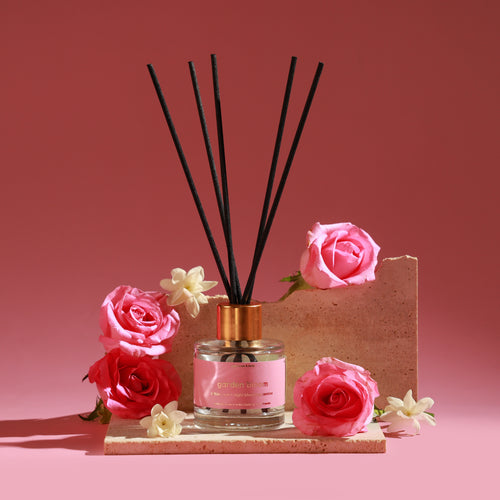
Then cut the source, and only then add scent. Most of this is won at the pan: lid on wherever the dish allows, chimney on two minutes before you start and left running ten minutes after you finish, and a window open on the far side of the flat so the plume has a route out rather than a route into the living room. Cross-ventilate for ten minutes after every heavy cooking session — five to ten minutes with two openings on opposite sides moves more air than an hour with one window. When the flat is genuinely reset, the ambient layer is worth having, and in a small flat cooked in twice a day the right answer is usually the constant one: a reed diffuser from ₹749 running all the time, in the living area rather than the kitchen, at four reeds if the room is under about 120 sq ft. If you would rather have a burst before people arrive, the Sukoon at ₹1,899 with 3–6 drops of a Hotel Collection scent from ₹299 covers roughly 270–320 sq ft, which is most of a compact flat on its own.
The order that works
Almost all of this is a washing machine, a balcony and a lid. The purchase comes after, and in a small flat it should be set quieter than you would set it in a large one.
| Step | What to do | When | Cost |
|---|---|---|---|
| 1. Remove the source | Lid on the pan, chimney on early and left running after, check the bin underside and the kitchen floor drain | Before anything else | ₹0 |
| 2. Move the air | Cross-ventilate ten minutes after every heavy cooking session — two openings on opposite sides | Daily, five to ten minutes | ₹0 |
| 3. Deal with what holds it | Wash every cushion cover and throw, sun the cores, vacuum and air the rug on both faces | Weekly to monthly | ₹0 |
| 4. Then the always-on layer ★ | A SOSA reed diffuser — a constant background in a flat cooked in twice a day; four reeds if the room is under 120 sq ft | 50ml 6-8 weeks · 130ml 14-18 | from ₹749 |
| 5. Or the on-demand layer | Sukoon with a Hotel Collection scent — a burst before people arrive; covers roughly 270–320 sq ft, which is most of a compact flat | Run it when you want it | ₹1,899 |
Versailles
The thing I wish more people in compact flats knew is that the cheapest fix is also the fastest. One wash load containing every cushion cover, every throw and the tea towels will change a 1BHK more than anything I sell. It costs an hour and it is the single highest-yield thing on the list. I would rather you did that this Sunday than bought a diffuser this Sunday.
Rugs are the blind spot. Everyone vacuums the top and almost nobody turns one over. The underside, the backing and the floor beneath are all holding something, and in a small flat the rug is close enough to the kitchen to be taking a real dose every meal. Hang it over the balcony railing for an afternoon and beat it — what comes out will settle the argument.
For a home where Indian food is cooked twice a day, I generally recommend the constant layer over the switchable one, because the load is constant too. A reed diffuser sits there, needs nothing, and holds a steady background. It does not remove the cooking smell and I would not claim it does — it gives the room a baseline character once you have dealt with the fabric. A portion of every order funds a girl's classroom through Nanhi Kali.
Frequently asked questions
- Why the sofa absorbs an open kitchen — droplets landing on upholstery.
- How often soft furnishings need cleaning — a cadence you will actually keep.
- Sofa, curtains or rug — how to tell — isolating one reservoir at a time.
- Stopping frying smells spreading — source control at the pan.
- Brand: the SOSA founder story.
SOSA products & prices (verified August 2026): Hotel Collection water-based ultrasonic diffuser fragrance 15ml ₹299 · 100ml ₹999 · 300ml ₹1,799 · Pack of 7 (15ml, all fragrances) ₹1,799; refills 100ml from ₹999. Seven scents: The Ritz-Carlton-inspired (white tea · bergamot · cedar), Westin-inspired (white tea · aloe · cedar), 1 Hotels-inspired (cedarwood · vetiver · green leaves), The St. Regis-inspired (amber · violet · woods), Shangri-La-inspired (jasmine · green tea · white tea), Four Seasons-inspired (citrus · floral · sandalwood), W Hotels-inspired (citrus · pepper · amber). Diffusers: Boond 300ml ₹899 · Sukoon 500ml ₹1,899 · Megh 6L ₹3,499. Water-based, phthalate-free, composed to IFRA standards for home diffusion; 3–6 drops per tank. Made in India, Pune. The Hotel Collection scents are SOSA's own interpretations inspired by the world's finest hotels; all hotel names are trademarks of their respective owners and are used only to describe the scent style — SOSA is an independent Indian fragrance house, not affiliated with or endorsed by any hotel brand. Prices and availability subject to change — see the live product pages.