


- The direct answer
- Why a machine genuinely can out-project coffee
- The three decisions that follow from that capability
- Where 'can' turns into 'should never'
- Where this capability is actually put to honest use
- What to buy — and the one thing never to point at the counter
- A note from Sonal
- Questions about machine power versus coffee aroma
2. That capability is the problem this page describes, not a reason to use it there. Winning a projection contest against the coffee aroma means the customer now smells the machine instead of the coffee they came for — which is a worse outcome for the café than either aroma alone, and not a trade a serious operator should ever choose to make.
3. A specialty café's whole commercial proposition depends on the coffee aroma reaching the customer cleanly. If a fragrance can out-compete that aroma, running it anywhere near the counter actively undermines the reason a customer chose a specialty café over any other option, whatever the added fragrance is meant to convey.
4. The honest use of that same projecting power is in a zone with no coffee aroma at all. The identical adjustable intensity that makes a machine capable of overpowering coffee also makes it capable of holding a steady, low register across a genuinely separated washroom or entrance, which is where the specification actually earns its keep.
5. This is a placement and intensity judgement, not a claim about which aroma is 'better'. No comparison is being made about the quality of either smell — only about what happens to a customer's experience when two aromas of unequal strength occupy the same air at once, which is a question of mechanics, not of taste.
Vaayu's adjustable intensity is exactly why it should never be pointed at a counter — the same dial that lets it hold a light register in a washroom is capable of overwhelming a coffee aroma if it were ever turned up in the wrong room.
Why a machine genuinely can out-project coffee aroma
Projection is mostly a function of three things: how concentrated the fragrance is at the point of diffusion, how much air the machine moves it through, and how large or enclosed the room is. A commercial-grade cold-air diffuser rated for up to roughly 2,000–3,000 sq ft at adjustable intensity has considerably more raw projecting capacity than the passive release of aroma from grinding and brewing coffee, which depends entirely on ambient heat and surface area rather than any mechanical assistance. There's no ambiguity in the mechanics here — a machine built for that scale of coverage can, at higher settings, become the dominant aroma in a room the size of most café counters, and it would do so within minutes of being switched on at anything above a low setting.
That is exactly why this capability needs to be treated as a hazard in this vertical rather than a feature to advertise. A specialty coffee café's entire proposition rests on the customer's nose receiving the coffee aroma clearly, ideally without competition, right up to the moment the drink is in their hands. A machine capable of overpowering that aroma, run anywhere near the counter, doesn't add value to the experience — it actively degrades the one thing the café is actually selling, regardless of how pleasant the added fragrance is on its own. A customer who notices the diffuser before they notice the coffee has already had the experience the café was trying to avoid.
The same projecting power is genuinely useful once it's aimed at a zone with nothing to compete with. In a washroom or a separated entrance, there's no coffee aroma present at all, so a machine's ability to hold a steady, room-filling level becomes an asset rather than a risk. The capability doesn't change between these two situations — only the wisdom of where it's pointed does, which is why this page treats placement, not power, as the entire decision.
The three decisions that follow from that capability
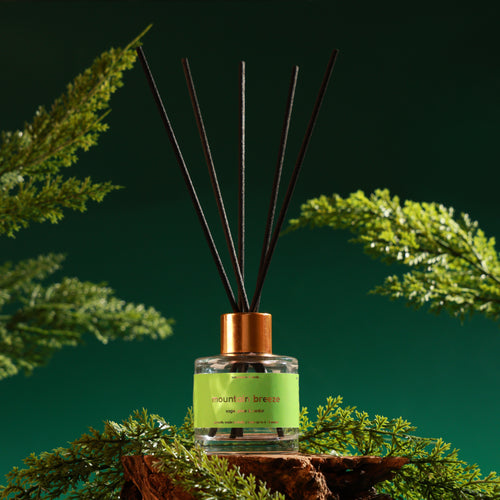
 Mountain Breeze₹849A machine's ability to out-project coffee aroma is precisely the property that makes proximity to the counter dangerous — the more powerful the unit, the more distance and zoning it actually needs.
Where 'can' turns into 'should never'
The same machine, at the same intensity setting, produces a very different outcome depending entirely on which zone it's running in.
| Placement | Can it out-project coffee here? | Should it ever run here? | What it costs |
| At or near the counter | Yes, easily, at moderate to high intensity | Never | ₹0 — this placement should not exist |
| Anywhere in the dining or seating area | Yes, if intensity is high enough | Never | ₹0 — same answer as the counter |
| A genuinely separated entrance, real air boundary | Not applicable — no coffee aroma present | Yes, at a low, steady setting | Reed ₹749–₹849 or Sukoon ₹1,899 |
| Washroom with its own door | Not applicable — no coffee aroma present | Yes, the clearest candidate in this cluster | Reed, Sukoon, or Vaayu depending on zone count |
| Retail or merchandise, separated from service | Not applicable, if the boundary is genuine | Yes, at a level suited to the footprint | Reed, Sukoon or Vaayu depending on size |
| Projecting capacity is a fixed property of the machine — it doesn't become safer near the counter just because the intensity dial is turned down, since even a fainter version of an added fragrance still competes for the same receptors as the coffee aroma. | |||
Mountain Breeze · steady coverage, no competition₹849Shop →  Sukoon · a self-contained zone, run at full advantage₹1,899Shop →
  Vaayu · zoned power, never pointed at the counter₹11,999Shop →
Where this capability is actually put to honest use
Never let a machine's projecting power anywhere near the counter, the pass or the seating — this is the one placement where the mechanism this page describes turns from a useful specification into an active liability, degrading the exact aroma the customer came for. No adjustable-intensity setting makes this placement safe; a lower dial only makes the interference less obvious, not absent.
Sometimes a genuinely separated entrance is a fair place to let that same power do real work — provided a real door and a distinct air volume exist, so there's no coffee aroma present for the machine to compete with in the first place. Confirm the boundary by walking it, not by trusting the floor plan or the distance alone.
Usually the washroom is where this capability is most straightforwardly useful, because the room has no coffee aroma to interfere with at all — even here, intensity should stay low enough that nobody leaving the room could identify a fragrance while walking back past the counter. The goal is a room that smells clean, not a room that announces the machine that made it that way.
What to buy — and the one thing never to point at the counter
Every route below is chosen for zones with nothing to out-project — this table has no row for the counter or the dining room, deliberately.
| Route | Premises | Why | What it costs |
| Reed diffuser, Mountain Breeze, washroom | Under 300 sq ft, one washroom well away from the counter | A steady register with no coffee aroma to compete with | ₹749–₹849 |
| Sukoon ultrasonic, separated entrance | 300–750 sq ft, a genuinely separated arrival zone | Holds a level on its own air, never reaching the service side | ₹1,899 |
| Vaayu, wall or HVAC-mounted, per zone | 750 sq ft and above, several zones kept apart from service | Adjustable intensity lets each zone run at exactly the level it needs, nothing more | ₹11,999 |
| Vaayu, freestanding, retail counter | Any café with packaged goods sold apart from service | Full projecting capability, aimed at air with nothing to out-compete | ₹11,999 |
| Aangan, HVAC-integrated, non-dining zones | Above roughly 3,000 sq ft, several separated zones | Distributes through ducting that never crosses into the service air | ₹25,999 |
I get asked, more often than I'd like, whether a stronger machine near the counter would make a café smell 'more premium'. The honest mechanical answer is that yes, it could — a powerful enough unit would win that contest easily. I say no anyway, every time, because winning it is the wrong goal entirely, and I'd rather lose the sale than sell someone a way to undercut their own coffee.
A café that's gone to real trouble sourcing, roasting and brewing well doesn't need a fragrance loud enough to beat that work in a straight contest — it needs the fragrance kept somewhere else entirely, so the coffee aroma never has to compete for attention in the first place. The owners who understand this fastest are usually the ones who've spent the most on their coffee programme already; they don't want anything competing with it either.
I think of Vaayu's power as something to spend on distance and zoning, not volume — several rooms run well, rather than one room run loudly. That's a less dramatic pitch than 'strong enough to beat your coffee', but it's the one that actually serves a café well, and it's the one I can stand behind a year later when the owner tells me their coffee still smells like their coffee.
Questions about machine power versus coffee aroma
- Can Artificial Fragrance Interfere With the Aroma of Coffee? — the underlying interference mechanism this page's answer depends on.
- Where Should a Commercial Scent Machine Be Placed if I Don't Want It Near Food? — the practical placement guidance that follows from this page.
- When Does a Café Actually Need Commercial Waterless Scenting? — the scale question behind whether Vaayu applies at all.
- When Does SOSA Vaayu Make Sense for a Café, and When Is It the Wrong Product? — the honest boundary this page draws around Vaayu specifically.
- Brand: the SOSA founder story.
SOSA products & prices (verified September 2026): Reed diffusers 50ml ₹749–₹849 (to 150 sq ft, 6–8 weeks at six reeds) · 130ml ₹1,249–₹1,349 (above 150 sq ft, 14–18 weeks) · reed refill 300ml ₹2,399. Ultrasonic: Boond ₹899 (~150 sq ft) · Sukoon ₹1,899 (270–320 sq ft, ships with three 15ml Hotel Collection fragrances) · Megh ₹3,499 (6L tank, ~100 hrs runtime, ~215 sq ft — a runtime machine, not a coverage upgrade). Waterless cold-air: Safar ₹3,999 (no published coverage figure) · Vaayu ₹11,999 (up to 1000 m³, roughly 2,000–3,000 sq ft; 400ml tank lasting about 90+ days; app and onboard control, 1h/4h/8h/24h run windows, adjustable intensity, key-lock, under 38 dB, freestanding or wall/HVAC mount, 5W, CE/RoHS/SGS) · Aangan ₹25,999 (8,000–10,000 sq ft). Hotel Collection water-based fragrance 15ml ₹299 · 100ml ₹999 · 300ml ₹1,799 is for ultrasonic machines; reed oil and Hotel Collection are not interchangeable. Reed diffusers are alcohol-free, phthalate-free, paraben-free, IFRA-compliant and low VOC, handmade in small batches in Pune. Every purchase funds a girl's education through Nanhi Kali. Prices and availability subject to change — see the live product pages.