



Why it happens: nose-blindness. Olfactory adaptation removes a constant background from your awareness within minutes, so the person adjusting the level is the only person in the transaction who cannot judge it.
The four free corrections: set a level once and write it down rather than adjusting by feel; walk in from the lift or the gate thirty minutes before rather than judging from inside; use the timer so the level stops rather than accumulating across back-to-back viewings; and have a colleague walk in cold and tell you the truth.
The rule: adjust down, never up. If you are unsure, you are already too high.
2. Which makes a slightly stale flat the safer failure. Stale air says the property has been shut up. Strong fragrance says somebody has been working on it. Only one of those makes a buyer start looking for a reason.
3. The mechanism is nose-blindness, and it is not carelessness. Olfactory adaptation removes a constant smell from your conscious awareness within a few minutes of exposure. The agent has been in that flat repeatedly for weeks. Their nose has stopped reporting it entirely.
4. So the dose creeps up, and the only person who cannot tell is the one adjusting it. Each time it seems faint, it goes up a step. It never goes down, because it never seems strong from the inside. The buyer arrives un-adapted and receives the whole of it in about four seconds.
5. The corrections cost nothing. Set a level once and write it down. Walk in from the lift or the gate thirty minutes before, not from the kitchen. Use the timer so the level stops rather than accumulating across three viewings in a day. And have a colleague walk in cold and be honest with you.
6. And the rule that covers every case: adjust down, never up. If you are uncertain, you are too high, because uncertainty in an adapted nose almost always means the level is above what an unadapted one will receive.
A portion of every order supports girl-child education through Nanhi Kali.
Why strong reads as concealment, not as care
It is worth being precise about what actually goes wrong, because the usual explanation — that a strong scent is unpleasant — is both true and much too mild. The real damage is that a buyer walking into a property they are considering buying is already running a search for problems, and a strong smell of any kind is a data point in that search. A strong pleasant smell is not exempt from it. It is a strong smell that happens to be pleasant. What the buyer's brain does with it is entirely predictable, and it is not flattering to you: it asks why. That single question, asked silently in the first few seconds, is the whole of the problem.
How to tell you have already gone too far
Since you cannot assess the level directly, assess it from evidence instead. These are the signs that a property is being over-scented, in roughly the order you are likely to encounter them, with what each one actually means and what to do about it. The last row is the one to aim for, and it looks like nothing happening at all, which is why it is so often mistaken for failure.
| What happens | What it actually means | The correction | Cost |
|---|---|---|---|
| A buyer comments on the fragrance ★ | Not a compliment. It means the scent competed successfully with the property for their attention, which is the opposite of the job | Down one step immediately, and down again for the next viewing. Nobody should be able to remark on it | ₹0 |
| Somebody opens a window or a balcony door in the first five minutes | The clearest possible signal, and usually done without comment or even conscious thought. They are diluting your air | Down two steps, and check the property is being properly ventilated between appointments rather than only scented | ₹0 |
| A buyer asks whether the flat has damp, or has been closed up | The concealment reading has already happened. The strength itself raised the question you least wanted asked | Stop the machine for that viewing, air the property, and restart at the lowest setting for the next one | ₹0 |
| You can smell the property from the lift lobby or the gate | Fragrance is escaping the volume entirely, which means the output is far above what the space needs | Halve it. A property should be detectable from inside the front door and not before it | ₹0 |
| You notice it on your own jacket that evening | Deposition on fabric takes considerable airborne concentration over hours. The level has been high for longer than one appointment | Timer windows rather than continuous running, and ventilation between back-to-back viewings | ₹0 |
| A colleague walking in cold calls it strong | The most reliable reading available to you, because it is the only un-adapted nose in the building | Believe them over your own judgement, every time. Down one step and repeat the test | ₹0 |
| Nobody says anything at all | The target. The property registered as clean and looked after, and the fragrance was never separated out from it | Write the setting down and reproduce it. This is the result you were buying | ₹0 |
Timers and key-lock · Vaayu₹11,999Shop →  Runs low well · Quiet Luxuryfrom ₹299Shop →
  Down, never upthe ruleShop →
The four corrections, all of which are free
Start with the written level, because it converts an unreliable judgement into a repeatable decision. Decide the setting once, on a day when you have not been in the property, after walking in from outside — then record it: the intensity step, the scent, the start time relative to the appointment, and the size of the flat. Keep it with the property file. Every subsequent viewing runs the recorded setting rather than a fresh assessment, because a fresh assessment made by an adapted nose is worse than no assessment at all. This is also the reason a machine with defined, repeatable intensity steps and app control is worth more to a working agent than a machine with a knob: what you are buying is not power, it is the ability to reproduce a decision you made properly once. Over a portfolio the habit compounds — after five or six properties you have a set of settings by square footage and you are no longer guessing at all. Second, always make the final check from the outside. Thirty minutes before the appointment, leave. Take the lift down, stand outside, walk around the block if the property is a villa. Two or three minutes in genuinely different air restores enough sensitivity to give you a usable reading, and then walk in through the front door exactly as the buyer will, at the same pace, without stopping to think about it. Ask one question: did I notice the smell before I noticed the room. If yes, one step down. If you detect nothing whatever standing in the hall, one step up and no further.
Then the timer, which solves the version of this problem that no amount of care can fix. Continuous running is what turns a correct level into a wrong one over the course of a day, and it is entirely invisible while it is happening. Three viewings between ten and four in a closed flat, with the machine on throughout and no ventilation between appointments, is a property that gets steadily stronger through the afternoon while every individual decision along the way seemed reasonable. The correction is to give each viewing a defined window rather than leaving the property in a permanently scented state: on at two hours before, off at the end of the appointment, and ten or fifteen minutes of ventilation in between if the building allows it. The 1h and 4h timers on the Vaayu are exactly this tool, the app means you are not driving back to the property to switch something off, and auto-stop means an unattended machine in a vacant flat does not simply run for a week. The key-lock deserves a mention here too, because a surprising proportion of over-scented listings were not over-scented by the agent. A caretaker, an owner or a helpful colleague finds the machine, decides it seems weak — with an adapted nose, in a property they have been standing in — and turns it up before a viewing you are running the next morning. A locked setting removes an entire category of surprise.
Then the borrowed nose, and the honest boundary. The single most valuable thing available to you is a colleague who has not been in the property, and it costs nothing beyond asking. Have them walk in cold and answer one question without diplomacy: did you notice the smell before you noticed the room. A photographer arriving for a shoot, a colleague dropping keys, a floor-plan surveyor — any of them will give you a better reading than you can generate yourself, and if you handle premium listings regularly it is worth setting up as a reciprocal habit with somebody in your own office. Two agents checking each other's properties solves this problem permanently. And then the boundary, which is where this page connects to the rule the whole cluster is built on. If you find yourself increasing the level because something in the property keeps coming back through it, stop. That is not a dosing problem and it will not be solved by a stronger setting: a smell with a physical cause — damp, a drain, smoke damage, something under a floor — always returns, and increasing the fragrance to stay ahead of it is precisely the behaviour that produces the concealment reading in the first place. It is also, once you are doing it knowingly, a material misrepresentation about a property rather than a presentation choice. Find it, fix it or disclose it. A property that needs a high setting to smell acceptable is telling you something, and the correct response is to listen to it rather than to turn up the machine. Everything else on this page assumes a listing that is genuinely sound, which is the only kind worth scenting.
The SOSA edit
For an agent who suspects their listings are running too strong — which, if you are asking the question at all, they probably are. The first three rows are free. The last row is the purchase that makes the problem worse rather than better, and it is one people make with the best intentions.
| Do | What it is | Why it works | Cost |
|---|---|---|---|
| 1. Walk in from the lift, thirty minutes out ★ | Leave the property, spend a few minutes in different air, then re-enter through the front door as the buyer will | Partial de-adaptation gives you the closest thing available to the buyer's first three seconds. Free, and it takes five minutes | ₹0 |
| 2. Write the setting down | Intensity step, scent, start time and square footage, kept in the property file and reproduced rather than re-judged | It replaces a judgement your nose cannot make with a decision you made once when it could | ₹0 |
| 3. Borrow a colleague's nose | Anyone who has not been in the property that day, asked one blunt question and instructed not to be polite | The only un-adapted reading in the building. Believe it over your own, every time | ₹0 |
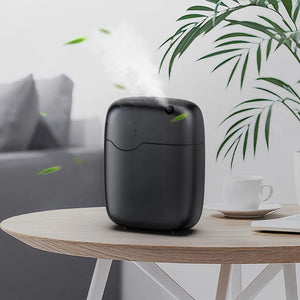
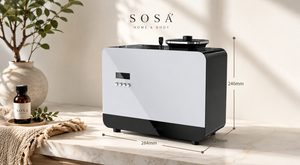
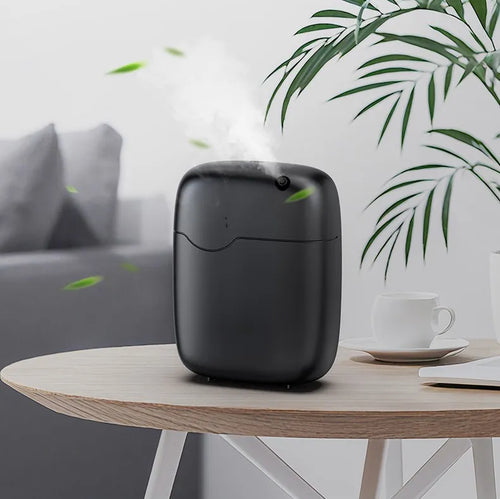
| 4. SOSA Vaayu timers and key-lock | 1h/4h/8h/24h scheduling with app control, adjustable repeatable intensity, auto-stop and a locked setting | It makes the level stop rather than accumulate across a day of viewings, and stops helpful people raising it | ₹11,999 |
| 5. Ritz-Carlton-inspired · Quiet Luxury | White tea, bergamot and cedar — a wood-based composition that holds a level at very low output | Half of over-dosing is running a top-heavy scent that genuinely does vanish. A cedar base removes the reason to reach for the dial | from ₹299 |
| Do not: add a second product on top | A candle, a reed diffuser or a spray used alongside a machine because the machine seems insufficient | Two sources cannot be assessed or turned down together, and layering is the fastest route to the concealment reading. Fix the setting instead | — |
Versailles
This is the correction I make more often than any other, and it is almost always to somebody conscientious. The people who over-scent properties are not the ones who do not care. They are the ones who have been to the flat six times, who have taken the trouble to think about how it smells, and who have therefore destroyed their own ability to assess it. I find that worth saying plainly, because agents often feel foolish when this is explained to them and there is nothing foolish about it. A nose that stops reporting a constant is a nose working properly. It just happens to make you the worst-qualified person in the transaction to set the level, and the only one with a hand on the dial.
The part I would most like people to take from this page is the reframe, though. Stop asking whether the property smells good and start asking what a stranger will conclude from it in four seconds. Those two questions have different answers surprisingly often, and the second one is the one that matters, because a buyer who has silently wondered what a smell is covering has already started reading the whole property differently. Given a choice between a flat that is faintly under-done and one that is faintly over-done, I would take the under-done one every single time, and I sell fragrance for a living. The under-done flat is simply a flat. The over-done one is a question.
Everything is made and supported from Pune, and a part of every order funds girl-child education through Nanhi Kali. You get a space that smells like somewhere considered; a girl gets a classroom. That equation has always felt right to me.
Frequently asked questions
- Should the entrance of a luxury home have the strongest fragrance impact — why a strong doorway backfires.
- How long before a viewing should the scenting system go on — the timing that removes the climb.
- Should I scent a luxury property before buyers arrive — the two conditions, and the line about masking.
- The safest fragrance strategy when you do not know a buyer's preferences — the group pillar.
- Brand: the SOSA founder story.
Facts verified August 2026: Product facts used in this guide. SOSA Vaayu ₹11,999: waterless cold-air nebulising diffuser, atomises undiluted fragrance oil to a dry residue-free nano-mist, coverage up to 1000m³ (approximately 2,000–3,000 sq ft), 400ml refillable tank lasting up to about 75 days per fill, Bluetooth app plus onboard control, 1h/4h/8h/24h timer scheduling, adjustable intensity, under 38 dB, DC 12V/1A at 5W, 165 × 80.5 × 215 mm and 0.9 kg, freestanding or wall/HVAC mounted, auto-stop and key-lock, CE, RoHS and SGS certified, supplied with four hotel-inspired fragrances. SOSA Aangan ₹25,999: HVAC-connected or standalone commercial nebulising diffuser, coverage up to 3,000m³ (roughly 8,000–10,000 sq ft), 800ml reservoir, metal body, programmable schedules, under 42 dB. Ultrasonic machines are water-based and consume 30–50 ml of water an hour: Sukoon ₹1,899 (500ml, 270–320 sq ft, 16–18 hours on low, 3–6 drops per tank, steady/2H/4H timers, three 15ml Hotel Collection scents included), Boond ₹899 (300ml), Megh ₹3,499 (6 litres). Hotel Collection water-based fragrance 15ml ₹299, 100ml ₹999, 300ml ₹1,799, Pack of 7 at 15ml ₹1,799 against ₹2,093 bought singly; the Vaayu and Aangan take their own undiluted oil rather than these water-based bottles. Reed diffusers (separate alcohol-free line) from ₹749, requiring 24–72 hours to reach their working level. Scented candles from ₹379, scenting a room in roughly 15–20 minutes but requiring attendance. Free shipping above ₹499. Timings: a nebulising diffuser reaches a working level within minutes and a stated viewing level well inside two hours. This guide makes no claim that fragrance affects a property's price, offer level or time on market; it is presentation, in the same category as photography, styling and lighting. Fragrance must never be used to conceal a material defect. SOSA is not affiliated with or endorsed by any hotel brand. Prices subject to change — see the live product pages.