
Why four reeds, not six: a split AC recirculates the room's air instead of exchanging it, so scent concentrates overnight in a way it does not in an unconditioned room. Four reeds is the correction for that concentration — not a smaller dose, and not a reason to buy the 130ml.
The mistake to avoid: placing the bottle under or beside the indoor unit, which sits in the strongest, coldest airflow in the room and strips scent off the reeds before it reaches the bed.
Through Pune's monsoon (roughly July–September), drop to three reeds — the AC is usually off, the window is shut for the rain instead, and the room is humid rather than cold.
2. The reed count: four, not six. A split AC recirculates the room's air rather than exchanging it, so nothing leaves and scent concentrates overnight in a way it would not in an open room. Four reeds corrects for that concentration. It is the answer to "the air doesn't change," not a reason to buy a bigger bottle.
3. The placement: the far side of the room from the AC, 300mm off any sill. The indoor unit's return-air path is the strongest, coldest airflow in the room. A bottle sitting under or beside it has scent stripped off the reeds and diluted before it ever reaches the bed — and the bottle empties faster while smelling weaker the whole time. This is the single most useful thing in this post.
4. Do not over-dose in week one. Cold air holds and moves fragrance differently to warm air — the same bottle at 22°C reads quieter than at 30°C. Most people set the reed count for a hot, un-cooled room and then run the AC, which is why an AC bedroom often smells too strong for the first week and then, once the nose adapts, too heavy by week three. Start at four reeds and hold there.
5. Open the window for eight to ten minutes each morning. A closed AC room goes stale as well as cold over eight hours. Airing it does more for how the room actually smells than any product change, and it costs nothing.
Alcohol-free, phthalate-free, paraben-free, IFRA-compliant and low VOC — composed by an ISIPCA Versailles-trained perfumer and handmade in small batches in Pune. Every purchase funds a girl's education through Nanhi Kali.
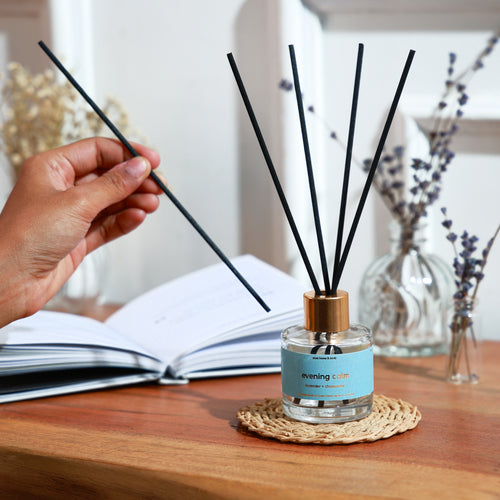
What a split AC actually does to a closed bedroom overnight
A split AC cools the room by pulling air in through the indoor unit, running it over a cold coil, and pushing it back out — the same air, over and over, all night. Nothing leaves through a window or a duct to outside. That single fact is the whole argument for this post: in an unconditioned room, air drifts and exchanges slowly with the rest of the flat, but in a sealed AC bedroom the same lungful of air is cycled past the reeds dozens of times before morning, and scent has nowhere to go but to build up. That is the case for four reeds instead of six — it is not a case for a bigger bottle. The 130ml exists for rooms above 150 sq ft; a recirculating bedroom does not need more oil, it needs less surface area feeding it.
The mistake almost everyone makes is where the bottle stands, not what is in it. The return-air path — the zone directly under or beside the indoor unit, where air is being pulled in fastest and coldest — is the worst place in the room for a reed diffuser. Scent is stripped off the exposed reed ends and diluted into that airflow before it ever travels the few metres to where you are actually lying, and because the reeds are working harder in that draught, the bottle also empties faster while smelling weaker at the bed. This is the single most useful placement rule in this whole guide: move the bottle to the far side of the room, and keep it at least 300mm off any windowsill, where a different draught and direct sun do the same stripping.
Cold air also holds and carries fragrance differently to warm air. A room sitting at 22°C under the AC reads quieter than the same bottle at 30°C with the AC off, because cooler air is denser and fragrance molecules disperse through it more slowly. This is exactly why people over-dose an AC bedroom in the first week — they judge the room on a hot afternoon, add reeds, then run the AC that night and the room reads far stronger than expected. By week three, once the nose has adapted to a scent that never changed and never left, the same setting reads as heavy rather than pleasant. Setting the reed count once, at four, for the room as it actually runs at night avoids both ends of that swing.
The three things to get right, in order
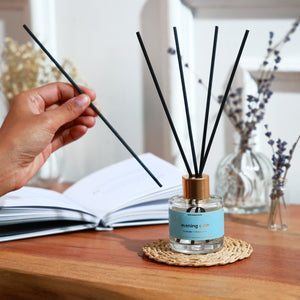
 Evening Calm 50ml₹799Every SOSA reed bottle ships with six fibre reeds, and six is the right count for a room with a door standing open and air moving through it. A sealed, AC-cooled bedroom is the opposite case: no exchange, cold air holding the scent closer to the surface it sits on, and eight straight hours for it to build. Four reeds is the adjustment — enough surface area to still be there at the pillow, not so much that the room is doing the same job twice over. It also runs longer: a 50ml on four reeds lasts roughly 8–10 weeks against 6–8 at six reeds, so the correction for the room happens to be the cheaper setting too.
Which SOSA reed scent actually works overnight in this room
Strength matters less here than register. A composition built to be noticed on entry is the wrong choice for a room you are lying in for eight hours with the air recirculating past it; a quiet composition is the only one that does not become the thing you are aware of at 2am. The table below runs the five 50ml scents against that one test.
| Scent | Register | Reeds here | Verdict |
|---|---|---|---|
| Evening Calm 50ml ₹799 | Lavender · chamomile | Four | The pick — quiet enough to sit in recirculated air all night |
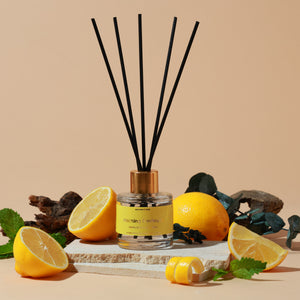
| Morning Freshness 50ml ₹749 | Malabar lemon · peppermint · eucalyptus | Four | Works — cool and clean rather than soft, a fair alternative |
| Fresh Brew 50ml ₹849 | Coorg coffee · Kerala vanilla | — | Too assertive — a warm gourmand concentrates in still, cold air and reads heavy by morning |
| Garden Bloom 50ml ₹799 | British rose · night-blooming jasmine | — | Too assertive — a floral this present is right for a living room, not eight closed hours |
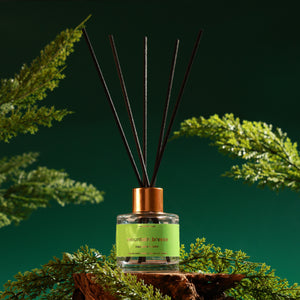
| Mountain Breeze 50ml ₹849 | Himalayan pine · sage · cedar | — | Borderline — resinous enough to feel present at the pillow; fine elsewhere in the flat |
| Evening Calm 130ml ₹1,299 | Same lavender · chamomile | Six | Skip — built for rooms above 150 sq ft; an AC bedroom is 50ml territory |
| Why register beats strength here: because the room recirculates its own air all night, whatever you put in it has eight hours and no exit to build up. A composition that is pleasant for the first ten minutes on entry can be the same composition still sitting in the room with you at 1am — quiet compositions are simply more forgiving of that arithmetic. | |||
Evening Calm · the pick50ml ₹799Shop → 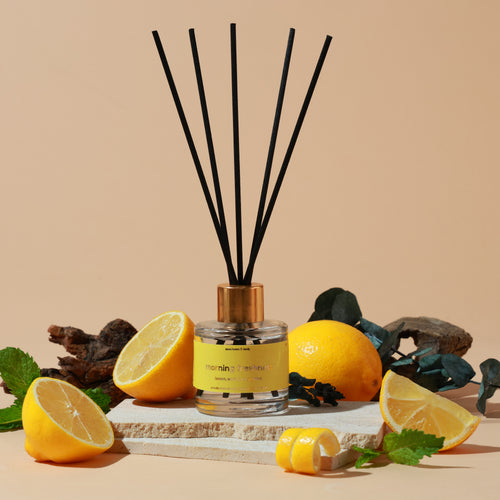 Morning Freshness · cooler alt50ml ₹749Shop →
 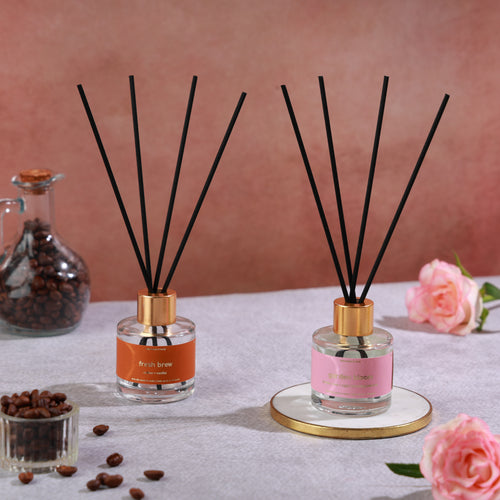 Refill · once you know it works300ml ₹2,399Shop →
Reed count, placement and the Pune calendar
Pune's AC season runs roughly March to June, with a shorter return in October once the post-monsoon heat picks back up. Through those months, run four reeds — the setting that corrects for a recirculating, cooled room without over-scenting it. From roughly November to February, Pune's winter is mild enough that most bedrooms sit with a window cracked rather than the AC running; with real air exchange back in the room, six reeds is the right baseline again, the same as any unconditioned room in this size. The reed count should follow the AC, not the calendar month for its own sake.
The monsoon, roughly July to September, is its own case and the one people get wrong by assuming "AC off" means "back to six reeds." It does not. The window is shut through the rain rather than for cooling, and the room is humid rather than cold — high humidity slows how fast fragrance disperses, so the same bottle reads heavier in July than it did in April. Drop to three reeds for these months. It is the same correction as any humid Indian city, just arriving at a different time of year because Pune's monsoon and Pune's AC season do not overlap.
Placement inside the room matters as much as the season. Stand the bottle on the far wall from the indoor unit, roughly level with the bed rather than up on a high shelf where warm air pools, and never directly in the arc of a ceiling fan either — a second source of stripping airflow that does the same damage as the AC's return path. Flip the reeds saturated-end up every three to five days regardless of season; this is the entire maintenance routine and the one habit that keeps four reeds performing like four reeds rather than fading to two within a month.
What it costs, worked by hand
A reed diffuser has no electricity cost and the only variable is reed count against the calendar above. Every figure below divides the bottle price by the weeks the reed count actually runs, checked by hand rather than assumed.
| Season | Reeds | Runs | Cost per week |
|---|---|---|---|
| AC season (Mar–Jun, and October) | Four | 8–10 weeks | ₹80–100 |
| Monsoon (roughly Jul–Sep) | Three | 10–14 weeks | ₹57–80 |
| Mild winter (Nov–Feb, window open) | Six | 6–8 weeks | ₹100–133 |
| Cooler alternative — Morning Freshness 50ml ₹749 | Four (AC season) | 8–10 weeks | ₹75–94 |
| Running cost — 300ml refill ₹2,399 | Refills six 50ml bottles | ≈₹400 a fill | saves ₹2,395 against six new bottles |
Versailles
This question arrives from Pune more than any other city, and I think it is because Pune's weather changes its mind more often than most — dry heat for four months, a real monsoon for three, and a mild stretch the rest of the year where the AC is barely needed. Almost nobody adjusts their reed count to match, and the person writing in is usually convinced their bottle has gone wrong when the room has simply changed underneath it.
The placement question matters more than people expect. I have walked into more than one Pune bedroom where the reed diffuser sat directly below the indoor unit because that happened to be where the side table was, and moving it three metres to the opposite wall did more than any change of scent or reed count would have. The AC is not your enemy here — it is just moving air faster and colder than anything else in the room, and a reed diffuser has no way to fight a draught. It can only be kept out of one.
If I could leave a reader with one habit rather than one bottle, it would be the morning window. Ten minutes before the AC goes back on costs nothing and does more for how a closed bedroom actually smells than any product I sell. Buy the bottle for the scent. Open the window for the room. Every purchase funds a girl's education through Nanhi Kali — not a percentage, not a quarterly cheque. Every one.
Frequently asked questions
- My Bed Is Near the AC — Where Should the Reed Diffuser Go? — the placement rule on its own, for any city.
- Why Does My Home Smell Stale During Pune Monsoon Even After Cleaning? — the humidity half of this same room.
- How Long Should a Reed Diffuser Last in Pune Weather? — the full-year reed-count calendar.
- Best Home Fragrance for a Delhi Apartment With AC Running All Summer — the same recirculation problem, drier air.
- Brand: the SOSA founder story.
SOSA products & prices (verified August 2026): Scented candles from ₹379 (small, ~15–18 hrs) · candle duos ₹664 (~30–36 hrs) · wax melts ₹474 · woodenwick and ceramic jar candles ₹949. Reed diffusers: Morning Freshness 50ml ₹749 · 130ml ₹1,249 · Evening Calm 50ml ₹799 · 130ml ₹1,299 · Garden Bloom 50ml ₹799 · 130ml ₹1,299 · Fresh Brew 50ml ₹849 · 130ml ₹1,349 · Mountain Breeze 50ml ₹849 · 130ml ₹1,349; six fibre reeds and refillable glass with every bottle, 50ml lasts 6–8 weeks at six reeds and longer at fewer, 130ml 14–18 weeks. Reed duo sets 2 × 50ml ₹1,498–₹1,598 · 2 × 130ml ₹2,498–₹2,598. Reed refills 300ml ₹2,399 · 500ml ₹3,499. Ultrasonic diffusers: Boond ₹899 (USB) · Sukoon ₹1,899 (ships with three 15ml fragrances) · Megh ₹3,499; Hotel Collection water-based fragrance 15ml ₹299 · 100ml ₹999 · 300ml ₹1,799 — a fragrance for a machine, not a standalone product. Reed oil and the water-based Hotel Collection are not interchangeable. Alcohol-free, phthalate-free, paraben-free, IFRA-compliant, low VOC; composed and handmade in small batches in Pune. Every purchase funds a girl's education through Nanhi Kali. Prices and availability subject to change — see the live product pages.