


Choose contrast if the room clears properly — good cross-ventilation, incense once in the morning, a flat that is genuinely aired. Morning Freshness ₹749, 9.0, with a eucalyptus base that slows the lemon three to four times.
Not this: a sweet gourmand over incense residue. Fresh Brew at 9.5 is the deepest thing we make and I would not lead it in this house.
The honest gap: there is no sandalwood reed diffuser at SOSA — no oud, vetiver or amber either. Mountain Breeze is the nearest register and it is not the same thing.
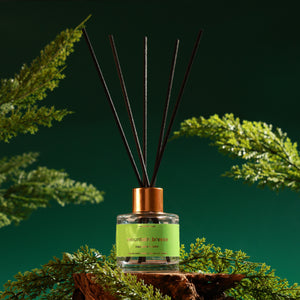
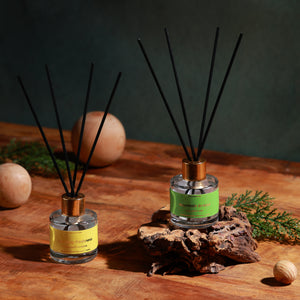
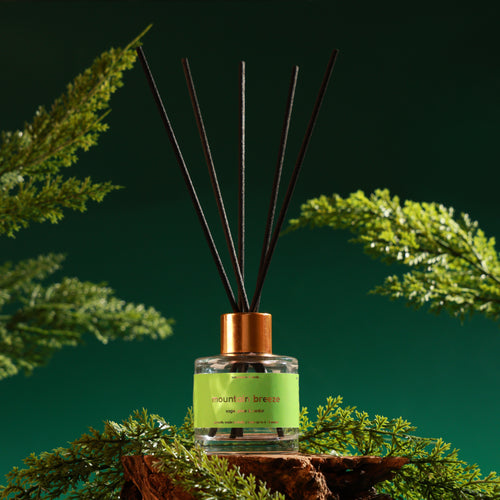
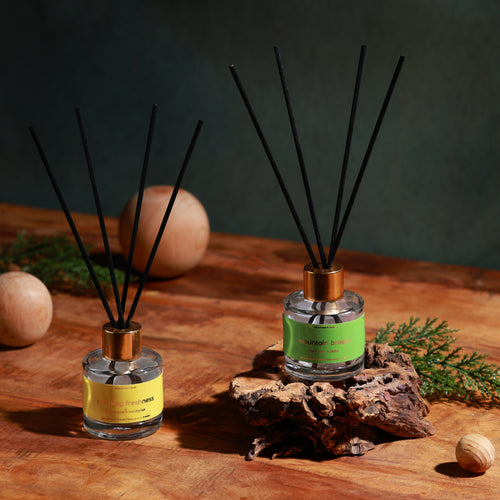
2. If the flat holds it, choose continuity: Mountain Breeze ₹849. Himalayan pine, sage and Indian cedar. Dry, resinous and un-sweet — the same textural family as the woody core of most agarbatti, which means the reed does not have to wait for the room to be perfectly clean before it starts making sense. 9.4 on the SOSA strength scale, so three reeds in a small room and six in a living room.
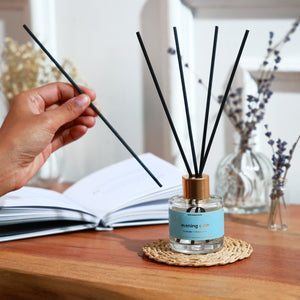
3. If the flat clears, choose contrast: Morning Freshness ₹749. Cold-pressed Malabar lemon, peppermint and a eucalyptus globulus base. It reads as cut fruit rather than as perfume and it draws a visible line under the morning. It is the cleaner, brighter answer and it is also the cheaper one.
4. Ventilate between them, every day, without exception. No reed diffuser removes smoke, and a reed started into a room still thick with it will simply be inaudible. Open something while the agarbatti burns and for a few minutes after. The reed needs no further attention — that is the whole appeal of the format.
5. Keep it away from the flame. Fragrance oil is flammable. A reed diffuser, its bottle and its refill do not belong on the same shelf as a lit agarbatti or diya, in the path of one, or anywhere a stand can be knocked into it.
Alcohol-free, phthalate-free, IFRA-compliant, 0 ppm formaldehyde, six fibre reeds, refillable glass. Composed in Pune. A portion of every order supports girl-child education through Nanhi Kali.
The question that decides it, and the two that do not
Most buying guides for this situation try to settle it on notes — which scent family is culturally compatible with incense, which is respectful, which is modern. None of that is the operative variable. What decides the right reed is how much incense character is still present in the room when the reed's hours start, and that is a building question, not a fragrance question. Here are the three factors that produce the answer.
 Mountain Breeze₹849Some of the smoke stays airborne and leaves with the first proper airing. The rest settles onto curtains, cushions, upholstery, rugs and walls, and comes back off them slowly over hours. A room full of fabric therefore stays an incense room long after the visible smoke has gone, while a room of tile, glass and hard furniture returns to neutral quickly. This is the same mechanism that makes a kitchen smell of last night's cooking, and it is why two households following identical routines need different diffusers.
 Morning Freshness₹749A flat with two openings on different walls turns its air over quickly; a flat with one window and a closed balcony door does not. High exchange is the reason a house that burns incense every single morning can still read as neutral by lunch — and it is also, honestly, the reason a reed diffuser projects less in that flat, because air leaving the room takes fragrance with it. The trade is real in both directions. Where exchange is good, contrast works beautifully and Morning Freshness is the buy.
 Fresh & Grounded₹1,548A single morning agarbatti gives the reed a long, clean run at the rest of the day. A morning and an evening one leaves it a window in the middle and asks it to make sense on either side of two combustion events. In the second case contrast starts to feel like an interruption rather than a fresh start, and continuity is the calmer choice — or, if two rooms are in play, one of each. The Fresh & Grounded duo at ₹1,548 is those two bottles bought together.
Continuity and contrast, explained properly
Continuity means choosing a register adjacent to what is already in the room. The woody core of a sandalwood agarbatti is dry, resinous and slightly balsamic, and the useful thing about pine, sage and cedar is that they share that texture without imitating it. When the reed's material and the residual material belong to the same family, the nose does not register a handover at all — the room simply becomes quieter, cooler and less smoky as the morning recedes. That is the least disruptive possible transition and it is why Mountain Breeze is the default recommendation for this household.
Contrast means deliberately changing the subject once the room is clean. Bright citrus does that better than anything else because it is the furthest thing in the range from combustion — light, cool, and read by almost everybody as a signal that a space has been reset. The technical reason Morning Freshness can do this for weeks rather than days is the base: citrus top notes are small light molecules that ordinarily leave a reed diffuser inside ten to fourteen days, and the eucalyptus globulus underneath slows the lemon's evaporation by roughly three to four times, which is what turns a fortnight of citrus into 6–8 weeks. That is a structural decision, not a strength one.
Two registers I would steer this house away from. A sweet gourmand — our own Fresh Brew at 9.5, the deepest we make — stacks with the resinous sweetness in incense residue rather than contrasting with it, and the combined impression is heavy and slightly confused. And a second floral, if the household burns jasmine incense: Garden Bloom is a very good jasmine, and two jasmines in one room stack and flatten each other into something less interesting than either. Register-matching is not the same as duplication.
All five SOSA reeds, scored for a daily-agarbatti home
The complete line judged on one criterion only: how it behaves in the hours after incense in an ordinary Indian flat. The bottom two rows are the ones I would not lead here, and they are included because a guide that shows you only the fitting answers is an advertisement rather than a guide.
| Scent | Notes | Strength | How it behaves after incense | 50ml |
|---|---|---|---|---|
| Mountain Breeze ★ | Himalayan pine · sage · Indian cedar | 9.4 · deep woody | Continuity. Same dry resinous family as the smoke's woody core — no seam in the handover | ₹849 |
| Morning Freshness ★ | Malabar lemon · peppermint · eucalyptus globulus | 9.0 · bright | Contrast. The cleanest break once the room has aired — and the cheaper of the two | ₹749 |
| Evening Calm | Kashmir lavender · chamomile · soft musk | 8.9 · softest in range | Neither, in a good way — quiet enough to sit under anything. The bedroom answer | ₹799 |
| Garden Bloom | British rose · night-blooming jasmine | 8.9 · medium floral | Only if the incense is not floral. Two jasmines stack and flatten each other | ₹799 |
| Fresh Brew | Coorg coffee · Kerala vanilla · caramel | 9.5 · deepest in range | The one I would not lead here. A gourmand stacks with resinous residue rather than lifting it | ₹849 |
Continuity · Mountain Breeze₹849Shop → 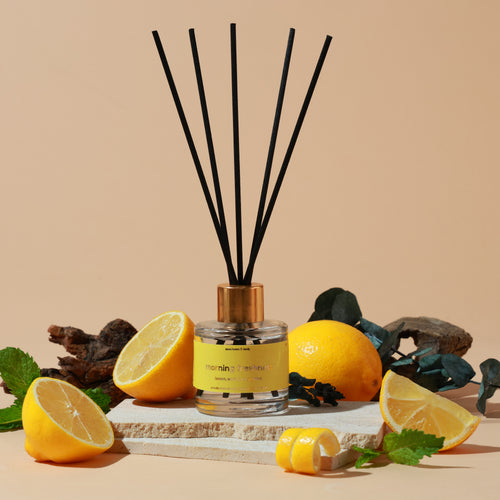 Contrast · Morning Freshness₹749Shop →
  Both · Fresh & Grounded₹1,548Shop →
Reeds, placement, and the one rule that is not negotiable
The reed count is the volume dial and it is free. All six fibre reeds is full projection and is right for a living room; three is a soft, bedside level that roughly doubles how long the bottle lasts. In a small or well-sealed room six is usually too many, and a great many complaints that a scent is cloying are complaints about concentration rather than composition. Flip the reeds every three to five days for a lift. Expect the first week to run hot — the reeds are saturating and the lightest materials leave first — and expect week three to be quieter and rounder. That is the composition settling into how it was designed to sit, not the bottle fading.
Fibre rather than rattan matters more in this country than it sounds. Rattan is a natural cane with irregular internal channels; in high humidity it wicks unevenly and tends to fade at the dry end, which is where the fade-then-nothing pattern people blame on the oil actually comes from. Every SOSA bottle ships with six fibre reeds, and the oil sits on a heat-stable CCT carrier rather than DPG, which can crack and turn bitter above 40°C. That is an ordinary afternoon in much of India, and it is the difference between a fragrance that fades and one that turns.
Placement: in the room's natural airflow path, near a doorway rather than in a still corner, at or slightly below nose height, out of a direct draught and out of direct sun. And the rule that is not negotiable in this particular house — fragrance oil is flammable, so the diffuser and its refill go well away from the agarbatti stand and any diya. Not on the same shelf, not in the path of a burning stick, and not where somebody reaching past can knock one into the other.
The buying order — and when the answer is not a bottle
In the order I would actually buy, for a household that lights an agarbatti every day. The last row is the situation in which I would tell you to spend nothing at all yet.
| Buy | What it is | When it is the right answer | Price |
|---|---|---|---|
| 1. Mountain Breeze 50ml ★ | Pine, sage, Indian cedar — dry and resinous, 9.4 | A flat that holds the incense: fabric-heavy rooms, one window, or more than one lighting a day | ₹849 |
| 2. Morning Freshness 50ml ★ | Malabar lemon, peppermint, eucalyptus — 9.0, the eucalyptus slows the lemon 3–4× | A flat that airs out well, and a household that wants the afternoon to feel like a new page | ₹749 |
| 3. Fresh & Grounded duo | Both of the above, two 50ml bottles — not a boxed set | Two rooms with different jobs: woody where the incense is, bright where the day happens | ₹1,548 |
| 4. Evening Calm 50ml | Kashmir lavender and chamomile — 8.9, the softest in the range | The bedroom, or any household where somebody has already said they dislike strong scent | ₹799 |
| Buy nothing yet: the honest gap | If the flat never really clears — incense twice a day, one window, heavy curtains — no reed will read cleanly, and there is no sandalwood reed to buy instead. Fix the airing first | Before the purchase, not after it. Ventilation is free and it is the larger half of this problem | ₹0 |
Versailles
People ask me for the reed diffuser that "goes with" agarbatti, and the honest reframing is that nothing goes with agarbatti while it is burning — the concentrations are not comparable and a diffuser is simply not in that conversation. What you are actually shopping for is the rest of the day. Once you see it that way the question becomes easy, because the rest of the day is a room you know well.
The reason I give two answers rather than one is that I have seen the same routine produce two completely different rooms. A curtained flat in a lane with one usable window is still an incense room at two in the afternoon; a cross-ventilated one on a higher floor is not. In the first, pine and cedar continue a sentence that has already started. In the second, lemon starts a new one. Both are correct and the flat decides, not the taste.
What I will not do is offer you a sandalwood reed, because we do not make one, and I would rather name that gap than sell you the nearest neighbour and let you find out. And whatever you buy, keep it away from the stand — fragrance oil is flammable and a diffuser does not belong beside something that is lit every morning. Everything is composed in Pune, and a part of every order funds a girl's classroom through Nanhi Kali.
Frequently asked questions
- Agarbatti every morning — what won't clash — the head page: sequencing first, register second.
- A reed diffuser near the puja room — the honest answer, including the flame-proximity part.
- Strong incense after morning puja — what works later in the day.
- Notes that pair with sandalwood agarbatti — and why there is no sandalwood reed.
- Jasmine incense — should the reed be floral too? — why two jasmines stack and flatten.
- A hotel-inspired scent in a daily-incense house — yes, by time-separation, and the hardware you need.
- Traditional versus hotel scents — one fragrance for a household that disagrees.
- Morning incense to a fresh evening — the daily sequence, hour by hour.
- Sukoon and incense in one home — the complete method for the whole family.
- Brand: the SOSA founder story.
SOSA reed diffusers — facts verified August 2026: Five scents, all alcohol-free, on a heat-stable CCT (caprylic/capric triglyceride) carrier rather than DPG, phthalate-free, paraben-free, IFRA-compliant, 0 ppm formaldehyde, six fibre reeds in a refillable glass bottle, composed in Pune and climate-tested at 45°C heat soak and 85% relative humidity. Morning Freshness (Malabar lemon · peppermint · eucalyptus globulus) 50ml ₹749 · 130ml ₹1,249 · 9.0 on the SOSA strength scale; the eucalyptus base slows lemon evaporation three to four times. Evening Calm (Kashmir lavender · chamomile · soft musk) ₹799 · ₹1,299 · 8.9, the softest in the range. Garden Bloom (British rose · night-blooming jasmine) ₹799 · ₹1,299 · 8.9, with indole held below the fecal threshold so the jasmine stays floral above 30°C. Mountain Breeze (Himalayan pine · sage · Indian cedar) ₹849 · ₹1,349 · 9.4. Fresh Brew (Coorg coffee · Kerala vanilla · caramel) ₹849 · ₹1,349 · 9.5, the deepest. 50ml suits rooms up to about 150 sq ft and lasts 6–8 weeks; 130ml suits above that and lasts 14–18 weeks. Six reeds give full projection, three a soft level and roughly double the life; flip cadence every 3–5 days. Fresh & Grounded duo ₹1,548 (two 50ml). Refills 300ml ₹2,399 · 500ml ₹3,499, oil only and not a first purchase. The reed line contains no oud, sandalwood, vetiver or amber. Fragrance oil is flammable; keep diffusers and refills away from agarbatti, diyas and open flame. Free shipping above ₹499. A portion of every order supports girl-child education through Nanhi Kali. SOSA is an independent Indian fragrance house and is not affiliated with any hotel brand. Prices subject to change — see the live product pages.