
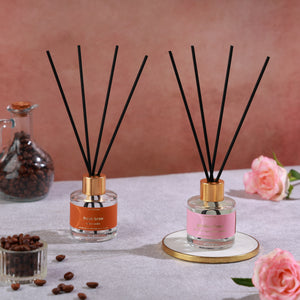
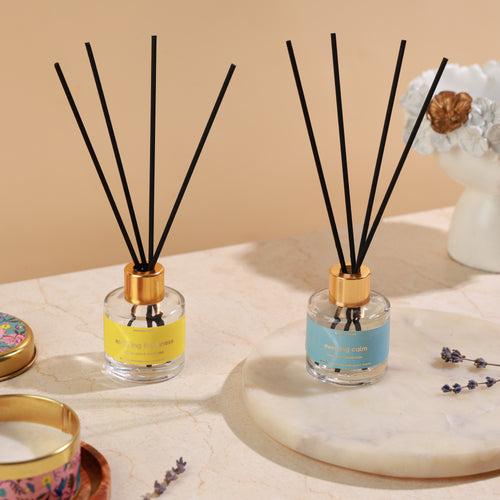
If the bathroom is where you bathe at night: Evening Calm at ₹799 — Kashmir lavender and chamomile, 8.9, the softest thing we make.
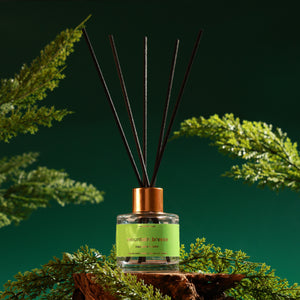
For a guest bathroom or powder room: Mountain Breeze at ₹849 — less obvious than citrus, and nobody can name it.
The economics: a bathroom needs two or three reeds, not six. At that count a 50ml runs close to three months — a little over ₹8 a day for a room that is scented permanently, unattended, with nothing switched on.
The honest gap: there is no orange blossom, neroli or bergamot reed diffuser at SOSA, and no aquatic, marine or "clean linen" scent either — which are the two things people most often picture for a bathroom. Said plainly rather than stretched to fit.
2. Use two or three reeds, not six, because the room is 40 to 60 sq ft. Reed count is a volume dial, not a quality setting. Six reeds in a bathroom does not smell stronger than three; it simply empties the bottle at twice the rate into a volume of air that could not absorb it anyway. Devika S. in Mumbai reported seven weeks on four reeds. Drop to two or three and you are into the third month.
3. Now do the sum, because the sum is the argument. ₹749 across roughly ninety days is a little over ₹8 a day. The same bottle at the standard six reeds in a bedroom is about ₹13 a day. Nothing else in a home costs eight rupees a day and is simply always on: no plug-in refill cycle, no machine, no electricity, no consumable but the oil itself.
4. Match the scent to the time of day the room is used. Morning Freshness if it is a shower bathroom and the point is to start the day. Evening Calm at ₹799 if it is where you take a bath at night. Mountain Breeze at ₹849 for a guest bathroom or powder room, where the object is for the room to smell considered rather than scented.
5. Put it on the counter or a shelf, away from the spray, and leave it alone. Never on the cistern, where it gets knocked into the pan; never on a windowsill in direct sun, which strips the top notes in days. Flip the reeds every three to five days. That is the entire maintenance schedule.
Alcohol-free, phthalate-free, made in Pune. A portion of every order supports girl-child education through Nanhi Kali.
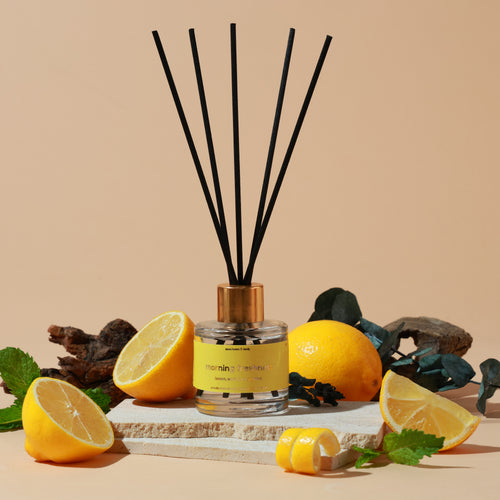
Why citrus and the bathroom are the best-matched pair in home fragrance
Most room-and-scent pairings are a matter of taste, and I am usually reluctant to tell people their taste is wrong. This one is not a matter of taste. The bathroom asks a fragrance to do a specific job under specific constraints, and citrus in a reed diffuser happens to be the only combination that satisfies all of them at once. Three arguments, in ascending order of how much money they save you.
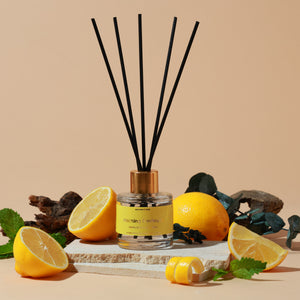
 Morning Freshness₹749Most Indian bathrooms have nowhere safe to plug anything in, and the ones that do have a socket have it at shaving height, next to a mirror, in a room where the walls run with condensation for half an hour a day. A plug-in wants a socket it should not have. An ultrasonic machine wants a socket, a flat dry surface, a water top-up and somebody to switch it on. A candle wants supervision. A reed diffuser wants nothing. It has no electrical component, no moving part, no tank and no on-switch, and it therefore works in the one room nobody remembers to visit for maintenance. That is not a small advantage dressed up — it is the difference between a room that is scented permanently and a room that is scented on the days you thought about it.
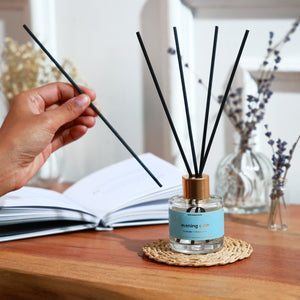
 Evening Calm₹799Every other room in a house is happy to have something added to the air. A living room can take a warm gourmand, a bedroom can take a floral, a study can take resin and wood. A bathroom is the single room where the brief is subtraction — you want the air to read as having been changed rather than as having been perfumed over, and a heavy fragrance in a small wet room reads instantly as covering something. Citrus is the family that does subtraction. It has lift, it is thin in the best sense, and the nose files it under air rather than under scent. That is precisely what Tanya K. in Pune was describing: "smells exactly like a spa — clean, breathable, not floral." Breathable is the operative word, and it is a thing florals and gourmands structurally cannot be at this volume.
 300ml refill₹2,399Here is the headline, and it is worth doing slowly. A bottle ships with six fibre reeds because six is what a living room needs. A typical Indian bathroom is 40 to 60 sq ft, which is roughly a third of the volume the six-reed rate was designed for, so two or three reeds is the correct setting and not a compromise. The published longevity of a 50ml is 6–8 weeks at six reeds. Devika S. in Mumbai got seven weeks at four. At two or three, in a small room, the bottle runs close to three months. So: ₹749 divided by roughly ninety days is a little over ₹8 a day, against about ₹13 a day for the same bottle running at full strength elsewhere. Evening Calm at ₹799 works out just under ₹9; Mountain Breeze at ₹849 at about ₹9.40. No electricity, no refill cartridge, no machine to amortise.
The monsoon argument — why a bathroom diffuser turns rather than merely fading
The complaint I hear about bathroom diffusers is almost never that they went quiet. It is that they went strange — sour, bitter, faintly acrid, a note that was not there in week one and that no amount of flipping reeds will remove. That is not the fragrance ageing. That is the carrier failing, and it is worth understanding because it is the one variable a buyer cannot see on a label.
A reed diffuser is mostly carrier. The fragrance is a minority of what is in the bottle; the rest is the solvent that dissolves it and travels up the reed. The industry default is DPG, dipropylene glycol, because it is cheap and it works — up to a point. That point is roughly 40°C, above which DPG begins to crack, and it also behaves badly at sustained high humidity, where it draws water and the composition goes sour. Now consider which room in an Indian home is hottest and wettest. A bathroom takes a hot shower's worth of steam once or twice a day, sits at 85% relative humidity for weeks on end through the monsoon, and in an unshaded flat in May will hold 40°C-plus in the afternoon. The bathroom is where DPG fails first. That is the actual mechanism behind the thing everybody has experienced and nobody has been told about.
Every SOSA reed sits on a heat-stable CCT base — caprylic/capric triglyceride, coconut-derived — which does not crack at those temperatures and does not go bitter at that humidity. It is tested through a 45°C heat soak and 85% RH, and it costs more than DPG, which is the entire reason most bottles are not made this way. The evidence I trust most is not the test rig but Nisha R. in Pune, who wrote that Evening Calm "lasted my whole monsoon in the bathroom and never went sharp" — a full Indian monsoon in the worst room in the house, with no chemical shift. Anjali R., also in Pune, reported the same of Mountain Breeze: "lasted exactly through one monsoon. Pine stayed pine — no bitterness, no chemical shift."
The second half of the chemistry is specific to citrus, and it is the reason this family is the hardest to sell honestly. Citrus molecules are the smallest and most volatile in perfumery, which is why they smell the way they do and also why they leave a bottle first. An unsupported citrus reed diffuser is thrilling for ten to fourteen days and then it is a jar of oil with sticks in it. Anyone selling you a citrus reed diffuser without telling you what is holding the citrus down is selling you two good weeks. In Morning Freshness the thing holding it down is the eucalyptus globulus base, which slows the lemon's evaporation by roughly three to four times and is the single reason that bottle runs 6–8 weeks at six reeds rather than a fortnight. Aanya R. in Gurugram named it without being prompted: "the eucalyptus base is the unfair advantage." None of this appears in a note list. All of it decides whether the ₹8 a day is real.
The five reed scents, ranked for a bathroom and costed per day
The whole line, including the two scents I would not put in a bathroom, because a guide that lists only what fits your search is an advertisement. Cost per day is worked two ways: the standard six-reed figure, and the bathroom figure at two or three reeds in a 40–60 sq ft room where a 50ml runs close to three months.
| Scent | Notes | Strength | In a bathroom | 50ml | Bathroom cost/day |
|---|---|---|---|---|---|
| Morning Freshness ★ | Malabar lemon · peppermint · eucalyptus | 9.0 · bright | The citrus answer. Reads as air being changed, not covered | ₹749 | a little over ₹8 |
| Evening Calm | Kashmir lavender · chamomile · soft musk | 8.9 · softest in range | For a bathroom you bathe in at night rather than shower in | ₹799 | just under ₹9 |
| Mountain Breeze | Himalayan pine · sage · Indian cedar | 9.4 · deep woody | Guest bathroom or powder room — less obvious, harder to name | ₹849 | about ₹9.40 |
| Garden Bloom | British rose · night-blooming jasmine | 8.9 · medium floral | Not the room for it — a floral in 50 sq ft reads as covering something | ₹799 | — |
| Fresh Brew | Coorg coffee · Kerala vanilla · caramel | 9.5 · deepest in range | No. A warm gourmand and a wet room are actively wrong together | ₹849 | — |
Shower · Morning Freshness₹749Shop → 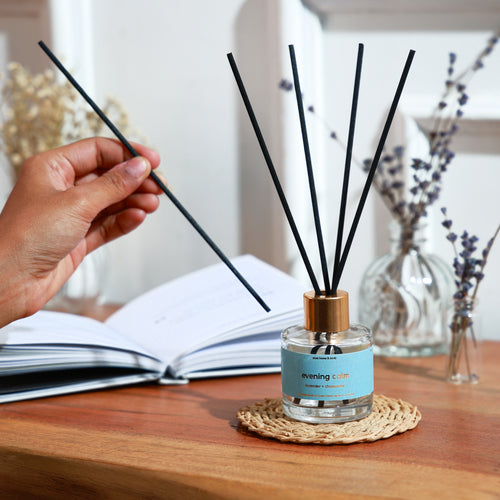 Bath · Evening Calm₹799Shop →
 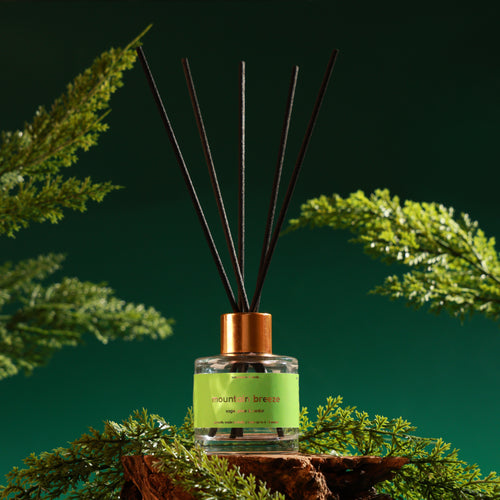 Guest · Mountain Breeze₹849Shop →
The ventilation paradox, and where the bottle actually goes
This is the part almost nobody explains, and it is responsible for more disappointed bathroom diffusers than any fault in a bottle. A reed diffuser has no fan. It relies entirely on the room's own air movement to lift evaporated fragrance off the reeds and carry it about. That produces two failure modes that look identical from the outside and have opposite fixes.
The first is too much air. An exhaust fan running continuously does exactly what it was designed to do, which is pull the air in the room outside — including every molecule your reeds have just released. If the fan runs all day, you are paying ₹8 a day to scent a duct. Run the fan for the shower and for a while after it, not all day. That is the whole fix, it is free, and it usually doubles the perceived strength of a bottle somebody had already written off.
The second is too little air. A completely sealed windowless bathroom with the door shut and the fan off will feel weak, and the instinct is to blame the oil and add reeds. The problem there is still air, not weak fragrance: with nothing moving, the vapour sits in a shallow layer around the bottle and never reaches nose height. The fix is to leave the door ajar between uses, or run the fan briefly, or simply accept that the room announces itself when you open the door rather than while you are standing in it — which for a bathroom is arguably the correct behaviour anyway. Adding reeds to a still room does not help; it only shortens the bottle.
Placement is the last variable and it is mostly about what not to do. Put the bottle on the counter or a shelf, away from the direct line of the shower spray — water in the neck of a diffuser does nothing good to an oil-based composition. Never on the cistern, which is where it eventually gets knocked over or into the pan by a towel. Never on a windowsill in direct sun: heat and UV strip the citrus top notes in days and leave you with the eucalyptus floor, which is the exact fade the eucalyptus was put there to prevent. And flip the reeds every three to five days — Morning Freshness likes the shorter end of that — for a lift that costs nothing.
The bathroom citrus edit, in buying order — and the gap
In the order I would actually buy it, followed by what this range does not contain. Two absences matter here and I would rather state both than let you find out in a fortnight. There is no orange blossom, neroli or bergamot reed diffuser at SOSA — Morning Freshness is a lemon, and lemon is not a substitute for orange blossom in any direction that matters. And there is no aquatic, marine or "clean linen" reed scent, which are the two smells people most often picture when they imagine a bathroom fragrance. If either of those is the smell in your head, read the last row of this table before you spend anything.
| Buy | What it is | When it is the right answer | Price |
|---|---|---|---|
| 1. Morning Freshness 50ml ★ | Malabar lemon, peppermint, eucalyptus — the only citrus in the reed line | A shower bathroom, and the default for almost everyone. Two or three reeds | ₹749 |
| 2. Evening Calm 50ml | Kashmir lavender and chamomile, 8.9 — the softest thing we make | If it is the bathroom you take a bath in at night rather than shower in | ₹799 |
| 3. Mountain Breeze 50ml | Himalayan pine, sage, Indian cedar, 9.4 — dry and green rather than sweet | Guest bathroom or powder room, where you want something less obvious | ₹849 |
| 4. Day & Night duo | Morning Freshness and Evening Calm together, 50ml × 2 | Two bathrooms, or a bathroom and the bedroom next to it | ₹1,498 |
| 5. 300ml refill | Tops up the bottle and reeds you already own | Once one scent is clearly the one you keep going back to | ₹2,399 |
| No orange blossom, no aquatic, no clean linen: the honest gap | There is no neroli, orange blossom or bergamot reed, and no marine or cotton-musk accord. Morning Freshness is the nearest to cool-and-clean and Evening Calm the nearest to soft-and-clean. On the ultrasonic side the Westin-inspired Hotel Collection scent (white tea · aloe · cedar) is the cleanest thing in the house, and the Ritz-Carlton-inspired (white tea · bergamot · cedar) is the only bergamot we have — both water-based, both machine-only | Said plainly rather than stretched to fit | ₹749 / ₹799 / ₹299 |
Versailles
The bathroom is the room I was least interested in when I started and the one I now think about most, because it is the only room in a house where fragrance has to survive without any help. Nobody adjusts it, nobody switches it on, and it spends its life in steam. If a formulation is going to fail, it fails there first — which makes the bathroom an unusually honest test of whether a bottle was made properly or made cheaply.
That is why the carrier decision was settled before any of the five scents existed. CCT costs more than DPG and no customer will ever smell it directly. What they will smell, if you use DPG, is the sourness that arrives in week five of a Pune monsoon, and by then they will have blamed the fragrance. Nisha's line about a whole monsoon in the bathroom with nothing going sharp is, to me, worth more than any note list on the label.
And I would rather you left with the arithmetic than with a purchase. Two or three reeds, not six. A ₹749 bottle across close to three months. A little over eight rupees a day for a room that never needs thinking about — and if what you actually wanted was orange blossom or something marine, we do not make it, and I would rather tell you that here than have you find out in a fortnight. Everything is composed in Pune, and a part of every order funds a girl's classroom through Nanhi Kali.
Frequently asked questions
- The citrus category and A citrus home — why citrus is the hardest family to make last, and a spine plus neighbours, and what a year costs.
- Orange blossom and Bedrooms — the four things sold under that name, and why we make none, and the sleeping room versus the getting-ready room.
- Living rooms and Not a cleaning product — the only family that survives an Indian kitchen, and the limonene problem, and how to smell past it.
- Sophisticated citrus — sophistication is a property of the base.
- The decision tree — one bottle, no reading, if you want one bottle and no argument.
- The complete citrus guide — every decision in one place.
- Brand: the SOSA founder story.
SOSA reed diffusers — facts verified August 2026: Five scents, all alcohol-free, on a heat-stable CCT (caprylic/capric triglyceride, coconut-derived) base rather than DPG, phthalate-free, paraben-free, IFRA-compliant, 0 ppm formaldehyde, six fibre reeds in a refillable glass bottle, composed and made in Pune, India. Morning Freshness (Malabar lemon · peppermint · eucalyptus globulus) 50ml ₹749 · 130ml ₹1,249 · 9.0 on the SOSA strength scale · 4.9 from 41 verified reviews; the eucalyptus base slows lemon evaporation three to four times. Evening Calm (Kashmir lavender · chamomile · soft musk) 50ml ₹799 · 130ml ₹1,299 · 8.9, the softest in the range. Garden Bloom (British rose · night-blooming jasmine) 50ml ₹799 · 130ml ₹1,299 · 8.9. Mountain Breeze (Himalayan pine · sage · Indian cedar) 50ml ₹849 · 130ml ₹1,349 · 9.4. Fresh Brew (Coorg coffee · Kerala vanilla · caramel) 50ml ₹849 · 130ml ₹1,349 · 9.5, the deepest in the range. Longevity 6–8 weeks on a 50ml and 14–18 weeks on a 130ml at six reeds; two or three reeds in a 50 sq ft bathroom makes a 50ml last nearly three months. 50ml suits rooms up to about 150 sq ft, 130ml above that. Duos: Day & Night ₹1,498, Fresh & Grounded ₹1,548, Warmth & Bloom ₹1,598 (50ml × 2). Refills 300ml ₹2,399 · 500ml ₹3,499. Climate-tested through 45°C heat soak and 85% RH monsoon humidity. The reed line contains no orange blossom, neroli, bergamot, grapefruit, mandarin, yuzu or lime, and no oud, sandalwood, vetiver, amber, aquatic, marine or clean-linen accord; where this guide is asked for one of those it says so rather than stretching the nearest scent to cover it. The water-based Hotel Collection (15ml ₹299 · 100ml ₹999 · 300ml ₹1,799) is ultrasonic-only and is a separate product from reed oil; the two are not interchangeable in either direction and there is no hotel-inspired reed diffuser. Machines: Boond ₹899 (up to 150 sq ft) and Sukoon ₹1,899 (270–320 sq ft, three 15ml scents included). Free shipping above ₹499. A portion of every order supports girl-child education through Nanhi Kali. SOSA is independent and is not affiliated with, endorsed by or connected to any hotel brand. Prices subject to change — see the live product pages.