



Why Does My House Smell Damp During Monsoon?

Why Does My House Smell Damp During Monsoon?

★ Monsoon, damp walls and the one situation where opening the window makes it worseCandle ₹379 · reed ₹749 · Boond ₹899 · Sukoon ₹1,899 · free shipping above ₹499A portion funds girl-child education
★ SOSA · find the cause, then scent the room
Above about sixty per cent humidity things start growing. Fragrance over damp is not a fix — it is a second smell on top of the first
★ ★ ★ ★ ★
★★★★★
"Told outright not to run a cool-mist diffuser in a flat I was trying to dry out, because it adds water to the air. That cost them a sale and earned my trust."
Ketan J. Told not to buy
Mumbai monsoon
★★★★★
"Ventilating on a wet day was making it worse. Switching to AC dry mode for two hours instead changed the whole flat."
Sonia R. Dry mode, not windows
The exception
★★★★★
"Wall smelled and there was nothing to see. It was seepage from the neighbouring bathroom. Fragrance would have hidden the one clue I had."
Ganesh P. Found the seepage
Diagnosed properly
★★★★★
"Books. My whole study was the bookshelf, every July. Now they get a fan on them and the room is fine."
Meera S. Books, Kolkata
Free fix · airflow
★★★★★
"Ground floor, and I had assumed my flat was just old. It was the floor I was on. Knowing that changed what I did about it."
Zoya H. Ground floor
Understood the cause
★★★★★
"Once it was genuinely dry, a candle was the right thing — no water in the air, and twenty minutes to work."
Nikhil D. Candle after drying
₹379
★★★★★
"Told outright not to run a cool-mist diffuser in a flat I was trying to dry out, because it adds water to the air. That cost them a sale and earned my trust."
Ketan J. Told not to buy
Mumbai monsoon
★★★★★
"Ventilating on a wet day was making it worse. Switching to AC dry mode for two hours instead changed the whole flat."
Sonia R. Dry mode, not windows
The exception
★★★★★
"Wall smelled and there was nothing to see. It was seepage from the neighbouring bathroom. Fragrance would have hidden the one clue I had."
Ganesh P. Found the seepage
Diagnosed properly
★★★★★
"Books. My whole study was the bookshelf, every July. Now they get a fan on them and the room is fine."
Meera S. Books, Kolkata
Free fix · airflow
★★★★★
"Ground floor, and I had assumed my flat was just old. It was the floor I was on. Knowing that changed what I did about it."
Zoya H. Ground floor
Understood the cause
★★★★★
"Once it was genuinely dry, a candle was the right thing — no water in the air, and twenty minutes to work."
Nikhil D. Candle after drying
₹379
A cool-mist diffuser adds 30–50 ml of water an hour — the wrong machine for a damp room Dry the room, find the water, then scent it. In that order, and not before Candles and reeds add no moisture · candles from ₹379, reeds from ₹749


Founder Diaries · Home Fragrance · Damp, Monsoon & Humidity
By Sonal Sahani · ISIPCA Versailles 11 min read Updated August 2026
The damp smell that arrives with the rain is not dirt, and it is not a failure of housekeeping. Microbial growth accelerates above roughly 60% relative humidity, and indoor humidity in an Indian monsoon commonly sits between 80 and 95% for weeks at a time, which means the whole flat spends three or four months inside the window where things grow. What you are smelling is what that growth gives off, released slowly from every porous surface you own. The fixes that matter cost nothing, one of them is the opposite of the advice you have been given all year, and the machine most people buy for this — a cool-mist diffuser — puts 30 to 50 millilitres of water an hour into a room you are trying to dry.
Quick answers — read this first
What is happening: above about 60% relative humidity, microbial growth on and inside porous materials speeds up. Monsoon indoor RH in India runs 80–95%, so fabric, paper, wood, plaster, leather and the AC filter all become sources at once.

The monsoon exception: opening the windows on a wet day imports moisture and can make it worse. Ventilate in the driest part of the day, use AC dry mode for a couple of hours, and move air internally with fans the rest of the time.

The refusal: do not run a cool-mist ultrasonic in a room you are drying out. It adds 30–50 ml of water an hour. A candle at ₹379 or a reed from ₹749 adds none, and both belong after the flat is dry rather than instead of drying it.
The short answer
Short answer: your house smells damp because relative humidity has crossed the threshold where microbial growth accelerates, at roughly 60%, and monsoon indoor humidity in India commonly runs 80–95%. The smell is the metabolic by-product of that growth escaping from porous materials — fabric, paper, wood, plaster, leather, the air-conditioner filter — which is why it seems to come from everywhere and from nothing in particular.
What to do, in order: ventilate in the driest part of the day rather than during or after rain; run AC dry mode for one to two hours daily even when it is not hot; keep fans moving interior air, especially into corners and behind furniture; wash the AC filter; and get anything soft into whatever sunlight the week offers. All of it free, and all of it ahead of any product.
Shop, once the flat is dry: a Bookshop candle at ₹379 reaches the room in 15–20 minutes and adds no water; alcohol-free reed diffusers from ₹749 hold one level for months and add no water either. The Sukoon at ₹1,899 is a good machine for October and the wrong one for July, because a cool mist puts 30–50 ml of water an hour into the air. Free shipping above ₹499.
Straight answer
Why does my whole house smell damp during the monsoon, and what actually fixes it?
1. Because the flat has crossed a biological threshold, not because it is dirty. Microbial growth on and inside porous materials accelerates above roughly 60% relative humidity. Indian monsoon indoor humidity commonly sits at 80–95% for weeks, so for three or four months the entire home is inside the growth window at once.

2. The smell itself is metabolic by-product, released from porous material. Moulds and bacteria growing in fabric, paper, timber, plaster, leather and filter media give off volatile compounds as they feed. Those compounds leave the material slowly and continuously, which is exactly why the smell is everywhere and attached to nothing you can point at.

3. Then the sentence that contradicts everything else on this site: do not open the windows on a wet day. When outdoor air is at 95% and raining, ventilating imports moisture rather than removing it. Ventilate in the driest part of the day — usually a bright break in the afternoon — and keep the flat shut while it is actually raining.

4. Use the machine you already own. An air-conditioner in dry mode condenses water out of the air and sends it down the drain line. One to two hours a day, even on a cool day when you do not want the cooling, does more for a monsoon flat than anything you can buy for the price. Fans do the rest: moving air does not remove water, but it stops still, saturated pockets forming behind cupboards and in corners, and still air is where growth starts.

5. And do not put a cool-mist diffuser into a room you are drying out. An ultrasonic works by misting water at 30 to 50 millilitres an hour — a full 500ml tank ends up in your air. Scenting damp gives you two smells rather than one. Once the flat is genuinely dry, a candle at ₹379 or a reed from ₹749 adds nothing to the air but scent.

A portion of every order supports girl-child education through Nanhi Kali.

TL;DR: above roughly 60% relative humidity microbial growth accelerates, and monsoon indoor humidity in India runs 80–95%, so the whole flat sits inside the growth window for months. The smell is metabolic by-product coming out of porous materials. Ventilate at the driest hour rather than in the rain, run AC dry mode for two hours a day, keep fans moving — and keep a cool-mist diffuser out of a room you are drying.
SOSA Sukoon · 500ml ultrasonic
The machine to leave switched off until the flat is dry
SOSA Sukoon · 500ml ultrasonic ₹1,899
This is the product most people arrive at this page intending to buy, and in a monsoon flat it is the wrong one. An ultrasonic diffuser works by breaking water into a cool mist with a 2.4MHz plate, and the whole of that water ends up in your room — 30 to 50 millilitres an hour, which means a full 500ml tank has gone into the air of a flat you are trying to dry out. In January that is a rounding error. In July, in a room already sitting at 85% relative humidity, it is the opposite of what the building needs, and it is the reason this page ends with a candle rather than with a diffuser. The Sukoon is a genuinely good machine — 270–320 sq ft, 16–18 hours per fill on low, steady, 2H and 4H timers, three 15ml scents of your choice included — and it is worth buying in October, not in July.

What is actually producing the smell

Almost everybody arriving at this question has already cleaned. That is the frustrating part, and it is also the clue. A monsoon damp smell is not a residue that survived the mop; it is being manufactured, continuously, by living things that have been handed the conditions they need — and the condition they needed was water in the air rather than dirt on the floor. Once you can see it that way the whole problem reorganises itself: you stop looking for a thing to remove and start looking at a number to bring down, and every useful action on this page follows from that single change of frame.

1
THE THRESHOLD
Above about 60% humidity, the flat becomes habitable to something other than you
Start with the number, because everything else on this page is downstream of it. Microbial growth — moulds, mildews and the bacteria that live alongside them — accelerates sharply above roughly 60% relative humidity, and becomes rapid above 70%. Below 50% most of it simply cannot get going: the spores are there, in every home on earth, sitting on every surface and in every cushion, but they lack the water to do anything about it. What the monsoon does is hand them the water. Indoor relative humidity in an Indian monsoon commonly runs 80 to 95%, and in a coastal flat it can hold there for weeks without a break. That is not a spike. That is a season, and the distinction matters enormously, because a room that goes to 85% for an afternoon and dries out overnight never gets far; a room that sits at 85% from the second week of June to the end of September is running a slow, quiet biological process in every porous thing it contains. This is also the honest answer to the question underneath the question — why the same flat, with the same furniture and the same cleaning routine, smells perfectly fine in January. Nothing about the flat has changed. The water in its air has, and a threshold has been crossed in one direction and then the other. You are not fighting your housekeeping. You are living inside a growth window for a third of the year, and the entire practical question is how much of that window you can close.
2
THE SMELL ITSELF
Metabolites out of porous material, which is why it is everywhere and nowhere
Now the part almost nobody explains, and it is the part that makes sense of the strangest feature of a damp smell. What you are smelling is not the mould. It is what the mould is giving off while it feeds. Microbial growth releases volatile organic compounds as a by-product of metabolism — a family of small, light, easily airborne molecules with a characteristic earthy, cellar-like, faintly sweet and slightly mushroomy character that the human nose reads instantly and dislikes reliably. They are produced inside the material rather than on top of it, in the fibres of a cushion, the pages of a book, the paper backing of a wardrobe, the timber of a bed frame, the plaster behind the paint, the leather of a bag left in a shoe cupboard, and the filter of the air-conditioner, which is a warm damp mat of trapped organic dust in the one place air is forced through daily. Because they are being released slowly from the inside of porous objects rather than evaporating off a surface, the smell has no source you can walk towards. It does not get stronger as you approach a corner. It does not clean off. It is simply the average of several dozen quiet emitters distributed evenly through the rooms you live in, which is precisely the sensation people describe when they say the whole house smells damp rather than that something in it does. And it is why the two instincts most people have — clean harder, or scent it — both fail. The first removes surface dirt that was never the emitter. The second adds a fragrance on top of a smell that is still being manufactured, and now the room has two.
3
THE REFUSAL
Fragrance over damp is two smells, and a cool mist is water you are adding on purpose
So here is where this cluster's commercial answer diverges from every other page on this site, and I would rather state it plainly than have you discover it after spending money. Fragrance does not remove a source, and damp is a source. A scent laid over an actively damp room does not replace the metabolic smell; it sits beside it, and the nose is extremely good at resolving two things at once, which is why scented damp reads worse than plain damp to almost everybody. It reads, specifically, as concealment, which is the single impression a home should never give. The second half of the refusal is about hardware, and it is more specific still: a cool-mist ultrasonic diffuser is a machine whose entire function is to put water into the air, at 30 to 50 millilitres an hour. A 500ml tank, run through, is half a litre of water that used to be in the tank and is now in your flat. In a dry Delhi winter that is pleasant and sometimes actively useful. In a room at 85% relative humidity in July it is the wrong direction, and I would rather lose the ₹1,899 than sell you a machine that works against what the rest of this page is asking you to do. Two formats add nothing at all to the air: a candle, which is a flame, and an alcohol-free reed, which relies on capillary action and ambient evaporation. Both of those are fair to recommend during monsoon. The diffuser is fair to recommend in October.
The order that decides whether anything works: bring the humidity down, deal with what is already growing, get the air moving, and only then think about what the room should smell like. Fragrance is the last step in that list and it is never a substitute for the first.

Where it is coming from, material by material

A monsoon damp smell is a sum rather than a source, so the useful table is not of rooms but of materials. Each row is a porous thing most Indian flats contain, what it is doing in high humidity, and the fix that costs nothing. Work down this list before you spend anything at all — in a normal flat, four of these six rows account for the whole smell, and the top row accounts for more of it than people expect.

Material by material
What is emitting, why, and what it costs to fix
Material What high humidity does to it The free fix Cost
Soft furnishings ★ Cushions, mattresses, rugs and curtains hold both moisture and the organic residue growth feeds on, and they release slowly for weeks Wash covers and throws; two hours of sun on cushions and rugs on any dry day; vacuum with an upholstery head ₹0
The AC filter A warm, damp mat of trapped dust in the one place air is forced through every day — biofilm forms on the coil and filter and is blown at you on start-up Filter out and washed every two to four weeks in season; a coil service if the first minute still smells ₹0 / service
Paper and books Cellulose is hygroscopic and takes up water from the air readily, and a shelf of paper is a large surface area held still in a closed corner Pull books forward off the wall, leave shelf doors open, and put a fan on the shelf for an hour a day ₹0
Timber and board Wardrobe carcasses, bed frames and especially the paper-backed particle board in Indian modular units swell and hold moisture in still air Cupboard doors open on any dry day, contents pulled off the back wall, and nothing damp put away ₹0
Plaster and masonry Walls take up water from humid air and hold it, and an external or shared wall stays colder and therefore wetter than the room Move furniture a few inches off external walls so air can reach them. If a wall smells on its own, diagnose it rather than scenting it ₹0
Leather and shoes Shoe cabinets are small, sealed, unventilated and full of organic material — the highest concentration of growth conditions in most flats Doors open daily, shoes out on a dry day, and a moisture absorber in the enclosed space ₹0 / ₹100s
Shop this guide
What is fair to recommend during monsoon, and what is not
The SOSA principle
A damp smell is not something left behind. It is something being manufactured, continuously, by living things you have accidentally supplied with water.
Which is why cleaning harder does not end it and fragrance does not cover it. Take the water away and the production stops. Everything else is decoration.

The monsoon exception, and the four-month routine

Start with the exception, because it contradicts the advice on almost every other page in this cluster and getting it wrong actively makes things worse. Every other smell in a home is improved by opening the windows. This one is not, if you open them at the wrong time. Ventilation works by exchanging indoor air for outdoor air, and it only helps when the outdoor air is drier than the indoor air. On a wet monsoon day the outdoor air is at 95% and carrying rain; twenty minutes of enthusiastic cross-ventilation then is twenty minutes of importing exactly the thing you are trying to remove. So the rule for these four months is to ventilate on a schedule set by the weather rather than by habit: pick the driest part of the day, which in most Indian cities is the bright break in the early afternoon between spells, and give the flat two openings on opposite walls for twenty minutes then. Keep it shut while it is actually raining, and shut again in the evening when the temperature drops and outdoor relative humidity climbs back. Then use the machine you already own. An air-conditioner in dry mode runs the compressor with a low fan speed so that far more moisture condenses on the cold coil per unit of cooling, and that water leaves the flat down the drain pipe rather than going back into the room. One to two hours a day of dry mode, even on a day that is not hot enough to want cooling, is the single most effective thing most readers of this page can do without spending anything, and it is the reason a Mumbai flat with a working AC smells better in July than an identical one without.

Then internal air movement, which is the part almost everyone skips because it feels like it should not matter. A fan does not remove a single gram of water from a room. What it does is prevent the still, saturated pockets where growth actually begins. Humidity in a closed room is not uniform: the air behind a wardrobe pushed flat against an external wall, in the corner behind a sofa, under a bed, inside a shoe cabinet and along the back of a bookshelf sits still, cools against the masonry and holds far more moisture against those surfaces than the middle of the room does. That is where a damp smell is generated first and most, and it is why the smell so often seems to live at the edges of a flat. Ceiling fans on low all day, a pedestal fan pointed into whichever corner smells worst for an hour, furniture pulled a few inches off external walls, cupboard doors left ajar, books pulled forward on their shelves — none of that costs anything and all of it attacks the problem where it starts. Add the AC filter to the weekly routine, because in monsoon it is both a source and a distributor: the filter is a damp mat of organic dust, growth establishes on it and on the wet coil behind it, and the machine then blows the result through every room it serves. Out, washed, dried, back in, every two to four weeks in season. And take whatever sunlight the week offers seriously — two hours of direct sun on a mattress, a rug or a stack of cushions on the one bright morning in a fortnight does more than any product in this range, because ultraviolet light and dry heat together do what neither cleaning nor scenting can.

Then, and only then, the fragrance question, with the honest constraints attached. Once the flat is genuinely dry — the reading is under 60%, the smell no longer returns within a day of airing, and nothing porous still feels cool to the back of the hand — two formats are fair to run and one is not. A candle is a flame and adds no water: fifteen to twenty minutes from lighting to a scented room, an hour or two of use in the evening, attended and put out, from ₹379 for 80g. An alcohol-free reed diffuser adds no water either and holds a single level for months without electricity or a routine, from ₹749, though it needs 24 to 72 hours to establish and is therefore the wrong buy for tonight and the right buy for a habit — in high humidity it establishes at the slower end of that range, which is patience rather than a fault. The one that is not fair during monsoon is the cool-mist ultrasonic, because 30 to 50 millilitres an hour of added water is the wrong direction in a room being dried. Buy the Sukoon at ₹1,899 in October, when it becomes a genuinely good machine for the other eight months, with a 500ml BPA-free tank, 270–320 sq ft of coverage, 16–18 hours per fill on low, steady, 2H and 4H timers and three 15ml Hotel Collection scents of your choice included. Note also that SOSA makes no room spray and no linen spray for the home; the sprays in the range are car perfumes, and a spray over damp linen is the shortest route to two smells there is. And expect to lose your own judgement about all of this within a fortnight, because olfactory receptors adapt and a constant smell becomes invisible to the people living in it while every visitor still receives it. In monsoon that adaptation is dangerous rather than merely inconvenient: it is how a family stops noticing a wall that is quietly getting wetter. Ask one honest guest in July. It is the only instrument you have that does not need batteries.

Every other smell in a house is improved by opening a window. This is the one that is made worse by opening it at the wrong hour.
— Sonal Sahani, SOSA

The SOSA edit

In the order I would actually do it, which for the first three rows means spending nothing. The last two rows are what SOSA makes and where it honestly belongs, and the final row is the machine I am asking you not to buy this month — printed in the table rather than left out of it.

The SOSA edit
A monsoon flat, in the order that works
Do this What it is Why it comes here in the order Cost
1. Ventilate at the driest hour ★ Two openings on opposite walls for twenty minutes, in the bright break rather than in the rain First, and free. Exchange only helps when the air outside is drier than the air inside, which in monsoon is a question of timing ₹0
2. AC dry mode, one to two hours daily The compressor condensing water out of the room air and sending it down the drain line Second, and it uses a machine you already own. The most effective single lever most readers have, on a cool day as much as a hot one ₹0
3. Fans, open cupboards, furniture off the walls Interior air movement into the still corners where growth actually starts Third. Air movement removes no water but it removes the stagnant pockets, and the AC filter comes out and gets washed in the same routine ₹0
4. A candle or the Amber Rose 80g at ₹379 for roughly 15–18 hours, or 130g at ₹599 and 220g at ₹799 for 25–30 and 40–50 Once the flat is dry. A flame adds no water and reaches the room in 15–20 minutes, which suits an evening rather than a season ₹379 / ₹599
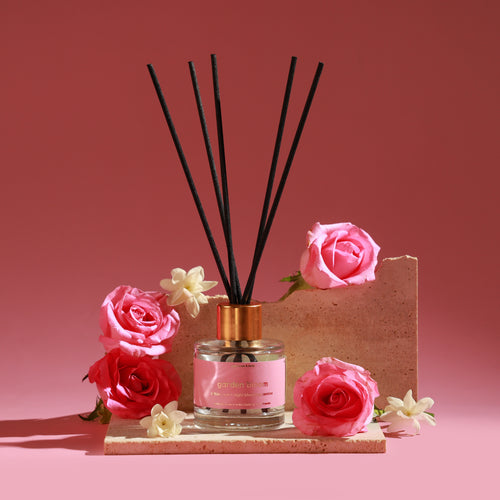
5. An alcohol-free reed Morning Freshness ₹749, Garden Bloom and Evening Calm ₹799, Fresh Brew and Mountain Breeze ₹849 For a level you want held for months with no electricity and no routine. Give it 24–72 hours to establish before judging it from ₹749
Not this month: the ultrasonic diffusers The Sukoon ₹1,899, Boond ₹899 and Megh ₹3,499 all mist water at 30–50 ml/h Good machines, wrong season. A 500ml tank is half a litre of water going into a flat you are drying out. Buy one in October
Honest notes for buyers: fragrance is the last step, never the first. It layers on air that is already clean and moving, and it will not remove a source — not damp, not a dry drain trap, not a loaded sofa, not a filter that needs washing. Deal with the cause, change the air, then scent the room. On timing: a candle puts scent into a room in fifteen to twenty minutes and a Sukoon reaches a steady level in about twenty, while a reed diffuser needs a day to three days before it is doing its job — the wrong buy for a deadline and the right buy for a room you want to hold one level for months. SOSA does not make a room or linen spray for the home; the sprays in the range are car perfumes. A cool-mist ultrasonic adds 30–50 ml of water an hour to the air, so it is the wrong machine for a room you are trying to dry out. The Hotel Collection is water-based and runs in the Sukoon, Boond and Megh only — not in reeds and not in the waterless Vaayu. Reed diffusers are a separate alcohol-free line with their own scents. Candles must be attended and put out. The Hotel Collection scents are SOSA's own interpretations inspired by the world's finest hotels; SOSA is an independent Indian fragrance house, not affiliated with or endorsed by any hotel brand. A portion of every order supports girl-child education through Nanhi Kali.
SOSA Bookshop candle · 80g
The format that puts nothing into the air except scent
SOSA Bookshop candle · 80g ₹379
A flame adds no water to a room. That single property is why a candle is the honest recommendation during the four months when everything else in this cluster is about removing moisture rather than adding it — and it is fifteen to twenty minutes from lighting to a scented room, so it works on the evening you actually want it. Eighty grams gives roughly fifteen to eighteen hours of burn, which at an hour an evening is a fortnight of monsoon. It must be attended and put out, which in a small flat is a feature rather than a chore: it ends. Light it after the room has been aired and the fans have run, never instead of them. ₹379, with the Amber Rose at ₹599 for 130g and ₹799 for 220g if you want longer evenings.
SS
ISIPCA
Versailles
A note from Sonal

I have written more refusals in this group of ten than in the rest of the site put together, and I would rather that than the alternative. Damp is a source, and a source is the one thing fragrance cannot do anything about. Every July I get letters from people who have bought a diffuser, run it in a room that smells musty, and found the room now smells musty and floral. They usually blame the scent. The scent is fine. The room was still generating a smell of its own, and no composition ever made stops that — it simply arrives beside it, and a nose separates the two instantly and thinks less of you for the attempt.

The harder sentence is the one about the machine, because it costs me the order. An ultrasonic diffuser is a device for putting water into air, at thirty to fifty millilitres an hour, and a monsoon flat is a place with too much water in the air already. There is no way to phrase that which makes the Sukoon the right purchase in July. It is the right purchase in October, and it will still be there. Until then, what this house can honestly offer you is a candle, which is a flame and adds nothing, or a reed, which is capillary action and adds nothing either — and both of them belong after the dry mode has run and the fans have been on, never in place of them. That order is not a marketing position. It is simply what works.

Everything is made and supported from Pune, and a part of every order funds girl-child education through Nanhi Kali. You get a home that smells like somewhere you chose; a girl gets a classroom. That equation has always felt right to me.

Frequently asked questions

Why does my house smell damp only during the monsoon?
Because microbial growth accelerates above roughly 60% relative humidity, and Indian monsoon indoor humidity commonly runs 80–95% for weeks. The same flat, with the same furniture, sits below the threshold in winter and above it in July. The smell is the metabolic by-product of that growth escaping from porous materials.
Should I open the windows if my house smells damp in monsoon?
Only in the driest part of the day. Ventilation exchanges indoor air for outdoor air, so it helps only when the air outside is drier. Opening up while it is raining, when outdoor humidity is near 95%, imports moisture and can make the smell worse. Twenty minutes in a bright afternoon break, two openings on opposite walls.
Does an ultrasonic diffuser make a damp room worse?
In a room you are actively drying out, yes. A cool-mist ultrasonic puts 30 to 50 millilitres of water an hour into the air — a 500ml tank ends up in your flat. It is the wrong machine for monsoon and a good one for the rest of the year. Candles and alcohol-free reeds add no water at all.
Will a home fragrance get rid of a damp smell?
No. Damp is a source and it keeps producing while you scent over it, so you end up with two smells rather than one, and most people read the result as concealment. Bring the humidity down, deal with what has already grown, get the air moving, and use fragrance as the finishing layer afterwards.
What is the single most effective free thing I can do?
One to two hours of AC dry mode a day, even when it is not hot. It condenses moisture out of the room air and sends it down the drain line, which is the only lever most flats have that actually removes water. Fans and open cupboard doors come second; they move air rather than removing water, but still air is where growth begins.
Dry the flat first · scent it second
Above 60% things growand monsoon indoors runs 80 to 95
Nothing on this page is a substitute for ventilating at the driest hour, running AC dry mode and keeping air moving. Once the flat is genuinely dry, a Bookshop candle is ₹379 for roughly 15–18 hours and the Amber Rose ₹599 for 130g; alcohol-free reed diffusers are from ₹749 and hold one level for months. The Sukoon is ₹1,899 and belongs in October rather than July, because a cool mist adds 30–50 ml of water an hour. Free shipping above ₹499, and a portion of every order supports girl-child education through Nanhi Kali.
See the candles → See the reed diffusers · from ₹749
Continue the read
More from SOSA
Editorial standards & sources
About this guide: Written by Sonal Sahani, ISIPCA Versailles-trained founder and perfumer at SOSA Home & Body, on why an Indian flat smells damp for three or four months of the year: the roughly 60% relative humidity threshold above which microbial growth accelerates, the 80–95% indoor humidity of a monsoon, why the smell is metabolic by-product released from porous materials rather than dirt on a surface, why opening the windows on a wet day imports moisture instead of removing it, and why a cool-mist ultrasonic diffuser is the wrong machine for a room being dried out.

Facts verified August 2026: Diagnostic facts used in this guide: a closed room accumulates what it cannot exchange, so cross-ventilation needs two openings rather than one; a drain's U-bend water seal evaporates in roughly two to four weeks of disuse and then admits sewer gas, which is corrected by pouring water down the drain; microbial growth in fabric and on surfaces accelerates above about 60% relative humidity, and Indian monsoon indoor humidity commonly runs 80–95%, which is the one situation where ventilating on a wet day can import moisture rather than remove it; an air-conditioner's cold, wet evaporator coil and filter grow biofilm that is blown into the room on start-up; textiles adsorb cooking aerosol and body oils and re-release them for weeks; and olfactory adaptation makes a constant household smell undetectable to its residents within about a fortnight while visitors still perceive it. Timings: a scented candle scents a normal room in roughly 15–20 minutes, a Sukoon ultrasonic diffuser reaches a steady level in about 20 minutes from cold, and a reed diffuser needs roughly 24–72 hours. SOSA products and prices: Sukoon 500ml ₹1,899 (270–320 sq ft, 16–18h on low, 9–12h high, 30–50 ml/h, 2.4MHz cool mist, remote, steady/2H/4H timers, BPA-free, auto shut-off, includes three 15ml Hotel Collection scents of your choice); Boond 300ml ₹899; Megh 6-litre ₹3,499; waterless Vaayu ₹11,999 (up to 1000m³); Aangan ₹25,999. Hotel Collection water-based fragrance 15ml ₹299, 100ml ₹999, 300ml ₹1,799, Pack of 7 at 15ml ₹1,799; dose 3–6 drops per tank. Reed diffusers (separate alcohol-free line): Morning Freshness from ₹749, Garden Bloom and Evening Calm from ₹799, Fresh Brew and Mountain Breeze from ₹849; 130ml from ₹1,249; duos from ₹1,498; 300ml refills ₹2,399. Scented candles: Bookshop 80g ₹379, Amber Rose 130g ₹599 and 220g ₹799, Smoked Oudh 130g ₹449, ceramic jar candles ₹949, Pure Calm wax melt set ₹854. Free shipping above ₹499. SOSA does not make a room or linen spray for the home. The Hotel Collection scents are SOSA's own interpretations; SOSA is not affiliated with or endorsed by any hotel brand. Prices subject to change — see the live product pages.
Torna al blog