





2. A competing fragrance contaminates that perception before the first sip happens. The customer's olfactory system doesn't cleanly separate an ambient room fragrance from what's in the cup — both arrive as one combined signal, which changes what the coffee actually seems to taste like, regardless of how carefully it was brewed.
3. The more distinctive a specialty coffee's own aroma is, the more there is for an added fragrance to damage. A commodity coffee with a flat, generic profile has comparatively little for a competing scent to disrupt; a carefully sourced, distinctively profiled coffee has considerably more, and stands to lose more from the same interference.
4. This is precisely why the specialty category is the worst place in hospitality for ambient fragrance, not the best. A category built on subtle aroma distinction is the category with the least tolerance for a second aroma competing for the same attention — the opposite of what a 'premium fragrance' pitch usually assumes about what a discerning customer wants in the room.
5. None of this is a taste or appetite claim — it's a perceptual mechanism about competing aromas in shared air. No claim is made here about food safety, hunger or how much a customer eats or drinks — only about what a nose reports when two aroma sources are present in the same air at once, which is a question about perception, not about consumption.
Vaayu has no role anywhere near a tasting bar or cupping table — its role, where one exists at all, is confined to rooms the tasting experience never reaches.
Why specialty coffee is especially vulnerable to this
Specialty coffee is priced and marketed on distinctions that depend on a very sensitive kind of smell — retronasal aroma, perceived through the back of the mouth and nose while a drink is actually in the mouth, not just ambient smell perceived before it. This is a considerably more delicate process than noticing a pleasant lobby scent on the way in, and it's far easier to disrupt. Cupping notes like stone fruit, jasmine, cocoa or citrus are subtle by definition — that's what makes them interesting to a specialty customer — and subtlety is exactly what a competing aroma erodes first. The vocabulary printed on a bag of beans is only meaningful if the room lets the customer actually perceive what it describes.
This creates a genuine paradox for any café hoping to combine a 'premium fragrance experience' with a specialty coffee programme: the more distinctive and carefully sourced the coffee, the more there is for a second aroma to damage. A commodity coffee with a flat, unremarkable profile has comparatively little nuance at stake; a specialty coffee, sold specifically because of its nuance, has the most to lose from anything competing with it in the same air. The irony is that the cafés most tempted to add an ambient fragrance for a 'premium' feel are often exactly the ones with the most to lose from doing so.
None of this is a claim about appetite, taste preference or how good either aroma is on its own — it's a mechanical point about what happens when two aroma sources occupy the same air at the same moment a customer is trying to notice something subtle in one of them. The nose reports a combined signal, not two clean, separable ones, and a specialty coffee programme has the least room of any café format to absorb that blending. No claim here concerns health, safety or how much a customer enjoys their visit overall — only what their nose is able to distinguish in the cup.
The three decisions that follow from this
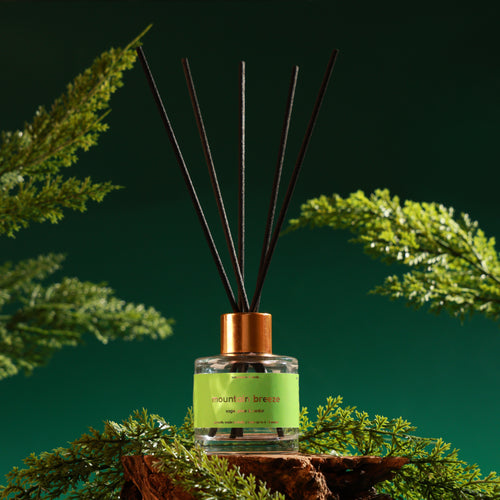
 Mountain Breeze₹849This includes the tasting bar, the pour-over station, the cupping table and general seating where a customer is actively drinking — not only the counter itself.
Which specialty formats are most at risk
The risk this page describes scales with how closely a format depends on the customer noticing subtle aroma while tasting.
| Format | How much is at risk | Why | What to do |
| Cupping table or formal tasting session | Highest | The entire exercise depends on isolating and naming subtle aroma notes | No fragrance anywhere near this room, ever |
| Pour-over or filter bar, ordered by origin | Very high | Customers are actively invited to notice distinctions between origins | No fragrance in this area |
| General specialty seating, espresso-based drinks | High | Still retronasal tasting, even if less formally framed | No fragrance in the seating area |
| A genuinely separated entrance or lobby | None, if the boundary is real | The tasting experience hasn't started yet, and isn't sharing that air | Reed ₹749–₹849 or Sukoon ₹1,899 |
| Washroom with its own door | None | No tasting occurs here at all | Reed, Sukoon, or Vaayu depending on zone count |
| The more a café leans into specialty positioning — single origins, named farms, tasting notes on the menu — the more carefully the tasting air needs to be protected, not the more it can tolerate a fragrance layered on top for atmosphere. | |||
Mountain Breeze · well outside the tasting air₹849Shop →  Sukoon · a separated zone, self-contained₹1,899Shop →
  Vaayu · several zones, all outside the tasting narrative₹11,999Shop →
Where the risk genuinely stops
Never place fragrance anywhere a customer tastes or evaluates coffee — the cupping table, the pour-over bar, the espresso counter and the seating where drinks are actually consumed all carry this risk, not only the immediate counter area. This is a stricter reading of the dining-room rule than a general café needs, and it should be treated that way.
Sometimes a genuinely separated entrance can carry a fragrance without touching the tasting narrative at all — but only where a real air boundary exists before the tasting experience begins, not simply a few steps of distance in an open room. If a customer can smell the entrance fragrance while seated at the tasting table, the boundary hasn't held.
Usually the washroom is the cleanest opportunity in a specialty operation, since no tasting happens there and no cupping vocabulary is being built in that air — keep the register clean and non-edible, and low enough that no trace of it could plausibly reach the tasting room. A specialty café has more reason than most to err on the side of too faint rather than too present.
What to buy, entirely outside the tasting room
Every route below sits outside the tasting narrative by design — nothing here is intended for a cupping table, pour-over bar or seating area.
| Route | Premises | Why | What it costs |
| Reed diffuser, Mountain Breeze, washroom | Under 300 sq ft, one washroom with its own door | No tasting occurs here, and no shared air with the cupping room | ₹749–₹849 |
| Sukoon ultrasonic, separated entrance | 300–750 sq ft, a genuinely separated arrival zone | Sits before the tasting narrative begins, on its own air | ₹1,899 |
| Vaayu, wall or HVAC-mounted, per zone | 750 sq ft and above, several non-tasting zones | Zoned scheduling keeps every fragrance zone outside the tasting air entirely | ₹11,999 |
| Vaayu, freestanding, retail counter | Any specialty café with packaged beans or equipment sold apart from tasting | Runs on its own air, with no cupping vocabulary being built nearby | ₹11,999 |
| Aangan, HVAC-integrated, non-tasting zones | Above roughly 3,000 sq ft, several separated zones | Distributes through ducting that never crosses into the tasting air | ₹25,999 |
I've sat through a cupping where someone, with entirely good intentions, had lit a fragrance reed nearby to make the room feel more considered. Within a few cups it was clear it was doing the opposite — the panel kept second-guessing notes that would otherwise have been obvious, and the reed was the reason. Nobody in the room set out to sabotage the tasting; the fragrance did it quietly, on its own.
That's stayed with me as the clearest version of why this vertical needs a stricter rule than most others I work in. A hotel lobby can absorb a fragrance without asking anything specific of a guest's nose. A cupping table asks a great deal of it, on purpose, and a competing aroma takes that precision away before the taster even notices it's gone. It's a genuinely different job for a nose to do, and it deserves a genuinely different scenting rule.
So my advice to specialty operators is always the plainest version of this cluster's rule: keep the tasting air completely clear, and if you want a fragrance identity at all, build it somewhere the tasting never happens. That's not a smaller ambition — it's the one that actually respects what you're selling, and it's the advice I'd want from a supplier if I were the one running the tasting programme.
Questions from specialty coffee operators
- Can Artificial Fragrance Interfere With the Aroma of Coffee? — the general interference mechanism this page narrows to specialty formats.
- Is Coffee Fragrance Oil a Good Idea Inside an Actual Coffee Shop? — the specific worst-case version of this problem.
- Natural Coffee Aroma vs Added Coffee Fragrance: What's Better for a Café? — the direct comparison this page's answer is built on.
- Should a Luxury Specialty Coffee Shop Use Ambient Fragrance? — the premium-format version of this same question.
- Brand: the SOSA founder story.
SOSA products & prices (verified September 2026): Reed diffusers 50ml ₹749–₹849 (to 150 sq ft, 6–8 weeks at six reeds) · 130ml ₹1,249–₹1,349 (above 150 sq ft, 14–18 weeks) · reed refill 300ml ₹2,399. Ultrasonic: Boond ₹899 (~150 sq ft) · Sukoon ₹1,899 (270–320 sq ft, ships with three 15ml Hotel Collection fragrances) · Megh ₹3,499 (6L tank, ~100 hrs runtime, ~215 sq ft — a runtime machine, not a coverage upgrade). Waterless cold-air: Safar ₹3,999 (no published coverage figure) · Vaayu ₹11,999 (up to 1000 m³, roughly 2,000–3,000 sq ft; 400ml tank lasting about 90+ days; app and onboard control, 1h/4h/8h/24h run windows, adjustable intensity, key-lock, under 38 dB, freestanding or wall/HVAC mount, 5W, CE/RoHS/SGS) · Aangan ₹25,999 (8,000–10,000 sq ft). Hotel Collection water-based fragrance 15ml ₹299 · 100ml ₹999 · 300ml ₹1,799 is for ultrasonic machines; reed oil and Hotel Collection are not interchangeable. Reed diffusers are alcohol-free, phthalate-free, paraben-free, IFRA-compliant and low VOC, handmade in small batches in Pune. Every purchase funds a girl's education through Nanhi Kali. Prices and availability subject to change — see the live product pages.