



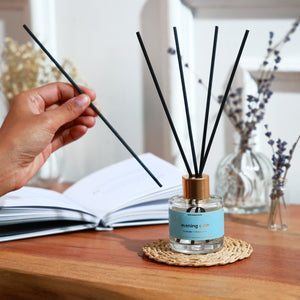

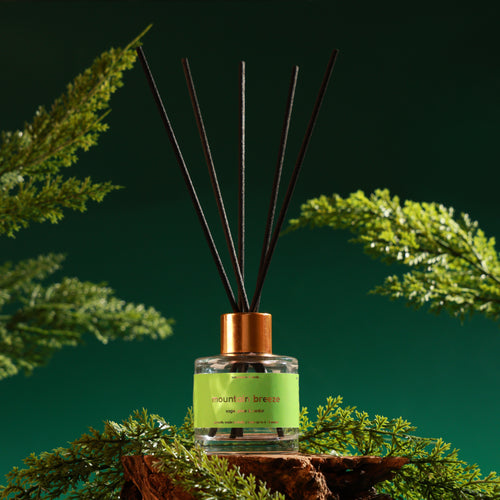
Which SOSA scent coexists best with resin smoke: Mountain Breeze 50ml at ₹849. Himalayan pine, sage and Indian cedar are dry and resinous themselves, so they sit in the same family as dhoop and agarbatti rather than talking across them.
Which to buy for the fortnight after: Garden Bloom ₹799 or Morning Freshness ₹749. A 50ml runs 6–8 weeks, which comfortably outlives the festival.
Handling, plainly: fragrance oil is flammable. Keep any diffuser bottle away from diyas, candles and open flame, and never stand it on the same tray or console as a lit lamp.
2. What actually reduces smoke in a room is moving air. An open window with a second opening for the air to leave, an extractor over the hob, ten minutes of cross-draught. That is the tool. Fragrance is not a substitute for it and adding more fragrance to a smoky room only gives you two things to smell instead of one.
3. During the festival, choose a scent that does not argue. If you want a bottle running through the week, Mountain Breeze at ₹849 is the one. Pine, sage and cedar are dry and resinous, which is the same family dhoop lives in, so the two read as one room rather than as two competing intentions.
4. Bright citrus and soft florals are the ones that create a seam. Morning Freshness beside burning agarbatti reads as two unrelated events. Evening Calm — the softest thing we make at 8.9 on SOSA's own internal scale at six reeds — is simply flattened and you have spent ₹799 on something inaudible.
5. The bottle is really for the fortnight after. A 50ml runs 6–8 weeks and a 130ml 14–18, so a diffuser bought or gifted at Diwali spends most of its life in the quiet weeks when the guests have gone and the house is being put back. That is when it is audible, and it is the honest way to think about the purchase.
6. Do not add reeds to make it cut through. Reed count is the only real volume control, but nine or ten reeds on a 50ml costs you weeks of bottle life — roughly five weeks instead of eight at nine reeds — and it still will not out-project a burning lamp. You will have spent the bottle for no gain.
7. Flame, stated as a handling fact. Fragrance oil is flammable. Keep the bottle away from diyas, candles and any open flame, and do not stand it on the same tray, console or windowsill as a lit lamp. Also stand it on a tray of its own — the oil marks wood and stone.
Composed and handmade in small batches in Pune, and a portion of every order supports girl-child education through Nanhi Kali.
Part one — what is actually in the air
I want to spend a little time on mechanism, because the reason this question keeps being asked is that the category has been sold badly for years. Words like neutralise, purify and eliminate have been attached to products that do none of those things, and buyers reasonably assume a fragrance is an eraser. It is an addition. Everything a room smells of at Diwali is still in the room after you put a bottle on the shelf; there is now simply one more thing there.
 Garden Bloom₹799 · 50mlThe thing that reduces smoke in a room is moving air, and one open window is not enough — air needs somewhere to leave, so open something at the far end and let a cross-draught run for ten minutes. In a kitchen, the extractor on before you start and left running after you finish does more than anything you can buy from us. Free fixes come before paid ones, and this is the freest fix in the house. There is a second consequence for the diffuser: that same draught is bad for the bottle. A reed diffuser standing in a strong cross-draught gets its reeds stripped, projects less into the room and empties weeks early. So ventilate the room, then close it, then let the bottle work in still-but-not-dead air. The two jobs are done at different times, which is exactly why fragrance was never the tool for the first one.
Part two — every source in the room, audited
Here is the Diwali house taken apart source by source: what each thing actually puts into the air, what a reed diffuser honestly does about it, and what genuinely helps instead. I have put no price against anything that is not ours, because the argument is not about money.
| The source | What it puts into the air | What a reed diffuser does about it | What actually helps |
|---|---|---|---|
| Diyas and oil lamps ★ | Combustion of ghee or oil with a wick — warm, slightly oily smoke | Nothing. Sits alongside it, and is out-projected in the same room | Air movement, and lamps in fewer places rather than everywhere |
| Agarbatti and dhoop | Burning resin and wood powder — the highest-intensity source in the house | Nothing, and a mismatched scent creates an audible seam | Ventilation, and burning one at a time rather than several |
| Deep frying and a kitchen running all day | Airborne oil, plus its breakdown products, which settle on surfaces | Nothing — and layered onto food it makes a third smell nobody designed | Extractor on before you start, left running after you stop |
| Flowers, garlands and marigold at the door | A genuine natural fragrance, strong at the entrance and short-lived | Competes with it directly in the one spot you would site a bottle | Move the bottle to a different room for those few days |
| Thirty guests, shoes at the door, an evening of food | A busy, mixed load that changes every hour | Adds one small constant that nobody's nose will isolate | Open the room between waves of visitors |
| The quiet fortnight afterwards | Almost nothing — the house is back to its own baseline | This is where the bottle is finally audible and worth what it cost | Nothing. Let it run; flip the reeds weekly with gloves |
| The honest caveat: none of this is a criticism of diyas, dhoop or the cooking. They are the festival. The mistake is asking a passive fragrance product to manage them, and then concluding the fragrance product is faulty. It is doing exactly what it was built to do — a low, constant, deliberately unhurried output — and a week of combustion is simply not the week that output is designed to be heard in. | |||
Mountain Breeze · coexists with resin₹849Shop →  Garden Bloom · for the quiet weeks₹799Shop →
  Sukoon · scent you can switch off₹1,899Shop →
Part three — the fortnight the bottle is really for
There is a quieter way to look at all this that I think is more useful than the disappointment. A 50ml reed diffuser runs 6–8 weeks and a 130ml runs 14–18. The festival is a handful of days. Whichever bottle you buy, the overwhelming majority of its life is spent outside the week you are worried about, in a house that has gone back to being an ordinary house. That is not a consolation prize; it is the actual product. The days after Diwali are, in most homes I know, faintly grim — furniture back where it was, the smell of old smoke in the curtains, half the family gone home. A room that has its own fragrance again is a genuinely nice thing in that week, and it does not have to compete with anything.
This changes how I would give one as a gift. If you are handing a bottle over at the door during the festival, the useful thing to say is not that it will make the house smell lovely tonight, because it will not — nothing will be heard tonight. The useful thing is that it is for later, and that the recipient should put it somewhere with gentle incidental traffic, at waist-to-chest height, away from a draught and well away from the lamps. Fragrance oil is flammable, and the console by the front door where you would instinctively stand a diffuser is often exactly where the diya thali goes. Say that plainly when you hand it over. It is a handling fact, not a warning about our product against anybody else's, and at the festival of lamps it is worth the sentence.
One more honest note about the days themselves. If what you want is a room that smells different now — before guests arrive, for an hour, at a level you choose — a reed diffuser is the wrong instrument and no scent selection fixes that. It is constant, passive and deliberately low; it has no switch. An ultrasonic Sukoon at ₹1,899 covers 270–320 sq ft, runs 16–18 hours on low, and can simply be turned off when the cooking starts, which is a real advantage during a festival week. Its fragrance is the water-based Hotel Collection, a separate line — reed oil never goes into a machine, and machine fragrance never goes into a reed bottle. Even then, it still adds rather than removes. Nothing in our catalogue subtracts a smell from a room.
Part four — what to do with the bottle each week
Rather than another scent ranking, here is the practical timetable I would follow in my own flat, which is where most of this was learned. It assumes one 50ml bottle and a household that lights lamps, burns dhoop and cooks properly for several days.
| When | What is happening in the room | What to do with the diffuser | What to expect |
|---|---|---|---|
| A fortnight before ★ | An ordinary house, cleaning under way | Open a new 50ml and let it run its days-1–3 spike out | Strong for three days, then it settles into its plateau — the plateau is the product |
| The week of, with dhoop burning | Resin smoke, the highest-intensity source in the house | Move it to a bedroom or a passage, away from the lamps | Inaudible in the main room. That is correct, not a fault |
| Cooking days | Airborne oil settling on every surface, including the reeds | Extractor on, window ten minutes, then close up. Bottle stays out of the kitchen | Fragrance over live cooking makes a third smell nobody designed |
| The evening itself, guests arriving | Flowers at the door, food, thirty people, lamps everywhere | Leave it where it is. Do not add reeds hoping it will cut through | Nine reeds costs about three weeks of bottle life and buys no reach |
| The day after | Old smoke in the curtains, the house being put back | Cross-draught for ten minutes, then close the room and let the bottle work | This is the first day it is genuinely audible again |
| The fortnight after | Baseline. Quiet rooms, ordinary evenings | Flip all six reeds weekly, with gloves, on a tray | Four to six more weeks of plateau from a 50ml bought at ₹749–₹849 |
Versailles
Our first Diwali, I did what a new founder does and put a bottle of everything in my own flat, expecting the place to smell like the brand. It smelled of ghee and dhoop and besan, which is what a house at Diwali smells like, and I spent two days being quietly annoyed with my own product before the obvious occurred to me.
What I had built was a low, constant, passive output. That is a deliberate design and I still think it is the right one — no flame, no socket, nothing to remember, a plateau that holds for the life of the bottle. But a design like that is not in the same weight class as combustion, and no amount of composition or reed count changes that. The honest thing is to say so, rather than to imply that a bottle can win an argument it was never entered into.
So the guidance I give now is the guidance I follow: open the windows, run the extractor, burn one dhoop rather than four, keep the fragrance oil well away from the lamps, and understand that the bottle you bought is for the week after. That week is quiet and slightly flat and a room with its own scent is a real pleasure in it. Everything is made in Pune in small batches, and a part of every order funds a girl's classroom through Nanhi Kali.
Frequently asked questions
- Does a diffuser clash with Diwali cooking? — the kitchen side of the same physics.
- Hosting Diwali — where fragrance is noticed in a house full of guests, and where it is wasted.
- The safest fragrance to gift and how many one household should own.
- The SOSA Diwali 2026 buying guide — budget, quantity and fragrance in one page.
- Brand: the SOSA founder story.
SOSA range & prices used in this guide (verified from the live store, 27 August 2026): Reed diffusers — alcohol-free, phthalate-free, paraben-free, IFRA-compliant compositions on a heat-stable coconut-derived (CCT) carrier, in a refillable glass bottle with six fibre reeds; 50ml lasts 6–8 weeks, 130ml lasts 14–18 weeks. Morning Freshness 50ml ₹749 · 130ml ₹1,249; Garden Bloom ₹799 · ₹1,299; Evening Calm ₹799 · ₹1,299; Fresh Brew ₹849 · ₹1,349; Mountain Breeze ₹849 · ₹1,349. Duo sets: Day & Night ₹1,498, Fresh & Grounded ₹1,548, Warmth & Bloom ₹1,598 (2 × 50ml); ₹2,498–₹2,598 (2 × 130ml). Oil-only refills 300ml ₹2,399 · 500ml ₹3,499 (vessel and reeds not included). The least expensive SOSA reed diffuser is ₹749 — no reed diffuser exists below that price in any size. Below it: scented jar candles from ₹379 (roughly 15–18 hours), Sandalwood or Smoked Oudh jar candle ₹449, wax melts ₹474 (a burner is needed and is not included), ceramic mugs ₹474, ribbed and face mugs and taper candles ₹569, Amber Rose candle ₹599, ceramic trinket dish ₹664, candle two-pack ₹664 (roughly 30–36 hours). Machines: Boond 300ml ₹899 · Sukoon 500ml ₹1,899 · Megh 6L ₹3,499 (~215 sq ft, a runtime and humidity machine rather than a coverage upgrade) · waterless Vaayu ₹11,999 · Safar car and travel diffuser ₹3,999. The water-based Hotel Collection (15ml ₹299 · 100ml ₹999 · 300ml ₹1,799) is a fragrance for an ultrasonic machine, not a standalone gift. SOSA publishes no bulk or corporate gifting terms — there is no discount slab, no minimum order quantity, no stated GST-invoicing arrangement, no custom branding service and no published lead time — and SOSA sells no gift card, gift hamper, gift box or curated gift set. Larger orders should be discussed with SOSA directly through the contact page before committing. Gift wrapping, gift notes, direct-to-recipient shipping and delivery timing are unconfirmed — check at checkout rather than assuming them; no delivery date is promised anywhere in this guide. Per-head and total costs shown are arithmetic on the listed prices, not quotations. Fragrance adds scent to a room; it does not clean air, remove cooking or smoke smells, or change how anyone feels. Fragrance oil is flammable — keep any diffuser away from diyas, candles and open flame. Composed and handmade in small batches in Pune, India; tested through 45°C summer heat and 85% monsoon humidity. Free shipping above ₹499. A portion of every order supports girl-child education through Nanhi Kali. Prices subject to change — see the live product pages.