

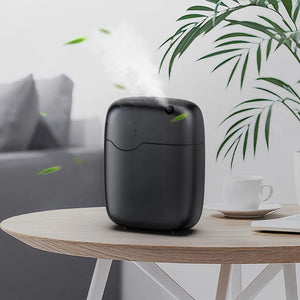
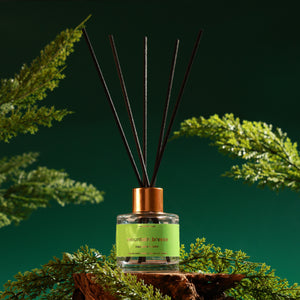
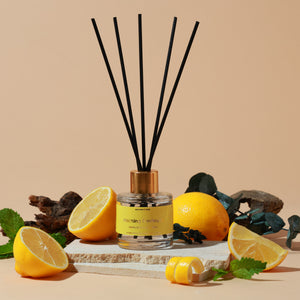

Reception and waiting are the only zone in scope — and you size to that zone, not to the clinic. A 900 sq ft practice is usually a 150–200 sq ft scenting job. For most Indian eye clinics the sized product is a Sukoon at ₹1,899 on its lowest setting, or a reed diffuser from ₹749 under about 150 sq ft.
The register is dry, low and unremarkable. Nothing sweet, nothing gourmand, nothing floral-heavy, nothing that reads as a spa. A clinic is judged on competence, and ambience must never compete with that signal.
What this page will not claim: fragrance does not calm anyone, shorten a wait, aid recovery or signal care. Some people are sensitive to airborne fragrance — which is why the clinical pathway stays clear, why a fragrance-free seat should always exist, and why the practice, not SOSA, sets its policy.
2. At reception, of a dry low note nobody can name. The target is a room that reads as considered rather than scented. If a visitor can identify the fragrance, it is set too high. That is a statement about calibration, not about anyone's experience.
3. Size to the arrival zone, never to the clinic. The number that matters is reception plus waiting — in most Indian eye clinics 150–400 sq ft, even when the practice occupies three times that. A Sukoon at ₹1,899 covers 270–320 sq ft and is the right answer far more often than anything expensive.
4. Set the level for the receptionist, not the visitor. Your front-desk staff sit in that air for eight or nine hours; a patient is there for part of a morning. Any intensity that is wrong for the person at the desk is simply wrong, and they are the only people in the building worth asking.
5. Keep a fragrance-free seat, always, and never mount a diffuser into shared air-conditioning. Some people are sensitive to airborne fragrance, so a practice that scents its reception should be able to seat someone where the fragrance does not reach. And ducting scent into central AC sends it to every room the system serves, including the ones that must stay clear. Freestanding in reception, set back from the corridor to consultation.
6. Nothing here is clinical advice. Ventilation standards, infection control, cleaning protocol and patient suitability rest entirely with you and your clinicians. I compose fragrance and I can tell you how a room behaves; the medical judgement is not mine to make.
Everything SOSA makes is composed and made in small batches in Pune, and a portion of every order supports girl-child education through Nanhi Kali.

Part one — the three decisions, in order
Almost every clinic that gets this wrong got the order wrong rather than the products: a fragrance, then a machine, then a decision about where to put it — by which point the important decision had already been made badly. The sequence that works is zone, then dose, then scent, and the third matters least.
 Vaayu waterless₹11,999 · under 38 dBRetail scenting is designed for a visit of a few minutes; an eye clinic is not that. People sit in your waiting area for a long stretch and staff sit in it all day. A level that seems faint on walking in is a great deal more than faint by the fortieth minute, and it is the fortieth minute that defines the room. Two consequences follow. Set the intensity to the lowest position at which anything registers at all, then leave it a fortnight before touching it. And ask the front desk — they are the only reliable instrument you have, because your own nose adapts to your own building within minutes of walking into it. A key-lock matters here for an unglamorous reason: it stops the setting drifting upward every time someone decides the room smells of nothing.
Part two — the zone map, room by room
Here is the map I would hand a practice on day one. It is deliberately blunt: most of this building gets nothing, and the parts that get something get very little.
| Zone | Scented? | Why | What goes there |
|---|---|---|---|
| Entrance and reception desk ★ | Yes — at the lowest workable level | Hospitality space; the one part of the building whose job is arrival | One source, freestanding, set back from the corridor |
| Waiting seating | Yes — the same source, the same level | Shares air with reception; a gradient inside one connected space cannot be held | Nothing additional. One zone, one scent, one setting |
| Optical and eyewear display, if it opens off reception | Yes, conditionally | Genuinely retail — but only if its air does not reach the clinical corridor | The same scent, at most a touch higher. Never a second fragrance |
| Corridor to consultation | No | It is the boundary. Whatever sits in this corridor arrives in the cabins | Nothing — and keep the source well back from its mouth |
| Consultation cabin | No | Clinical space. The conversation there should carry none of our ambience | Nothing |
| Refraction and diagnostic rooms | No | Long occupancy, equipment, staff working close to patients | Nothing |
| Dilation waiting bay | No | It looks like waiting but sits on the clinical pathway | Nothing |
| Procedure suite and post-operative area | No | The clearest clinical space in the building, and not my question to answer | Nothing |
| Staff room and back office | The practice's own call | Not a patient space — but it is your team's air for nine hours | A reed diffuser if they want one; ask them, not the patients |
| Patient WC | No product from us | A smell there is a cleaning and extraction question, and fragrance answers neither | Nothing. Fix ventilation and cleaning first |
| The honest caveat: this map is an ambience recommendation, not clinical guidance. Whether any fragrance at all is appropriate in your building — given your caseload, ventilation and protocols — is a decision for you and your clinicians, and a practice that reads this table and scents nothing has read it correctly. | |||
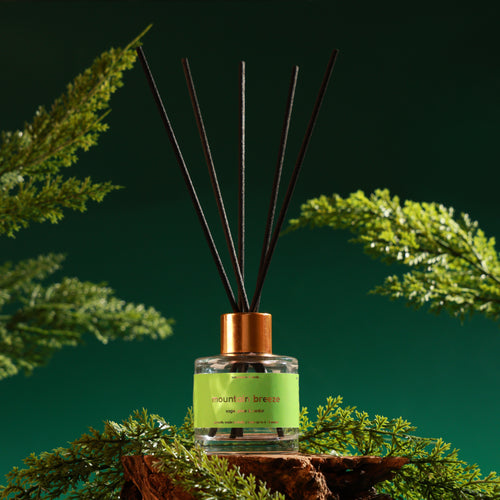 Mountain Breeze · under ~150 sq ft, dry and green₹849Shop → Sukoon · 150–320 sq ft, lowest setting₹1,899Shop →
 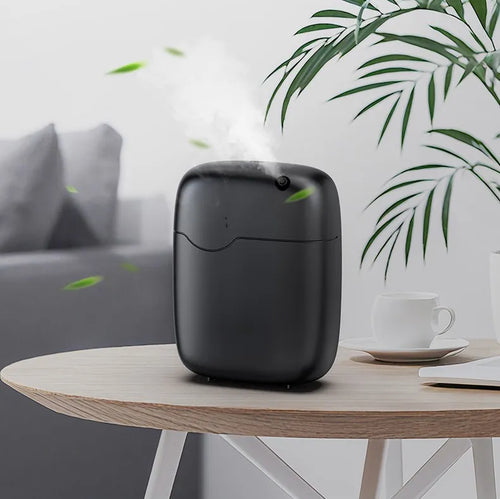 Vaayu · large open reception, freestanding₹11,999Shop →
Part three — when a clinic should not do this at all
There are practices I would talk out of this entirely, and I would rather do it here than after the invoice. The first is any clinic whose reception is small and poorly ventilated. If the front of the building already smells closed by mid-afternoon, adding fragrance makes it heavier rather than fresher — you have given the room two things to carry instead of one. That is a ventilation problem with a ventilation answer, and it costs nothing to test. Fragrance is the last layer in a room that is already right, never a correction to one that is not.
The second is a children's eye clinic or any practice with a large paediatric caseload, and that is close to an outright no. Children cannot reliably report that something in a room is bothering them, parents are watching, and nothing is gained that would justify the asymmetry. The third is a practice whose real complaint is a disinfectant or cleaning smell. Fragrance does not cover, cancel or remove that — layering a composition over a cleaning product produces a third smell worse than either. If that is your question, the right outcome of reading this page is that you buy nothing today.
The fourth is about supply. If what you want is a signature — one recognisable scent held constant across every visit and eventually across several branches — you are making a commitment that depends on buying the same oil for years. There is a live gap to be straightforward about: SOSA does not currently sell a separate cold-air refill oil for the Vaayu. The 400ml supplied in the box lasts roughly ninety days or more at a mid setting and is the whole supply available at the time of writing. For a home that is an inconvenience; for a practice building an identity on one scent it is a business problem. The water-based Hotel Collection is not a substitute — it is made for ultrasonic machines and must not be used in a Vaayu. Confirm current refill availability through the contact page before committing a practice to a Vaayu.
Part four — what to specify, by arrival zone
Measure reception plus waiting and ignore the rest of the floor plan. Two of the rows below end in spending nothing.
| Your arrival zone | What I would specify | Cost | Why not the next size up |
|---|---|---|---|
| Under ~150 sq ft reception, quiet practice ★ | One Mountain Breeze 130ml, six reeds, on a tray away from seating | ₹1,349 · 14–18 weeks | An active machine here is over-specified and harder to keep low |
| ~150–320 sq ft reception and waiting | Sukoon on its lowest intensity, 4H timer, sited behind the desk line | ₹1,899 · three 15ml fragrances included | This is the sized product. A Vaayu at this volume is simply wasted money |
| ~320–800 sq ft open reception, or two connected patient zones on one air path | Vaayu, freestanding, lowest intensity, run window set to opening hours, key-lock on | ₹11,999 | Under 38 dB and schedulable — but confirm refill supply before committing |
| An eye hospital with 3,000+ sq ft of connected public area | Aangan, specified with your facilities team, public areas only | ₹25,999 | Beyond ~10,000 sq ft the range continues at Meenar ₹38,500 |
| You want the optical display to read slightly warmer | The same scent, a second small source, only if optical has its own air path | ₹749–₹849 on top | Two scents in one air path become one muddled scent |
| Reception smells closed by afternoon | Nothing yet. Ventilation, then re-test the room in a fortnight | ₹0 today | Fragrance in an under-ventilated room reads heavier, not fresher |
| Children's eye clinic or a large paediatric caseload | Nothing. This is the one I would decline outright | ₹0 | Nothing is gained that would justify it, and I would rather say so |
Versailles
The first time an ophthalmologist wrote to me about her reception, she did not ask which fragrance to buy. She asked whether she should be doing this at all. That is the correct first question, and I have never had a better one from a home customer. Her speciality is the organ that volatile compounds irritate, and she was not going to accept a cheerful answer.
What I told her is what this page says. Some people are sensitive to airborne fragrance. That is not a reason to pretend otherwise, and not a reason to make a safety promise I have no standing to make — it is the reason the clinical pathway stays clear, the reason the dose in an arrival zone is lower than in any shop or lobby, and the reason a fragrance-free seat exists before the machine is switched on.
I have also learned to say the unprofitable half out loud. Several practices that have written to me should not scent anything yet — a paediatric caseload, a reception with no real air exchange, a cleaning smell that fragrance would only complicate. Saying so costs the sale and keeps the recommendation worth something to everyone else. Made in Pune in small batches, and a part of every order funds a girl's classroom through Nanhi Kali.
Frequently asked questions
- My clinic is modern but still feels clinical — the four things to fix before fragrance.
- Choosing the note for a reception — what survives forty minutes in the same air.
- Fresh, green, woody or neutral and matching scent to your positioning.
- Choosing a signature scent for a practice — the full selection method.
- Brand: the SOSA founder story.
SOSA range, specifications and prices used in this guide (verified August 2026): Vaayu ₹11,999 — waterless cold-air nebulisation of undiluted fragrance oil; no water, no heat, no added humidity, no white mineral dust. Coverage up to 1000 m³, about 2,000–3,000 sq ft. 400ml refillable tank lasting roughly 90+ days at a mid setting. Bluetooth app plus onboard controls, 1h / 4h / 8h / 24h run windows, day selection, adjustable intensity, auto-stop and key-lock. Under 38 dB. DC 12V / 1A, 5W. Freestanding or wall / HVAC mount. CE, RoHS and SGS certified. SOSA does not currently sell a separate Vaayu cold-air refill oil; the 400ml supplied in the box is the fragrance available at the time of writing, so a practice planning continuous or multi-site use should confirm current refill availability with SOSA before committing. The water-based Hotel Collection is made for ultrasonic machines and must not be used in a Vaayu. Other machines: Boond 300ml ₹899 (~150 sq ft, ultrasonic) · Sukoon 500ml ₹1,899 (270–320 sq ft, 16–18 hours on low, remote and steady/2H/4H timers, three 15ml fragrances included, ultrasonic) · Megh 6L ₹3,499 (~215 sq ft — a runtime and humidity machine that covers less than a Sukoon, never a coverage upgrade) · Safar ₹3,999 (waterless cold diffusion, cordless, 20ml, about 6.9cm, three speeds, 1/2/3-hour auto-off — sold as a car and travel diffuser, personal-scale only; SOSA publishes no coverage figure for it) · Aangan ₹25,999 (HVAC nebulising, ~8,000–10,000 sq ft) · Meenar ₹38,500 (commercial HVAC, 12,000–18,000 sq ft). Water-based Hotel Collection for ultrasonic machines: 15ml ₹299 · 100ml ₹999 · 300ml ₹1,799 · pack of seven ₹1,799; scents are inspired by the atmosphere of well-known hotels — SOSA is an independent Indian brand and is not affiliated with, endorsed by or supplying any hotel group. Reed diffusers ₹749–₹1,349 (50ml 6–8 weeks, 130ml 14–18 weeks, six fibre reeds, no 100ml size; replacement reeds are not sold separately). Reed oil cannot be used in an ultrasonic machine and Hotel Collection oil cannot be used in reeds. SOSA sells no room spray or home spray — every SOSA spray is a car perfume. Nothing in this guide is medical, clinical or safety advice. A fragrance diffuser adds a scent to the air. It does not clean, purify, filter, sanitise or disinfect air, does not remove or neutralise disinfectant, damp or occupancy smells, and has no effect on comfort, anxiety, waiting time, recovery or any clinical outcome. Some people are sensitive to airborne fragrance, which is why this guide recommends that examination rooms, diagnostic areas, consultation cabins, procedure suites and post-operative areas remain fragrance-free, that a fragrance-free seating option always exist, and that a diffuser is never mounted into shared HVAC in a clinical building. Decisions about clinical policy, ventilation standards, infection control and patient suitability rest entirely with the practice and its clinicians. A persistent stale, damp or disinfectant smell is a ventilation, moisture or cleaning problem — SOSA sells no dehumidifier and no air purifier, and fragrance should never be used to cover one. Coverage, runtime and longevity figures are manufacturer specifications and typical ranges, not guarantees, and vary with room volume, ceiling height, air exchange, occupancy and season. SOSA publishes no commercial or bulk pricing, no corporate account, no annual maintenance contract, no installation service, no stated warranty term and no multi-location programme; warranty length, spare parts, servicing and app platform availability are unconfirmed, and larger or multi-site enquiries should go through the contact page before any commitment. Composed and made in small batches in Pune, India. Free shipping above ₹499. A portion of every order supports girl-child education through Nanhi Kali. Prices subject to change — see the live product pages.