
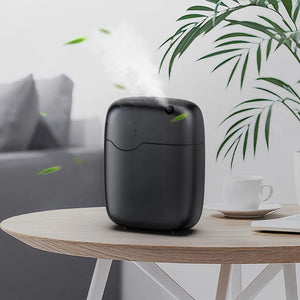


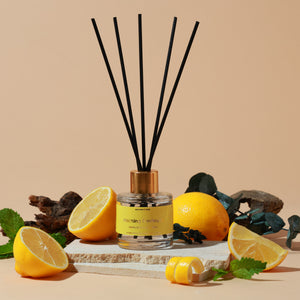
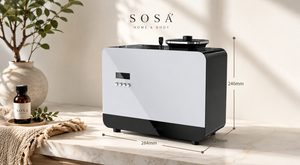
Under about 320 sq ft of connected zone: Sukoon ₹1,899. Even at 1,000 sq ft total. A corridor-plan clinic with a modest waiting area is a small scenting job wearing a large lease.
320–800 sq ft of one connected public zone: Vaayu ₹11,999 genuinely earns it. One machine, freestanding, scheduled to opening hours, key-locked, under 38 dB, adjustable intensity — and a single source is what keeps a large hall consistent.
Two things before you order one. Never mount it into shared HVAC in a clinical building. And confirm refill supply first: SOSA does not currently sell a separate Vaayu cold-air refill oil, so the 400ml in the box — roughly 90+ days — is the whole supply available at the time of writing.
2. Connected zone under about 320 sq ft: Sukoon ₹1,899, and I would say so even on a page titled around a large clinic. Rated 270–320 sq ft, lowest mode, 2H or 4H timer, at the far end from the corridor mouth. Most 1,000 sq ft ophthalmology practices land here, because the speciality needs enclosed darkened rooms and the extra area goes into them.
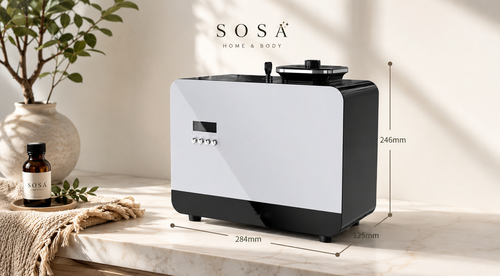
3. Connected zone of roughly 320–800 sq ft: Vaayu ₹11,999 genuinely earns it. Waterless cold-air nebulisation of undiluted oil, rated up to 1000 m³ ≈ 2,000–3,000 sq ft, Bluetooth app, 1h/4h/8h/24h run windows, day selection, adjustable intensity, key-lock, under 38 dB, 5W. CE, RoHS and SGS marked.
4. The case for it is control and quiet, not reach. Under 38 dB matters more in a clinic than anywhere else — a waiting hall where a machine is audible is worse than one with no fragrance at all. Key-lock means the level you set is the level that runs. Scheduling means it is never on during a session you did not intend.
5. Freestanding in the arrival hall. Never mounted into shared HVAC. The Vaayu can be wall or HVAC mounted, and in a clinical building the HVAC option is the one thing that undoes the entire design, because it delivers fragrance into examination, diagnostics and the procedure suite. If an architect or contractor proposes it, decline.
6. Confirm refill supply before you commit. SOSA does not currently sell a separate Vaayu cold-air refill oil. The 400ml supplied in the box lasts roughly 90+ days and is the whole supply available at the time of writing. For a single site that is an inconvenience; for a practice standardising a scent across branches it is a business problem, and it must be checked with SOSA first. The water-based Hotel Collection is never a substitute for it.
7. Above 3,000 sq ft of connected public area you are in a different range. Aangan at ₹25,999, and above that Meenar at ₹38,500. A 1,000 sq ft clinic never needs either.
8. Whatever you buy, the clinical pathway stays fragrance-free and a fragrance-free seat must exist. Examination rooms, diagnostics, consultation cabins, the procedure suite and any post-operative area take nothing at any level, and that boundary is the practice's own clinical judgement. Nothing here is medical, clinical, ventilation or regulatory advice, and no product or setting is described as safe or unsafe for anybody. Composed and made in small batches in Pune, and a portion of every order supports girl-child education through Nanhi Kali.
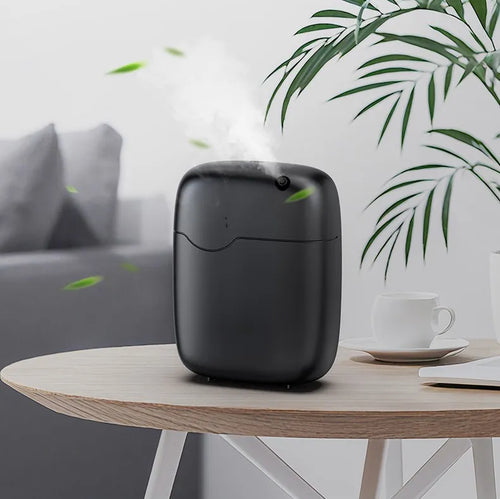
Part one — which of the two buildings you have
A thousand square feet is the point at which this cluster's sizing rule stops being a caution and starts being a fork. Two practices with identical lease areas can need products ₹10,100 apart, and the thing that separates them is a floor plan rather than a budget. Three things tell you which one you are in.
 Sukoon 500ml₹1,899 · 270–320 sq ftIf the case for the larger machine were simply "it covers more", I would not make it, because coverage alone is satisfied by running two smaller machines and that is cheaper. The case rests on three things a clinic values and a home does not. Under 38 dB, because a waiting hall is a quiet room in which people sit for a long time and any audible mechanical noise is a worse outcome than no fragrance at all. Scheduled run windows with day selection, so the machine runs during opening hours and is off during a Sunday theatre list or an early procedure session, without anybody remembering. And a key-lock, so the intensity you set stays set — reception staff, with the best intentions, adjust things. Add one more: a single source across a large volume produces a consistent room, while two sources produce a strong middle and two weak ends. Those four properties are what ₹10,100 buys. If none of them describes a problem you have, you do not have a Vaayu-shaped requirement, whatever your lease says.
Part two — two 1,000 sq ft clinics, side by side
The same lease area, two plans, and every decision that follows from the difference. Clinic A is the commoner ophthalmology arrangement; Clinic B is the one that justifies the larger machine.
| The question | Clinic A · corridor plan | Clinic B · open arrival hall | What the difference decides |
|---|---|---|---|
| Largest connected public zone ★ | 170 sq ft — reception and waiting, corridor with doors beyond | 420 sq ft — reception, waiting bank and optical display on one air path | Everything. This single figure is the input for every row below |
| Doors between the source and the nearest clinical room | One corridor and a closed door — a real boundary | An open passage, so distance and level are the only boundary | How low the level has to be set, and where the source can stand |
| Distance the scent must carry | About 5 metres, end to end | 12–15 metres, with a change of ceiling height along the way | Whether one small source can hold the room evenly at all |
| What happens with two small machines instead | Not needed — one is enough | A strong middle and two weak ends; inconsistency, not coverage | Why a single larger source is the correct architecture above ~320 sq ft |
| Ambient noise in the space | Ordinary reception noise; a quiet ultrasonic disappears into it | A hard-surfaced hall that is genuinely quiet between arrivals | Whether under 38 dB is a specification you are actually buying |
| Hours it must run unattended | Opening hours; the desk switches it off on the remote | Long days, sometimes a Sunday session — scheduling matters | Whether run windows and day selection are worth paying for |
| Who might change the setting | Anyone on the desk, which is fine at this scale | Several shifts of staff across a large team | Whether a key-lock is an operational requirement or a nicety |
| The sized product | Sukoon ₹1,899, lowest mode, 2H or 4H timer | Vaayu ₹11,999, freestanding, scheduled, locked, low intensity | A difference of ₹11,999 − ₹1,899 = ₹10,100 on identical floor areas |
| What goes wrong with the other choice | A Vaayu here runs permanently at the bottom of its range, and tempts an HVAC mount | A Sukoon here holds about 300 of 420 sq ft, and a second one makes it inconsistent | Both errors are expensive; only one of them is visible on an invoice |
| The honest caveat: both columns describe an arrival zone only. Examination rooms, diagnostic and testing areas, consultation cabins, the procedure suite and any post-operative area take nothing, in any format, at any level, and that boundary is the practice's own clinical judgement rather than a supplier's recommendation. Never mount a Vaayu or any diffuser into shared HVAC in a clinical building — ducting fragrance into central air is precisely how it reaches the clinical pathway. Coverage figures are manufacturer specifications and vary with ceiling height, air exchange and occupancy. Nothing on this page is medical, clinical, ventilation, infection-control or regulatory advice. No claim is made in either direction about how any patient or member of staff perceives, tolerates or responds to fragrance, and no SOSA product or setting is described as safe, unsafe or suitable for any group. Some people are sensitive to airborne fragrance, which is exactly why the clinical pathway stays fragrance-free and why a fragrance-free seat must genuinely exist somewhere a person would ordinarily sit. A diffuser adds a scent alongside what is already in the air and removes nothing. | |||
 Sukoon · under ~320 sq ft connected₹1,899Shop → Vaayu · 320–800 sq ft, under 38 dB₹11,999Shop →
  Aangan · 3,000+ sq ft public area₹25,999Shop →
Part three — when 1,000 sq ft still means buying nothing
There are three situations at this size where the right answer is no purchase at all, and one of them is the most expensive mistake in this cluster if it goes the other way. The first is the practice that cannot place the machine anywhere except near a clinical air path. A large open arrival hall is often open precisely because it flows into the rest of the plan, and if the only viable position — power, sightlines, safety, a surface nobody will knock — is within a few metres of the corridor to consultation or an open testing bay, then the honest answer is not a smaller setting, it is nothing until the plan changes. The machine is fine; the position is the product. Where an architect is still drawing, this is worth raising at layout stage rather than at handover, because power and placement are cheap on a drawing and expensive in a finished building.
The second is a supply-planning failure waiting to happen. If you are buying a Vaayu because you intend to run one identifiable scent continuously — the whole point of a signature, and the reason most large practices ask — then you are making a commitment that depends on a refill that is not currently sold separately. The 400ml in the box lasts roughly 90+ days. Beyond that you are dependent on asking SOSA what is available, and there is no published answer today. A practice with one site can accept that risk with its eyes open; a group planning three sites on one scent should get a written answer before ordering the first machine, and should treat "we will sort it out later" as an unacceptable basis for standardising anything. There is also no published bulk pricing, no corporate account, no maintenance contract, no installation service, no stated warranty term, no lead time and no multi-location programme — so where you would reasonably expect one of those to exist, ask rather than assume.
The third is the practice whose real problem is not an absence of scent. A 1,000 sq ft clinic has more room to hold an odour than a small one — a back corridor, a records store, a pantry, a plant room, a bay nobody opens — and if your reception smells of disinfectant, damp, a closed building or the day's accumulation, then a machine adds a scent alongside that and removes none of it. Fragrance is additive at every price, and a ₹11,999 machine is additive in exactly the same way a ₹749 bottle is. Find the source, fix the ventilation or the cleaning schedule, and come back with a clean baseline. And keep the target in view even when the building is grand: the correct intensity in a clinic is lower than in a salon, a showroom or a hotel lobby. A patient should notice the room is pleasant without being able to name a fragrance, and a waiting hall that smells like a spa reads as a practice trying to be something it is not. Ask the people who sit in it for nine hours a day before you ask anybody who passes through it for forty minutes.
Part four — the seven conditions before a Vaayu
Seven things I would want true before selling a practice a ₹11,999 machine, each with a test you can run this week. If any of them fails, the last column is the honest alternative — and one of the seven is not about your building at all.
| Condition | How to test it | A pass looks like | A fail looks like | What to do instead if it fails |
|---|---|---|---|---|
| One connected public zone past ~320 sq ft ★ | Walk from the entrance until you meet a normally closed door; measure what you crossed | 350–800 sq ft on one air path, no door in between | You stop at 170 sq ft because the corridor begins | Sukoon ₹1,899 — the sized product, and it does not become wrong because the lease is large |
| A freestanding position away from the clinical path | Mark the proposed spot; measure to the corridor mouth and to any open testing bay | Well set back, with a door or real distance between it and clinical space | The only viable spot is beside the corridor or an open bay | Nothing, until the plan changes. Raise it with the architect at layout stage |
| No HVAC integration, ever | Ask whoever is installing it what they intend to do | Plugged in, standing on a console, and that is all | Somebody proposes ducting it into central air conditioning | Decline. This is the one installation that undoes the whole design in a clinical building |
| Run windows that match your opening hours | Write out the week, including any weekend or evening session | 1h/4h/8h/24h windows and day selection cover your actual pattern | You need per-session control the schedule cannot express | A machine somebody switches on and off by hand, which a Sukoon's remote does for ₹1,899 |
| Key-lock used, not just present | Decide now who holds the key and where it lives | One named person, and the setting does not move between reviews | Nobody owns it, so the lock is never engaged | Any machine will drift. Assign the owner before the order, not after |
| Noise genuinely matters in the space | Stand in the empty hall at nine in the morning and listen | A quiet, hard-surfaced hall where under 38 dB is a real specification | A busy, noisy reception where any quiet machine disappears anyway | You are paying for a property you will not hear. Reconsider the smaller machine |
| Refill supply confirmed with SOSA in writing | Ask through the contact page before ordering | A clear current answer on availability of cold-air oil beyond the 400ml supplied | No published separate Vaayu refill oil — the position at the time of writing | Do not standardise a multi-site signature on it yet. Single-site use, eyes open, or wait |
Versailles
Two enquiries arrived in the same week, both from ophthalmologists, both describing a thousand-square-foot clinic, both asking about the Vaayu. I very nearly sent the same reply twice. Instead I asked each of them for one measurement: the distance from the front door to the first door that is normally kept closed, and the width of what lay between.
The first answered in one line — about five metres, then the corridor. A hundred and seventy square feet. He needed a Sukoon at eighteen hundred and ninety-nine rupees and he had been about to spend twelve thousand. The second sent a photograph instead: a double-height hall with the reception counter on one side, a seating bank opposite, spectacle displays along the far wall, and no door anywhere in the frame. Four hundred and thirty square feet on one air path. She needed the Vaayu, and one machine rather than the two small ones she had been considering.
What I told her before she ordered is the part I care about most. There is no separate cold-air refill oil sold today; the four hundred millilitres in the box lasts about ninety days, and if a signature scent was going to matter to her she should ask us for the current position in writing first. She did, planned around the answer, and bought with her eyes open. That is a worse sales conversation and a better business. Composed and made in small batches in Pune, and a part of every order funds a girl's classroom through Nanhi Kali.
Frequently asked questions
- When an eye clinic genuinely needs a waterless machine — the upgrade trigger stated as a test rather than a size.
- A 750 sq ft clinic with separate testing areas and the 500 sq ft setup.
- One machine or several zones — why two machines in one volume is not coverage.
- Should your architect plan scent-machine placement — including ruling out HVAC integration.
- Brand: the SOSA founder story.
SOSA range, specifications and prices used in this guide (verified August 2026): Vaayu ₹11,999 — waterless cold-air nebulisation of undiluted fragrance oil; no water, no heat, no added humidity, no white mineral dust. Coverage up to 1000 m³, about 2,000–3,000 sq ft. 400ml refillable tank lasting roughly 90+ days at a mid setting. Bluetooth app plus onboard controls, 1h / 4h / 8h / 24h run windows, day selection, adjustable intensity, auto-stop and key-lock. Under 38 dB. DC 12V / 1A, 5W. Freestanding or wall / HVAC mount. CE, RoHS and SGS certified. SOSA does not currently sell a separate Vaayu cold-air refill oil; the 400ml supplied in the box is the fragrance available at the time of writing, so a practice planning continuous or multi-site use should confirm current refill availability with SOSA before committing. The water-based Hotel Collection is made for ultrasonic machines and must not be used in a Vaayu. Other machines: Boond 300ml ₹899 (~150 sq ft, ultrasonic) · Sukoon 500ml ₹1,899 (270–320 sq ft, 16–18 hours on low, remote and steady/2H/4H timers, three 15ml fragrances included, ultrasonic) · Megh 6L ₹3,499 (~215 sq ft — a runtime and humidity machine that covers less than a Sukoon, never a coverage upgrade) · Safar ₹3,999 (waterless cold diffusion, cordless, 20ml, about 6.9cm, three speeds, 1/2/3-hour auto-off — sold as a car and travel diffuser, personal-scale only; SOSA publishes no coverage figure for it) · Aangan ₹25,999 (HVAC nebulising, ~8,000–10,000 sq ft) · Meenar ₹38,500 (commercial HVAC, 12,000–18,000 sq ft). Water-based Hotel Collection for ultrasonic machines: 15ml ₹299 · 100ml ₹999 · 300ml ₹1,799 · pack of seven ₹1,799; scents are inspired by the atmosphere of well-known hotels — SOSA is an independent Indian brand and is not affiliated with, endorsed by or supplying any hotel group. Reed diffusers ₹749–₹1,349 (50ml 6–8 weeks, 130ml 14–18 weeks, six fibre reeds, no 100ml size; replacement reeds are not sold separately). Reed oil cannot be used in an ultrasonic machine and Hotel Collection oil cannot be used in reeds. SOSA sells no room spray or home spray — every SOSA spray is a car perfume. Nothing in this guide is medical, clinical or safety advice. A fragrance diffuser adds a scent to the air. It does not clean, purify, filter, sanitise or disinfect air, does not remove or neutralise disinfectant, damp or occupancy smells, and has no effect on comfort, anxiety, waiting time, recovery or any clinical outcome. Some people are sensitive to airborne fragrance, which is why this guide recommends that examination rooms, diagnostic areas, consultation cabins, procedure suites and post-operative areas remain fragrance-free, that a fragrance-free seating option always exist, and that a diffuser is never mounted into shared HVAC in a clinical building. Decisions about clinical policy, ventilation standards, infection control and patient suitability rest entirely with the practice and its clinicians. A persistent stale, damp or disinfectant smell is a ventilation, moisture or cleaning problem — SOSA sells no dehumidifier and no air purifier, and fragrance should never be used to cover one. Coverage, runtime and longevity figures are manufacturer specifications and typical ranges, not guarantees, and vary with room volume, ceiling height, air exchange, occupancy and season. SOSA publishes no commercial or bulk pricing, no corporate account, no annual maintenance contract, no installation service, no stated warranty term and no multi-location programme; warranty length, spare parts, servicing and app platform availability are unconfirmed, and larger or multi-site enquiries should go through the contact page before any commitment. Composed and made in small batches in Pune, India. Free shipping above ₹499. A portion of every order supports girl-child education through Nanhi Kali. Prices subject to change — see the live product pages.